Milk Thistle Products Market Size, Share Demand Report By Product Type (Capsules & Tablets, Liquid Extracts, Powder, Softgels), By Application (Liver Health, Skincare, Detoxification, Others), By Distribution Channel (Online Retail, Pharmacies & Health Stores, Supermarkets & Hypermarkets, Specialty Stores), By End-Use (Adults, Geriatric, Others), By Region & Segment Forecasts, 2026–2034
USD 3950
Market Overview
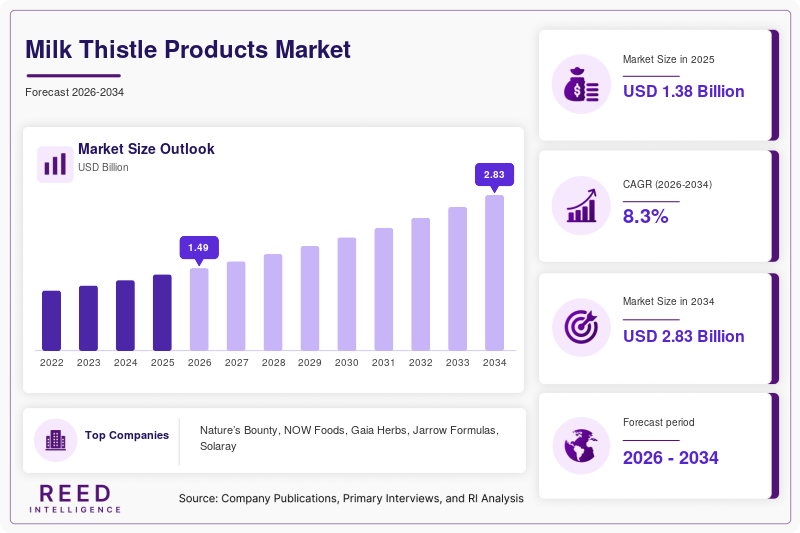
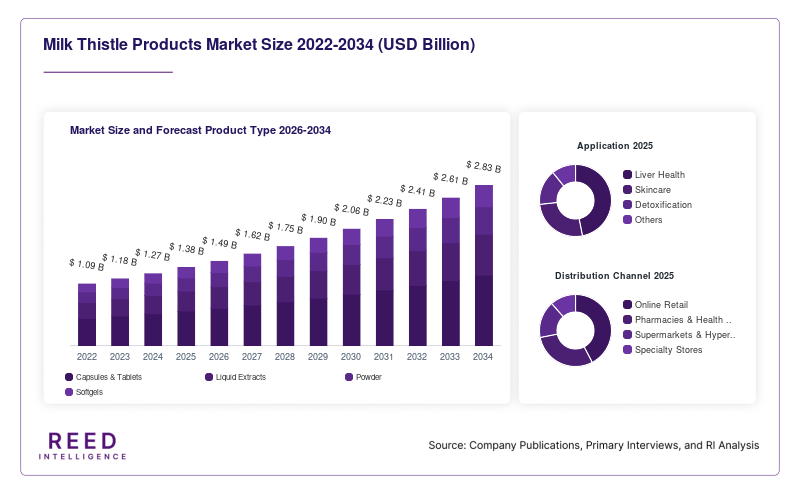
The Milk Thistle Products Market size was valued at USD 1.38 billion in 2026 and is projected to reach USD 2.61 billion by 2034, expanding at a CAGR of 8.3% during the forecast period (2026-2034). The market growth is supported by rising global awareness regarding liver health and increasing preference for plantbased dietary supplements. Milk thistle, known for its active compound silymarin, has gained attention for its antioxidant and hepatoprotective properties, contributing to sustained demand across pharmaceutical and nutraceutical sectors.
A key global factor driving the market is the growing shift toward preventive healthcare, where consumers increasingly adopt herbal supplements as part of daily wellness routines. This shift is particularly evident in urban populations with higher disposable incomes and health awareness levels.
Key Highlights
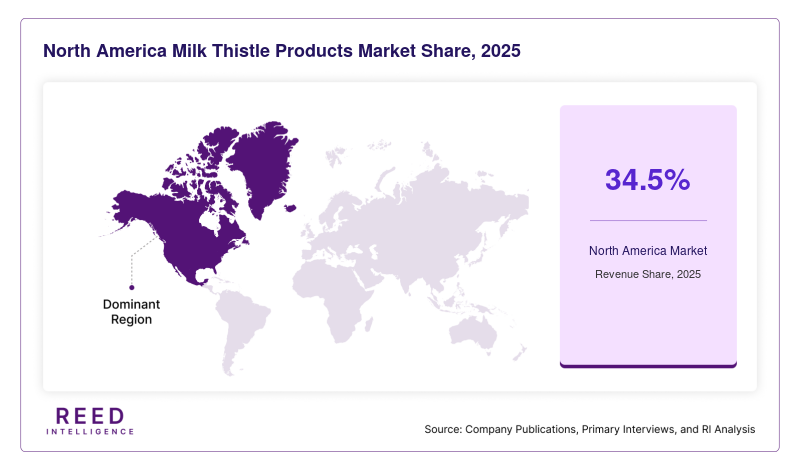
- North America dominated the market with 34.5% share in 2025, while Asia Pacific is expected to grow at the fastest CAGR of 9.6%.
- By product type, capsules/tablets led with 42.1% share in 2025, whereas liquid extracts are projected to grow at a CAGR of 9.2%.
- By application, liver health supplements dominated with 48.3% share, while skincare applications are expected to grow at a CAGR of 9.8%.
- The United States remained the dominant country, with market values of USD 420 million in 2024 and USD 455 million in 2025.
Market Trends
Rising Demand for CleanLabel Herbal Supplements
Consumers are increasingly opting for cleanlabel and plantbased supplements, driving demand for milk thistle products free from synthetic additives. Transparency in sourcing and organic certification are becoming essential purchasing factors, especially in developed markets.
Expansion into Functional Foods and Beverages
Milk thistle is gradually being incorporated into functional beverages, herbal teas, and fortified foods. This trend is expanding the application base beyond traditional capsules and tablets, creating new revenue streams for manufacturers.
Market Drivers
Increasing Prevalence of Liver Disorders
The rising incidence of liverrelated conditions, including fatty liver disease and toxininduced damage, is driving demand for natural hepatoprotective supplements. Milk thistle products are widely recognized for supporting liver detoxification and regeneration, which boosts their adoption across healthcare segments.
Growth of Nutraceutical Industry
The expansion of the global nutraceutical sector has significantly contributed to market growth. Increased consumer spending on dietary supplements and the availability of milk thistle products through multiple channels are accelerating product penetration.
Market Restraint
Limited Clinical Standardization
One of the major challenges in the market is the lack of standardized clinical evidence across different formulations. Variations in silymarin concentration and product quality can impact efficacy, limiting acceptance in certain regulated markets.
Market Opportunities
Expansion in Emerging Markets
Developing regions such as Asia Pacific and Latin America present significant growth opportunities due to rising healthcare awareness and increasing disposable income. Manufacturers are targeting these markets through affordable product lines and localized distribution strategies.
Product Innovation and Formulation Development
Advancements in formulation technologies, including enhanced bioavailability and combination supplements, are creating new opportunities. The integration of milk thistle with vitamins and other herbal extracts is expected to drive future product innovation.
Segmental Analysis
By Product Type
Capsules and tablets dominated the market with a 42.1% share in 2025, driven by convenience, standardized dosage, and longer shelf life. These forms are widely preferred among consumers for daily supplementation.
Liquid extracts are expected to grow at the fastest CAGR of 9.2%, supported by higher absorption rates and increasing preference for flexible dosage formats. The ability to incorporate liquid extracts into beverages is also contributing to growth.
By Application
Liver health supplements accounted for the largest share of 48.3% in 2025, reflecting the primary use of milk thistle in supporting liver function and detoxification.
Skincare applications are projected to grow at a CAGR of 9.8%, driven by increasing demand for natural antioxidants in cosmetic formulations. Milk thistle’s antiinflammatory properties are encouraging its use in creams and serums.
By Distribution Channel
Offline retail dominated with a 55.4% share in 2025, supported by pharmacies, health stores, and supermarkets offering a wide range of products and consumer trust in physical purchases.
Online retail is expected to grow at a CAGR of 10.2%, driven by expanding ecommerce platforms, convenience, and access to a broader product range. Digital marketing strategies and subscription models are further supporting this segment.
By EndUse
Adults represented the dominant segment with a 68.7% share in 2025, as they are the primary consumers of dietary supplements for preventive health.
The geriatric segment is anticipated to grow at a CAGR of 8.9%, driven by increasing health concerns and rising adoption of herbal supplements for chronic conditions.
Regional Analysis
North America
North America accounted for 34.5% market share in 2025 and is expected to grow at a CAGR of 7.8% during the forecast period. The United States dominated the region due to strong consumer awareness and widespread availability of dietary supplements. The presence of established nutraceutical companies and regulatory support for herbal products contributed to steady demand.
Europe
Europe held 27.2% share in 2025 and is projected to expand at a CAGR of 7.5%. Germany emerged as the dominant country due to its longstanding use of herbal medicine and high adoption of plantbased remedies. The region’s focus on natural healthcare solutions supports market growth.
Asia Pacific
Asia Pacific captured 21.6% share in 2025 and is expected to grow at the fastest CAGR of 9.6%. China dominated the region due to increasing integration of traditional herbal medicine with modern healthcare practices. Rising middleclass income and expanding ecommerce platforms are accelerating product accessibility.
Middle East & Africa
The Middle East & Africa accounted for 8.1% share in 2025 and is projected to grow at a CAGR of 7.1%. The UAE led the region due to growing interest in wellness products and increasing retail availability of dietary supplements.
Latin America
Latin America held 8.6% share in 2025 and is anticipated to grow at a CAGR of 7.9%. Brazil dominated the market, supported by a growing nutraceutical industry and increasing consumer awareness regarding herbal health products.
Competitive Landscape
The Milk Thistle Products Market is moderately fragmented, with key players focusing on product innovation, strategic partnerships, and geographic expansion. Leading companies are investing in research to improve product efficacy and bioavailability.
Nature’s Bounty holds a leading position due to its extensive product portfolio and strong retail presence. The company recently introduced a highpotency milk thistle formulation aimed at enhancing liver support. Other players such as NOW Foods and Gaia Herbs are focusing on organic and sustainably sourced products to attract healthconscious consumers. Solaray and Jarrow Formulas are expanding their distribution networks to strengthen global reach. Competitive strategies include mergers, acquisitions, and new product launches to maintain market share and meet evolving consumer preferences.
Key Players List
- Nature’s Bounty
- NOW Foods
- Gaia Herbs
- Jarrow Formulas
- Solaray
- Swanson Health Products
- Himalaya Wellness Company
- Blackmores Limited
- BioBotanica Inc.
- Solgar Inc.
- Herb Pharm
- Nature’s Way Products LLC
- Puritan’s Pride
- Douglas Laboratories
- Integrative Therapeutics
Recent Developments
- In 2025, a major nutraceutical company launched a new milk thistle supplement with enhanced bioavailability using advanced extraction technology.
- In 2024, a leading herbal brand expanded its product line to include milk thistleinfused functional beverages.
- In 2025, several companies entered partnerships with ecommerce platforms to strengthen online sales channels.
- In 2024, manufacturers increased investments in organic certification to meet rising demand for cleanlabel products.
- In 2025, a global player expanded its distribution network in Asia Pacific to tap into emerging market opportunities.
Milk Thistle Products Market Segments
Product Type
- Capsules & Tablets
- Liquid Extracts
- Powder
- Softgels
Application
- Liver Health
- Skincare
- Detoxification
- Others
Distribution Channel
- Online Retail
- Pharmacies & Health Stores
- Supermarkets & Hypermarkets
- Specialty Stores
End-Use
- Adults
- Geriatric
- Others
By Region
- North America
- Europe
- APAC
- Middle East and Africa
- LATAM