Milled Ferrosilicon Market Size, Share & Trends Analysis Report By Silicon Content (75–80% Silicon, 80–85% Silicon, 85–90% Silicon, 90% Plus Silicon) and By End-Use Application (Steel Production, Investment Casting, Refractory Materials, Specialty Alloys, Others) and By Region (North America, Europe, Asia Pacific, Latin America, Middle East & Africa) Forecasts, 2026–2034
USD 3950
Milled Ferrosilicon Market Size
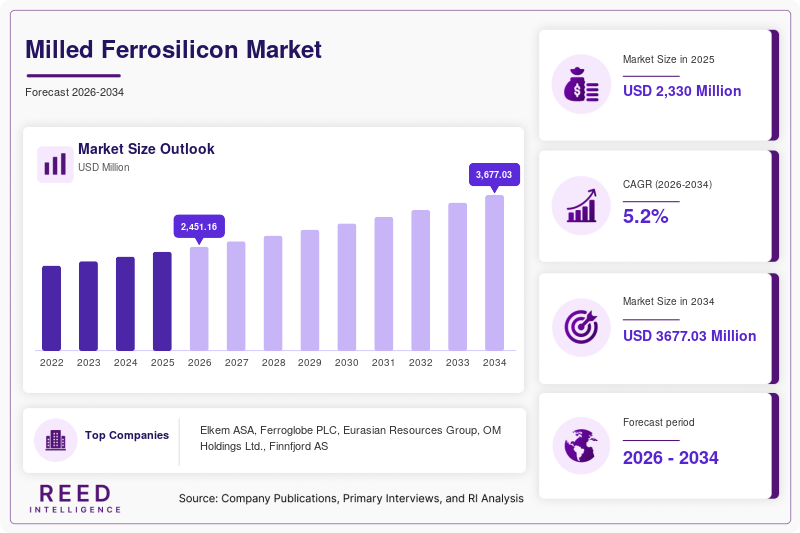
The global Milled Ferrosilicon Market size was valued at USD 2,330 million in 2025 and is projected to grow from USD 2,451.16 million in 2026 to USD 3,677.03 million by 2034, registering a CAGR of 5.2% during the forecast period from 2026 to 2034.
Milled ferrosilicon is produced by crushing and milling ferrosilicon alloys into controlled particle sizes. Compared with conventional lump ferrosilicon, milled material provides greater flexibility in dosing, particle-size control, and metallurgical processing. The most widely used ferrosilicon grade contains approximately 75% silicon, although commercial grades can range from approximately 15% to 90% silicon depending on application requirements.
The market is closely linked to global steel production because ferrosilicon is used for deoxidation and alloying. Increasing demand for specialty steels, electrical steel, stainless steel, and cast iron is supporting demand for controlled-particle-size ferrosilicon. The growth of electric arc furnace steelmaking and investment in modern steel capacity is also creating opportunities for suppliers offering consistent chemistry and particle-size distribution.
Milled Ferrosilicon Market Drivers
Steelmaking is the primary demand driver for ferrosilicon because the material is used as a deoxidizing and alloying agent. Continued expansion of carbon steel, stainless steel, electrical steel, and specialty-steel production therefore directly supports demand for milled ferrosilicon.
Electrical vehicles, power infrastructure, renewable-energy systems, transformers, and industrial equipment are increasing demand for electrical steel and other high-performance steel grades. These applications require carefully controlled alloy chemistry, creating opportunities for higher-purity milled ferrosilicon products.
Milling enables suppliers to provide specific particle-size distributions suited to individual metallurgical processes. Greater emphasis on dosing efficiency, dissolution behavior, and consistent alloying performance is encouraging steelmakers and foundries to use specialized milled products.
Ferrosilicon is also used in cast-iron and foundry operations. Growing demand for engineered castings in automotive, machinery, energy, and industrial equipment applications supports consumption of milled ferrosilicon as an inoculating and alloying material.
Milled Ferrosilicon Market Restraints
Ferrosilicon manufacturing requires high-temperature electric furnaces and substantial electricity consumption. Volatile energy costs can significantly influence production economics and selling prices.
Quartz or silica, carbon reductants, iron-bearing materials, and electricity represent important production inputs. Changes in raw-material availability and pricing can affect manufacturers' margins and product prices.
Ferroalloy trade is increasingly affected by tariffs, safeguard measures, antidumping actions, and changing trade policies. These measures can alter international flows and increase procurement costs for downstream users.
Ferroalloy production is carbon-intensive because carbon reductants are required to reduce silica in electric furnaces. Increasing emissions requirements may raise compliance costs and accelerate investment in lower-carbon production technologies.
Milled Ferrosilicon Market Opportunities
Demand for electrical steel, specialty steel, and advanced alloys is creating opportunities for high-purity milled ferrosilicon with tightly controlled aluminium, titanium, carbon, and other trace-element levels.
The expansion of electric arc furnace capacity provides an opportunity for suppliers of controlled-quality ferrosilicon. Modern steelmaking operations increasingly require consistent alloying materials to achieve tighter product specifications.
India and other developing Asian economies are expanding steel capacity and strengthening domestic ferroalloy supply chains. This creates opportunities for local milling, processing, and distribution of ferrosilicon products.
The transition toward renewable electricity, energy-efficient furnaces, recycled inputs, and carbon-reduction technologies creates opportunities for producers capable of supplying lower-carbon ferrosilicon to customers with increasingly strict sustainability requirements.
Milled Ferrosilicon Market Segmental Analysis
By Silicon Content
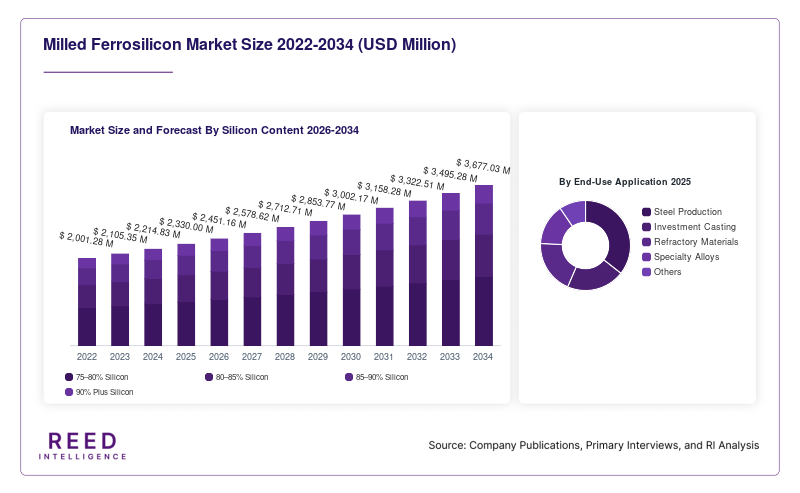
75–80% Silicon was the dominant silicon-content segment in 2025, accounting for approximately 42.0% of the global Milled Ferrosilicon Market. The segment benefits from widespread use in conventional steelmaking, particularly where ferrosilicon is required for deoxidation and alloying. Its broad availability, established specifications, and suitability for carbon and alloy steel production support its leading position. The segment is projected to grow at approximately 5.0% CAGR through 2034.
80–85% Silicon accounted for approximately 28.0% of the market in 2025 and is used extensively in specialty steel and stainless-steel applications. The segment is expected to expand at approximately 5.4% CAGR, supported by demand for higher-performance steel grades and tighter metallurgical specifications.
85–90% Silicon represented approximately 20.0% of market demand in 2025. These grades serve premium steel, alloy, and refractory applications where higher silicon concentration and controlled chemistry are important. The segment is expected to register approximately 5.5% CAGR through 2034.
90% Plus Silicon represented approximately 10.0% of the market and serves specialized applications requiring exceptionally high silicon content and controlled impurity levels. This segment is projected to be the fastest-growing silicon-content category, with approximately 5.7% CAGR through 2034, supported by specialty alloy and advanced metallurgical applications.
By End-Use Application
Steel Production was the dominant end-use application in 2025, accounting for approximately 65.0% of global Milled Ferrosilicon demand. Ferrosilicon is widely used as a deoxidizer and alloying agent during steel production, making the steel industry the principal consumption center. The segment is projected to grow at approximately 5.1% CAGR through 2034.
Investment Casting represents an important specialized application where controlled ferrosilicon chemistry can support precise alloy composition and casting performance. Demand is linked to automotive, aerospace, machinery, energy, and industrial component production.
Refractory Materials represent a smaller but established application segment. Milled particle sizes are useful in specialized refractory formulations where material distribution and chemical consistency are important.
Specialty Alloys are expected to represent an attractive growth area as aerospace, power generation, automotive, and advanced industrial applications increasingly require high-performance alloys. Exact comparable market share and CAGR for this subsegment are not independently confirmed.
Others include additional metallurgical and industrial applications where controlled silicon additions are required. Demand varies according to industrial production, alloy specifications, and regional processing capacity.
Milled Ferrosilicon Market Regional Analysis
North America Milled Ferrosilicon Market
North America is an established market for milled ferrosilicon, supported by steelmaking, foundries, specialty alloys, and industrial manufacturing. The region's demand is increasingly influenced by efforts to strengthen domestic critical-material supply chains and reduce dependence on imported ferroalloys.
Trade measures are also affecting regional market conditions. U.S. authorities determined in 2025 that domestic industry was materially injured by imports of ferrosilicon from Brazil, Kazakhstan, and Malaysia, leading to countervailing and antidumping duty orders. These measures may influence sourcing patterns and domestic supply economics.
Europe Milled Ferrosilicon Market
Europe represents a mature market characterized by established steel, foundry, specialty-alloy, and industrial manufacturing industries. Demand increasingly favors consistent, low-impurity ferroalloys that can satisfy stringent requirements for electrical steel, stainless steel, and specialty steel production.
European ferroalloy producers are also responding to trade-policy changes and challenging energy economics. Elkem reported that EU safeguard measures for ferrosilicon and foundry alloys were introduced against a backdrop of weak prices and production curtailments in early 2026.
Asia Pacific Milled Ferrosilicon Market
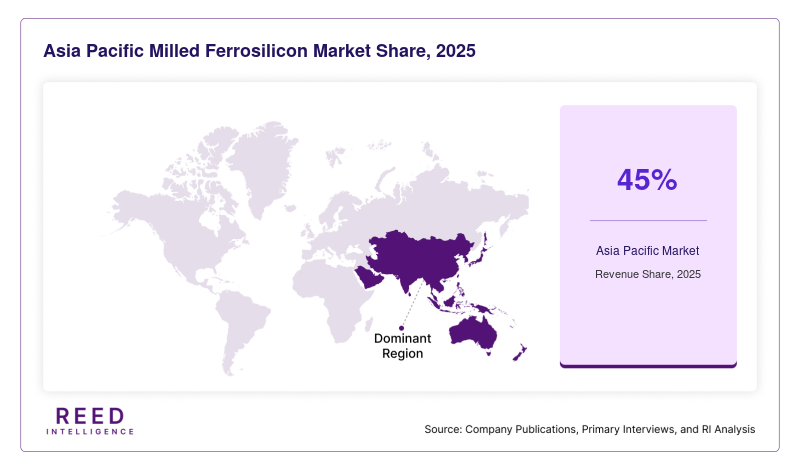
Asia Pacific is the dominant regional market, accounting for approximately 45.0% of global Milled Ferrosilicon revenue in 2025, equivalent to approximately USD 1.05 billion based on the market source's 2025 valuation. China accounts for a substantial portion of regional demand and production, while India, Japan, South Korea, and Southeast Asia contribute through steelmaking and specialty-alloy manufacturing.
Asia Pacific is also the fastest-growing major regional market, supported by expanding steel production, infrastructure development, electric arc furnace investment, and increasing domestic ferroalloy capacity. Broader ferrosilicon research estimates Asia Pacific at 58.81% of the broader ferrosilicon market in 2025 with approximately 4.53% CAGR through 2031, although this broader-market statistic should not be treated as the exact milled-ferrosilicon share.
Latin America Milled Ferrosilicon Market
Latin America represents an important production and consumption region for ferrosilicon and related ferroalloys. Brazil is particularly significant because of its established ferroalloy industry and large steel sector, while Mexico and other countries provide additional downstream demand.
Regional demand is closely tied to steel production, foundry activity, construction, automotive manufacturing, and industrial investment. The region also remains important for international ferroalloy suppliers because changes in trade policies can redirect material flows between Latin American and North American markets.
Middle East & Africa Milled Ferrosilicon Market
The Middle East & Africa market is supported by steelmaking, foundries, infrastructure development, and industrial expansion. South Africa has an established ferroalloy industry, while other African markets provide opportunities associated with developing steel and mineral-processing capacity.
Long-term demand potential is supported by infrastructure investment and industrialization, although electricity availability, production costs, logistics, and trade infrastructure can affect regional competitiveness. Exact comparable 2025 market share and CAGR for the Milled Ferrosilicon Market are unavailable from a sufficiently aligned source.
Milled Ferrosilicon Market Competitive Landscape
The Milled Ferrosilicon Market is competitive, with manufacturers differentiating through silicon purity, trace-element control, particle-size distribution, production reliability, energy efficiency, and regional supply capabilities. Producers serving premium steel and specialty-alloy applications increasingly emphasize consistent chemistry and customized grades.
Elkem ASA is a leading global supplier of ferrosilicon and silicon-based materials. Its portfolio includes standard, low-carbon, ultra-low-carbon, low-titanium, low-aluminium, and specialty ferrosilicon grades for steelmaking and other applications. Elkem also operates dedicated ferrosilicon production facilities, including the Rana plant in Norway, which has annual FeSi capacity of approximately 90,000 tonnes.
Key Market Players
- Elkem ASA
- Ferroglobe PLC
- Eurasian Resources Group
- OM Holdings Ltd.
- Finnfjord AS
- RFA International
- Sakura Ferroalloys Sdn. Bhd.
- Mississippi Silicon Corporation
- Ferro Alloys Corporation Limited
- Tashi Group
Recent Market Developments
- September, 2026, Ferroglobe confirmed that the European Commission formally initiated an interim review of antidumping duties on silicon-metal imports from China. The review covers dumping and injury and could influence European silicon-related supply chains and pricing. The development is relevant to the broader ferrosilicon and silicon-alloy industry because trade measures are reshaping regional sourcing and competitiveness.
- August, 2026, Ferroglobe reported Q2 2026 silicon-based alloy shipments of 62,915 tonnes, up 3.7% sequentially and 18.6% year-on-year. Silicon-based alloy revenue reached USD 124.9 million, up 2.2% sequentially, while adjusted EBITDA increased to USD 14.5 million from USD 6.8 million in Q1. The company also highlighted strategic initiatives focused on secure Western critical-material supply chains.
Milled Ferrosilicon Market Segments
By Silicon Content
- 75–80% Silicon
- 80–85% Silicon
- 85–90% Silicon
- 90% Plus Silicon
By End-Use Application
- Steel Production
- Investment Casting
- Refractory Materials
- Specialty Alloys
- Others
By Region
- North America
- Europe
- APAC
- Middle East and Africa
- LATAM