Milled Steel Fiber Reinforced Concrete (SFRC) Market Size, Share & Trends Analysis Report By Type (Hooked, Straight, Deformed, Others) and By Application (Industrial Flooring, Bridge Decks, Tunnel Linings, Precast Concrete, Others) and By End User (Construction, Infrastructure, Mining, Others) and By Region (North America, Europe, Asia Pacific, Latin America, Middle East & Africa) Forecasts, 2026–2034
USD 3950
Milled Steel Fiber Reinforced Concrete (SFRC) Market Size
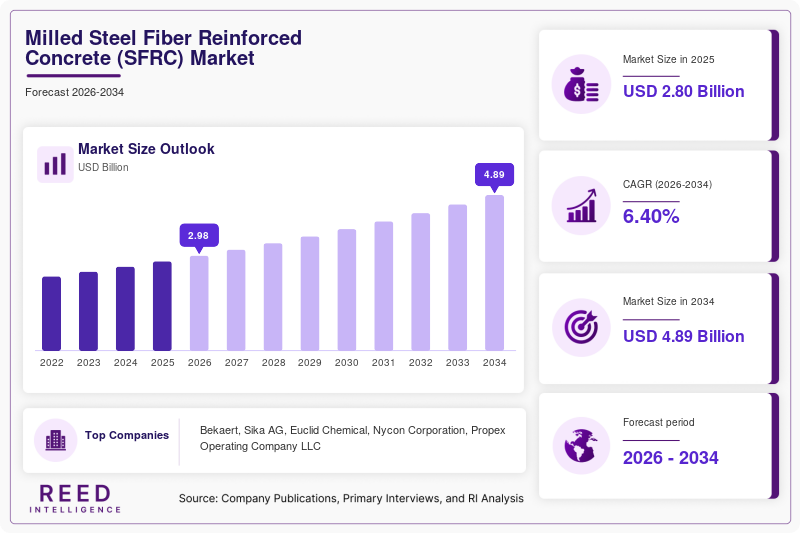
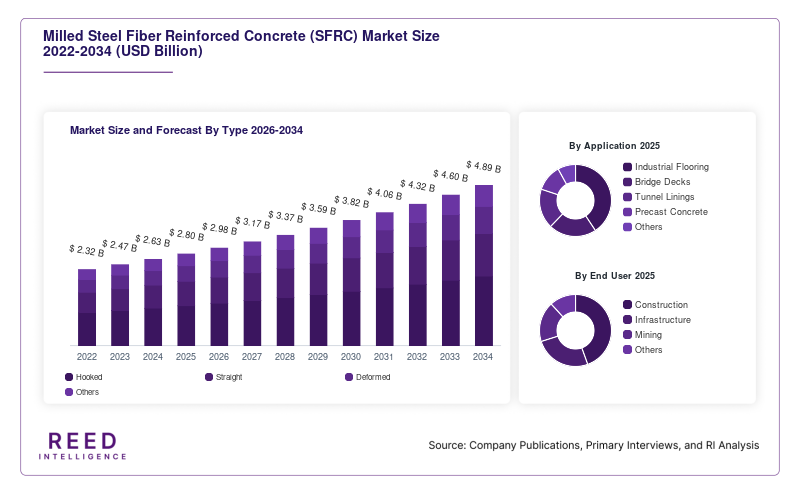
The global milled steel fiber reinforced concrete (SFRC) market was valued at USD 2.80 billion in 2025 and is projected to grow from USD 2.98 billion in 2026 to USD 4.89 billion by 2034, registering a CAGR of 6.40% during the forecast period from 2026 to 2034.
Milled Steel Fiber Reinforced Concrete is a composite construction material in which short steel fibers are distributed through a concrete matrix to provide three-dimensional reinforcement. Depending on fiber geometry, length, aspect ratio and anchorage characteristics, the fibers can improve the concrete's post-cracking behavior, ductility, energy absorption and resistance to impact and abrasion.
The market is being driven by construction productivity requirements and the increasing complexity of infrastructure projects. SFRC can reduce or eliminate certain conventional reinforcement operations, including cutting, placing and tying reinforcement, helping contractors reduce labor requirements and accelerate construction. Industrial floors, pavements, tunnels and precast products represent important demand centers.
Milled Steel Fiber Reinforced Concrete (SFRC) Market Driver
Large-scale investment in roads, bridges, tunnels, airports, metro systems and other infrastructure is increasing demand for durable reinforcement technologies. SFRC is particularly attractive for tunnel linings, bridge decks, pavements and other structures where crack control, impact resistance and long service life are important.
The expansion of warehouses, distribution centers, manufacturing plants, cold-storage facilities and automated logistics centers is increasing demand for high-performance concrete floors. Steel fibers can support jointless or reduced-joint slab designs and provide reinforcement throughout the slab, making them suitable for heavily loaded industrial floors. Bekaert reports that more than one-third of industrial floor area in Europe is reinforced with steel fiber reinforced concrete.
Steel fiber reinforced shotcrete and precast tunnel segments are increasingly used in underground construction. SFRC provides distributed reinforcement and crack control while simplifying reinforcement installation. Bekaert identifies tunneling and mining as major applications for its steel-fiber reinforcement solutions.
Labor shortages, project scheduling pressure and the need for faster construction are encouraging contractors to adopt reinforcement systems that reduce manual installation. Steel fibers can be incorporated directly into concrete mixes, reducing some conventional reinforcement activities and improving construction efficiency.
Milled Steel Fiber Reinforced Concrete (SFRC) Market Restraints
Steel fiber manufacturers depend on steel wire rod and other steel inputs. Changes in steel prices can affect manufacturing costs, product pricing and project economics. Periods of elevated steel prices may reduce the cost advantage of fiber reinforcement relative to alternative reinforcement systems.
Although SFRC can reduce labor and reinforcement installation costs, the fiber material itself increases the cost of the concrete mix. Contractors and project owners therefore require project-specific lifecycle and structural calculations to justify adoption.
SFRC performance depends on fiber geometry, dosage, concrete mix design, distribution and structural requirements. Engineers and contractors require appropriate testing and design methodologies to ensure that specified fiber systems meet required flexural and post-cracking performance.
Steel rebar, welded wire mesh and other reinforcement systems remain deeply established in the construction industry. Existing contractor expertise, specifications and procurement practices can slow substitution toward SFRC, particularly in markets where fiber-reinforced design practices are less developed.
Milled Steel Fiber Reinforced Concrete (SFRC) Market Opportunities
Circular steel fibers provide a significant opportunity for market differentiation. In January 2026, Bekaert launched Dramix Loop, a steel fiber produced from recovered steel from end-of-life tires. The company positions the product as a lower-carbon reinforcement option for industrial flooring, precast elements, sprayed concrete and UHPC applications.
Precast manufacturers increasingly require reinforcement systems that simplify production while maintaining structural performance. Steel fibers can be incorporated into complex precast components and can reduce reinforcement congestion. Bekaert highlighted steel-fiber use in precast infrastructure elements such as crash barriers and U-drain channels in 2026.
The expansion of underground mining for copper, lithium, cobalt, nickel and other critical minerals creates opportunities for SFRC shotcrete and tunnel-support applications. Mining projects require reinforcement systems capable of supporting demanding underground conditions, creating a structural growth opportunity for steel fiber suppliers.
Governments are investing in bridge rehabilitation, road upgrades and durable pavement systems. Steel fiber reinforced concrete can improve crack control, toughness and durability in demanding transportation applications, creating opportunities in both new construction and rehabilitation projects.
Milled Steel Fiber Reinforced Concrete (SFRC) Market Segmental Analysis
By Type
Hooked steel fibers represent the dominant type, accounting for approximately 52.3% of the market in 2025. Hooked fibers provide mechanical anchorage within the concrete matrix and improve pull-out resistance and post-cracking performance. They are widely suited to industrial flooring, tunnel construction and other structural applications requiring high energy absorption. Recent market research estimates a 6.6% CAGR for hooked fibers through 2034.
Deformed steel fibers represent an important alternative because their geometry improves anchorage and load-transfer characteristics. Straight fibers remain relevant for applications where cost and specific performance requirements are important. Exact comparable market shares and CAGRs for all remaining types are not independently verified on the same market-sizing basis.
By Application
Industrial Flooring is the dominant application, representing approximately 34.2% of market revenue in 2025. Warehouses, manufacturing facilities, logistics centers and cold-storage facilities increasingly require durable floors capable of supporting heavy static and dynamic loads. Steel fiber reinforcement can reduce conventional reinforcement requirements and facilitate efficient slab construction.
Precast Concrete is the fastest-growing application, with a reported 7.1% CAGR through 2034. Growing adoption of off-site construction and the need for efficient reinforcement of pipes, barriers, drainage elements and tunnel segments support this segment. Bekaert's 2026 industry content also highlights the role of steel fibers in precast infrastructure.
By End User
Construction is the dominant end-user segment, accounting for approximately 42.1% of market revenue in 2025. Commercial buildings, industrial facilities, warehouses, manufacturing plants and other structures are significant consumers of steel fiber reinforced concrete. The segment is supported by increasing construction productivity requirements and the adoption of reinforced industrial flooring systems.
Mining is the fastest-growing end-user segment, with a reported 7.4% CAGR through 2034. Expansion of underground mining for critical minerals is creating additional demand for fiber-reinforced shotcrete and underground support systems. The infrastructure segment remains another major demand center because of tunnel, bridge, airport and port construction.
Milled Steel Fiber Reinforced Concrete (SFRC) Market Regional Analysis
North America Milled Steel Fiber Reinforced Concrete (SFRC) Market
North America represents a technologically mature SFRC market supported by industrial construction, logistics facilities, infrastructure rehabilitation, mining and tunnel development. The United States accounts for a significant proportion of regional demand because of its extensive warehouse, manufacturing, transportation and infrastructure construction activity. Steel fiber systems are increasingly used in industrial slabs, pavements, precast elements and structural concrete applications.
The region is also characterized by established design standards and strong technical support from international reinforcement suppliers. Demand is expected to benefit from infrastructure rehabilitation and continued investment in industrial facilities. Exact North American market share and market value compatible with the supplied global market dataset are unavailable.
Europe Milled Steel Fiber Reinforced Concrete (SFRC) Market
Europe is an established market for steel fiber reinforced concrete, particularly in industrial flooring, tunneling, precast construction and infrastructure. The region benefits from established engineering practices and a strong supplier ecosystem. Bekaert reports that more than one-third of industrial floor area in Europe is reinforced with steel fibers, demonstrating the established penetration of SFRC in the region.
Sustainability and embodied-carbon reduction are increasingly influencing reinforcement specifications across Europe. Circular steel fiber products such as Bekaert's Dramix Loop are aligned with these priorities and can support green-building objectives. Exact regional market share, market value and comparable CAGR are unavailable on the same basis as the supplied global dataset.
Asia Pacific Milled Steel Fiber Reinforced Concrete (SFRC) Market
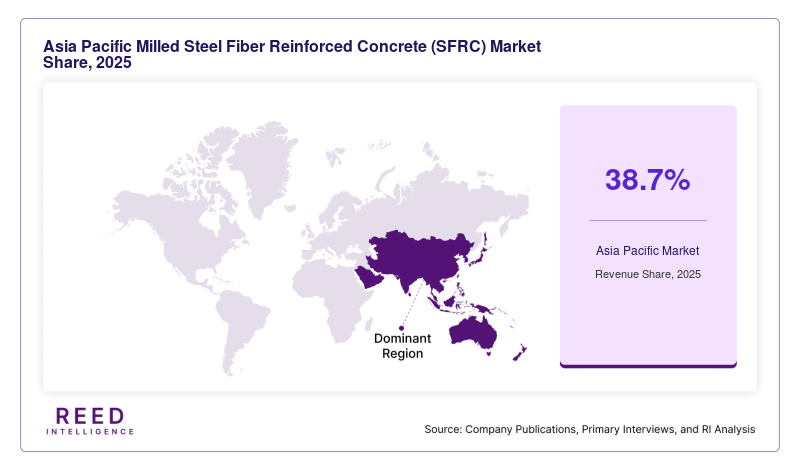
Asia Pacific is the dominant regional market, accounting for approximately 38.7% of global SFRC revenue in 2025. Based on the market-specific regional estimate, this corresponds to approximately USD 1.08 billion in 2025. The regional estimate comes from the same market-specific dataset reporting the USD 2.8 billion global 2025 market, making the regional value directly compatible with the supplied base-year market size.
The region is also expected to remain one of the fastest-growing markets, supported by infrastructure investment, metro and tunnel construction, industrial facilities and urbanization across China, India and Southeast Asia. India is particularly important because of expanding infrastructure construction and steel consumption. India's Ministry of Steel reported crude steel production of 42.1 million tonnes during April–June 2026, up 3.0% year over year, while finished steel production increased 4.9%, supporting the broader construction-material ecosystem.
Latin America Milled Steel Fiber Reinforced Concrete (SFRC) Market
Latin America represents an emerging market for SFRC, supported by infrastructure construction, industrial facilities and mining activity. Brazil is an important regional market, while Chile, Peru and Mexico offer opportunities through underground mining and transportation infrastructure. Steel fiber reinforced shotcrete can provide particular value in mining applications where durable underground support is required.
The region's growth is influenced by public infrastructure spending, mining investment and industrial development. However, economic volatility and fragmented distribution networks can constrain adoption. Recent market research estimates Latin America at approximately 5.6% of global SFRC revenue in 2025 and projects a 5.4% CAGR through 2034.
Middle East & Africa Milled Steel Fiber Reinforced Concrete (SFRC) Market
Middle East & Africa represents an emerging SFRC market supported by large-scale infrastructure, transportation, industrial and mining projects. Gulf countries are investing heavily in airports, metro systems, urban developments and major construction projects, while African mining markets provide opportunities for underground reinforcement and shotcrete applications.
The region's demand is increasingly linked to large infrastructure programs and mining expansion. Recent market research estimates the region at approximately 7.2% of global SFRC revenue in 2025 and projects a 6.9% CAGR through 2034, making it one of the faster-growing emerging regional markets.
Milled Steel Fiber Reinforced Concrete (SFRC) Market Competitive Landscape
The global Milled Steel Fiber Reinforced Concrete market is competitive, with leading companies differentiating themselves through fiber geometry, structural performance, technical support, application engineering, sustainability credentials and global distribution. Key companies include Bekaert, Sika AG, Euclid Chemical, KrampeHarex, Nycon Corporation, Propex and other regional steel-fiber manufacturers.
Bekaert is one of the strongest global competitors through its Dramix steel fiber portfolio. The company has a broad presence across flooring, tunneling, mining, precast and structural applications. Its product-development strategy increasingly emphasizes sustainability and circularity, illustrated by the January 2026 launch of Dramix Loop, a steel fiber produced using steel recovered from end-of-life tires.
Key Market Players
- Bekaert
- Sika AG
- Euclid Chemical
- Nycon Corporation
- Propex Operating Company LLC
- KrampeHarex GmbH & Co. KG
- Harex Steel Fiber GmbH & Co. KG
- Fibercon International Inc.
- Hunan Sunshine Steel Fiber Co., Ltd.
- Spajic DOO
- Chircu Prod-Impex S.R.L.
Milled Steel Fiber Reinforced Concrete (SFRC) Market Recent Developments
- January, 2026, Bekaert announced the launch of Dramix Loop, a steel fiber manufactured from steel recovered from end-of-life tires. Bekaert describes it as its most sustainable steel fiber to date and states that the product is intended for applications including industrial flooring, precast elements, sprayed concrete and UHPC. The launch strengthens the sustainability and circular-economy proposition of steel fiber reinforcement.
- March, 2026, Bekaert announced that Dramix Loop received a World of Concrete 2026 Innovative Product Award. The award recognized the circular steel-fiber solution made from end-of-life tires and highlighted the growing importance of lower-carbon reinforcement technologies in concrete construction.
Milled Steel Fiber Reinforced Concrete (SFRC) Market Segments
By Type
- Hooked
- Straight
- Deformed
- Others
By Application
- Industrial Flooring
- Bridge Decks
- Tunnel Linings
- Precast Concrete
- Others
By End User
- Construction
- Infrastructure
- Mining
- Others
By Region
- North America
- Europe
- APAC
- Middle East and Africa
- LATAM