Millet Flour Market Size, Share & Trends Analysis Report By Product Type (Pearl Millet Flour, Finger Millet Flour, Foxtail Millet Flour, Sorghum Millet Flour, Proso Millet Flour) and By Nature (Organic, Conventional) and By Application (Bakery & Confectionery, Snacks & Extruded Foods) and By Distribution Channel (Direct Sales, Supermarkets & Hypermarkets, Specialty Health & Organic Stores, Online Retail) Forecasts, 2026–2034
USD 3950
Millet Flour Market Size
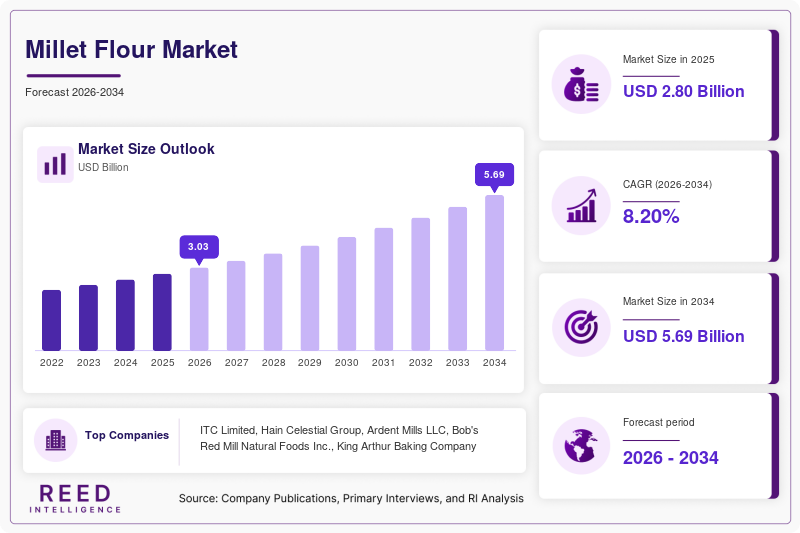
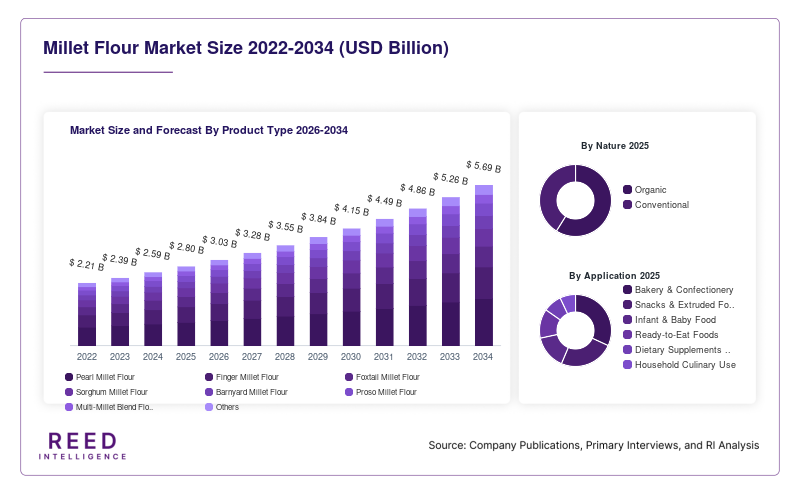
The global Millet Flour Market was valued at USD 2.80 billion in 2025 and is projected to grow from USD 3.03 billion in 2026 to USD 5.69 billion by 2034, registering a CAGR of 8.20% during the forecast period from 2026 to 2034.
Millet flour is produced by milling varieties such as pearl millet, finger millet, foxtail millet, sorghum millet and other small grains into flour suitable for direct consumption or incorporation into processed food formulations. The market is gaining commercial importance because millet flour provides gluten-free functionality while also offering dietary fiber, minerals and other nutritional attributes. Its use spans traditional flatbreads and porridges as well as modern bakery, snack, infant-food and functional-food formulations.
Millet Flour Market Drivers
Growing consumer interest in gluten-free diets is supporting millet flour adoption across bakery, snack and household cooking applications. Millet flour provides food manufacturers with an alternative to wheat flour while enabling nutritional positioning around fiber, minerals and traditional grain consumption. The expanding health-food category is therefore creating new opportunities for millet flour producers and processors.
Bakery and confectionery manufacturers are increasingly incorporating millet flour into bread, cakes, cookies, crackers and specialty bakery mixes. This trend is supported by demand for healthier baked products and the development of composite formulations that combine millet with wheat or other functional ingredients. Bakery and confectionery is identified as the leading application segment in recent market research.
Government initiatives are strengthening the commercial ecosystem for millet cultivation, processing and value addition. In India, the Production Linked Incentive Scheme for Millet-Based Products has an allocation of INR 800 crore, while INR 793.27 crore had been approved for 29 applicants by March 2026. The PMFME program had also approved 4,612 millet-processing micro enterprises with subsidies totaling INR 91.20 crore as of December 2025.
Millet flour is increasingly being incorporated into ready-to-eat foods, breakfast products, snacks, health mixes, beverages and functional-food formulations. Food manufacturers are using millet as an ingredient to improve nutritional positioning while responding to demand for convenient products. This application diversification reduces dependence on traditional household flour consumption and broadens the addressable market.
Millet Flour Market Restraints
Millet grains can require specialized cleaning, de-hulling, grading, polishing and milling processes depending on the variety. Smaller processors may face challenges associated with equipment availability, processing efficiency, quality consistency and investment costs. Lack of appropriate processing infrastructure can therefore constrain commercialization, particularly among small producers and farmer organizations.
Millet flour can face quality and shelf-life challenges because milling exposes grain components to oxidation and other deterioration mechanisms. Producers must maintain appropriate processing, packaging and storage conditions to preserve product quality. These requirements can increase operating costs and create challenges for smaller processors without advanced packaging and quality-control systems.
Millet flour competes with rice flour, corn flour, buckwheat flour, oat flour, sorghum flour and other specialty grain alternatives. Consumers and food manufacturers can switch between ingredients depending on price, availability, functional properties and formulation requirements. This competitive environment can limit pricing power for millet flour producers.
Although awareness of millet is increasing, some consumers remain unfamiliar with the taste, texture and baking characteristics of millet flour. Food manufacturers may therefore need to use blended formulations or product-development expertise to achieve desirable texture and sensory characteristics, particularly in bakery applications.
Millet Flour Market Opportunities
Organic millet flour and specialty varieties provide opportunities for premiumization. Consumers seeking clean-label, natural and minimally processed products are increasingly interested in specialty grains and alternative flours. Producers can differentiate through organic certification, single-variety products, multi-millet blends, fortified formulations and traceable sourcing.
Online retail provides millet flour manufacturers with access to consumers beyond traditional geographic markets. Digital channels can support direct-to-consumer sales, subscription models, premium product positioning and wider distribution of specialty varieties. This is particularly important for organic and functional millet flour products.
Millet flour is increasingly being considered for infant food, dietary supplements and functional food formulations because of its nutritional profile. Research also highlights growing use of millet flour in traditional and modern food formulations, including composite flours and health-oriented products.
Development of small-scale processing facilities near millet-growing regions can reduce post-harvest losses, improve farmer returns and create local flour-processing businesses. Recent ICAR initiatives demonstrate the potential for integrated primary and secondary millet processing at the FPO level.
Millet Flour Market Segmental Analysis
By Product Type
Pearl Millet Flour represents the dominant product type in the global Millet Flour Market. Recent industry research estimates pearl millet at approximately 33.8% of the millet type segment, supported by its extensive cultivation and consumption in India and other millet-producing regions. Pearl millet flour benefits from established household consumption, traditional food applications and increasing incorporation into commercial bakery and health-food products.
Finger Millet Flour represents another important segment, particularly in India, where ragi-based traditional foods, infant foods and health mixes provide an established consumption base. Foxtail, sorghum, barnyard and proso millet flours are gaining opportunities through specialty food applications, while multi-millet blends are benefiting from consumer interest in diversified nutritional formulations. Exact comparable market shares for these remaining product types are not reliably verified.
By Nature
Conventional Millet Flour is the dominant nature segment, accounting for approximately 62.4% of the segment in 2026. Its leadership is supported by broader availability, competitive pricing and established use across household and commercial food applications. Conventional flour is expected to remain the largest category because mainstream consumers and food manufacturers continue to prioritize supply consistency and affordability.
Organic Millet Flour represents the premium-growth opportunity within the category. Demand is supported by clean-label preferences, organic food consumption and interest in sustainably sourced grains. However, a directly comparable 2026–2034 CAGR for organic versus conventional millet flour on the same market-sizing basis is unavailable from a sufficiently consistent source.
By Application
Bakery & Confectionery is the dominant application segment, accounting for approximately 36.8% according to recent industry estimates. Millet flour is increasingly incorporated into breads, cakes, cookies, crackers and other baked products because it supports gluten-free and nutrition-focused positioning. Its application is expanding beyond traditional recipes into modern bakery formulations.
Snacks & Extruded Foods and Ready-to-Eat Foods represent important growth opportunities as manufacturers develop convenient millet-based products. Infant and baby food, dietary supplements and functional foods are also emerging applications, supported by increasing interest in nutrient-dense ingredients. Exact comparable CAGRs for each remaining application are unavailable.
By Distribution Channel
Indirect Sales represent the dominant distribution model, accounting for approximately 71.3% of the distribution channel in 2026 in recent market research. Supermarkets, specialty stores, distributors and other intermediaries provide broad consumer access and remain important for packaged flour products.
Online Retail represents a high-potential channel because it allows specialty, organic and multi-millet flour brands to reach consumers beyond traditional retail networks. Digital channels also support product discovery and direct-to-consumer strategies. However, a reliable exact-market CAGR for online retail is unavailable.
Millet Flour Market Regional Analysis
North America Millet Flour Market
North America represents a mature but expanding market for millet flour, supported by consumer interest in gluten-free foods, ancient grains, clean-label ingredients and specialty baking products. Demand is concentrated in the United States and Canada, where millet flour is increasingly available through natural-food stores, specialty retailers, supermarkets and online platforms. Food manufacturers are also incorporating millet into gluten-free bakery and snack formulations. Exact North American market share and market value on the same basis as the supplied global dataset are unavailable.
The region's growth is expected to remain supported by premiumization and increasing consumer interest in alternative grains. Retail availability and product innovation are particularly important for increasing penetration. Competition from rice, oat, buckwheat and other gluten-free flours remains a constraint. A directly comparable regional CAGR could not be reliably verified.
Europe Millet Flour Market
Europe is an important specialty market for millet flour, with demand supported by organic food consumption, gluten-free diets and interest in sustainable and ancient grains. Germany, the United Kingdom, France and other Western European markets provide opportunities for premium organic and specialty millet flour products. Bakery and health-food applications remain key areas of commercial adoption.
The European market is increasingly influenced by clean-label requirements, ingredient transparency and demand for plant-based and functional foods. Specialty retail and online channels are important for niche millet flour brands. Exact regional market share, market value and comparable CAGR on the supplied global market-size basis are unavailable.
Asia Pacific Millet Flour Market
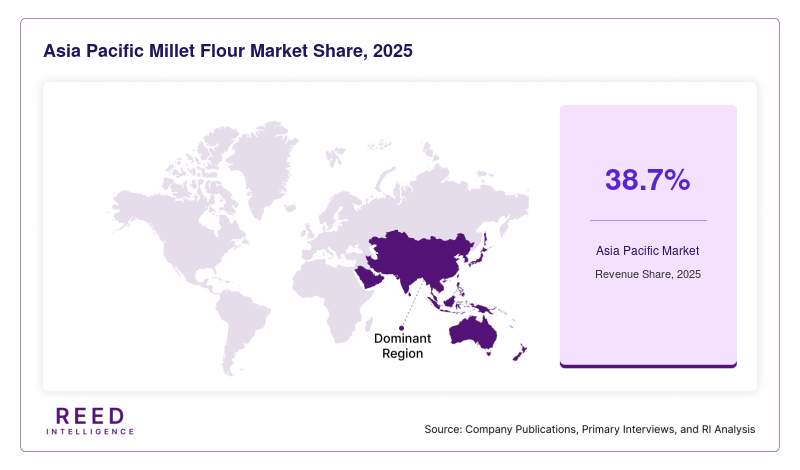
Asia Pacific is the dominant region in the global Millet Flour Market. Recent market research identifies the region as the largest regional market, with approximately 38.7% global revenue share in 2025 in one market-specific estimate. However, the source's corresponding regional valuation is based on a different global market-size dataset than the Reed Intelligence market-size figures supplied for this report; therefore, a directly compatible regional market value is not stated to avoid mixing market-sizing methodologies.
Asia Pacific is also among the fastest-growing regional markets, supported by India's strong millet production and consumption base, government processing initiatives, expanding urban health-food demand and increasing commercialization of millet products. India and China are specifically identified among the fastest-growing country markets in recent research. Government support is strengthening the processing ecosystem, while ICAR initiatives are expanding decentralized processing capabilities and farmer-level value addition.
Latin America Millet Flour Market
Latin America represents an emerging opportunity for millet flour as consumers and food manufacturers increasingly explore alternative grains and functional ingredients. Brazil and other markets offer opportunities for specialty bakery products, health foods and gluten-free formulations. However, millet remains less deeply embedded in mainstream diets than in major Asian and African producing regions.
Market development will depend on consumer awareness, availability of processing infrastructure and the ability of manufacturers to establish millet flour within existing retail and foodservice channels. Exact regional market share, market value and comparable CAGR for the Millet Flour Market are not reliably verified.
Middle East & Africa Millet Flour Market
Middle East & Africa has significant structural potential because millet cultivation and consumption are established in several African markets. Traditional consumption provides a foundation for flour demand, while commercial processing and packaged-food development can increase market value. Millet's climate resilience and suitability for semi-arid agricultural environments further support long-term production potential.
The region also provides opportunities for local milling, farmer cooperatives, fortified food products and nutrition-oriented applications. Nevertheless, fragmented processing infrastructure, logistics constraints and differences in consumer purchasing power can restrict commercialization. A directly comparable regional market share, market value and CAGR are unavailable.
Millet Flour Market Competitive Landscape
The global Millet Flour Market is highly fragmented, with competition distributed among multinational food companies, large-scale flour millers, organic-food companies, regional millet processors and specialized health-food brands. Companies compete through product diversification, organic certification, processing quality, distribution expansion, packaging innovation and development of millet-based bakery and functional-food applications. Recent industry research identifies ITC Limited, Hain Celestial Group, Ardent Mills, Bob's Red Mill, King Arthur Baking Company, Pristine Organics and Manna Foods among the notable market participants.
ITC Limited has a strong position in India's branded food and staples ecosystem and benefits from the country's large millet production and consumption base. Its broad distribution infrastructure provides opportunities for expanding millet-based products across urban and rural markets.
Key Market Players
- ITC Limited
- Hain Celestial Group
- Ardent Mills LLC
- Bob's Red Mill Natural Foods Inc.
- King Arthur Baking Company
- Azure Standard
- Raja Foods LLC
- Hodgson Mill
- Doves Farm
- Pristine Organics Pvt. Ltd.
- Conscious Food Pvt. Ltd.
Millet Flour Market Recent Developments
- September, 2026, ICAR-IIMR launched a five-day training program for Uttar Pradesh Farmer Producer Organisations covering millet production, processing, value addition and entrepreneurship. The program includes practical training in primary and secondary processing, machinery layout, product development, packaging and market-oriented millet businesses, supporting greater local production of processed millet products and flour.
- July, 2026, ICAR-IIMR inaugurated a millet primary processing unit for Sevalal Farmers Producer Organisation in Kurnool, Andhra Pradesh. The facility includes secondary processing equipment such as a pulverizer, vibro separator, blender and millet rava maker, enabling local processing and value addition. The FPO represents 757 tribal farming families, strengthening the supply and processing ecosystem for millet-based products.
Millet Flour Market Segments
By Product Type
- Pearl Millet Flour
- Finger Millet Flour
- Foxtail Millet Flour
- Sorghum Millet Flour
- Barnyard Millet Flour
- Proso Millet Flour
- Multi-Millet Blend Flour
- Others
By Nature
- Organic
- Conventional
By Application
- Bakery & Confectionery
- Snacks & Extruded Foods
- Infant & Baby Food
- Ready-to-Eat Foods
- Dietary Supplements & Functional Foods
- Household Culinary Use
By Distribution Channel
- Direct Sales
- Supermarkets & Hypermarkets
- Specialty Health & Organic Food Stores
- Online Retail
By Region
- North America
- Europe
- APAC
- Middle East and Africa
- LATAM