Millimeter Wave Connector Market Size, Share & Trends Analysis Report By Connector Type (SMA, SMP, SMPM, 2.92 mm, 2.4 mm, 1.85 mm, 1.0 mm, Others) and By Application (Telecommunication, Aerospace & Defense, Automotive, Electronics & Semiconductor, Test & Measurement, Healthcare, Others) and By Frequency Range (Up to 30 GHz, 30–60 GHz, 60–90 GHz, Above 90 GHz) and Forecasts 2026–2034
USD 3950
Millimeter Wave Connector Market Size
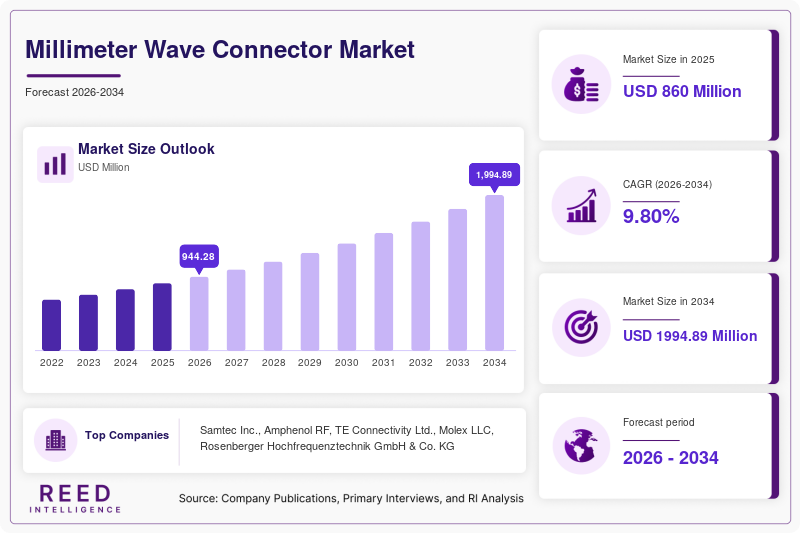
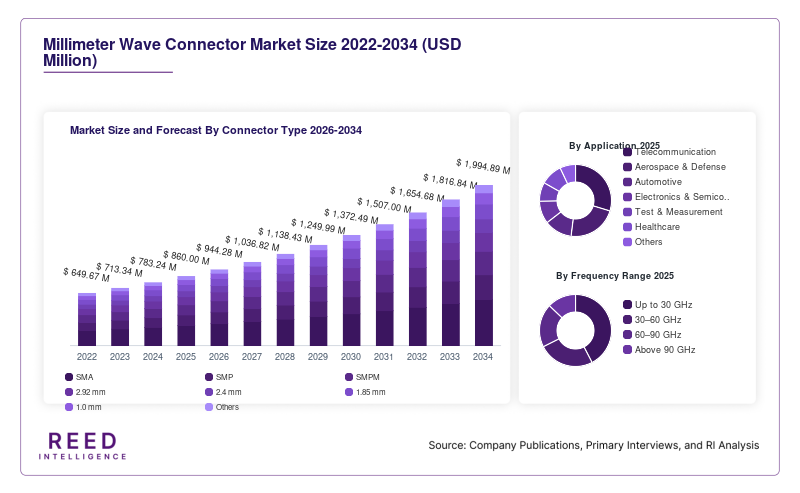
The global Millimeter Wave Connector Market was valued at USD 860 million in 2025 and is projected to grow from USD 944.98 million in 2026 to USD 1,994.89 million by 2034, registering a CAGR of 9.80% during the forecast period from 2026 to 2034.
Millimeter wave connectors are precision RF interconnect components designed to transfer high-frequency signals between cables, printed circuit boards, antennas, modules, test equipment and other RF systems. They include connector families such as SMA, SMP, SMPM, 2.92 mm, 2.4 mm, 1.85 mm and 1.0 mm interfaces. Their applications span telecommunications, aerospace and defense, automotive radar, semiconductor testing, satellite communications, industrial sensing and advanced electronics.
The increasing operating frequency of modern wireless and sensing systems is creating greater demand for precision connector architectures. At higher frequencies, small changes in connector geometry, PCB launch design, dielectric properties and impedance can materially affect signal integrity. Manufacturers are therefore investing in optimized end-launch, board-mount, compression-mount, blind-mate and solderless connector technologies.
Millimeter Wave Connector Market Drivers
The deployment of high-frequency wireless infrastructure is increasing demand for RF connectors capable of maintaining signal integrity at increasingly higher frequencies. 5G networks and emerging 6G architectures require compact, low-loss interconnects for antennas, radios, test systems and high-frequency modules. Connector suppliers are therefore expanding portfolios toward higher-frequency and smaller interfaces.
The development of advanced semiconductor, radar, wireless and communication systems requires accurate high-frequency testing. Millimeter-wave connectors are essential for vector network analyzers, signal generators, RF test fixtures and production testing. Amphenol RF's 2.92 mm connectors, for example, provide broadband electrical performance up to 40 GHz for high-frequency test and instrumentation applications.
Automotive radar systems increasingly use millimeter-wave frequencies to support object detection, distance measurement and advanced driver-assistance functions. Connector designs supporting E-band and other high-frequency applications are consequently becoming increasingly important. Rosenberger identifies millimeter-wave sensors for self-driving vehicles among applications for its RPC-1.35 precision connector series.
Radar, electronic warfare, satellite communications, avionics and high-frequency defense electronics require connectors with stable electrical and mechanical performance under demanding conditions. SMPM connectors, for example, operate to 65 GHz and are used in aerospace, defense and 5G applications.
Millimeter Wave Connector Market Restraints
Millimeter-wave connectors require extremely tight dimensional tolerances because connector geometry directly influences impedance, reflections and signal loss. Precision machining, plating, inspection and RF testing increase manufacturing complexity and production costs compared with conventional low-frequency connectors.
Connectors capable of supporting 90 GHz, 110 GHz or 120 GHz frequencies typically require specialized materials, precision manufacturing and advanced testing. These characteristics increase component costs and can limit adoption in price-sensitive applications.
At millimeter-wave frequencies, PCB layout, connector launch geometry, dielectric selection and cable construction have a significant impact on performance. Poorly optimized connector transitions can introduce impedance discontinuities, return loss and insertion loss. This increases engineering requirements for system designers.
The market includes several connector sizes and interfaces with different mechanical and electrical specifications. Emerging interfaces, including very small high-frequency connectors, may require additional standardization and qualification before achieving broad adoption across equipment manufacturers.
Millimeter Wave Connector Market Opportunities
The movement toward higher operating frequencies creates substantial opportunities for manufacturers capable of developing reliable connectors above 100 GHz. Samtec's September 2026 launch of 1.0 mm connectors operating through 120 GHz demonstrates the continued expansion of the commercially available high-frequency connector range.
Increasing satellite deployment and high-throughput communication systems require compact, lightweight and high-performance RF interconnects. Millimeter-wave connectors can support high-frequency communication, phased-array systems, RF modules and testing equipment used throughout the satellite ecosystem.
Solderless and compression-mount connectors provide flexibility during testing, prototyping and high-frequency PCB integration. Molex offers high-frequency connectors with mechanical and compression attachment options, while Samtec's 1.0 mm series uses vertical solderless compression mounting for applications extending to 120 GHz.
The continued miniaturization of communication modules, radar systems and electronic equipment is creating demand for smaller connectors with high-frequency performance. Microminiature interfaces such as SMPM and SMPS enable designers to reduce PCB footprint while maintaining high-frequency signal transmission.
Millimeter Wave Connector Market Segmental Analysis
By Connector Type
SMA connectors represent the dominant connector type because of their extensive installed base, established industry standards, broad availability and suitability for microwave and high-frequency RF applications. Newer SMA designs are also extending the technology into higher-frequency applications. In March 2026, Samtec introduced SMA edge-mount board connectors capable of reliable performance through 26.5 GHz, targeting 5G/6G, test and measurement, military and aerospace applications.
1.0 mm connectors represent the fastest-growing technology segment as system designers move toward frequencies exceeding 100 GHz. Samtec's September 2026 100-CM 1.0 mm connectors support operation through 120 GHz, illustrating the strong technology shift toward smaller interfaces and higher-frequency performance.
By Application
Telecommunication is the dominant application segment, supported by 5G infrastructure, high-frequency wireless systems, antenna technologies and continued development of advanced communication networks. High-frequency connectors provide essential signal paths between RF modules, antennas, test equipment and communication electronics.
Aerospace & Defense represents one of the fastest-growing application areas because radar, electronic warfare, satellite communication and advanced avionics increasingly operate at high frequencies. Connector reliability, low VSWR, mechanical durability and stable performance under demanding environmental conditions are particularly important in these applications. Exact comparable application shares and CAGRs are not reliably verified.
By Frequency Range
Up to 30 GHz represents a major installed-base segment because SMA and related RF connectors are widely deployed across established microwave communication, instrumentation and industrial applications. Samtec's expansion of SMA products to 26.5 GHz demonstrates continued demand for connector solutions within this frequency range.
Above 90 GHz is the fastest-growing frequency segment as research, communications, sensing and test applications move toward higher-frequency operation. Samtec's 1.0 mm connectors supporting up to 120 GHz and Molex's product portfolio extending to 115 GHz demonstrate the rapid commercialization of ultra-high-frequency connector technologies.
Millimeter Wave Connector Market Regional Analysis
North America Millimeter Wave Connector Market
North America represents a major market for millimeter-wave connectors due to its large aerospace and defense industry, advanced telecommunications infrastructure, semiconductor ecosystem and strong test-and-measurement sector. The United States is particularly important because of ongoing investments in radar, satellite communications, advanced wireless technologies, defense electronics and high-frequency semiconductor development. Exact North American market share and market value on the same basis as the supplied global dataset are unavailable.
The region is expected to maintain strong demand as 5G/6G development and defense modernization increase requirements for precision RF interconnects. The presence of major connector and RF technology suppliers further supports product development and commercialization. A directly comparable regional CAGR could not be reliably verified.
Europe Millimeter Wave Connector Market
Europe is an important market for millimeter-wave connectors because of its aerospace, automotive, telecommunications, industrial automation and scientific research sectors. Germany, France, the United Kingdom and other European markets have significant demand for high-frequency RF components used in automotive radar, satellite systems, aerospace electronics and advanced measurement equipment.
Automotive sensing and industrial RF applications are particularly important growth areas. Rosenberger's RPC-1.35 connector portfolio is designed for applications including 5G, E-band industrial sensors and millimeter-wave sensors for autonomous vehicles, demonstrating European expertise in high-frequency interconnect technology. Exact regional share and market value are unavailable on a directly comparable basis.
Asia Pacific Millimeter Wave Connector Market
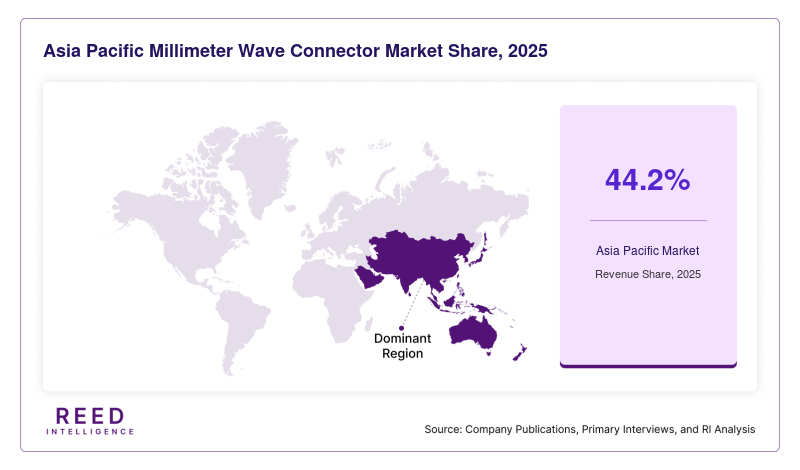
Asia Pacific is expected to represent the dominant regional market because of its extensive telecommunications infrastructure, large electronics manufacturing base, semiconductor production, 5G deployment and growing automotive electronics industry. China, Japan, South Korea and Taiwan are important markets for high-frequency components and electronic interconnects. However, an exact numeric global market-share percentage and compatible regional market value could not be reliably verified for the specific Millimeter Wave Connector Market dataset supplied for this report and therefore are unavailable rather than estimated.
The region is also expected to be among the fastest-growing markets because of continued investment in 5G infrastructure, semiconductor manufacturing, advanced radar, automotive sensing and high-frequency communication systems. Expansion of electronics manufacturing and demand for compact RF components will support connector adoption through 2034.
Latin America Millimeter Wave Connector Market
Latin America represents an emerging market for millimeter-wave connectors, supported by telecommunications modernization, expansion of wireless networks and increasing adoption of advanced electronic systems. Brazil and Mexico are the most important markets because of their telecommunications, automotive, industrial and electronics sectors.
Growth is expected to remain closely connected with 5G deployment, industrial digitization and investment in advanced communications equipment. However, limited domestic production of highly specialized RF components and dependence on imported technologies can constrain market expansion. Exact market share, regional value and CAGR are unavailable.
Middle East & Africa Millimeter Wave Connector Market
The Middle East & Africa market is supported by investments in telecommunications infrastructure, satellite communications, defense electronics, radar and smart-city technologies. Countries with substantial aerospace and defense spending are particularly relevant for high-frequency RF connector suppliers.
The expansion of satellite communications and advanced wireless networks should create additional demand for compact, high-performance RF interconnects. However, market development remains uneven across countries and depends on infrastructure investment and technology imports. Exact regional market share, market value and comparable CAGR are unavailable.
Millimeter Wave Connector Market Competitive Landscape
The global Millimeter Wave Connector Market is characterized by strong competition among specialized RF connector manufacturers and diversified electronic-connectivity companies. Key competitive factors include frequency capability, signal integrity, VSWR, insertion loss, mechanical durability, miniaturization, connector standardization, environmental resistance and customization capabilities.
Samtec is a leading high-frequency interconnect supplier with an expanding portfolio covering SMA, 1.0 mm and other RF technologies. Its 2026 product development includes 26.5 GHz SMA connectors and 120 GHz 1.0 mm compression-mount connectors, demonstrating a strong focus on higher-frequency applications.
Key Market Players
- Samtec Inc.
- Amphenol RF
- TE Connectivity Ltd.
- Molex LLC
- Rosenberger Hochfrequenztechnik GmbH & Co. KG
- Radiall
- Smiths Interconnect
- Hirose Electric Co., Ltd.
- Pasternack Enterprises
- Southwest Microwave, Inc.
- Carlisle Interconnect Technologies
Millimeter Wave Connector Market Recent Market Developments
- September 2026, Samtec announced its 100-CM Series 1.0 mm vertical solderless compression-mount connectors, designed to provide reliable performance through 120 GHz. The company also highlighted mating cable assemblies supporting frequencies up to 130 GHz, reinforcing the industry's movement toward ultra-high-frequency interconnects for advanced RF and millimeter-wave systems.
- June 2026, Amphenol RF announced several high-frequency connector developments, including solderless 2.92 mm connectors supporting up to 40 GHz, compact NEX10 connectors for high-density wireless infrastructure and IP67 RP-SMA connectors for harsh-environment wireless applications. These products address growing requirements for compact and reliable RF connectivity.
Millimeter Wave Connector Market Segments
By Connector Type
- SMA
- SMP
- SMPM
- 2.92 mm
- 2.4 mm
- 1.85 mm
- 1.0 mm
- Others
By Application
- Telecommunication
- Aerospace & Defense
- Automotive
- Electronics & Semiconductor
- Test & Measurement
- Healthcare
- Others
By Frequency Range
- Up to 30 GHz
- 30–60 GHz
- 60–90 GHz
- Above 90 GHz
By Region
- North America
- Europe
- APAC
- Middle East and Africa
- LATAM