Millimeter Wave Therapy Devices Market Size, Share & Trends Analysis Report By Product Type (Portable MWT Devices, Fixed MWT Devices) and By Application (Pain Management, Dermatology, Oncology, Cardiovascular, Others) and By End User (Hospitals, Specialty Clinics, Home Care Settings, Others) and By Region (North America, Europe, Asia Pacific, Latin America, Middle East & Africa) Forecasts, 2026–2034
USD 3950
Millimeter Wave Therapy Devices Market Size
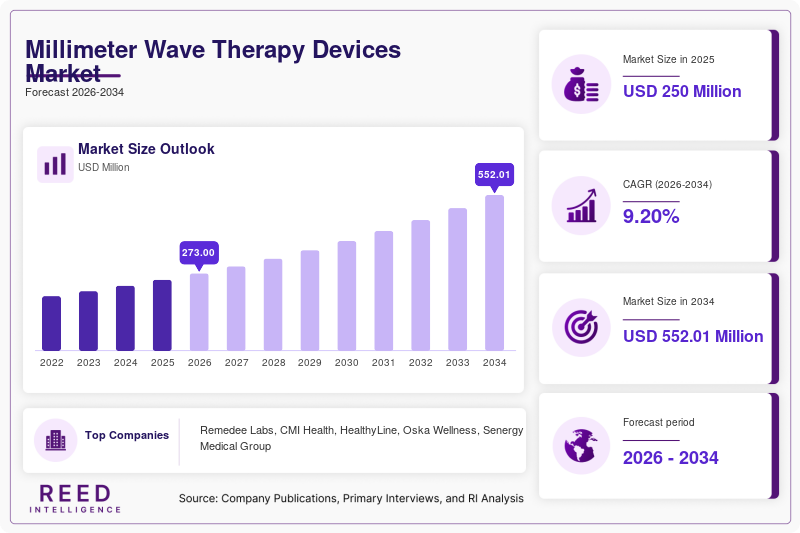
The global Millimeter Wave Therapy Devices Market was valued at USD 250 million in 2025 and is projected to grow from USD 273 million in 2026 to USD 552.01 million by 2034, registering a CAGR of 9.20% during the forecast period from 2026 to 2034.
Millimeter wave therapy devices use millimeter-wave electromagnetic radiation for therapeutic and neuromodulation applications. Commercial development has increasingly focused on non-pharmacological approaches to pain management, with wearable and portable systems allowing patients to receive treatment in outpatient or home environments.
The strongest commercial application is currently pain management. Clinical research has provided additional support for this application, including a randomized crossover study of 60 patients with peripheral osteoarthritis. The study reported a statistically significant reduction in pain during millimeter-wave medical-device use, together with improvements in quality of life and sleep quality, with no serious adverse events related to the device.
Millimeter Wave Therapy Devices Market Drivers
The increasing burden of chronic pain, osteoarthritis and other musculoskeletal conditions is creating demand for non-invasive therapeutic technologies. Millimeter-wave neuromodulation is being investigated as an adjunct to conventional pain management, providing manufacturers with an opportunity to address patients seeking drug-free or complementary approaches.
Clinical evidence is strengthening the commercial case for millimeter-wave therapy devices. A randomized crossover study published in Rheumatology evaluated a millimeter-wave medical device in 60 patients with peripheral osteoarthritis and found significantly lower pain scores during device use, alongside improvements in quality of life and sleep.
Concerns regarding long-term medication use and the need for multimodal pain management are increasing interest in non-pharmacological technologies. Wearable millimeter-wave systems can potentially complement conventional therapies while offering patients a technology-based treatment option without requiring invasive procedures.
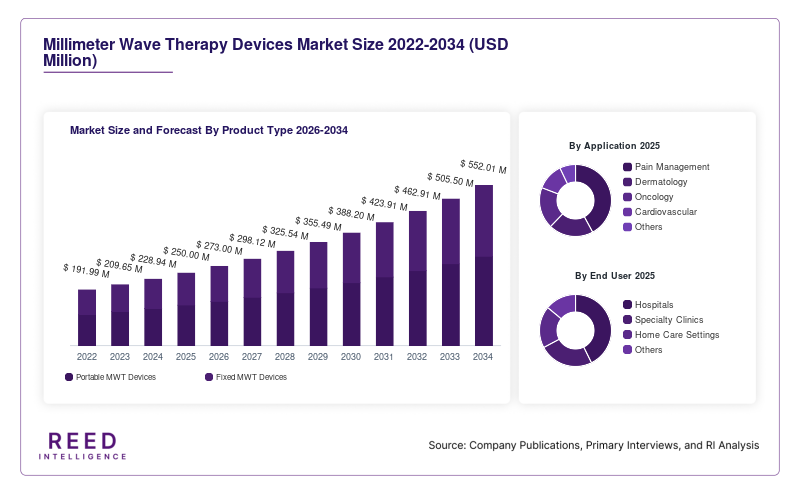
Healthcare delivery is increasingly moving toward outpatient, remote and home-based treatment models. Portable millimeter-wave therapy devices are particularly suited to this transition because they can be used outside hospitals and specialty facilities. The portable segment accounted for approximately 58.3% of the market in 2025 and is projected to grow faster than fixed systems.
Millimeter Wave Therapy Devices Market Restraints
Although clinical evidence is developing, the evidence base remains more established for pain-related applications than for oncology, cardiovascular and several dermatological indications. Additional randomized and long-term studies are required to establish efficacy across broader patient populations.
Medical-device manufacturers must satisfy different regulatory requirements across countries. Clinical evidence, safety documentation and local approval requirements can increase product-development timelines and commercialization costs, particularly for companies entering multiple international markets.
Millimeter-wave therapy remains a specialized technology compared with conventional pharmacological, physiotherapy and established neuromodulation treatments. Limited awareness among physicians and healthcare institutions can slow procurement and patient adoption.
Reimbursement policies vary substantially across healthcare systems and indications. Limited or inconsistent reimbursement can increase patient out-of-pocket costs and restrict adoption in markets where hospitals and patients require clear reimbursement pathways before investing in new therapeutic devices.
Millimeter Wave Therapy Devices Market Opportunities
Wearable millimeter-wave therapy represents one of the strongest commercial opportunities. Compact wrist-worn systems can provide treatment at home while reducing dependence on repeated hospital visits. The development of connected devices, treatment tracking and patient-support platforms can further increase the value proposition.
Recent randomized clinical evidence supports further exploration of millimeter-wave therapy for osteoarthritis-related pain. In the published trial, regular use of the device significantly reduced pain and improved quality of life and sleep, creating opportunities for broader clinical adoption and additional evidence generation.
Integration of millimeter-wave devices with mobile applications, remote monitoring and digital coaching can improve treatment adherence and generate real-world evidence. Such platforms can also help healthcare providers monitor treatment frequency and patient-reported outcomes.
Dermatology, wound care, inflammatory conditions and supportive oncology applications represent potential areas for market expansion. Industry research identifies dermatology as the second-largest application segment, although evidence and regulatory positioning vary by specific indication.
Millimeter Wave Therapy Devices Market Segmental Analysis
By Product Type
Portable MWT Devices are the dominant product segment, accounting for approximately 58.3% market share in 2025. Portable systems are benefiting from growing demand for flexible treatment delivery, outpatient care and home-based therapy. Their compact form factors allow treatment outside conventional hospital environments and support greater patient convenience. The segment is also the fastest-growing product category, with a reported 10.1% CAGR during 2026–2034.
Fixed MWT Devices accounted for approximately 41.7% of the market in 2025 and remain important for hospitals, research centers and high-volume treatment facilities. These systems can support institutional treatment environments where repeated patient use and dedicated clinical infrastructure justify fixed installation. The segment is projected to grow at approximately 7.8% CAGR through 2034.
By Application
Pain Management is the dominant application, accounting for approximately 32.5% market share in 2025 in the product-type/application market dataset. Osteoarthritis, fibromyalgia, chronic musculoskeletal pain and other pain conditions represent major areas of application. The segment benefits from the growing demand for non-invasive and non-pharmacological treatment alternatives.
Dermatology is the second-largest application at approximately 28.1%, with applications including inflammatory skin conditions and wound-related treatment. It also represents the fastest-growing application in the referenced market analysis, with a reported 10.5% CAGR through 2034. Oncology, cardiovascular and other applications remain emerging areas, and comparable growth rates for each cannot be reliably confirmed.
By End User
Hospitals are the dominant end-user category, accounting for approximately 45.2% market share in the market-specific MWT devices analysis. Hospitals have advantages in terms of capital-equipment procurement, specialist clinical expertise and access to patient populations requiring chronic pain and other therapeutic interventions.
Specialty Clinics are an important growth segment because pain-management, orthopedic and dermatology clinics can deploy portable systems with relatively flexible treatment workflows. Specialty clinics account for approximately 27.5% in the referenced analysis and are projected to expand at around 10.8% CAGR. Home-care settings are also expected to gain importance as portable devices become more widely adopted.
Millimeter Wave Therapy Devices Market Regional Analysis
North America Millimeter Wave Therapy Devices Market
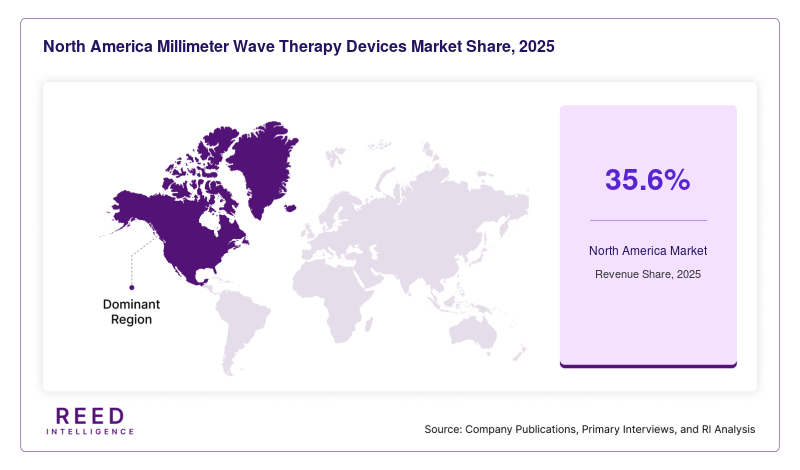
North America is the dominant regional market, accounting for approximately 35.6% of global market share in 2025, equivalent to approximately USD 88.9 million based on the market-specific 2025 global valuation of USD 250 million. The region benefits from developed healthcare infrastructure, high healthcare expenditure, established medical-device distribution networks and significant demand for advanced non-invasive therapies.
The United States represents the primary regional market because of its large chronic-pain patient population, specialist healthcare infrastructure and established medical-device ecosystem. Continued clinical evidence generation and development of portable therapy solutions are expected to support regional adoption. A comparable North American CAGR was not reliably verified from the same dataset.
Europe Millimeter Wave Therapy Devices Market
Europe is the second-largest regional market, accounting for approximately 27.4% market share in 2025 according to the market-specific analysis. Germany, France, the United Kingdom and other European markets provide opportunities because of advanced healthcare infrastructure and established specialty-care networks.
France is particularly relevant to millimeter-wave neuromodulation because clinical development has included French university hospitals and pain centers. A randomized clinical study conducted through Grenoble Alpes University Hospital demonstrated significant pain reduction in peripheral osteoarthritis patients using a millimeter-wave medical device. Exact comparable European CAGR and market value are unavailable.
Asia Pacific Millimeter Wave Therapy Devices Market
Asia Pacific is the fastest-growing regional market, with a reported 11.8% CAGR from 2026 to 2034. Growth is being supported by healthcare infrastructure development, increasing medical-device expenditure, large aging populations and expanding access to advanced therapeutic technologies in China, India, Japan and South Korea.
The region is expected to become increasingly important for manufacturers seeking long-term expansion. Rising healthcare spending and the increasing prevalence of chronic pain and age-related disorders create a large potential patient base. Exact Asia Pacific market share and market value on the same basis as the dominant North American dataset are not reliably verified.
Latin America Millimeter Wave Therapy Devices Market
Latin America represents an emerging market for millimeter-wave therapy devices, supported by expanding private healthcare infrastructure, increasing healthcare investment and rising demand for advanced pain-management technologies. Brazil and Argentina provide important commercial opportunities because of their relatively developed private healthcare systems.
The market remains smaller than North America and Europe because of differences in healthcare spending, reimbursement coverage and availability of specialized medical devices. A reliable comparable regional CAGR was not identified from the same market-specific dataset.
Middle East & Africa Millimeter Wave Therapy Devices Market
Middle East & Africa represents an emerging opportunity driven by healthcare infrastructure development, medical tourism investments and modernization of specialty healthcare facilities. Gulf Cooperation Council countries provide particularly relevant opportunities for advanced medical-device suppliers because of ongoing investment in private hospitals and specialist treatment centers.
Adoption outside the Gulf region remains more limited because of healthcare-access differences and equipment costs. Exact comparable market value and CAGR for the region are unavailable on the same methodology as the supplied global market-size dataset.
Millimeter Wave Therapy Devices Market Competitive Landscape
The Millimeter Wave Therapy Devices Market is characterized by a combination of specialized medical-technology companies, neuromodulation developers and technology providers. Competition is increasingly centered on clinical validation, device miniaturization, portability, treatment personalization and development of evidence supporting specific therapeutic indications.
Remedee Labs is one of the most directly relevant specialized companies in millimeter-wave neuromodulation. The company has developed a millimeter-wave endorphin-stimulation wristband and reports clinical validation for fibromyalgia and osteoarthritis-related pain. Its technology has been evaluated in randomized clinical research and is positioned as a non-pharmacological approach to chronic pain management.
Key Market Players
- Remedee Labs
- CMI Health
- HealthyLine
- Oska Wellness
- Senergy Medical Group
- Shenzhen Kexin Electronic Instrument
- WIKAR
- Emerson Electric Co.
- Honeywell International Inc.
- Keysight Technologies Inc.
- NEC Corporation
Millimeter Wave Therapy Devices Market Recent Developments
- January 2026 evaluated a millimeter-wave-emitting medical device in 60 patients with peripheral osteoarthritis. During the device-use period, mean daily pain scores were 4.57 compared with 5.32 without device use, representing a statistically significant difference. The study also reported improvements in quality of life and sleep quality, with no serious adverse events related to the device.
- 2026, Remedee Labs continued positioning its millimeter-wave endorphin-stimulation technology for chronic pain management. The company's current portfolio includes NoviRem, designed for osteoarthritis-related pain, and FibroRem, designed for fibromyalgia symptom management. The company reports clinical evidence from osteoarthritis and fibromyalgia studies and continues to develop its millimeter-wave neuromodulation platform.
Millimeter Wave Therapy Devices Market Segments
By Product Type
- Portable MWT Devices
- Fixed MWT Devices
By Application
- Pain Management
- Dermatology
- Oncology
- Cardiovascular
- Others
By End User
- Hospitals
- Specialty Clinics
- Home Care Settings
- Others
By Region
- North America
- Europe
- APAC
- Middle East and Africa
- LATAM