Millimetric Wave Solutions Market Size, Share & Trends Analysis Report By Component (Hardware, Software, Services) and By Application (Telecommunications, Healthcare, Automotive, Aerospace & Defense) and By Frequency Band (24–57 GHz, 57–95 GHz, 95–300 GHz) and By End User (Telecom Operators, Enterprises, Government) and By Region (North America, Europe, Asia Pacific, Latin America, Middle East & Africa) Forecasts, 2026–2034
USD 3950
Millimetric Wave Solutions Market Size
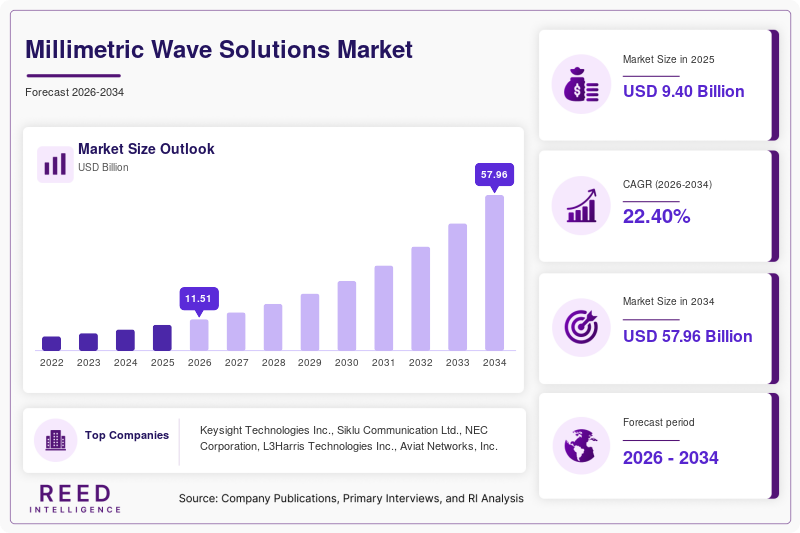
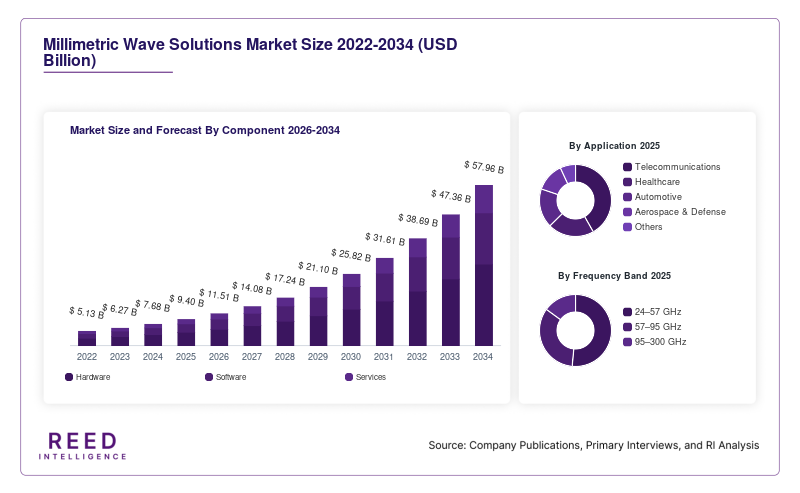
The global Millimetric Wave Solutions Market was valued at USD 9.40 billion in 2025 and is projected to grow from USD 11.51 billion in 2026 to USD 57.96 billion by 2034, registering a CAGR of 22.40% during the forecast period from 2026 to 2034.
Millimetric wave, commonly referred to as millimeter wave or mmWave, generally covers frequencies in the high-frequency range used for applications requiring high bandwidth, directional transmission and high-resolution sensing. The technology is particularly valuable for high-capacity wireless communications because wider frequency bandwidths can support substantially higher data rates than conventional lower-frequency wireless systems.
The telecommunications industry remains the largest commercial opportunity because operators are deploying mmWave infrastructure for dense urban areas, fixed wireless access, enterprise connectivity, stadiums, campuses and high-capacity network links. Market research identifies 5G and beyond-5G deployment as a major growth driver for millimetric wave solutions.
Millimetric Wave Solutions Market Drivers
The expansion of 5G networks is the primary commercial driver for millimetric wave solutions. Operators require high-capacity spectrum to support growing mobile data traffic, fixed wireless access and dense urban connectivity. The evolution toward 5G-Advanced is further increasing demand for advanced RF components, antennas, transceivers and testing systems.
Millimetric wave fixed wireless access enables operators to provide high-speed broadband without extensive last-mile fiber deployment. The technology is particularly attractive in dense urban areas, enterprise locations and regions where fiber deployment is expensive or difficult. Ceragon reported approximately USD 120 million in year-to-date orders from Indian operators by July 2026, supporting nationwide 4G/5G transport and fixed wireless access expansion.
Automotive manufacturers are increasingly integrating high-frequency radar systems into ADAS and automated-driving platforms. Millimetric wave radar enables accurate object detection and distance measurement under different lighting and weather conditions, supporting applications such as adaptive cruise control, blind-spot monitoring, collision avoidance and automated parking.
The development of 6G is creating a new long-term demand cycle for millimetric, upper-midband and sub-terahertz technologies. Industry participants are already validating new spectrum bands, advanced MIMO, integrated sensing and communications, AI-native networking and high-frequency RF architectures. Qualcomm and industry partners announced a roadmap targeting commercial 6G systems from 2029 onward.
Millimetric Wave Solutions Market Restraints
Millimetric waves experience higher atmospheric and propagation losses than lower-frequency radio waves. Oxygen absorption, rain attenuation, obstruction and limited penetration through buildings can reduce coverage and require denser network deployment.
Deploying dense mmWave networks requires additional small cells, antennas, backhaul links and supporting infrastructure. The resulting capital requirements can limit adoption in areas with low population density or insufficient demand for ultra-high-speed connectivity.
Millimetric wave systems require advanced semiconductor fabrication, antenna design, thermal management, signal processing and testing. Design complexity can increase development costs and extend product-development cycles.
High-frequency spectrum allocation varies by country and application. Different licensing requirements, frequency-band policies and technical standards can complicate international product deployment and increase compliance requirements.
Millimetric Wave Solutions Market Opportunities
6G represents the largest long-term opportunity for millimetric and adjacent high-frequency technologies. Industry development is moving toward AI-native networks, integrated sensing and communication, advanced MIMO, new spectrum bands and extremely high data rates. Keysight joined the Verizon 6G Innovation Forum in September 2026 to support pre-standard 6G validation and testing.
Enterprises, data centers, campuses and industrial facilities increasingly require high-bandwidth wireless connectivity. E-band and other mmWave solutions can provide multi-gigabit point-to-point connections where fiber deployment is expensive or operationally difficult.
The expansion of autonomous driving and ADAS provides substantial opportunities for radar manufacturers, semiconductor suppliers, antenna companies and system integrators. Increasing sensor density in higher levels of vehicle automation should expand demand for mmWave radar modules.
Development is moving beyond conventional mmWave toward sub-terahertz frequencies for future communications, imaging and sensing. Keysight's 2026 European Microwave Week program includes RF-to-sub-THz characterization and testing for emerging high-frequency designs, demonstrating growing commercial attention to frequencies above conventional mmWave bands.
Millimetric Wave Solutions Market Segmental Analysis
By Component
Hardware is the dominant component segment, accounting for approximately 52.3% of the global market in 2025. Hardware includes antennas, transceivers, amplifiers, oscillators, frequency converters, RF modules and other high-frequency components required to construct millimetric wave systems. Hardware demand is directly linked to 5G infrastructure expansion, automotive radar deployment and high-frequency sensing applications.
Software and services represent important supporting segments as networks and RF systems become more complex. Software is gaining importance through network optimization, simulation, digital twins and AI-assisted RF design, while services include testing, integration, consulting and maintenance. A reliable comparable CAGR for the individual software and services segments is not independently verified.
By Application
Telecommunications is the dominant application segment because millimetric wave technologies provide high-capacity wireless connectivity for 5G, fixed wireless access, wireless backhaul and emerging 6G networks. The rapid growth of mobile data traffic and the deployment of high-capacity network infrastructure continue to support demand.
Automotive is among the fastest-growing application segments, supported by increasing integration of 77 GHz and 79 GHz radar into ADAS and automated-driving systems. Healthcare, aerospace and defense are also expanding through high-frequency imaging, sensing, secure communications and radar applications. Exact comparable application-level CAGRs are unavailable.
By Frequency Band
24–57 GHz represents the dominant frequency-band segment, supported by widespread deployment of 5G mmWave systems around the 24 GHz, 26 GHz, 28 GHz, 39 GHz and related spectrum ranges. These bands provide a practical balance between bandwidth, component availability and network deployment requirements.
95–300 GHz represents the highest-potential advanced-frequency segment as research expands toward sub-terahertz communications, sensing, imaging and defense applications. Keysight's 2026 high-frequency testing initiatives demonstrate increasing industry investment in characterization capabilities extending toward 250 GHz and beyond.
By End User
Telecom Operators are the dominant end-user segment because operators are the principal investors in 5G mmWave infrastructure, fixed wireless access, high-capacity transport and future 6G network development. The segment benefits directly from growing mobile data consumption and the need for additional network capacity.
Enterprises represent a high-growth opportunity as factories, logistics facilities, campuses and data centers increasingly require high-bandwidth, low-latency wireless connections. Government demand remains important for aerospace, defense, surveillance and secure communications applications.
illimetric Wave Solutions Market Regional Analysis
North America Millimetric Wave Solutions Market
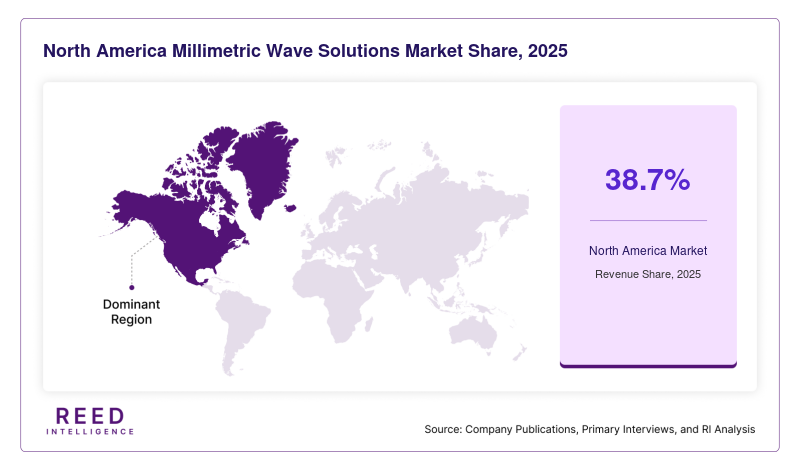
North America is the dominant regional market, accounting for approximately 38.7% of global Millimetric Wave Solutions revenue in 2025. Based on the market-specific dataset, this corresponds to approximately USD 3.64 billion in 2025. North America's leadership is supported by advanced 5G infrastructure, major technology companies, strong semiconductor capabilities, defense spending and early adoption of high-frequency wireless technologies.
The United States remains the primary regional market, supported by major telecom operators, semiconductor companies, defense contractors and technology research institutions. The region is also central to early 6G development, with Keysight joining the Verizon 6G Innovation Forum in September 2026 to support pre-standard validation and spectrum experimentation.
Europe Millimetric Wave Solutions Market
Europe represents a technologically advanced market for millimetric wave solutions, supported by telecommunications modernization, automotive radar, aerospace and defense, industrial automation and RF research. Germany, the United Kingdom, France and Italy provide significant demand through automotive manufacturers, telecom operators and advanced industrial technology companies.
The region is also becoming increasingly important for next-generation RF and sub-THz development. Keysight's European Microwave Week 2026 activities in London included demonstrations covering RF-to-sub-THz characterization, 6G waveform analysis, satellite communications and advanced MIMO, highlighting continued European investment in high-frequency technologies.
Asia Pacific Millimetric Wave Solutions Market
Asia Pacific is a rapidly expanding market supported by 5G infrastructure deployment, fixed wireless access, consumer electronics manufacturing, automotive production, semiconductor development and government investment in next-generation communications. China, Japan, South Korea and India are among the region's most important markets.
India is demonstrating particularly strong demand for millimetric wave connectivity. Ceragon reported approximately USD 120 million in orders from Indian operators during the first seven months of 2026, with a significant portion involving its next-generation millimeter-wave IP-50EXA platform for nationwide 4G and 5G transport and FWA expansion. Japan is also strengthening its mmWave ecosystem: NTT DOCOMO launched the docomo millimeter wave initiative on September 29, 2026 with eight industry partners to accelerate mmWave utilization and expand the industrial ecosystem.
Latin America Millimetric Wave Solutions Market
Latin America represents an emerging market for millimetric wave solutions, driven by telecommunications modernization, fixed wireless access and increasing demand for high-speed broadband. Brazil and Mexico represent important markets because of their large subscriber bases, urban concentration and ongoing network investments.
Fixed wireless access provides an attractive opportunity where fiber deployment can be expensive or geographically difficult. Operators can use high-capacity wireless links to extend broadband connectivity and increase network capacity. However, spectrum availability, infrastructure investment requirements and economic volatility can constrain adoption. Exact regional market share and market value on the supplied global dataset are unavailable.
Middle East & Africa Millimetric Wave Solutions Market
The Middle East & Africa market is supported by telecommunications expansion, smart-city programs, enterprise connectivity, defense applications and high-capacity wireless infrastructure. Gulf countries are investing heavily in digital infrastructure and advanced communications, while African markets provide opportunities for wireless broadband expansion where fixed-line infrastructure remains limited.
Millimetric wave solutions can support high-capacity backhaul and fixed wireless access in dense urban environments and selected enterprise deployments. Aerospace and defense applications provide an additional opportunity, particularly in countries with significant defense technology investment. Exact regional market share and market value compatible with the supplied global dataset are unavailable.
Millimetric Wave Solutions Market Competitive Landscape
The global Millimetric Wave Solutions Market is characterized by strong competition among test-and-measurement companies, telecommunications equipment manufacturers, semiconductor companies, wireless backhaul providers and aerospace and defense technology suppliers. High technical barriers, advanced RF design requirements, spectrum expertise and relationships with telecom operators and government organizations create significant barriers to entry.
Keysight Technologies is a leading participant through its extensive RF and microwave test, measurement, simulation and validation portfolio. The company is expanding its capabilities toward 6G, sub-THz and AI-driven RF engineering. In September 2026, Keysight joined the Verizon 6G Innovation Forum, while its October 2026 European Microwave Week demonstrations covered RF-to-sub-THz characterization and 6G testing.
Key Market Players
- Keysight Technologies Inc.
- Siklu Communication Ltd.
- NEC Corporation
- L3Harris Technologies Inc.
- Aviat Networks, Inc.
- Smiths Group plc
- Vubiq Networks, Inc.
- Millimeter Wave Products Inc.
- BridgeWave Communications, Inc.
- E-Band Communications LLC
Millimetric Wave Solutions Market Recent Developments
- October , 2026, Inseego announced completion of its acquisition of Nokia's Fixed Wireless Access business. The transaction adds indoor, outdoor and millimeter-wave FWA solutions to Inseego's portfolio and expands its wireless broadband footprint across Europe, the Middle East, Asia, Oceania and the Americas. The acquisition is expected to approximately double Inseego's revenue and strengthen its position in wireless broadband.
- September , 2026, NTT DOCOMO announced the launch of the docomo millimeter wave initiative (dmwi) with eight industry partners, including AGC, KYOCERA, Panasonic System Networks Development Research Institute and Fujikura. The initiative aims to accelerate mmWave utilization, promote technology development and expand the industrial ecosystem around millimeter-wave applications.
Millimetric Wave Solutions Market Segments
By Component
- Hardware
- Software
- Services
By Application
- Telecommunications
- Healthcare
- Automotive
- Aerospace & Defense
- Others
By Frequency Band
- 24–57 GHz
- 57–95 GHz
- 95–300 GHz
By End User
- Telecom Operators
- Enterprises
- Government
- Others
By Region
- North America
- Europe
- APAC
- Middle East and Africa
- LATAM