Milling Tool Insert Market Size, Share & Trends Analysis Report By Material Composition (Carbide, Ceramic, Cobalt-Based, Polycrystalline Diamond, Polycrystalline Cubic Boron Nitride, High-Speed Steel) and By Application (Automotive, Aerospace, Medical Devices, Machinery & Industrial Fabrication) and By Geometry Design (Face Milling, End Milling, Boring, Turning) and Forecasts, 2026–2034
USD 3950
Milling Tool Insert Market Size
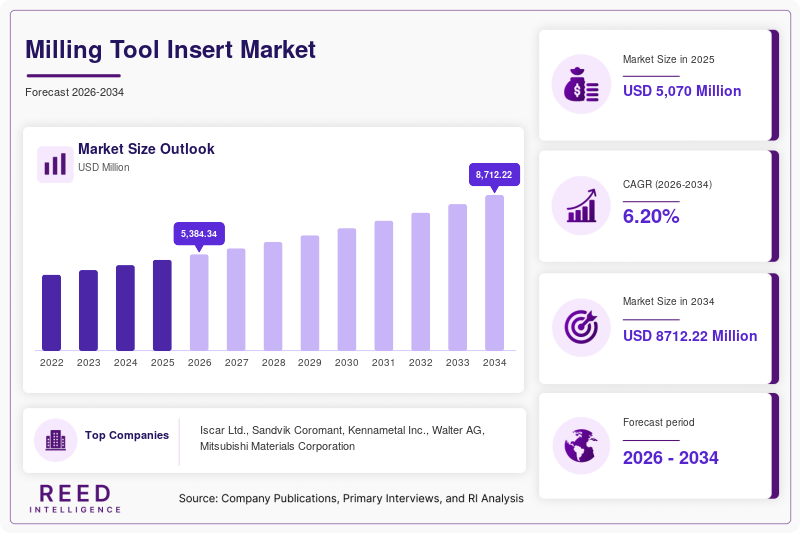
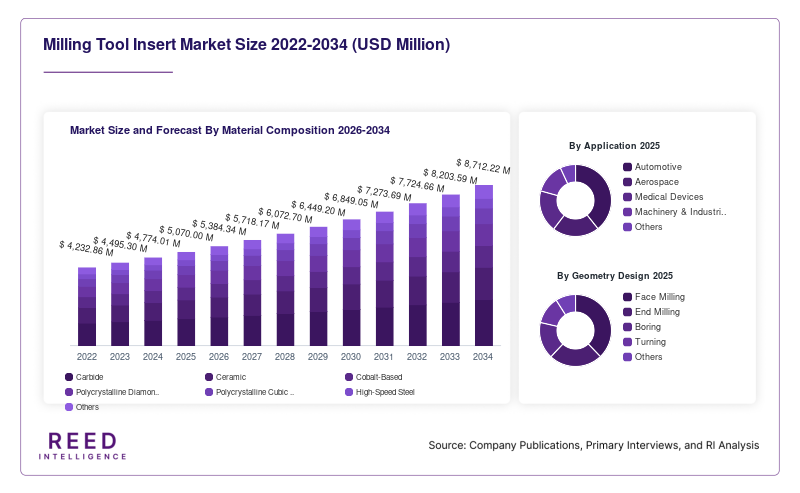
The global Milling Tool Insert Market was valued at USD 5,070 million in 2025 and is projected to grow from USD 5,384.34 million in 2026 to USD 8,712.22 million by 2034, registering a CAGR of 6.20% during the forecast period from 2026 to 2034.
Milling tool inserts are replaceable cutting components installed in milling cutters and machining systems to perform material-removal operations such as face milling, shoulder milling, slotting, profiling, pocketing, ramping, and high-feed milling. Their adoption is closely associated with CNC machining centers because insert-based tooling allows manufacturers to replace worn cutting edges without replacing the complete cutter body.
The market is undergoing a transition from conventional standardized inserts toward application-specific products engineered around workpiece materials, machine conditions, cutting parameters, and required surface quality. Carbide remains the dominant material category because of its balance of hardness, thermal stability, wear resistance, and cost effectiveness. Dataintelo estimates carbide inserts held a 47.3% market share in 2025, while ceramic inserts accounted for 28.7%.
Milling Tool Insert Market Drivers
The expansion of CNC machining centers across automotive, aerospace, medical-device, machinery, and industrial-component manufacturing is one of the primary drivers of milling tool insert demand. CNC systems require cutting tools capable of maintaining predictable performance across automated production cycles, increasing the need for reliable indexable inserts with stable edge geometry and controlled wear.
Growing requirements for tighter dimensional tolerances, superior surface finishes, and repeatable production quality are encouraging manufacturers to adopt specialized milling inserts. Aerospace, medical devices, automotive components, and precision industrial equipment increasingly involve difficult-to-machine materials and complex geometries, supporting demand for high-performance insert solutions.
PVD and CVD coatings, refined carbide grades, ceramic compositions, CBN, PCD, and application-specific edge preparations are improving cutting performance. Advanced coatings help reduce abrasive and thermal wear, allowing manufacturers to operate at higher cutting speeds and maintain predictable tool life.
Industry 4.0 initiatives are encouraging manufacturers to integrate machining processes with real-time monitoring, predictive maintenance, and digital production management. This creates opportunities for tooling suppliers to provide inserts and machining systems optimized for automated production environments where process stability and predictable tool life are critical.
Milling Tool Insert Market Restraints
Carbide inserts depend heavily on tungsten carbide and cobalt binder systems. Fluctuations in raw-material availability and pricing can increase manufacturing costs and compress margins throughout the tooling supply chain.
Premium carbide grades, ceramic inserts, CBN, PCD, and specialized coated inserts can have substantially higher acquisition costs than conventional alternatives. Small and medium-sized machining companies may therefore prioritize lower-cost products even when premium inserts provide better total cost of ownership.
Manufacturers in China, India, and other emerging markets are increasing their production capabilities and offering competitively priced cutting inserts. This creates pricing pressure for established multinational suppliers, particularly in standardized and commodity-oriented applications.
Milling Tool Insert Market Opportunities
The integration of sensors, tool-condition monitoring, machine connectivity, and predictive analytics creates opportunities for intelligent tooling solutions. Milling inserts can become part of digitally monitored machining systems that optimize replacement timing and machining parameters.
The expansion of aerospace production and medical-device manufacturing is creating demand for inserts capable of machining titanium alloys, nickel-based superalloys, cobalt-chrome materials, stainless steel, and other difficult-to-machine materials.
EV production is changing the machining requirements of automotive manufacturers. Battery housings, electric motor components, lightweight aluminum structures, thermal-management components, and other EV parts require specialized milling operations, creating opportunities for advanced geometries and coatings.
India, Southeast Asia, Mexico, and other emerging production centers are expanding automotive, electronics, aerospace, and industrial manufacturing capacity. These developments are expected to generate additional demand for CNC equipment and replacement milling inserts.
Milling Tool Insert Market Segmental Analysis
By Material Composition
Carbide dominated the Milling Tool Insert Market in 2025, accounting for approximately 47.3% of global market share. Carbide remains the preferred material because of its high hardness, thermal stability, wear resistance, and balanced cost-performance characteristics. It is widely used for machining steel, cast iron, aluminum alloys, stainless steel, and other industrial materials.
Specialized materials represented the fastest-growing material category in the available comparable Dataintelo analysis, with a reported 7.1% CAGR, ahead of ceramic at 6.9% and carbide at 5.8%. Increasing machining of exotic alloys and demanding aerospace and medical components is supporting demand for specialized material solutions.
By Application
Automotive was the dominant application segment in 2025, accounting for approximately 35.4% of the market. High-volume machining of engine, transmission, chassis, structural, battery, and electric-motor components creates substantial recurring demand for milling inserts. The transition toward electric vehicles is also introducing new machining requirements for aluminum, magnesium, copper, and other lightweight or electrically conductive materials.
Aerospace and medical-device manufacturing represented a significant high-value application group, together accounting for approximately 24.3% in the cited market analysis. Demand in these applications is supported by difficult-to-machine materials, tight tolerances, stringent surface-finish requirements, and the need for highly predictable tool performance. A standalone exact-market CAGR for the fastest-growing application is not sufficiently comparable to confirm numerically.
By Geometry Design
Face milling was the dominant geometry category in 2025, accounting for approximately 41.2% of the market. Face milling inserts are extensively used for rapid material removal and surface finishing across automotive components, industrial machinery, and general metalworking applications. Their broad applicability across different machine configurations and workpiece materials supports continued market leadership.
End milling represented approximately 35.8% of the market and remains particularly important for pocketing, slotting, profiling, and complex component machining. Increasing adoption of multi-axis CNC machining and demand for complex geometries are supporting continued growth in this category. A reliable standalone CAGR for the fastest-growing geometry segment is unavailable in the compatible exact-market dataset.
Milling Tool Insert Market Regional Analysis
North America Milling Tool Insert Market
North America represented19.8% of global Milling Tool Insert Market revenue in 2025. The region benefits from established aerospace, automotive, medical-device, defense, and advanced industrial manufacturing sectors. The United States remains the principal demand center, supported by reshoring initiatives, CNC modernization, automation investments, and demand for high-performance tooling capable of machining titanium, nickel alloys, stainless steel, and other difficult materials.
North American buyers increasingly evaluate milling inserts according to productivity, tool life, process reliability, and total cost per component. Aerospace and defense production, medical-device machining, and specialty metal fabrication provide opportunities for premium insert grades and advanced coatings. A directly comparable exact-market CAGR for North America is not sufficiently verified in the available dataset.
Europe Milling Tool Insert Market
Europe accounted for approximately 26.5% of the global Milling Tool Insert Market in 2025, making it the second-largest regional market. Germany, Italy, France, and other industrial economies maintain significant demand because of their automotive, aerospace, machinery, medical, and precision-engineering industries. European manufacturers generally emphasize dimensional accuracy, tool reliability, process stability, and sustainable manufacturing practices.
The region's mature manufacturing base supports continued replacement demand for advanced milling inserts, particularly where manufacturers are upgrading CNC equipment and adopting automated production cells. Aerospace and premium automotive applications support demand for higher-value cutting tools. A directly comparable exact-market CAGR for Europe is unavailable from the compatible source.
Asia Pacific Milling Tool Insert Market
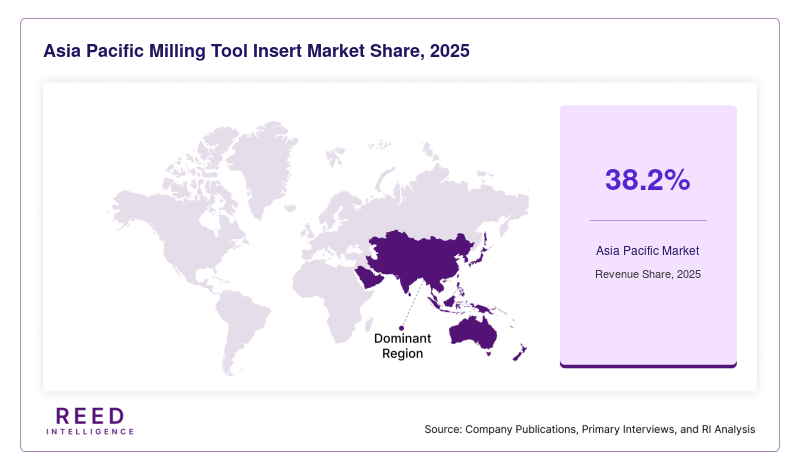
Asia Pacific was the dominant regional market in 2025, accounting for 38.2% of global Milling Tool Insert Market revenue. The corresponding 2025 regional market value was approximately USD 1.94 billion. This value is directly reported in the compatible Dataintelo market dataset, which uses the same USD 5.07 billion global 2025 market size supplied for this report.
The region's leadership is supported by China's large manufacturing base, India's expanding automotive and aerospace industries, Japan's precision-engineering capabilities, and growing manufacturing activity across Vietnam and Southeast Asia. Automotive, electronics, machinery, and industrial fabrication continue to generate substantial recurring demand for milling inserts. Asia Pacific is expected to maintain its leadership through 2034, although an exact comparable regional CAGR for this specific dataset is unavailable and therefore is not estimated here.
Latin America Milling Tool Insert Market
Latin America accounted for approximately 9.2% of global Milling Tool Insert Market revenues in 2025. Brazil and Mexico represent important demand centers because of their automotive, machinery, industrial manufacturing, energy, and metalworking activities. Manufacturing localization and expanding supplier networks are supporting gradual adoption of CNC equipment and associated cutting-tool consumables.
The region provides opportunities for cost-effective milling inserts, particularly among automotive suppliers, general engineering companies, and industrial job shops. Demand is also influenced by foreign investment in manufacturing facilities and efforts to establish shorter regional supply chains. A directly comparable exact-market CAGR for Latin America is not sufficiently verified.
Middle East & Africa Milling Tool Insert Market
The Middle East & Africa accounted for approximately 6.3% of global Milling Tool Insert Market revenue in 2025. Demand is associated with industrial diversification, machinery fabrication, energy-related manufacturing, infrastructure development, and the gradual expansion of precision machining capabilities. Gulf economies are increasingly investing in localized manufacturing and advanced industrial infrastructure.
Manufacturers and distributors in the region have opportunities to expand premium tooling adoption as machining operations become more automated and quality requirements increase. Mining, energy equipment, construction machinery, and industrial fabrication can provide additional demand for durable milling inserts. A directly comparable exact-market CAGR for the region is unavailable from the verified dataset.
Milling Tool Insert Market Competitive Landscape
The Milling Tool Insert Market is moderately consolidated, with leading multinational cutting-tool manufacturers competing through material science, carbide grades, coatings, insert geometries, application engineering, distribution networks, and technical support. Major companies focus on increasing tool life, improving machining productivity, reducing vibration, and developing application-specific products for difficult-to-machine materials.
Iscar maintains a strong competitive position through a broad portfolio of indexable milling systems, insert geometries, carbide grades, and application-specific tooling. Its product development strategy emphasizes higher productivity, secure insert clamping, improved chip evacuation, and optimized cutting performance across aluminum, steel, stainless steel, aerospace alloys, and other materials. ISCAR's 2026 product announcements include expanded milling insert geometries and product families such as HELI-DO, HELI-SLOT, HELI-3-MILL, and related milling solutions.
Key Market Players
- Iscar Ltd.
- Sandvik Coromant
- Kennametal Inc.
- Walter AG
- Mitsubishi Materials Corporation
- Tungaloy Corporation
- MAPAL Group
- Kyocera Corporation
- Sumitomo Electric Hardmetal
- Seco Tools AB
Recent Market Developments
- October, 2026 Sandvik Coromant: New GC1250 Milling Grade for Titanium Alloys
Sandvik Coromant introduced the GC1250 milling grade as a new first-choice grade for indexable milling of titanium alloys. The grade combines a heat-tough substrate with a Certivo multi-nano-layer coating and is targeted at aerospace, defense, and space applications. Sandvik also highlighted reduced carbon footprint through the elimination of ruthenium in the solution. - September, 2026 Kennametal: New Additive Tungsten-Carbide Grade KAF82
Kennametal introduced KAF82, a fully dense tungsten-carbide grade designed for additive manufacturing of customized metal-cutting tools. The technology enables complex geometries and optimized cooling channels while shortening customized-tool development and production timelines from months to weeks. The solution targets aerospace and defense, energy, transportation, and general engineering applications.
Milling Tool Insert Market Segments
By Material Composition
- Carbide
- Ceramic
- Cobalt-Based
- Polycrystalline Diamond
- Polycrystalline Cubic Boron Nitride
- High-Speed Steel
- Others
By Application
- Automotive
- Aerospace
- Medical Devices
- Machinery & Industrial Fabrication
- Others
By Geometry Design
- Face Milling
- End Milling
- Boring
- Turning
- Others
By Region
- North America
- Europe
- APAC
- Middle East and Africa
- LATAM