Milling Turning Centers Market Size, Share & Trends Analysis Report By Product Type (CNC Milling-Turning, Conventional Milling-Turning) and By Industry Application (Aerospace, Automotive, Medical Devices, Electronics) and By Size of Operation (Small & Medium Enterprises, Large Enterprises) and By Technology Type (3-Axis Milling-Turning Centers) and By End-User Segment (Original Equipment Manufacturers, Job Shops, Contract Manufacturing) and Forecasts 2026–2034
USD 3950
Milling Turning Centers Market Size
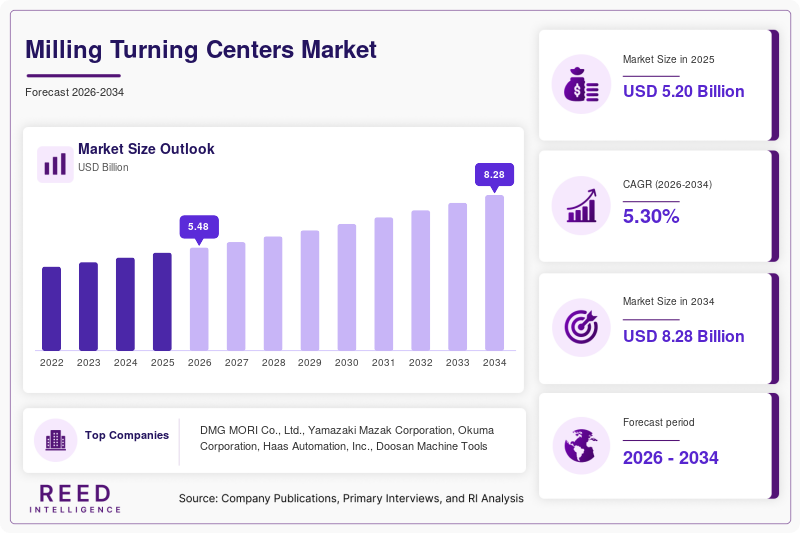
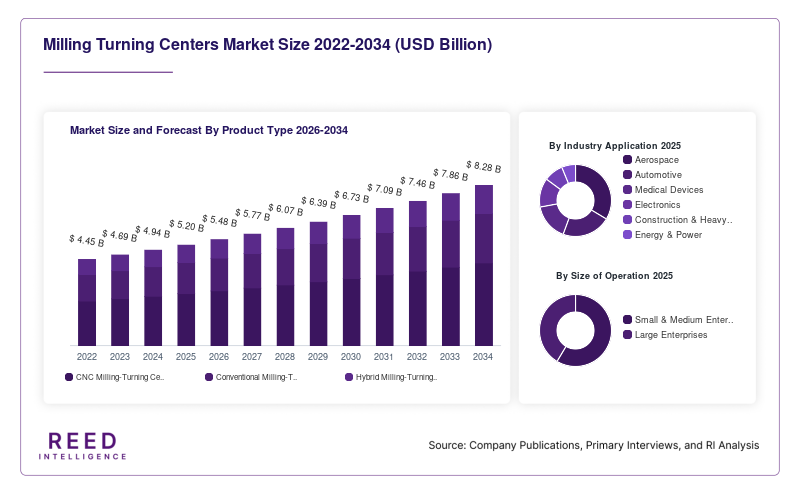
The global milling turning centers market was valued at USD 5.20 billion in 2025 and is projected to grow from USD 5.48 billion in 2026 to USD 8.28 billion by 2034, registering a CAGR of 5.30% during the forecast period from 2026 to 2034.
Milling-turning centers, also known as mill-turn or turn-mill centers, integrate turning and milling capabilities into a single CNC machine. The technology enables manufacturers to complete multiple operations without repeatedly transferring and repositioning the workpiece between separate machines. This integrated approach improves production efficiency and is particularly valuable for complex components requiring tight dimensional tolerances.
The market is being transformed by Industry 4.0, automation, advanced CNC controls, predictive maintenance, digital manufacturing and increasing adoption of 5-axis machining. Machine-tool manufacturers are also integrating automatic tool changers, high-speed spindles, thermal compensation, machine monitoring and robotic loading systems to improve productivity.
Milling Turning Centers Market Drivers
Manufacturers are increasingly replacing multiple conventional machines with integrated milling-turning platforms. Completing several operations in a single setup reduces workpiece transfers, setup time and dimensional variation while increasing machine utilization. This is particularly important for aerospace, medical, automotive and precision-engineering manufacturers producing complex components.
The growing production of aerospace components, medical implants, automotive powertrain components and electronic parts requires increasingly precise machining. Milling-turning centers combine multiple machining processes with multi-axis control, making them suitable for components that require complex geometries and tight tolerances.
Integration of CNC controls, IoT sensors, production monitoring, predictive maintenance and automated tool management is increasing the productivity of modern mill-turn equipment. Manufacturers increasingly expect machine tools to connect with broader factory-management systems and provide real-time information about machine condition and production performance.
Labor shortages are encouraging manufacturers to automate more production processes and reduce dependence on highly skilled manual intervention. Multi-tasking machining centers can consolidate operations and reduce the number of machine setups and operator interventions required for complex parts. DMG MORI specifically identifies labor shortages, accuracy requirements and shorter lead times as drivers for process integration.
Milling Turning Centers Market Restraints
Milling-turning centers typically require substantially higher capital investment than conventional turning or milling machines. The cost of multi-axis CNC systems, advanced tooling, automation and supporting infrastructure can discourage adoption among small machine shops with limited capital budgets.
Advanced multi-axis machines require specialized programming and process-planning expertise. Although manufacturers are increasingly introducing conversational programming and technology cycles, the complexity of simultaneous turning, milling and multi-axis operations can still create training requirements.
Integrated machines contain multiple mechanical, electrical and software systems. Maintenance requirements can therefore be more complex than those of single-purpose machines. Downtime can also have a significant financial impact when a high-value multi-tasking machine becomes unavailable.
Demand for machine tools is closely linked to industrial investment cycles. Economic uncertainty, interest-rate conditions, manufacturing slowdowns and fluctuations in automotive and aerospace capital expenditure can delay machine-tool purchasing decisions.
Milling Turning Centers Market Opportunities
The adoption of 5-axis and multi-axis machining provides manufacturers with greater ability to produce complex components without multiple setups. This creates opportunities for machine-tool companies to move customers from conventional equipment toward integrated high-performance platforms.
Aerospace and defense components frequently require complex geometries, difficult-to-machine materials and tight tolerances. The ability of mill-turn centers to combine multiple processes makes them attractive for turbine components, landing-gear parts, structural components and other precision applications.
Medical-device manufacturers increasingly require precision machining for implants, surgical instruments and specialized components. Compact multi-axis machines are particularly attractive for manufacturers seeking high accuracy while reducing the number of production stages.
Integration with robotic loading, bar feeders, automatic tool management and digital monitoring is creating opportunities for unmanned or semi-unmanned machining cells. Machine-tool manufacturers can increase equipment value by combining mill-turn centers with automation and software platforms.
Milling Turning Centers Market Segmental Analysis
By Product Type
CNC Milling-Turning Centers represent the dominant product category because modern industrial machining increasingly depends on computerized multi-axis control, automated tool management and integrated production monitoring. CNC systems provide the precision, repeatability and flexibility required for aerospace, automotive, medical and electronics manufacturing. Exact market-share percentages for CNC versus conventional and hybrid systems are not reliably available on the same market-sizing basis.
Hybrid Milling-Turning Centers represent an important technology opportunity as manufacturers seek increasingly flexible machining platforms combining subtractive machining with additional manufacturing technologies. However, a reliable comparable CAGR for the hybrid segment could not be independently verified.
By Industry Application
Aerospace is the dominant application segment, accounting for approximately 31.8% market share in the available mill-turn market analysis. Aerospace manufacturers increasingly require multi-axis machining for complex components, lightweight structures, engine parts and precision assemblies. The segment also benefits from increasing aircraft production and the need for higher machining productivity.
Medical Devices represent the fastest-growing application segment in the available industry analysis, with a reported 8.7% CAGR. Demand is supported by the production of orthopedic implants, surgical instruments and other precision medical components. Aerospace remains the largest application, while medical manufacturing is expanding more rapidly because of rising demand for precision healthcare components.
By Size of Operation
Large Enterprises represent the dominant end-user group because they have greater capital availability and higher machining volumes, making it easier to justify investments in advanced multi-tasking machinery. Aerospace manufacturers, automotive OEMs and large contract manufacturers are particularly important purchasers of integrated machining systems.
Small & Medium Enterprises represent an important growth opportunity because mill-turn technology can help smaller manufacturers consolidate multiple machining processes into fewer machines. Lower-floor-space requirements, improved automation and increasingly accessible CNC programming technologies can encourage adoption. Exact comparable segment shares and CAGRs are unavailable.
By Technology Type
5-Axis Milling-Turning Centers represent the leading advanced technology category because they enable complex components to be machined from multiple orientations while reducing repositioning requirements. The technology is particularly relevant to aerospace, medical, die-and-mold and precision engineering applications.
Multi-Spindle Milling-Turning Centers offer significant productivity advantages for high-volume production by allowing multiple machining operations or workpieces to be processed efficiently. Their adoption is strongest where production volumes justify higher equipment complexity and capital expenditure. Reliable comparable market shares and CAGRs for each technology category are unavailable.
By End-User Segment
Original Equipment Manufacturers (OEMs) represent the dominant end-user category because major aerospace, automotive, medical and industrial equipment manufacturers require high-capacity precision machining for proprietary component production. OEMs also have the capital resources needed to deploy integrated machining cells and automation.
Contract Manufacturing represents a significant growth opportunity because contract manufacturers increasingly compete through flexibility, reduced lead times and precision. Mill-turn centers allow contract manufacturers to accept complex jobs while reducing the number of machines and production stages required. A reliable exact-market CAGR is unavailable.
Milling Turning Centers Market Regional Analysis
North America Milling Turning Centers Market
North America is a major market for milling-turning centers because of its established aerospace, defense, automotive, medical-device and industrial manufacturing base. The United States represents the region's largest demand center, supported by aerospace production, defense manufacturing, reshoring initiatives and continued investment in automated machining systems.
The region also has a strong ecosystem of machine-tool manufacturers, distributors, automation integrators and precision contract manufacturers. Demand is increasingly focused on multi-axis machining, connected equipment and automated production cells. Exact North American market share and market value on the same basis as the supplied global dataset are not independently verified.
Europe Milling Turning Centers Market
Europe remains a significant market because Germany, Italy, Switzerland, France and the United Kingdom have strong precision-engineering and machine-tool manufacturing industries. Aerospace, automotive, medical technology and industrial equipment manufacturers are important customers for high-performance milling-turning systems.
European manufacturers are emphasizing energy efficiency, automation, process integration and digital manufacturing. The region's large installed base of advanced machine tools also creates recurring replacement and modernization opportunities. Exact comparable regional market share, market value and CAGR are unavailable.
Asia Pacific Milling Turning Centers Market
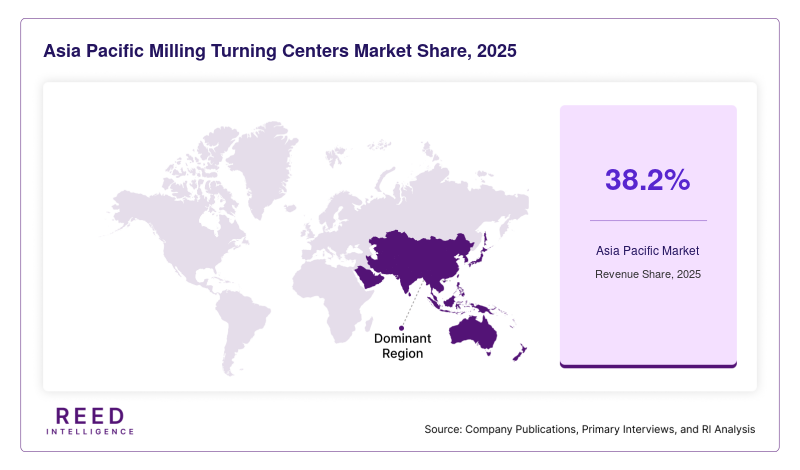
Asia Pacific is the dominant region, accounting for approximately 38.2% of global mill-turn market revenue in the available industry-specific analysis. Applying this share to the Reed Intelligence 2025 global market value of USD 5.20 billion gives an indicative derived regional value of approximately USD 1.99 billion in 2025. This value is a calculation rather than a separately reported regional valuation and should therefore be treated as an estimate based on the reported share.
Asia Pacific is supported by large manufacturing bases in China, Japan, South Korea, Taiwan and India. Japan is particularly important because leading machine-tool manufacturers such as DMG MORI, Mazak and Okuma maintain extensive manufacturing and technology-development capabilities in the region. Increasing automotive, electronics, semiconductor, aerospace and medical-device production is expected to sustain demand. The region's exact comparable CAGR is not reliably verified from the same dataset.
Latin America Milling Turning Centers Market
Latin America represents an emerging opportunity for milling-turning centers as automotive, aerospace, industrial equipment and general manufacturing activities expand. Brazil and Mexico are particularly important because of their manufacturing bases and connections to international automotive and aerospace supply chains.
Adoption is supported by modernization of older machine-tool fleets and increasing demand for higher production efficiency. However, capital constraints, economic volatility and imported-equipment costs can limit investment. Exact market share, market value and CAGR are unavailable.
Middle East & Africa Milling Turning Centers Market
Middle East & Africa represents an emerging market for advanced machining equipment. Demand is being supported by industrial diversification, aerospace development, energy-sector manufacturing and investments in local production capabilities. Gulf countries are particularly relevant to high-value industrial machining applications.
The region offers opportunities for manufacturers supplying equipment to energy, defense, aerospace and heavy-equipment industries. However, the installed base of advanced multi-tasking machines remains smaller than in North America, Europe and Asia Pacific. Exact comparable market share and CAGR are unavailable.
Milling Turning Centers Market Competitive Landscape
The Milling Turning Centers Market is characterized by strong competition among Japanese, European, North American and Asian machine-tool manufacturers. Competition is increasingly focused on multi-axis capability, spindle performance, thermal stability, automation, digital controls, process integration and energy efficiency.
DMG MORI is one of the leading global suppliers of integrated mill-turn technology. Its NTX portfolio combines turning and milling with additional capabilities such as gear cutting, grinding and measurement. In March 2026, the company released new Gear Shaping and Gear Broaching technology cycles for NTX mill-turn machines, reinforcing its focus on process integration.
Key Market Players
- DMG MORI Co., Ltd.
- Yamazaki Mazak Corporation
- Okuma Corporation
- Haas Automation, Inc.
- Doosan Machine Tools
- Hurco Companies, Inc.
- Matsuura Machinery Corporation
- Hyundai WIA Corporation
- Tsugami Corporation
- Nakamura-Tome Precision Industry Co., Ltd.
Milling Turning Centers Market Recent Developments
- September , 2026, Yamazaki Mazak demonstrated the INTEGREX j-300S NEO horizontal Multi-Tasking machine at IMTS 2026. The machine combines twin turning spindles with a milling spindle to enable single-setup machining, while improvements include higher spindle torque, faster spindle speeds, improved positioning accuracy, heat-displacement compensation and expanded tool-magazine capacity. The development directly reflects the market's movement toward higher-productivity integrated mill-turn machining.
- March , 2026, DMG MORI announced new Gear Shaping and Gear Broaching technology cycles for its NTX mill-turn machines. The technology enables gear machining on universal mill-turn platforms and is designed to consolidate previously separated machining processes. DMG MORI stated that the development addresses labor shortages, accuracy requirements, shorter lead times and work-in-process reduction.
Milling Turning Centers Market Segments
By Product Type
- CNC Milling-Turning Centers
- Conventional Milling-Turning Centers
- Hybrid Milling-Turning Centers
By Industry Application
- Aerospace
- Automotive
- Medical Devices
- Electronics
- Construction & Heavy Equipment
- Energy & Power
By Size of Operation
- Small & Medium Enterprises
- Large Enterprises
By Technology Type
- 3-Axis Milling-Turning Centers
- 4-Axis Milling-Turning Centers
- 5-Axis Milling-Turning Centers
- Multi-Spindle Milling-Turning Centers
By End-User Segment
- Original Equipment Manufacturers
- Job Shops
- Contract Manufacturing
By Region
- North America
- Europe
- APAC
- Middle East and Africa
- LATAM