Millworks Market Size, Share & Trends Analysis Report By Product Type (Interior Millwork, Exterior Millwork, Architectural Millwork, Custom Millwork, Pre-Engineered Millwork) and By Material (Wood, Medium-Density Fiberboard, Plywood, Veneer, Composite Materials, Others) and By Application (Residential, Commercial, Institutional, Industrial) and By Region (North America, Europe, Asia Pacific, Latin America, Middle East & Africa) Forecasts, 2026–2034
USD 3950
Millworks Market Size
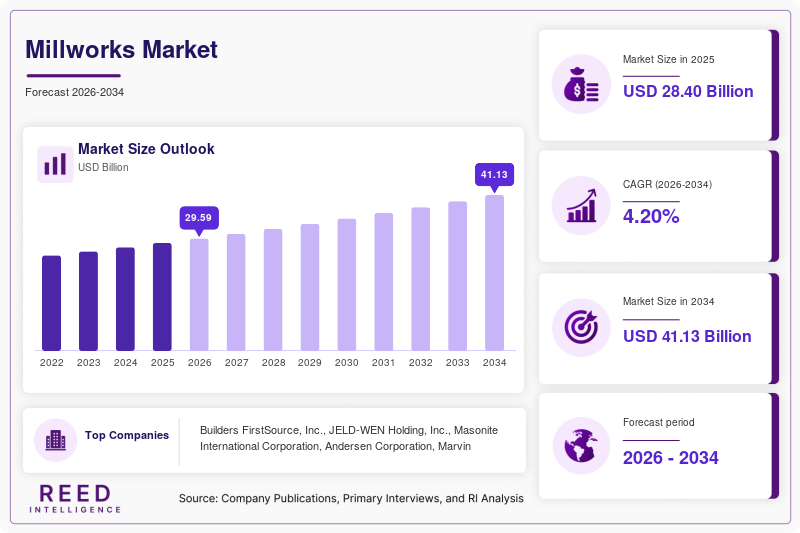
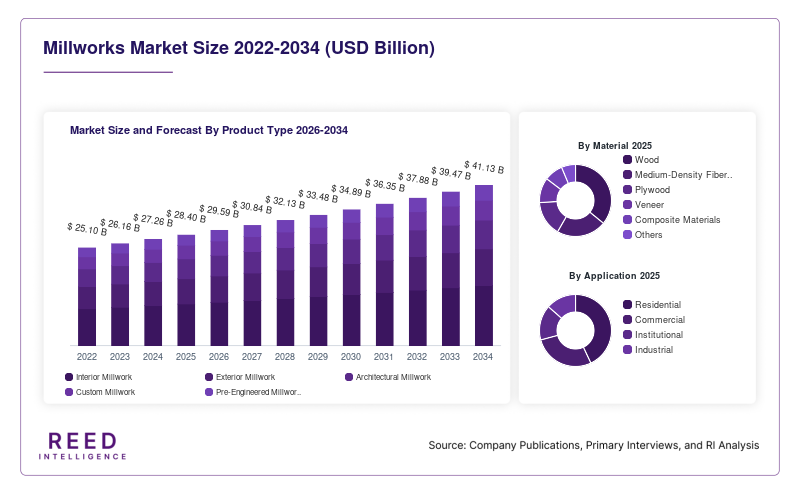
The global Millworks Market was valued at USD 28.40 billion in 2025 and is projected to grow from USD 29.59 billion in 2026 to USD 41.13 billion by 2034, registering a CAGR of 4.20% during the forecast period from 2026 to 2034.
Millworks refers to manufactured wood and wood-based building components produced in a mill or specialized manufacturing facility. The category encompasses doors, windows, moldings, trim, cabinetry, paneling, stair components and architectural woodwork used in residential, commercial, institutional and industrial buildings.
The market is increasingly shifting toward customized, precision-manufactured and digitally designed millwork. Computer-aided design, CNC machining, automated cutting, edge processing and digital production workflows allow manufacturers to produce complex architectural components with greater consistency and shorter lead times.
Millworks Market Drivers
Residential construction remains one of the primary demand generators for millwork. New homes require doors, cabinetry, trim, molding, stair components, windows and other architectural products. Population growth, urbanization and housing development therefore create a structural demand base for millwork manufacturers.
Renovation activity is supporting demand for replacement doors, cabinetry, flooring-related wood components, decorative moldings and customized architectural features. Remodeling projects also provide opportunities for premium and customized millwork because homeowners often seek differentiated interior designs.
Architects, designers and homeowners increasingly favor customized interiors and differentiated architectural elements. Custom millwork allows manufacturers to deliver specialized dimensions, finishes, profiles and design elements that cannot always be efficiently produced using standardized building products.
CNC routers, automated saws, digital design systems and integrated production software are improving millwork manufacturing efficiency. These technologies allow manufacturers to produce complex components with high dimensional accuracy while reducing material waste and manual processing requirements.
Millworks Market Restraints
Millwork manufacturers are exposed to fluctuations in lumber, plywood, veneer, MDF, adhesives and other input prices. Volatility in timber availability and transportation costs can affect manufacturing margins and final product prices.
Millwork production requires skilled carpenters, finishers, designers, CNC operators and installation professionals. Shortages of experienced workers can limit production capacity and increase labor costs, particularly for custom and architectural millwork.
Millwork demand is closely connected to residential and commercial construction activity. Economic downturns, higher interest rates and reduced construction spending can delay new-building projects and renovation investments.
Large doors, cabinetry, architectural panels and custom woodwork can be expensive to transport and install. Products may also require specialized handling to prevent damage during delivery, creating additional costs for manufacturers and distributors.
Millworks Market Opportunities
Growing environmental awareness is increasing demand for responsibly sourced timber and certified wood products. Manufacturers can differentiate through FSC-certified materials, low-emission adhesives, recycled materials and sustainable manufacturing practices.
The increasing adoption of modular construction provides opportunities for factory-produced millwork components. Manufacturers can supply standardized and customized cabinetry, doors, trim and other components directly to modular construction facilities.
High-end residential construction provides attractive opportunities for customized cabinetry, premium doors, decorative wall panels, specialty molding and architectural woodwork. Premium customers generally have greater willingness to pay for unique materials and customized craftsmanship.
Digital visualization, online configuration tools and virtual design platforms can make customized millwork more accessible to consumers. Online channels can also expand geographic reach and allow manufacturers to market directly to homeowners, architects and contractors.
Millworks Market Segmental Analysis
By Product Type
Interior Millwork represents the dominant product category because of extensive use in residential and commercial buildings. Doors, cabinetry, trim, molding, wall paneling and built-in architectural components generate substantial recurring demand across new construction and remodeling projects. Interior applications benefit from both functional requirements and increasing consumer emphasis on interior aesthetics.
Custom Millwork represents a high-value growth opportunity because architects, interior designers and homeowners increasingly seek customized dimensions, finishes and architectural details. Premium residential and hospitality projects are particularly important users. Exact comparable market shares and CAGRs for all product categories are not reliably available on a consistent global basis.
By Material
Wood remains the dominant material category because solid wood provides durability, aesthetic appeal, workability and a premium appearance. It remains widely used for doors, cabinetry, moldings, architectural details and high-end interior applications.
Composite Materials represent an important growth opportunity as manufacturers seek alternatives that improve dimensional stability, reduce material waste and support sustainable construction. MDF and plywood also maintain significant demand because of their consistent dimensions and suitability for automated production. Reliable comparable CAGR figures for individual material categories are unavailable.
By Application
Residential is the dominant application segment because millwork is extensively used in homes for cabinetry, doors, windows, trim, moldings, staircases and customized interior elements. New residential construction and renovation activity both contribute to demand.
Commercial represents a major growth opportunity because hotels, offices, restaurants, retail facilities and mixed-use developments require substantial quantities of customized architectural woodwork. Hospitality projects in particular use millwork extensively for reception areas, wall paneling, cabinetry, doors and decorative elements. Exact comparable segment CAGRs are unavailable.
By Distribution Channel
Direct Sales represent the dominant distribution channel for millwork because large contractors, builders, architects and commercial developers frequently purchase products directly from manufacturers. Direct relationships also allow manufacturers to customize dimensions, finishes and production specifications.
Online Channels represent the fastest-growing distribution opportunity as digital design tools and e-commerce platforms make standardized and semi-custom millwork products more accessible to consumers. Online channels are particularly suitable for replacement doors, trim, cabinetry components and smaller architectural products. A reliable exact-market CAGR is unavailable.
Millworks Market Regional Analysis
North America Millworks Market
North America is the dominant region in the global Millworks Market, supported by its large residential construction, remodeling, commercial construction and home-improvement industries. The United States represents the largest regional demand center, with millwork widely used in single-family homes, multifamily buildings, offices, hotels and institutional facilities.
The region also benefits from a mature network of millwork manufacturers, distributors, home-improvement retailers and architectural-product suppliers. Renovation activity and demand for customized residential interiors continue to support the market. Exact comparable North American market share and market value based on the supplied USD 28.40 billion global dataset are not independently verified and are therefore not stated.
Europe Millworks Market
Europe is a significant millwork market due to established construction and renovation industries and strong demand for high-quality architectural wood products. Germany, the United Kingdom, France, Italy and the Nordic countries represent important markets for doors, cabinetry, interior woodwork and customized architectural products.
Sustainability is particularly important in Europe, with manufacturers increasingly emphasizing certified timber, low-emission materials, energy-efficient manufacturing and circular production practices. Renovation of older residential and commercial buildings provides a substantial demand base. Exact regional market share, market value and comparable CAGR are unavailable.
Asia Pacific Millworks Market
Asia Pacific represents a major growth market because of rapid urbanization, expanding construction activity and increasing investment in residential and commercial buildings. China, Japan, India, South Korea and Southeast Asian markets are important contributors to regional demand.
Increasing household incomes and development of modern residential interiors are creating additional demand for cabinetry, doors, decorative panels and customized architectural woodwork. The expansion of hospitality, retail and commercial construction further supports demand. Exact comparable regional market share, market value and CAGR are unavailable on the same basis as the supplied global dataset.
Latin America Millworks Market
Latin America is an emerging market for millwork, supported by residential construction, commercial development and renovation activity. Brazil and Mexico represent important markets because of their large populations and construction industries.
Demand is concentrated in doors, cabinetry, interior trim and other residential applications, while commercial and hospitality development provides opportunities for higher-value architectural millwork. Economic volatility, construction financing conditions and raw-material price fluctuations can affect demand. Exact market share and market value are unavailable.
Middle East & Africa Millworks Market
Middle East & Africa offers growth opportunities through commercial construction, hospitality development, luxury residential projects and infrastructure investment. Gulf countries are particularly attractive for premium architectural millwork because of extensive hotel, resort, retail and high-end residential construction.
Demand is increasingly focused on customized architectural products, decorative wall panels, doors and cabinetry. However, market development varies significantly by country and remains sensitive to construction cycles and imported material costs. Exact comparable market share and CAGR are unavailable.

Millworks Market Competitive Landscape
The Millworks Market is highly fragmented, with competition among large building-products companies, architectural wood manufacturers, regional millwork specialists, custom woodworking companies and home-improvement suppliers. Competition is increasingly based on customization capabilities, manufacturing capacity, material quality, sustainability credentials, lead times and installation services.
Builders FirstSource, Inc. is one of the largest suppliers of building products and manufactured components in North America, providing millwork and other products to professional builders and contractors. Its extensive distribution and manufacturing footprint provides advantages in serving large residential construction markets.
Key Market Players
- Builders FirstSource, Inc.
- JELD-WEN Holding, Inc.
- Masonite International Corporation
- Andersen Corporation
- Marvin
- Pella Corporation
- Woodgrain
- Quanex Building Products Corporation
- Simpson Door Company
- TruStile Doors
- Kolbe & Kolbe Millwork Co., Inc.
Millworks Market Recent Developments
- 2026, Builders FirstSource continued expanding its technology-enabled approach to building-product manufacturing and distribution, including digital solutions designed to improve ordering, design and production workflows for professional builders. The company's integrated manufacturing and distribution model supports continued adoption of factory-produced building components and customized millwork.
- JELD-WEN continued its focus on manufacturing productivity and operational efficiency across its global doors and windows business during 2026. Its manufacturing footprint and product portfolio remain closely connected to residential and commercial construction demand, providing exposure to replacement and new-construction millwork applications.
Millworks Market Segments
By Product Type
- Interior Millwork
- Exterior Millwork
- Architectural Millwork
- Custom Millwork
- Pre-Engineered Millwork
By Material
- Wood
- Medium-Density Fiberboard
- Plywood
- Veneer
- Composite Materials
- Others
By Application
- Residential
- Commercial
- Institutional
- Industrial
By Distribution Channel
- Direct Sales
- Specialty Stores
- Home Improvement Stores
- Online Channels
By Region
- North America
- Europe
- APAC
- Middle East and Africa
- LATAM