MIM Metal Injection Molding Furnace Market Size, Share & Trends Analysis Report By Furnace Type (Sintering Furnaces, Debinding Furnaces, Specialty Furnaces) and By Application (Automotive, Medical Devices, Electronics, Aerospace & Defense, Industrial Equipment, Others) and By Region (North America, Europe, Asia Pacific, Latin America, Middle East & Africa) Forecasts, 2026–2034
USD 3950
MIM Metal Injection Molding Furnace Market Size
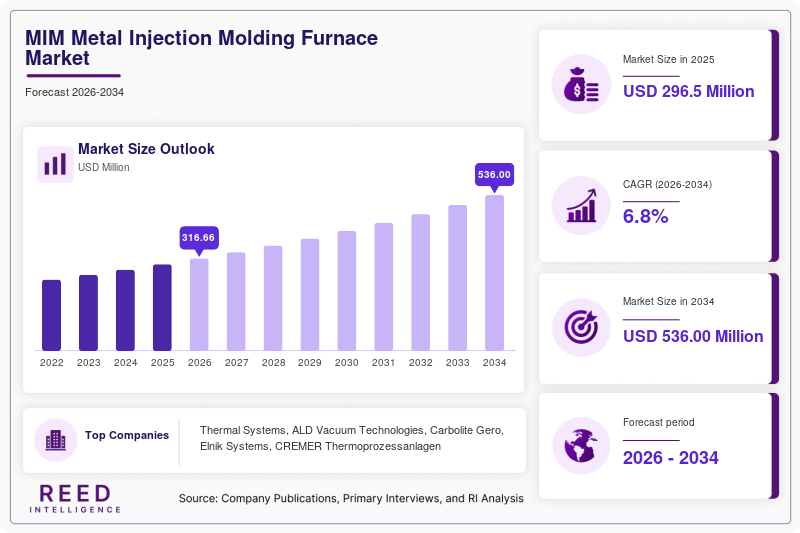
The global MIM metal injection molding furnace market was valued at USD 296.5 million in 2025 and is projected to grow from USD 316.66 million in 2026 to USD 536.00 million by 2034, registering a CAGR of 6.8% during the forecast period from 2026 to 2034.
Metal Injection Molding (MIM) furnaces are specialized thermal-processing systems used for debinding and sintering components produced through the MIM process. MIM combines metal powders with binder systems to produce green components through injection molding, followed by controlled binder removal and high-temperature sintering to obtain the required density, strength, dimensional accuracy, and surface quality.
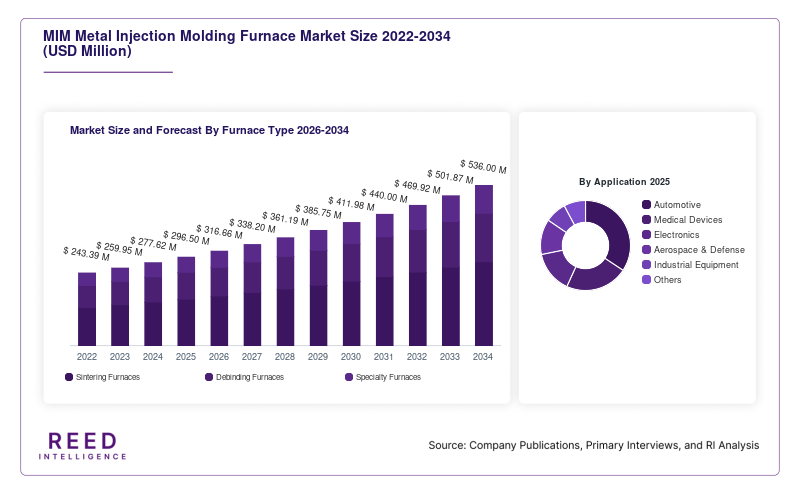
The market is primarily divided into debinding furnaces, sintering furnaces, and specialty furnace systems. Sintering furnaces represent the largest segment because the final thermal consolidation step determines the mechanical properties, dimensional stability, and metallurgical performance of MIM components. According to Dataintelo, sintering furnaces accounted for 48.2% of the market in 2025.
MIM Metal Injection Molding Furnace Market Drivers
The increasing use of MIM for producing small, intricate, high-volume components is a major market driver. Automotive, medical, electronics, consumer products, and industrial manufacturers use MIM to achieve complex geometries, repeatable dimensions, high material utilization, and reduced secondary machining requirements.
Automotive manufacturers increasingly use MIM for small components such as sensor parts, actuator components, fuel-system components, gears, structural elements, and other precision metal parts. The expansion of electric vehicles and advanced vehicle electronics further creates opportunities for high-volume precision manufacturing.
Medical-device manufacturers require components with high dimensional accuracy, repeatability, biocompatibility, and surface quality. MIM is increasingly suitable for surgical instruments, dental components, orthopedic components, and other miniature medical parts, supporting demand for advanced debinding and sintering equipment.
The continued miniaturization of electronics and electromechanical systems creates demand for compact metal components with complex geometries. MIM furnaces enable controlled processing of miniature connectors, housings, shielding components, mechanical components, and other precision parts.
MIM Metal Injection Molding Furnace Market Restraints
Industrial MIM furnace systems require significant capital investment, particularly high-temperature vacuum and controlled-atmosphere systems. Smaller manufacturers may face difficulties justifying investment where production volumes are insufficient to achieve attractive equipment utilization.
MIM requires careful control of debinding, heating, sintering, cooling, gas atmosphere, temperature uniformity, and shrinkage. Variations in thermal profiles can cause cracking, distortion, dimensional deviations, residual porosity, or other defects.
Operating MIM furnaces requires specialized knowledge of powder metallurgy, binder systems, furnace atmospheres, sintering kinetics, and material behavior. A shortage of specialized process engineers can restrict adoption among smaller manufacturers.
MIM Metal Injection Molding Furnace Market Opportunities
Integrated furnace architectures can reduce component handling, improve process consistency, and simplify production workflows. Elnik's MIM3000, for example, combines second-stage debinding and sintering within a single thermal workflow and provides six-zone temperature control.
Energy efficiency represents an important opportunity as manufacturers face increasing energy costs and sustainability requirements. Furnace manufacturers are developing smaller footprints, improved insulation, optimized gas flows, rapid cooling, and more efficient heating systems.
Integration of sensors, automated temperature control, production monitoring, recipe management, data logging, and predictive maintenance can improve process repeatability and production traceability.
Manufacturing expansion in Asia Pacific, particularly China, Japan, South Korea, India, and Southeast Asia, provides opportunities for new MIM furnace installations and replacement of older thermal-processing equipment.
MIM Metal Injection Molding Furnace Market Segmental Analysis
By Furnace Type
Sintering Furnaces dominated the MIM Metal Injection Molding Furnace Market in 2025, accounting for approximately 48.2% of the global market. Sintering is the critical thermal-processing stage in which debound MIM components are consolidated to achieve final density, mechanical properties, dimensional stability, and microstructural characteristics. Demand is supported by increasing production of automotive, medical, electronics, and precision industrial components.
Debinding Furnaces represented the second-largest segment, accounting for approximately 38.6% of the market in 2025. These systems are responsible for controlled removal of binder material before final sintering. Increasing adoption of catalytic, thermal, and hydrogen-based debinding technologies is supporting equipment demand.
Specialty Furnaces serve specialized alloys, laboratory production, pilot-scale manufacturing, and applications requiring customized thermal or atmospheric conditions. This segment remains smaller but benefits from growing requirements for advanced materials and specialized MIM processing.
By Application
Automotive represented the dominant application segment, accounting for approximately 38.1% of market demand. Automotive manufacturers increasingly use MIM for compact and complex components where high-volume production, dimensional consistency, material efficiency, and reduced machining requirements are important.
Medical Devices represent another major application because MIM enables production of intricate components with tight tolerances and repeatable properties. Increasing medical-device miniaturization and demand for precision components support furnace installations.
Electronics is supported by increasing miniaturization of connectors, housings, shielding components, and electromechanical parts. Aerospace and defense applications benefit from MIM's ability to produce lightweight and complex components, while industrial equipment applications provide additional demand across precision machinery and specialized components.
MIM Metal Injection Molding Furnace Market Regional Analysis
North America MIM Metal Injection Molding Furnace Market
North America represents a significant MIM furnace market supported by established medical-device, aerospace, defense, automotive, and precision-manufacturing industries. The region has a mature MIM ecosystem and strong demand for advanced thermal-processing equipment with high levels of temperature, atmosphere, and process control.
The region also benefits from specialized furnace manufacturers and MIM processors that invest in high-performance equipment for production and development applications. Growth is supported by increasing demand for high-value precision components and modernization of manufacturing infrastructure.
Europe MIM Metal Injection Molding Furnace Market
Europe maintains a strong position in the MIM furnace industry because of its established automotive, medical technology, industrial machinery, aerospace, and precision-engineering sectors. Germany, Italy, France, and the United Kingdom represent important manufacturing markets.
European furnace manufacturers are increasingly emphasizing energy efficiency, automation, thermal uniformity, and integrated process control. CREMER's MIM-Master Neo represents this direction, combining continuous residual debinding and sintering while targeting higher throughput and lower energy consumption.
Asia Pacific MIM Metal Injection Molding Furnace Market
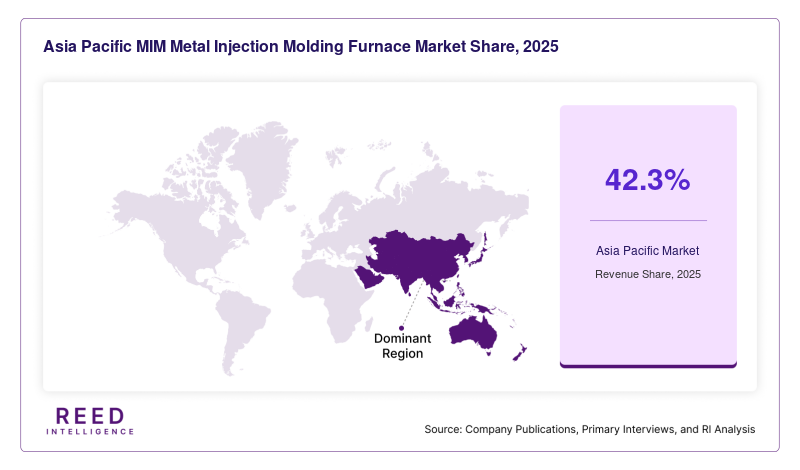
Asia Pacific was the dominant regional market in 2025, accounting for 42.3% of global revenue and approximately USD 125.2 million. This regional value is directly reported alongside the same USD 296.5 million global 2025 market size, so it is compatible with the supplied market dataset. Asia Pacific also represents the fastest-growing region, with a reported CAGR of approximately 7.2% through 2034.
China, Japan, South Korea, Taiwan, India, and Southeast Asian manufacturing economies support regional demand through automotive production, electronics manufacturing, medical-device production, and precision engineering. Increasing localization of advanced manufacturing and continued expansion of MIM component production are expected to sustain furnace demand.
Latin America MIM Metal Injection Molding Furnace Market
Latin America represents a developing market for MIM furnace equipment. Growth is supported primarily by automotive manufacturing, industrial production, medical-device supply chains, and gradual adoption of advanced manufacturing technologies.
Brazil and Mexico offer the strongest opportunities because of their established automotive and industrial manufacturing bases. Market expansion is expected to remain dependent on capital investment, availability of technical expertise, and development of local MIM processing capabilities.
Middle East & Africa MIM Metal Injection Molding Furnace Market
The Middle East & Africa represent emerging opportunities for MIM furnace manufacturers. Demand is supported by industrial diversification, aerospace and defense manufacturing initiatives, precision engineering, and development of advanced manufacturing capabilities.
Adoption remains comparatively smaller than in Asia Pacific, Europe, and North America because of limited local MIM infrastructure and specialized process expertise. However, investments in advanced manufacturing and localized industrial production may create long-term opportunities.
MIM Metal Injection Molding Furnace Market Competitive Landscape
The global MIM Metal Injection Molding Furnace Market is characterized by competition based on thermal uniformity, atmosphere control, furnace capacity, process automation, energy efficiency, production throughput, reliability, and after-sales service.
Elnik Systems is a major participant in the market with dedicated MIM furnace platforms. Its MIM3000 Series provides integrated second-stage debinding and sintering, six-zone temperature control, controlled gas-flow management, and multiple chamber capacities up to approximately 340 liters.
Key Market Players
- Thermal Systems
- ALD Vacuum Technologies
- Carbolite Gero
- Elnik Systems
- CREMER Thermoprozessanlagen
- Nabertherm GmbH
- Ipsen International
- Shanghai Gehui Furnace
- Shandong Hongyang Furnace
- ECM Technologies
- TAV VACUUM FURNACES
MIM Metal Injection Molding Furnace Market Recent Developments
- March , 2026, describing how Nichols Portland Inc. uses Elnik and DSH Technologies sintering technology to address production challenges. The case study highlights the requirement for different sintering recipes and controlled furnace atmospheres across materials including copper, titanium, and stainless steel, demonstrating the growing importance of flexible furnace platforms for MIM and related processes.
- CREMER's MIM-Master Neo represents a next-generation continuous furnace platform for ferrous and non-ferrous MIM production. The system couples continuous residual debinding and sintering and provides more than 120% higher production capacity than the previous generation while reducing gas and energy consumption by approximately 40% and furnace investment requirements by approximately 35% under the company's comparison scenario.
MIM Metal Injection Molding Furnace Market Segments
By Furnace Type
- Sintering Furnaces
- Debinding Furnaces
- Specialty Furnaces
By Application
- Automotive
- Medical Devices
- Electronics
- Aerospace & Defense
- Industrial Equipment
- Others
By Region
- North America
- Europe
- APAC
- Middle East and Africa
- LATAM