Mindfulness Meditation Application for B2B Market Size, Share & Trends Analysis Report By Application (Stress & Burnout Management, Focus & Productivity, Sleep & Recovery), By Enterprise Size (Small & Medium-Sized Enterprises, Large Enterprises), By Deployment Model (Cloud-Based, On-Premises/Private Cloud), By Distribution Channel (Direct Enterprise Sales, Benefits Platforms & Health Plans) Forecasts, 2026-2034
USD 3950
Mindfulness Meditation Application for B2B Market Size
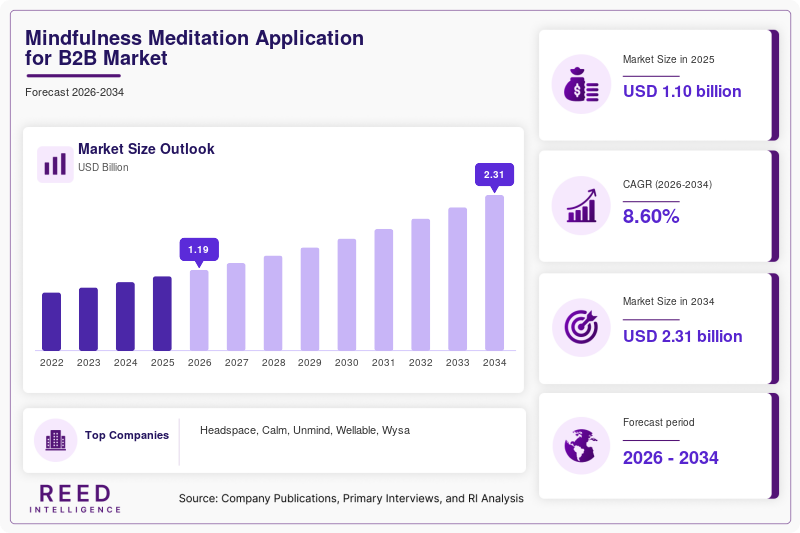
The Mindfulness Meditation Application for B2B Market was valued at USD 1.10 billion in 2025 and is estimated at USD 1.19 billion in 2026. Based on the supplied market model, the market is projected to reach USD 2.31 billion by 2034, representing a CAGR of 8.60% from 2026 to 2034.
The market is moving from stand-alone meditation content toward employer-sponsored digital wellbeing infrastructure. This shift is supported by the scale of workplace mental-health needs: the World Health Organization estimates that 15% of working-age adults live with a mental disorder, while depression and anxiety are associated with approximately 12 billion lost working days annually and around USD 1 trillion in lost productivity.
The supplied 2025–2034 forecast therefore reflects a market in which employers increasingly use mindfulness applications as an accessible, preventive layer alongside EAPs, coaching, therapy, sleep programs and other workforce-health benefits.
B2B mindfulness meditation applications are software platforms sold or sponsored for employees rather than primarily for individual consumers. Their core functionality includes guided meditation, breathing exercises, mindfulness programs, stress-management content, sleep support, focus exercises and, increasingly, personalized recommendations and links to broader mental-health services.
The commercial proposition is changing from “meditation as a wellness perk” to “digital mental-health support embedded in employee benefits.” Headspace, for example, positions its employer offering around mindfulness, meditation, stress, sleep, focus and emotional resilience while also providing coaching, therapy, psychiatry and EAP services.
Mindfulness Meditation Application for B2B Market Drivers
Employer spending is shifting toward preventive and accessible mental-health support
Workplace mental health has become a business-management issue rather than only an employee-benefits issue. WHO recommends a combination of organizational interventions, manager training, worker training and individual interventions, creating a broader environment in which digital mindfulness applications can operate as one component of workplace mental-health programs.
The demand is reinforced by employee experience. The APA's 2024 Work in America survey found that 43% of workers typically feel tense or stressed during their workday, rising to 61% among workers reporting lower psychological safety. It also found that 67% had experienced at least one outcome associated with workplace burnout during the previous month.
Digital delivery fits distributed and hybrid workforces
Cloud-based mindfulness applications allow employers to deliver the same core benefit to employees working remotely, in offices, across countries or in different time zones. This reduces the operational limitations associated with physical wellness programs and makes short sessions accessible during the workday.
The commercial model is particularly suitable for multinational organizations because content can be distributed centrally while employee engagement can be tracked at an aggregated level. Calm Health, for example, expanded internationally into the UK and Canada in June 2025, explicitly positioning the move around employer and health-plan access across borders.
AI is changing personalization and engagement
AI is increasingly being used to identify user needs, recommend relevant content and connect self-guided mindfulness with other levels of care. In May 2025, Headspace introduced an AI-powered stratified-care model for organizational customers using its Ebb AI companion, with personalized recommendations, assessments and navigation across self-guided and human care.
This is commercially important because low engagement is one of the main weaknesses of employee wellness programs. Applications that can recommend a five-minute breathing session for immediate stress, a sleep program later in the evening, or human coaching when needs become more complex can potentially increase the usefulness of the employer benefit.
Mindfulness Meditation Application for B2B Market Restraints
Meditation applications cannot address structural workplace stress by themselves
A mindfulness application can help employees develop individual coping skills, but it cannot independently resolve excessive workloads, job insecurity, poor management, harassment or inadequate staffing. EU-OSHA identifies excessive workload, conflicting demands, poor organizational change, job insecurity and lack of management support as important psychosocial risks.
This creates a clear limitation for B2B vendors: employers increasingly expect platforms to demonstrate measurable organizational value rather than simply distribute meditation content.
Evidence quality and measurement remain inconsistent
Although workplace mindfulness research generally reports positive outcomes, results vary by intervention, population, control group and follow-up period. The 2025 meta-analysis found an improvement in task performance against passive controls but not active controls and rated confidence in the evidence as very low.
Consequently, vendors face pressure to demonstrate outcomes such as employee engagement, stress reduction, benefit utilization and retention while avoiding unsupported claims that mindfulness directly produces productivity or financial returns.
Privacy and trust can restrict enterprise adoption
Employee mental-health information is sensitive. B2B applications must therefore separate individual-level information from employer reporting and provide clear privacy controls. This is particularly important when AI is introduced into mental-health applications.
Headspace states that its Ebb AI conversations are encrypted and not shared with employers, coaches or third parties, illustrating how privacy has become part of the enterprise product proposition rather than merely a technical feature.
Mindfulness Meditation Application for B2B Market Opportunities
Integration with EAPs, health plans and broader benefits ecosystems
The strongest opportunity is the integration of mindfulness applications with existing employee-benefit infrastructure. Instead of requiring HR teams to manage another isolated application, platforms can become an access layer connecting meditation, coaching, therapy, EAPs and clinical services.
Calm Health joined the Solera Health network in January 2026, expanding access to its employer and health-plan offering to a network representing more than 16 million individuals.
AI-assisted personalization
AI can make mindfulness programs more relevant by adapting recommendations to employee goals, usage patterns and self-reported needs. Headspace's organizational strategy illustrates this direction, combining AI-guided support with a library of more than 5,000 meditations and mindfulness activities.
Industry-specific workplace programs
Healthcare, financial services, technology and other high-pressure sectors provide opportunities for specialized mindfulness programs. EU-OSHA's 2025 analysis of the health and social-care sector, for example, identifies substantial exposure to psychosocial risks and emphasizes preventive organizational approaches.
Manager and leadership applications
Mindfulness is also moving beyond individual stress reduction into leadership and team development. Applications can combine meditation with manager training, emotional regulation, communication and resilience programs. This expands the addressable budget from wellness departments into HR, learning and development, leadership development and organizational-health programs.
Segmental Analysis
By Application
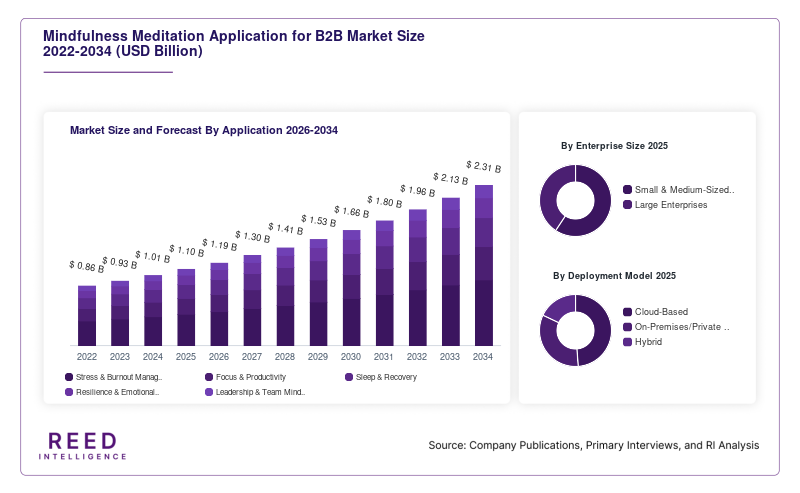
Stress & Burnout Management represents approximately 28% of the 2025 market, equivalent to about USD 0.31 billion under the internal analytical allocation. It is modeled at approximately 8.60% CAGR through 2034, producing an indicative value of about USD 0.66 billion. This is the largest application because workplace stress and burnout are directly connected to employer mental-health priorities; APA reported that 43% of U.S. workers typically feel tense or stressed during the workday.
Focus & Productivity represents approximately 24% of the 2025 market, equivalent to about USD 0.26 billion under the internal allocation. It is modeled at approximately 9.10% CAGR, resulting in an indicative 2034 value of about USD 0.59 billion. Its commercial case comes from linking short mindfulness sessions with concentration, task management and cognitive recovery, although research indicates that productivity effects should be interpreted cautiously because stronger evidence is available against passive rather than active controls.
Sleep & Recovery accounts for approximately 18% of the 2025 market, or about USD 0.20 billion. It is modeled at approximately 8.10% CAGR, reaching an indicative USD 0.40 billion by 2034. Sleep content expands the use of workplace mindfulness applications beyond working hours and gives employers a broader wellbeing proposition, particularly as major platforms combine meditation with sleep programs.
Resilience & Emotional Wellbeing represents approximately 18% of the 2025 market, equivalent to about USD 0.20 billion. It is modeled at approximately 8.70% CAGR, producing an indicative USD 0.42 billion in 2034. The segment benefits from employer demand for preventive support that employees can access before problems require clinical intervention, consistent with WHO's emphasis on promoting mental health and preventing mental-health conditions at work.
Leadership & Team Mindfulness represents approximately 12% of the 2025 market, or about USD 0.13 billion under the internal allocation. It is modeled at approximately 7.60% CAGR, reaching about USD 0.25 billion by 2034. The segment is smaller because it targets narrower employee populations, but it provides a route into leadership development and organizational culture programs.
By Enterprise Size
Small & Medium-Sized Enterprises represent approximately 25% of the 2025 market, equivalent to about USD 0.28 billion. The segment is modeled at approximately 9.10% CAGR, reaching an indicative USD 0.62 billion by 2034. SMEs can use cloud applications to obtain structured wellness programs without building internal infrastructure, although cost sensitivity can make per-employee pricing and simple implementation important purchasing criteria.
Large Enterprises account for approximately 75% of the 2025 market, equivalent to about USD 0.83 billion. They are modeled at approximately 8.35% CAGR, producing an indicative USD 1.68 billion by 2034. Large organizations have larger eligible populations and more established benefits budgets, while multinational employers also have a stronger need for multilingual content, privacy controls, centralized reporting and integration with health-plan ecosystems.
By Deployment Model
Cloud-Based solutions represent approximately 82% of the 2025 market, equivalent to about USD 0.90 billion. They are modeled at approximately 8.70% CAGR, reaching an indicative USD 1.91 billion by 2034. Cloud delivery is favored because it simplifies deployment across distributed workforces and supports continuous content updates, mobile access and integration with employer benefits systems.
On-Premises/Private Cloud solutions represent approximately 10% of the 2025 market, or about USD 0.11 billion. They are modeled at approximately 6.50% CAGR, reaching approximately USD 0.19 billion by 2034. This segment is more relevant where organizations require tighter control over data environments, security policies or internal IT architecture.
Hybrid deployment represents approximately 8% of the 2025 market, equivalent to about USD 0.09 billion. It is modeled at approximately 8.00% CAGR, producing an indicative USD 0.18 billion by 2034. Hybrid models can appeal to organizations combining cloud employee applications with controlled enterprise or health-system infrastructure.
By Distribution Channel
Direct Enterprise Sales account for approximately 58% of the 2025 market, equivalent to about USD 0.64 billion. The segment is modeled at approximately 8.80% CAGR, reaching about USD 1.36 billion by 2034. Direct sales remain important because large employers often require customized contracts, security reviews, employee-communication programs and integration with existing benefits.
Benefits Platforms & Health Plans represent approximately 27% of the 2025 market, or about USD 0.30 billion. They are modeled at approximately 8.30% CAGR, producing an indicative USD 0.61 billion by 2034. Partnerships can reduce customer-acquisition friction by embedding mindfulness applications inside broader employer-benefit ecosystems, as demonstrated by Calm Health's Solera relationship.
Brokers & Consultants account for approximately 15% of the 2025 market, equivalent to about USD 0.17 billion. This channel is modeled at approximately 7.80% CAGR, reaching about USD 0.32 billion by 2034. Consultants and benefits brokers influence employer purchasing decisions by comparing employee engagement, coverage, pricing, security and measurable outcomes across multiple wellness providers.
Regional Analysis
North America Mindfulness Meditation Application for B2B Market
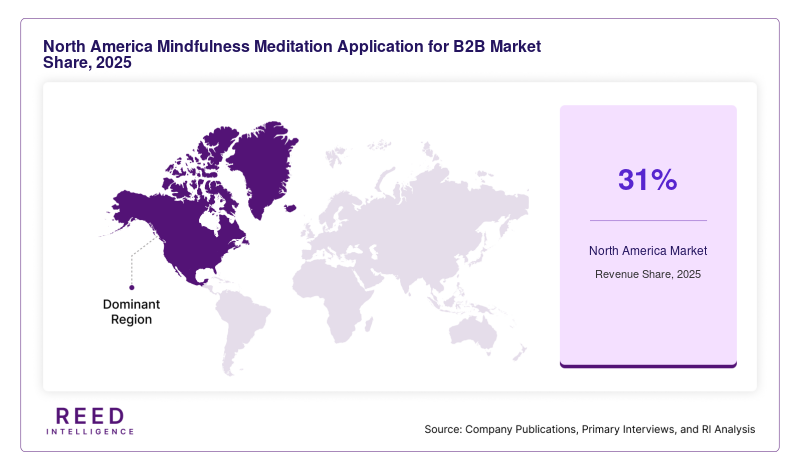
North America represents approximately 31% of the 2025 market, equivalent to about USD 0.34 billion under the internal allocation. It is modeled at approximately 8.0% CAGR, producing an indicative USD 0.68 billion by 2034.
The region benefits from mature employer benefits programs, established digital-health procurement channels and a relatively developed ecosystem of meditation and mental-health applications. SHRM reported that around 90% of U.S. employers offered mental-health coverage in 2024, while approximately 17% offered meditation and mindfulness apps such as Calm and Headspace.
North America also has strong vendor competition. Current platforms increasingly combine meditation with coaching, therapy, EAP and mental-health navigation, making the region an important testing ground for integrated B2B models.
Europe Mindfulness Meditation Application for B2B Market
Europe represents approximately 25% of the 2025 market, or about USD 0.28 billion under the internal allocation. It is modeled at approximately 7.5% CAGR, reaching around USD 0.53 billion by 2034.
Demand is supported by increasing recognition of psychosocial risks at work and by employer interest in preventative wellbeing. WHO Europe notes that negative work environments and excessive job strain can create physical and mental-health problems and contribute to productivity losses.
The region also presents a localization requirement because multinational employers need multilingual and culturally appropriate content. Calm's June 2025 expansion into the UK and Canada illustrates how international vendors are building geographically broader employer platforms.
APAC Mindfulness Meditation Application for B2B Market
APAC represents approximately 27% of the 2025 market, equivalent to about USD 0.30 billion. It is modeled at the highest regional CAGR of approximately 10.2%, reaching an indicative USD 0.71 billion by 2034.
The higher modeled growth reflects the opportunity created by large employee populations, expanding digital benefits infrastructure, rising interest in employee wellbeing and increasing adoption of mobile-first workplace services. The region also contains substantial variation between mature corporate markets and developing markets, making localized pricing and distribution important.
Middle East and Africa Mindfulness Meditation Application for B2B Market
The Middle East and Africa represent approximately 6% of the 2025 market, or about USD 0.07 billion under the internal allocation. The segment is modeled at approximately 7.5% CAGR, reaching about USD 0.13 billion by 2034.
Adoption is expected to remain concentrated in larger employers, multinational corporations, government-linked organizations and companies with established employee-benefits systems. Digital delivery can reduce the need for physical infrastructure, but localization, language coverage, procurement structures and employee awareness remain important constraints.
LATAM Mindfulness Meditation Application for B2B Market
LATAM represents approximately 11% of the 2025 market, equivalent to about USD 0.12 billion. It is modeled at approximately 8.7% CAGR, reaching around USD 0.26 billion by 2034.
The region benefits from the expansion of corporate wellness platforms and mobile-first employee services. Partnerships between wellness platforms and meditation providers also support broader employer access, particularly when mindfulness applications are distributed through larger corporate-benefits ecosystems.
Competitive Landscape
Competition is increasingly based on enterprise integration, evidence, engagement, privacy, personalization and breadth of care, rather than simply the size of a meditation content library.
Headspace has expanded from meditation into a broader enterprise mental-health platform, including coaching, therapy, psychiatry, EAP and AI-supported care. Its employer platform reports more than 3,000 hours of content and positions mindfulness as part of a broader employee-support ecosystem.
Calm competes through Calm Health, which provides employer-sponsored mental-health programs and integrates with resources such as EAPs and therapy. Its international expansion and health-plan partnerships show a strategy focused on distribution through established benefits infrastructure.
Unmind is competing more broadly in workplace mental health, including AI-supported delivery. In July 2025, the company announced a USD 35 million Series C funding round intended to scale its ethical AI approach to workplace mental-health support.
Wellable competes from the broader corporate-wellness side, offering mindfulness and meditation sessions alongside wellness challenges, health content, coaching and benefits-navigation tools. Its platform serves both large organizations and SMEs.
Key Market Players
Recent Market Developments
January 2025 - Headspace-backed UCSF study strengthens evidence for digital mindfulness
A randomized controlled study involving more than 1,400 UCSF employees examined eight weeks of Headspace use and reported improvements in perceived stress, job strain, burnout, work engagement, mindfulness, depression and anxiety. The study strengthens the evidence base for employer-sponsored digital mindfulness, although individual vendor research should still be interpreted alongside independent evidence.
June 2025 - Calm Health expands into the UK and Canada
Calm Health announced international expansion beginning with the UK and Canada, providing its employer- and health-plan-sponsored digital mental-health application to multinational organizations seeking more consistent access across countries.
Mindfulness Meditation Application for B2B Market Segments
By Application
- Stress & Burnout Management
- Focus & Productivity
- Sleep & Recovery
- Resilience & Emotional Wellbeing
- Leadership & Team Mindfulness
By Enterprise Size
- Small & Medium-Sized Enterprises
- Large Enterprises
By Deployment Model
- Cloud-Based
- On-Premises/Private Cloud
- Hybrid
By Distribution Channel
- Direct Enterprise Sales
- Benefits Platforms & Health Plans
- Brokers & Consultants
By Region
- North America
- Europe
- APAC
- Middle East and Africa
- LATAM