Mindfulness Meditation Application Market Size, Share & Trends Analysis Report By Platform (iOS, Android, Web-based) and By Type (Guided Meditation, Unguided Meditation, Mantra Meditation) and By End User (Individual, Corporate, Educational Institutions) and By Subscription Model (Free, Freemium, Paid) and By Region (North America, Europe, Asia Pacific, Latin America, Middle East & Africa) Forecasts, 2026–2034
USD 3950
Mindfulness Meditation Application Market Size
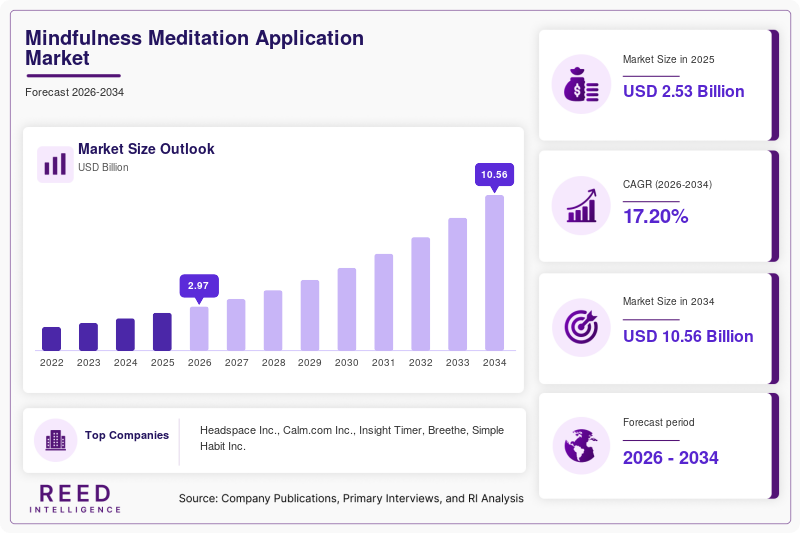
The global mindfulness meditation application market was valued at USD 2.53 billion in 2025 and is projected to grow from USD 2.97 billion in 2026 to USD 10.56 billion by 2034, registering a CAGR of 17.20% during the forecast period from 2026 to 2034.
Mindfulness meditation applications provide users with digital access to guided meditation, unguided meditation, mantra meditation, breathing exercises, relaxation programs, sleep content, and other mindfulness practices. These applications are primarily delivered through smartphones and tablets, while web-based platforms increasingly support enterprise and workplace wellness programs.
The market is characterized by strong consumer adoption and a growing shift toward personalized digital wellness. Leading applications such as Headspace and Calm are expanding beyond conventional meditation content into broader mental-health ecosystems, while platforms such as Insight Timer continue to emphasize large libraries of meditation, mindfulness, sleep, and breathwork content.
Mindfulness Meditation Application Market Drivers
Growing awareness of stress, anxiety, burnout, sleep problems, and emotional well-being is encouraging consumers to seek convenient digital wellness tools. Meditation applications provide relatively low-cost and easily accessible mindfulness programs without requiring users to attend physical classes or wellness centers.
The widespread adoption of smartphones has created a large distribution infrastructure for meditation applications. Users can access meditation sessions during commuting, working, traveling, or at home, supporting frequent and habitual engagement.
Employers are increasingly integrating mindfulness and meditation applications into employee wellness programs. Corporate customers provide an attractive recurring-revenue opportunity because organizations can purchase subscriptions for groups of employees rather than relying solely on individual consumer acquisition.
Integration with smartwatches, fitness trackers, sleep monitors, and health-data platforms is improving personalization. Applications can increasingly use permitted health information to recommend meditation or breathing exercises according to users' daily routines and wellness conditions.
Mindfulness Meditation Application Market Restraints
Meditation applications frequently experience difficulty converting initial downloads into long-term habitual use. Users may discontinue subscriptions after trying free content or completing short-term wellness goals.
The increasing number of subscription-based digital services can make consumers reluctant to maintain another recurring payment. Free and freemium alternatives therefore remain important competitors to premium meditation applications.
Meditation applications increasingly process behavioral, wellness, sleep, and biometric information. Privacy regulations and consumer concerns regarding personal data can increase compliance requirements and restrict certain personalization and tracking capabilities.
The market contains a large number of meditation and wellness applications competing for consumer attention. Established platforms benefit from strong brands and large content libraries, making customer acquisition more challenging for smaller entrants.
Mindfulness Meditation Application Market Opportunities
Corporate wellness represents a major expansion opportunity. Organizations can integrate meditation applications into employee assistance, wellness, stress-management, and mental-health benefit programs, creating recurring B2B revenue streams.
Meditation platforms can increasingly integrate with healthcare providers, health plans, behavioral-health programs, and digital-health ecosystems. Such integration can expand the addressable market beyond consumer wellness into clinically supported mental-health services.
AI-enabled recommendations can tailor session duration, meditation type, content difficulty, and timing to individual user preferences. This can improve engagement and provide stronger differentiation between competing applications.
Asia Pacific, Latin America, and parts of the Middle East offer significant user-acquisition opportunities because of increasing smartphone penetration and growing interest in affordable digital wellness services.
Mindfulness Meditation Application Market Segmental Analysis
By Platform
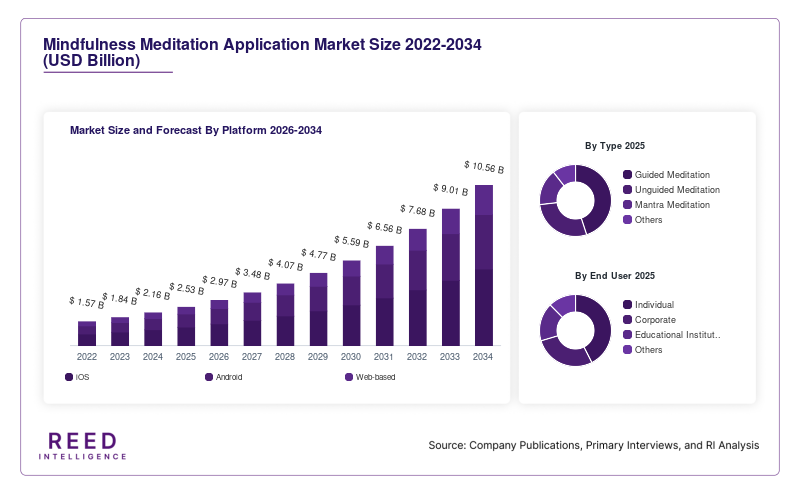
iOS was the dominant platform, accounting for approximately 48.6% of market share in 2025. Its leadership is supported by strong adoption among premium users, higher willingness to pay for subscriptions, and integration with Apple's broader health and wearable ecosystem.
Web-based platforms represent an important growth opportunity because they are increasingly used by enterprises and workplace wellness programs. Dataintelo projects web-based platforms to increase their share from 12.7% in 2025 to 16.4% by 2034. The comparable segment CAGR is reported at approximately 18.4% for iOS, while a separately verified CAGR for web-based applications is not stated.
By Type
Guided Meditation dominated the type segment with approximately 51.2% market share in 2025. Guided sessions are particularly attractive to new users because they provide structured instructions, pacing, breathing guidance, and expert-led meditation techniques.
Unguided Meditation is expected to gain importance as users become more experienced and transition from structured sessions to independent meditation practices. Dataintelo indicates that unguided meditation could increase its share over the forecast period, although an independently verified exact segment CAGR is not stated.
By End User
Individual users represented the dominant end-user category, accounting for approximately 52.7% of market share in 2025. Direct-to-consumer adoption is supported by personal wellness goals, stress management, sleep improvement, and the convenience of mobile meditation.
Corporate users represent the fastest-growing strategic opportunity. Corporate adoption accounted for approximately 33.8% in 2025 and is projected to reach around 39.6% by 2034. Dataintelo reports a segment CAGR of approximately 17.1% for the individual segment, while corporate adoption is expected to gain share through expanding employee wellness programs.
By Subscription Model
Freemium was the dominant subscription model, accounting for approximately 42.3% of market share in 2025. The model provides users with free access to selected content while encouraging conversion to premium meditation programs.
Paid subscriptions represented approximately 35.4% of the market, while free applications represented 22.3%. Freemium remains particularly attractive in emerging markets because it lowers the initial adoption barrier while providing a pathway toward premium monetization.
Mindfulness Meditation Application Market Regional Analysis
North America Mindfulness Meditation Application Market
North America represented the second-largest regional market, accounting for approximately 28.4% of global revenue in 2025. Demand is supported by premium subscription adoption, high smartphone penetration, enterprise wellness programs, and strong adoption of established platforms such as Calm and Headspace.
The region also benefits from extensive integration between meditation applications, healthcare ecosystems, employee wellness programs, and wearable technologies. Corporate customers represent an important revenue opportunity because employers increasingly use digital wellness services as part of employee benefits.
Europe Mindfulness Meditation Application Market
Europe accounted for approximately 19.8% of global market revenue in 2025. Germany, the United Kingdom, France, Italy, Spain, and Scandinavian countries represent important markets because of strong consumer interest in wellness and growing attention to workplace mental health.
Data privacy and regulatory requirements are important competitive factors in Europe. Established providers with robust privacy practices can benefit from consumer trust, while integration with corporate wellness and educational programs provides additional growth opportunities.
Asia Pacific Mindfulness Meditation Application Market
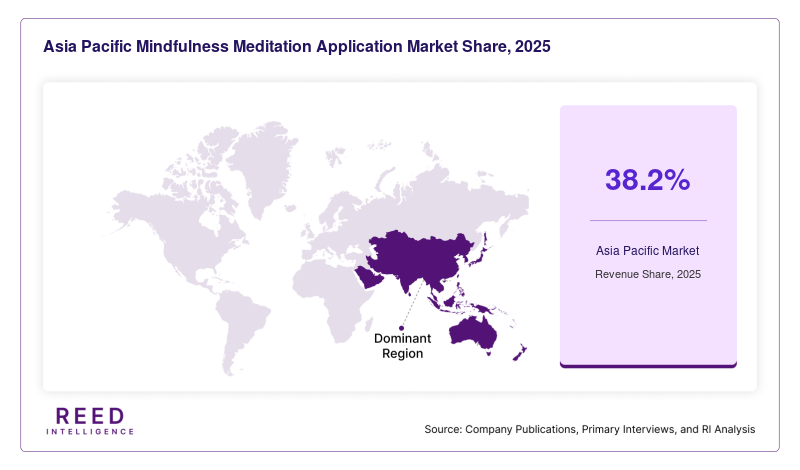
Asia Pacific was the dominant regional market, accounting for approximately 38.2% of global revenue in 2025, equivalent to approximately USD 967 million. This market value is directly reported against the USD 2.53 billion global market and therefore provides a compatible regional value.
The region's leadership is supported by large smartphone-user populations, strong cultural familiarity with meditation and mindfulness, increasing workplace stress, and expanding digital wellness adoption in India, China, Japan, South Korea, and Southeast Asia. The region is also expected to remain one of the fastest-growing markets during the forecast period.
Latin America Mindfulness Meditation Application Market
Latin America represents an emerging market for mindfulness meditation applications as smartphone penetration, digital payments, and consumer awareness of mental wellness increase. Brazil and Mexico are particularly important markets for consumer and corporate wellness applications.
The region is expected to benefit from mobile-first distribution and freemium models, which allow users to access basic meditation content without immediately committing to paid subscriptions. A directly comparable exact regional CAGR is unavailable from the verified market dataset.
Middle East & Africa Mindfulness Meditation Application Market
The Middle East & Africa market is developing as smartphone adoption, digital healthcare infrastructure, and awareness of mental wellness increase. The United Arab Emirates, Saudi Arabia, and South Africa offer important opportunities for premium digital wellness services.
Applications that provide multilingual content, culturally relevant meditation programs, and flexible subscription options are likely to gain greater adoption. However, an independently verified exact market share and CAGR for the region are unavailable from the comparable 2025 market dataset.
Mindfulness Meditation Application Market Competitive Landscape
The global Mindfulness Meditation Application Market is highly competitive, with established providers differentiating through content libraries, personalized recommendations, AI capabilities, wearable integration, corporate wellness programs, and healthcare partnerships. Headspace Inc. and Calm.com Inc. are identified as leading companies, supported by strong consumer brands and extensive digital wellness ecosystems.
Headspace has expanded from traditional meditation content into a broader mental-health platform incorporating meditation, mindfulness, coaching, therapy, and AI-supported experiences. In May 2026, the company launched an enhanced Apple Watch experience featuring personalized meditation, breathing nudges, sleep support, and health-data integration.
Key Market Players
- Headspace Inc.
- Calm.com Inc.
- Insight Timer
- Breethe
- Simple Habit Inc.
- Smiling Mind
- 10% Happier
- Aura Health
- Meditopia
- Stop, Breathe & Think
- MyLife Meditation
Mindfulness Meditation Application Market Recent Developments
- September, 2026, Sword announced an agreement to acquire Headspace, combining Sword's AI-powered mental-health technology with Headspace's global mindfulness and mental-health platform. The transaction is expected to expand personalized, proactive, AI-enabled mental-health support across Headspace's user and employer network.
- September, 2026, BrightInsight announced a partnership with Headspace to integrate curated Headspace mental-health content into patient-support and treatment-adherence programs. The collaboration connects mindfulness and mental-health support with digital therapeutic and pharmaceutical patient-engagement workflows.
Mindfulness Meditation Application Market Segments
By Platform
- iOS
- Android
- Web-based
By Type
- Guided Meditation
- Unguided Meditation
- Mantra Meditation
- Others
By End User
- Individual
- Corporate
- Educational Institutions
- Others
By Subscription Model
- Free
- Freemium
- Paid
By Region
- North America
- Europe
- APAC
- Middle East and Africa
- LATAM