Mine Rescue Vehicle Market Size, Share Demand Report By Vehicle Type (Underground Rescue Vehicles, Surface Rescue Vehicles, Hybrid/Electric Rescue Vehicles), By Application (Emergency Evacuation, Fire Suppression, Medical Assistance, Hazard Detection), By End-Use (Coal Mining, Metal Mining, Mineral Mining) By Region & Segment Forecasts, 2026–2034
USD 3950
Market Overview
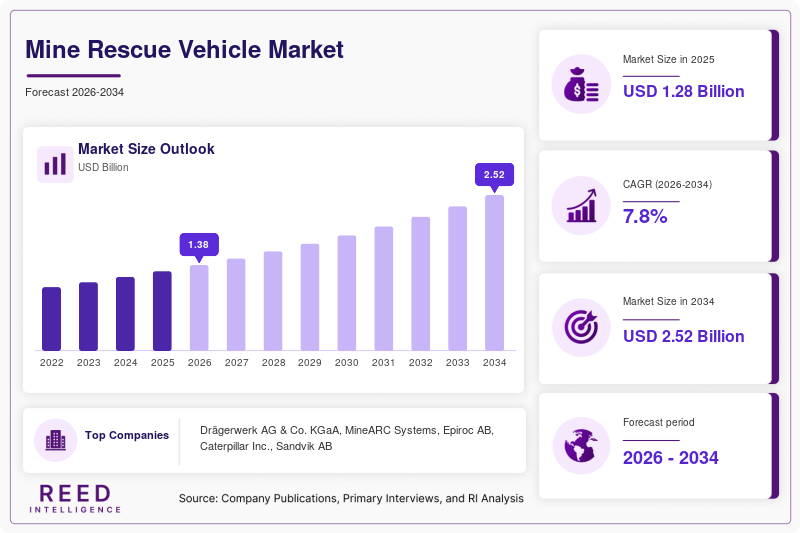
The Mine Rescue Vehicle Market size was valued at approximately USD 1.28 billion in 2026 and is projected to reach around USD 2.34 billion by 2034, expanding at a compound annual growth rate (CAGR) of 7.8% during the forecast period (2026–2034). The market is witnessing steady growth due to increasing safety regulations and the need for rapid emergency response systems in underground and surface mining operations. Governments and regulatory authorities across major mining economies are enforcing stricter compliance standards, which is encouraging mining operators to invest in advanced rescue vehicles equipped with life-support systems, gas detection technologies, and remote navigation capabilities.
One major global factor supporting market growth is the rising emphasis on occupational safety and health standards across the mining sector. As mining activities expand into deeper and more hazardous environments, companies are prioritizing investments in specialized rescue infrastructure to minimize fatalities and operational downtime. Technological advancements, including automation, telematics, and real-time monitoring systems, are also enhancing the functionality and efficiency of mine rescue vehicles, thereby boosting adoption rates globally.
Key Highlights
- North America dominated the market with a 33.8% share in 2025.
- Asia Pacific is expected to grow at the fastest CAGR of 9.4% during 2026–2034.
- By vehicle type, underground rescue vehicles accounted for the largest share of 42.6%, while hybrid-powered rescue vehicles are projected to grow at a CAGR of 10.2%.
- By application, emergency evacuation led with a 39.1% share, whereas fire suppression is expected to expand at a CAGR of 9.8%.
- The United States remained the dominant country, with market values of USD 420 million in 2024 and USD 455 million in 2025.
Market Trends
Increasing Integration of Smart Technologies in Rescue Vehicles
The integration of smart technologies is becoming a defining trend in the Mine Rescue Vehicle Market. Manufacturers are increasingly incorporating advanced communication systems, real-time tracking, and remote diagnostics into rescue vehicles to enhance operational efficiency. These systems allow rescue teams to monitor underground conditions such as gas levels, temperature, and structural integrity in real time. The use of IoT-enabled sensors and AI-driven analytics is enabling predictive maintenance and improving response time during emergencies. This trend is particularly significant in developed mining regions where digital transformation initiatives are already underway, leading to higher adoption of technologically advanced rescue solutions.
Additionally, autonomous and semi-autonomous rescue vehicles are gaining attention as mining companies seek to reduce human exposure to hazardous environments. These vehicles can navigate through confined spaces and unstable terrains without direct human intervention, making them highly valuable during mine collapses or gas leak incidents. The growing collaboration between mining companies and technology providers is further accelerating innovation in this space, contributing to sustained market growth.
Shift Toward Electrification and Low-Emission Vehicles
Another notable trend shaping the Mine Rescue Vehicle Market is the shift toward electrification and environmentally sustainable solutions. As global mining companies commit to reducing carbon emissions, there is a growing demand for electric and hybrid mine rescue vehicles. These vehicles not only reduce environmental impact but also improve air quality within underground mines, which is critical during rescue operations. Electric rescue vehicles generate less heat and noise, making them more suitable for confined underground environments where ventilation is limited.
Moreover, regulatory frameworks promoting cleaner energy solutions are encouraging manufacturers to develop low-emission rescue vehicles. This trend is particularly prominent in Europe and parts of Asia Pacific, where sustainability initiatives are strongly enforced. The adoption of battery-powered systems is also improving operational efficiency by reducing fuel dependency and maintenance costs. As battery technology continues to advance, the performance and reliability of electric rescue vehicles are expected to improve, further driving their adoption across the mining industry.
Market Drivers
Rising Focus on Worker Safety and Regulatory Compliance
The increasing focus on worker safety is a key driver of the Mine Rescue Vehicle Market. Mining remains one of the most hazardous industries, with risks such as cave-ins, gas explosions, and equipment failures posing significant threats to workers. Governments and international organizations are implementing stringent safety regulations, requiring mining companies to maintain robust emergency response systems. This has led to a surge in demand for specialized rescue vehicles equipped with advanced safety features such as oxygen supply systems, thermal imaging cameras, and reinforced structures.
Mining companies are also investing in training programs and emergency preparedness initiatives, further boosting the demand for rescue vehicles. Compliance with safety standards is not only a legal requirement but also a critical factor in maintaining operational continuity and corporate reputation. As a result, companies are increasingly allocating budgets toward safety infrastructure, including modern rescue vehicles, thereby driving market growth.
Expansion of Mining Activities in Emerging Economies
The expansion of mining activities in emerging economies is another major driver contributing to market growth. Countries in Asia Pacific, Latin America, and Africa are witnessing increased mining operations due to rising demand for minerals and metals. This expansion is creating a need for enhanced safety measures, including the deployment of mine rescue vehicles. New mining projects often incorporate advanced safety systems from the outset, which includes the procurement of modern rescue vehicles.
In addition, foreign investments in mining sectors of developing regions are bringing in advanced technologies and safety practices. International mining companies operating in these regions are adhering to global safety standards, which further drives the adoption of rescue vehicles. The combination of increasing mining activities and the adoption of modern safety practices is expected to sustain the growth of the Mine Rescue Vehicle Market over the forecast period.
Market Restraint
High Initial Investment and Maintenance Costs
One of the primary restraints affecting the Mine Rescue Vehicle Market is the high initial investment required for procurement and maintenance. Advanced rescue vehicles are equipped with sophisticated technologies such as gas detection systems, communication tools, and life-support equipment, which significantly increases their cost. Small and medium-sized mining companies often find it challenging to allocate substantial budgets for such specialized equipment, limiting market penetration in certain regions.
In addition to the initial cost, ongoing maintenance and operational expenses further add to the financial burden. These vehicles require regular inspections, component replacements, and specialized training for operators, which can increase overall operational costs. For instance, maintaining battery systems in electric rescue vehicles or ensuring the reliability of advanced sensors can be resource-intensive. As a result, cost considerations may delay or restrict the adoption of modern rescue vehicles, particularly in cost-sensitive markets, thereby restraining overall market growth.
Market Opportunities
Development of Autonomous Rescue Systems
The development of autonomous rescue systems presents a significant opportunity for the Mine Rescue Vehicle Market. Autonomous vehicles can operate in hazardous environments without exposing human rescuers to danger, making them highly valuable during emergencies. These vehicles are equipped with advanced navigation systems, sensors, and AI-based decision-making capabilities, enabling them to perform complex rescue operations efficiently.
As technology continues to evolve, the cost of autonomous systems is expected to decrease, making them more accessible to a wider range of mining companies. The integration of robotics and machine learning is further enhancing the capabilities of these vehicles, allowing them to adapt to dynamic underground conditions. This opportunity is expected to drive innovation and create new growth avenues for manufacturers in the market.
Increasing Adoption of Retrofit Solutions for Existing Fleets
Another promising opportunity lies in the adoption of retrofit solutions for existing mining vehicle fleets. Instead of purchasing new rescue vehicles, mining companies are increasingly opting to upgrade their current vehicles with advanced rescue capabilities. Retrofit solutions include the installation of communication systems, safety equipment, and monitoring technologies, which can transform standard vehicles into functional rescue units.
This approach is particularly beneficial for companies operating on limited budgets, as it reduces capital expenditure while enhancing safety standards. The growing availability of modular retrofit kits is making it easier for mining operators to upgrade their fleets. As awareness of cost-effective safety solutions increases, the demand for retrofit systems is expected to rise, contributing to overall market expansion.
Segmental Analysis
By Vehicle Type
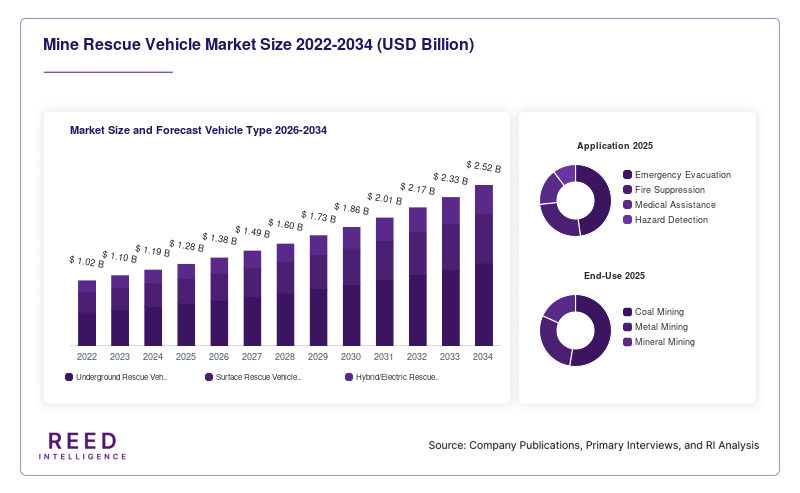
Underground rescue vehicles dominated the Mine Rescue Vehicle Market, accounting for approximately 42.6% of the market share in 2024. These vehicles are specifically designed to operate in confined underground environments, making them essential for mining operations. They are equipped with advanced safety features such as reinforced structures, gas detection systems, and life-support equipment. The increasing depth of mining operations and the associated risks are driving the demand for underground rescue vehicles. Additionally, regulatory requirements mandating the availability of specialized rescue equipment in underground mines are further supporting this segment’s dominance.
Hybrid-powered rescue vehicles are expected to be the fastest-growing subsegment, with a projected CAGR of 10.2% during the forecast period. The growing emphasis on sustainability and the need for efficient energy usage are key factors driving this growth. Hybrid vehicles offer a balance between performance and environmental impact, making them suitable for modern mining operations. Their ability to operate in low-emission mode is particularly beneficial in underground environments, where air quality is a concern. As mining companies adopt greener practices, the demand for hybrid rescue vehicles is expected to increase significantly.
By Application
Emergency evacuation emerged as the dominant application segment, holding a market share of 39.1% in 2024. This segment includes the use of rescue vehicles for safely transporting injured or trapped workers during emergencies. The high frequency of accidents in mining operations underscores the importance of efficient evacuation systems. Rescue vehicles designed for evacuation are equipped with medical facilities, communication systems, and protective structures, ensuring the safety of both rescuers and victims. The increasing focus on minimizing casualties and improving response time is driving the demand for evacuation-focused rescue vehicles.
Fire suppression is anticipated to be the fastest-growing application segment, with a CAGR of 9.8% during the forecast period. The rising incidence of fire-related accidents in mining operations is a key factor driving this growth. Rescue vehicles equipped with fire suppression systems can effectively control and contain fires, preventing further damage. Technological advancements in fire detection and suppression systems are enhancing the capabilities of these vehicles. As mining operations expand into more hazardous environments, the demand for fire suppression solutions is expected to increase.
By End-Use
Coal mining dominated the end-use segment, accounting for a significant share of the market in 2024. The extensive use of coal in energy production and industrial applications is driving mining activities, thereby increasing the demand for rescue vehicles. Coal mines are often associated with high risks, including gas explosions and structural collapses, making rescue vehicles essential for ensuring worker safety. The presence of large-scale coal mining operations in countries such as China and India is further contributing to the segment’s dominance.
Metal mining is projected to be the fastest-growing end-use segment, with a CAGR of 8.9% during the forecast period. The increasing demand for metals such as copper, lithium, and rare earth elements is driving mining activities in this segment. Metal mines often operate in challenging environments, requiring advanced safety measures. The adoption of modern mining technologies and the emphasis on worker safety are driving the demand for rescue vehicles in metal mining operations. As the global demand for metals continues to rise, this segment is expected to witness significant growth.
Regional Analysis
North America
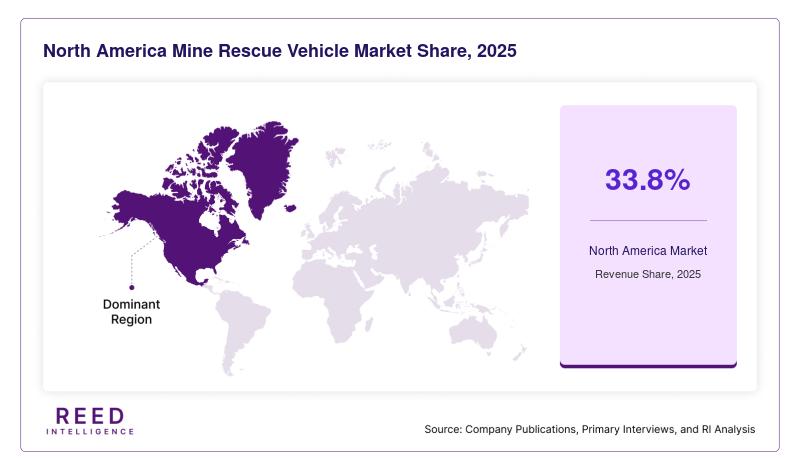
North America accounted for a significant share of the Mine Rescue Vehicle Market, holding approximately 33.8% of the global market in 2025. The region is expected to grow at a CAGR of 6.9% during the forecast period. The presence of well-established mining industries and stringent safety regulations are key factors driving market growth. Additionally, technological advancements and high investment capacity among mining companies are supporting the adoption of advanced rescue vehicles.
The United States remains the dominant country in the region, driven by its extensive mining operations and strict enforcement of safety standards. A unique growth factor in the country is the integration of advanced communication technologies in rescue vehicles, enabling real-time coordination during emergencies. This focus on technological innovation is expected to sustain market growth in North America.
Europe
Europe held a market share of around 24.5% in 2025 and is projected to grow at a CAGR of 7.2% over the forecast period. The region’s strong emphasis on environmental sustainability and worker safety is driving the adoption of advanced rescue vehicles. Regulatory frameworks promoting low-emission technologies are also influencing market trends.
Germany leads the European market, supported by its advanced engineering capabilities and strong industrial base. A unique growth factor in the country is the increasing adoption of electric rescue vehicles, aligned with national sustainability goals. This trend is expected to drive further innovation and market expansion in Europe.
Asia Pacific
Asia Pacific is expected to witness the fastest growth, with a CAGR of 9.4% during the forecast period, while holding a market share of 21.7% in 2025. Rapid industrialization and expanding mining activities are key factors contributing to market growth. Governments in the region are also strengthening safety regulations, encouraging the adoption of rescue vehicles.
China dominates the Asia Pacific market due to its large-scale mining operations. A unique growth factor is the increasing investment in mining safety infrastructure, driven by government initiatives. This focus on safety is expected to boost the demand for rescue vehicles in the region.
Middle East & Africa
The Middle East & Africa region accounted for a market share of 10.6% in 2025 and is projected to grow at a CAGR of 7.5%. The region’s rich mineral resources and growing mining activities are driving market demand. However, limited infrastructure in certain areas may pose challenges.
South Africa is the leading country in the region, supported by its well-established mining sector. A unique growth factor is the increasing collaboration between mining companies and safety equipment manufacturers, which is enhancing the availability of advanced rescue vehicles.
Latin America
Latin America held a market share of 9.4% in 2025 and is expected to grow at a CAGR of 7.8%. The region’s expanding mining activities and increasing foreign investments are key growth drivers. Governments are also focusing on improving safety standards in the mining sector.
Brazil leads the Latin American market, driven by its large mining industry. A unique growth factor is the adoption of modern safety practices by international mining companies operating in the country. This is expected to drive the demand for rescue vehicles in the region.
Competitive Landscape
The Mine Rescue Vehicle Market is moderately fragmented, with several global and regional players competing based on technology, product innovation, and pricing strategies. Leading companies are focusing on developing advanced rescue vehicles equipped with smart technologies and sustainable energy solutions. Strategic collaborations, mergers, and acquisitions are also common as companies aim to expand their market presence.
A prominent leader in the market is Drägerwerk AG & Co. KGaA, known for its advanced safety and rescue solutions. The company has recently introduced a new generation of mine rescue vehicles equipped with enhanced gas detection and communication systems, aimed at improving operational efficiency. Other key players are also investing in research and development to introduce innovative products and gain a competitive edge.
Key Players
- Drägerwerk AG & Co. KGaA
- MineARC Systems
- Epiroc AB
- Caterpillar Inc.
- Sandvik AB
- Strata Worldwide
- Boart Longyear
- J.H. Fletcher & Co.
- Becker Mining Systems
- Sany Group
- Komatsu Ltd.
- Liebherr Group
- RDH Mining Equipment
- Tesmec S.p.A.
Recent Developments
- A leading manufacturer introduced an electric mine rescue vehicle designed for low-emission underground operations, improving air quality and operational efficiency.
- A major mining company partnered with a technology provider to develop autonomous rescue vehicles equipped with AI-based navigation systems.
- An industry player expanded its product portfolio by launching retrofit kits for upgrading existing mining vehicles with advanced rescue capabilities.
Mine Rescue Vehicle Market Segments
Vehicle Type
- Underground Rescue Vehicles
- Surface Rescue Vehicles
- Hybrid/Electric Rescue Vehicles
Application
- Emergency Evacuation
- Fire Suppression
- Medical Assistance
- Hazard Detection
End-Use
- Coal Mining
- Metal Mining
- Mineral Mining
By Region
- North America
- Europe
- APAC
- Middle East and Africa
- LATAM