Mine Transformer Market Size, Share & Trends Analysis Report By Cooling Type (Oil-Cooled, Dry-Type, Gas-Insulated, Ventilated), By Voltage Rating (Low Voltage, Medium Voltage, High Voltage, Ultra-High Voltage), By Mining Commodity (Copper, Coal, Gold, Rare Earth Minerals, Others) and By Region (North America, Europe, Asia Pacific, Latin America, Middle East & Africa) Forecasts, 2026–2034
USD 3950
Mine Transformer Market Size
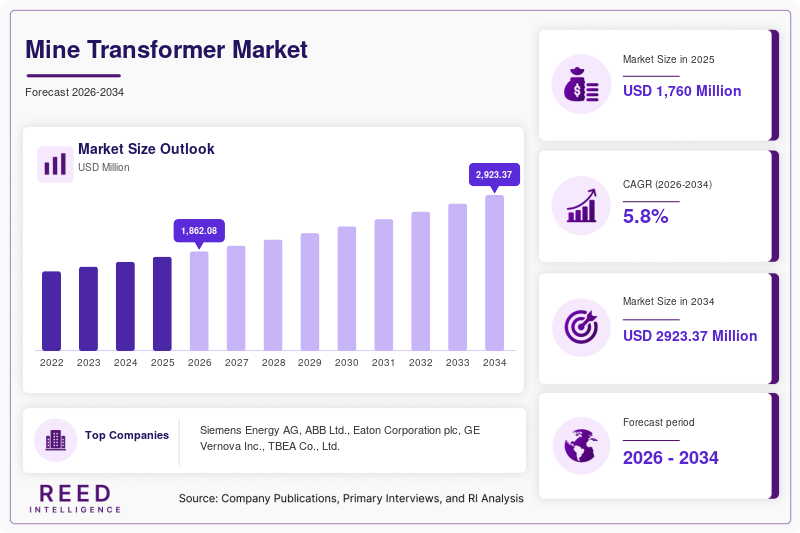
The global mine transformer market was valued at USD 1,760 Million in 2025 and is projected to grow from USD 1,862.08 Million in 2026 to USD 2,923.37 Million by 2034, registering a CAGR of 5.8% during the forecast period from 2026 to 2034.
Mine transformers are specialized electrical transformers engineered to provide dependable power distribution in demanding mining environments. Unlike conventional commercial transformers, mine transformers must operate reliably under conditions involving dust, moisture, vibration, temperature variations, restricted installation space, hazardous atmospheres, long cable distances, and fluctuating electrical loads. They are deployed in underground and surface mines as well as mineral-processing plants, substations, conveyor systems, crushing and grinding facilities, ventilation networks, pumps, hoists, and electric vehicle charging infrastructure.
The growing electrification of mining is becoming one of the most important structural drivers for transformer demand. Mining companies are replacing diesel-powered equipment with battery-electric or electrically driven haulage, drilling, loading, ventilation, and material-handling equipment. These changes increase electrical load density and require additional substations and distributed transformer stations. Deep underground mines also require cascading voltage transformation systems because power must travel significant distances from surface substations to underground equipment.
Mine Transformer Market Drivers
Increasing mining depth and the transition toward automated and electrically powered mining equipment are generating additional demand for transformers. Underground mines require multiple voltage transformation stages to distribute electricity efficiently across shafts, tunnels, production zones, ventilation systems, pumping stations, and processing areas. Electrification of haul trucks, loaders, drilling equipment, conveyors, and ventilation systems further increases electrical infrastructure requirements.
As mines become more automated, electricity becomes a larger component of operating infrastructure. Distributed transformer stations can provide power closer to equipment loads, reduce transmission losses, improve voltage stability, and provide redundancy. The expansion of deep underground copper, gold, coal, and critical-mineral mines is therefore expected to remain a major demand driver through 2034.
The energy transition is increasing demand for copper, lithium, nickel, cobalt, and rare earth minerals. Mining companies are expanding existing facilities and developing new greenfield projects to respond to these requirements. Every major new mine requires substantial electrical infrastructure, including substations, transformers, switchgear, distribution systems, and monitoring equipment.
Copper mining is particularly important because large copper mines require high-capacity electrical systems for crushing, grinding, conveying, pumping, and processing. Expansion of mining operations in Chile, Peru, Australia, Africa, Indonesia, and other resource-rich regions is consequently supporting demand for specialized transformers.
Mining companies are increasingly deploying solar, wind, battery storage, and hybrid microgrids to reduce fuel consumption and carbon emissions at remote sites. Renewable generation creates additional requirements for transformers capable of managing variable loads, voltage fluctuations, harmonics, and bidirectional power flows.
Remote mines that previously relied heavily on diesel generation can increasingly integrate renewable generation with battery storage and electrical distribution infrastructure. This creates demand for specialized transformers, distributed substations, power-quality equipment, and intelligent monitoring systems.
Mine Transformer Market Restraints
Mine transformers require specialized designs, safety certifications, enhanced insulation, thermal management, and environmental protection. These specifications can make mining transformers more expensive than standard industrial transformers. Dry-type and gas-insulated designs can have particularly high upfront costs compared with conventional oil-cooled units.
Mining companies must therefore evaluate initial capital expenditure against operating efficiency, maintenance requirements, environmental compliance, equipment life, and potential downtime costs. Cost-sensitive mining projects may continue to favor proven oil-cooled technologies where environmental and safety requirements permit.
Large transformers are engineered according to site-specific voltage, capacity, environmental, and safety requirements. Manufacturing, testing, transportation, installation, and commissioning can therefore require significant lead times. The market source identifies customized transformer lead times of approximately 42–60 weeks in some cases because of supply constraints involving copper conductors and electrical steel.
Long procurement cycles can delay mine construction and expansion projects. Mining companies are consequently increasingly pursuing early procurement, framework agreements, multiple suppliers, localized manufacturing, and long-term service arrangements.
Mining capital expenditure is closely connected to commodity prices. Weak copper, coal, gold, lithium, nickel, or rare-earth prices can cause mining companies to postpone new projects or defer transformer replacement programs. Because transformers are generally purchased as part of larger electrical infrastructure investments, reductions in mining capital expenditure can directly affect market demand.
Mine Transformer Market Opportunities
The transition toward safer and environmentally responsible electrical infrastructure creates significant opportunities for dry-type and ester-fluid transformers. Dry-type transformers eliminate mineral-oil leakage risks and can be particularly attractive for underground or environmentally sensitive locations.
According to the available market assessment, dry-type transformers represented 32.8% of the market in 2025 and are projected to grow at a faster pace than oil-cooled transformers, supported by environmental compliance requirements and demand for non-flammable solutions.
Digital monitoring provides another major opportunity. Sensors measuring temperature, vibration, dissolved gases, insulation condition, load, and other parameters can identify transformer deterioration before catastrophic failure. Mining operators can integrate this information into centralized asset-management platforms to schedule maintenance according to equipment condition.
Smart transformer systems can reduce unplanned downtime and improve asset utilization, which is particularly valuable for mines operating continuously in remote locations.
Remote mining projects frequently face transportation and infrastructure challenges. Modular transformer architectures can reduce transportation complexity and allow equipment to be assembled closer to the installation site. This creates opportunities for manufacturers capable of designing compact, modular, scalable, and rapidly deployable transformer systems.
Mine Transformer Market Segmental Analysis
By Cooling Type
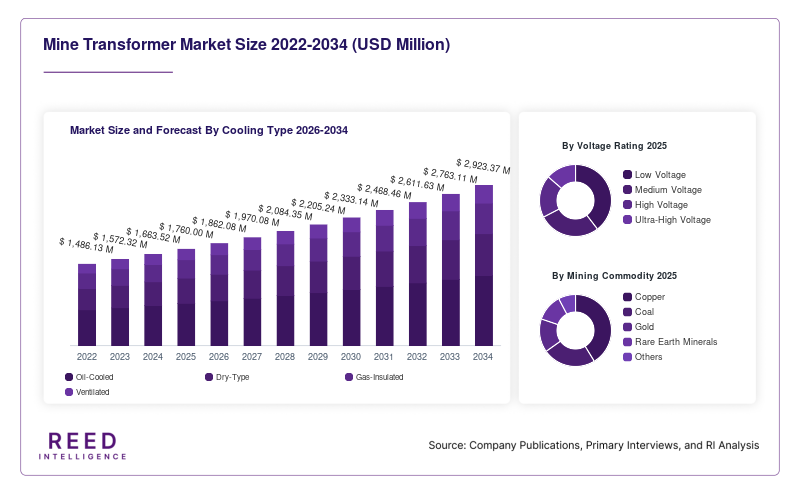
Oil-Cooled transformers represented the dominant cooling segment, accounting for 48.5% of the market in 2025. Their leadership is supported by established use in large underground and surface mining operations, high-capacity applications, proven thermal performance, widespread servicing capabilities, and relatively competitive lifecycle economics. Oil-cooled systems remain particularly relevant in copper and coal mining environments where high continuous loads require efficient heat dissipation.
Dry-Type transformers are the fastest-growing cooling segment, with a reported 7.2% CAGR through 2034. Their growth is supported by environmental regulations, non-flammable operation, reduced leakage risk, and suitability for underground and environmentally sensitive mining locations. Dry-type transformers accounted for 32.8% of the market in 2025, giving the segment a substantial installed and replacement opportunity.
Gas-Insulated transformers accounted for 11.2% of the market in 2025 and are gaining application in space-constrained and ultra-deep mining projects. Ventilated transformers represented 7.5% and remain relevant in selected coal-mining applications.
By Voltage Rating
Medium Voltage transformers represented the dominant voltage-rating segment, accounting for 54.3% of the market in 2025. Medium-voltage systems are fundamental to primary electrical distribution within underground and surface mines, connecting mine substations with dispersed production equipment. Typical mine networks use medium-voltage systems to distribute power across long distances while maintaining practical current levels and manageable equipment sizes.
High Voltage transformers are the fastest-growing major voltage segment, with a reported 6.7% CAGR. Increasing mine depth, geographically distributed operations, and the need to transmit electricity over longer distances are supporting higher-voltage infrastructure. High-voltage transformers are increasingly required in large mines that connect regional transmission networks with dedicated mine substations.
Low-voltage transformers continue to serve localized equipment and auxiliary systems, while ultra-high-voltage transformers remain concentrated in exceptionally large integrated mining operations requiring extensive transmission infrastructure.
By Mining Commodity
Copper represented the dominant mining-commodity segment, accounting for 35.2% of total mine transformer demand. Copper mines are generally highly electricity-intensive because of crushing, grinding, material handling, pumping, ventilation, hoisting, and processing requirements. Expansion of copper projects in Latin America and Africa is therefore an important source of transformer demand.
Rare earth minerals represent an important high-growth opportunity as governments and mining companies seek secure supplies of minerals required for permanent magnets, electric vehicles, wind turbines, and advanced electronics. New projects frequently require new electrical infrastructure rather than simple replacement of existing equipment, supporting transformer procurement.
Coal accounted for 28.4% of demand, while gold represented 18.3%. Other commodities, including nickel, molybdenum, and tin, collectively represent an important demand pool, particularly as battery-material supply chains expand.
Mine Transformer Market Regional Analysis
North America Mine Transformer Market
North America represented approximately 28.5% of the global Mine Transformer Market in 2025, making it the second-largest regional market. Demand is supported by copper, gold, rare-earth, molybdenum, and other mineral extraction in the United States and Canada. Mining operators are increasingly upgrading electrical infrastructure to support mechanization, automation, deeper mining, and stricter safety requirements.
The region is also benefiting from increasing investment in domestic critical-mineral supply chains. New mining projects require dedicated substations and transformers, while established mines require replacement and modernization of aging equipment. Demand for dry-type, environmentally safer, digitally monitored, and high-efficiency transformers is expected to increase as operators focus on reliability and lifecycle costs.
Europe Mine Transformer Market
Europe accounted for approximately 18.3% of the global market in 2025. Demand is concentrated around mining operations in countries such as Poland and Sweden, together with emerging lithium and other critical-mineral projects in parts of Europe. Environmental standards and sustainability requirements are encouraging mining operators to consider lower-emission and oil-free electrical technologies.
The European market is increasingly characterized by modernization rather than rapid expansion of conventional mining. Transformer replacement, energy efficiency, environmental compliance, noise reduction, and integration of renewable energy are expected to represent important opportunities. The transition toward smarter electrical infrastructure should further increase demand for condition monitoring and digitally connected transformer systems.
Asia Pacific Mine Transformer Market
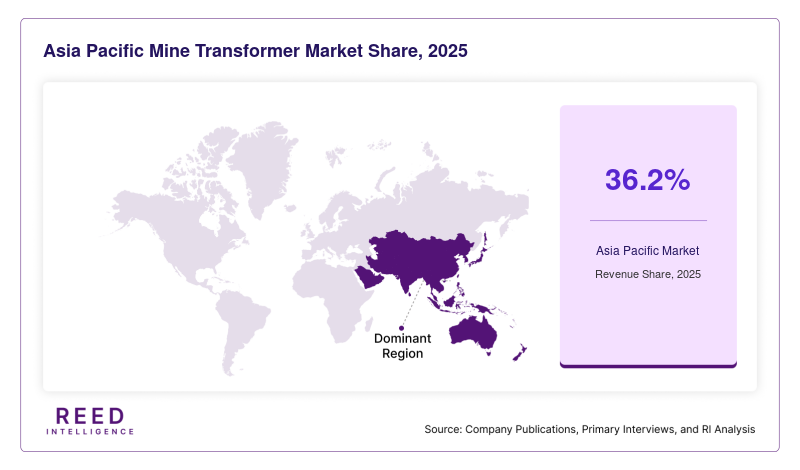
Asia Pacific was the dominant regional market in 2025, accounting for 36.2% of global market revenue, with a regional market value of approximately USD 640 million. This makes Asia Pacific the largest regional market for mine transformers. China, India, Australia, Indonesia, and other mineral-producing economies provide a broad installed base and continuing investment opportunities.
The region benefits from large-scale coal, copper, iron ore, nickel, rare-earth, and other mineral extraction. Indonesia's nickel industry, China's large mining base, Australia's coal and iron ore operations, and India's expanding mineral production are important demand centers. Rapid electrification, renewable integration, replacement of aging transformers, and localized transformer manufacturing are expected to sustain regional demand through 2034. Hitachi Energy's June 2026 announcement of an approximately INR 2,000 crore investment in a new large-power-transformer factory in Vadodara further demonstrates the scale of transformer manufacturing expansion in India.
Latin America Mine Transformer Market
Latin America represented approximately 12.4% of the global market in 2025, with demand concentrated heavily in copper-producing economies such as Chile and Peru. Large-scale copper mines require substantial electrical infrastructure for extraction, crushing, grinding, pumping, material handling, and processing operations.
The region is also becoming important for lithium and other critical-mineral projects. New greenfield projects create opportunities for complete electrical infrastructure deployment, while established copper and gold mines are upgrading their transformer fleets to improve reliability and accommodate increased production capacity. Renewable energy integration at remote mines is expected to further support transformer demand.
Middle East & Africa Mine Transformer Market
The Middle East & Africa region accounted for approximately 4.6% of global market revenue in 2025. South Africa's platinum and gold mining industries represent important demand centers, while emerging mining activity in countries such as the Democratic Republic of Congo, Zambia, Tanzania, and Mozambique creates additional opportunities.
Africa offers significant long-term potential because many new mining projects are being developed in locations where electrical infrastructure is limited. Remote mines require customized transformers capable of handling difficult transportation conditions, dust, high temperatures, and variable grid reliability. A May 2026 project in Pakistan, involving 13 dry-type transformers for a remote copper-gold mining project, illustrates the growing requirement for transformers specifically engineered for harsh mining environments.
Mine Transformer Market Competitive Landscape
The global Mine Transformer Market is moderately consolidated, with major electrical-equipment companies competing through transformer technology, integrated power systems, mining-sector expertise, local service networks, customization capabilities, and digital asset-management solutions. Siemens Energy and ABB are identified as leading participants, followed by Eaton, GE, TBEA, China XD Electric, Dachi Electric, Crompton Greaves, and Hyundai Heavy Industries.
Siemens Energy maintains a strong position through its broad transformer, high-voltage, substation, grid-management, and mining electrical portfolio. Its metals and mining offering combines transformers with high-voltage substations, voltage regulation, energy storage, and other electrical technologies, allowing mining customers to source integrated power solutions.
Key Market Players
- Siemens Energy AG
- ABB Ltd.
- Eaton Corporation plc
- GE Vernova Inc.
- TBEA Co., Ltd.
- China XD Electric Co., Ltd.
- Dachi Electric
- CG Power and Industrial Solutions Ltd.
- Hyundai Heavy Industries Co., Ltd.
- Hitachi Energy Ltd.
- Schneider Electric SE
Mine Transformer Market Recent Developments
- July , 2026: ABB completed its acquisition of Specialtrasfo S.p.A., an Italian manufacturer of specialized medium-voltage transformers, including converter and rectifier transformers. ABB stated that the acquisition strengthens its specialized transformer portfolio and supply-chain resilience across industries including metals and mining. Specialtrasfo operates three production sites in Italy and had approximately EUR 80 million in 2025 revenue
- June , 2026: Trafo Power Solutions announced the supply of 13 dry-type transformers for a remote copper-gold mining project in Pakistan's Chagai district. The equipment includes 5 kVA isolation transformers, 75 kVA lighting transformers, and 250–1,000 kVA power-distribution transformers. The units were designed for ambient temperatures exceeding 50°C and use Class H insulation
Mine Transformer Market Segments
By Cooling Type
- Oil-Cooled
- Dry-Type
- Gas-Insulated
- Ventilated
By Voltage Rating
- Low Voltage
- Medium Voltage
- High Voltage
- Ultra-High Voltage
By Mining Commodity
- Copper
- Coal
- Gold
- Rare Earth Minerals
- Others
By Region
- North America
- Europe
- APAC
- Middle East and Africa
- LATAM