Mineral Base Oil Market Size, Share & Trends Analysis Report By Type (Group I, Group II, Group III, Group IV, Group V) and By Application (Engine Oils, Gear Oils, Metalworking Fluids, General Industrial Oils, Greases, Process Oils, Others) and By Region (North America, Europe, Asia Pacific, Latin America, Middle East & Africa) Forecasts, 2026–2034
USD 3950
Mineral Base Oil Market Size
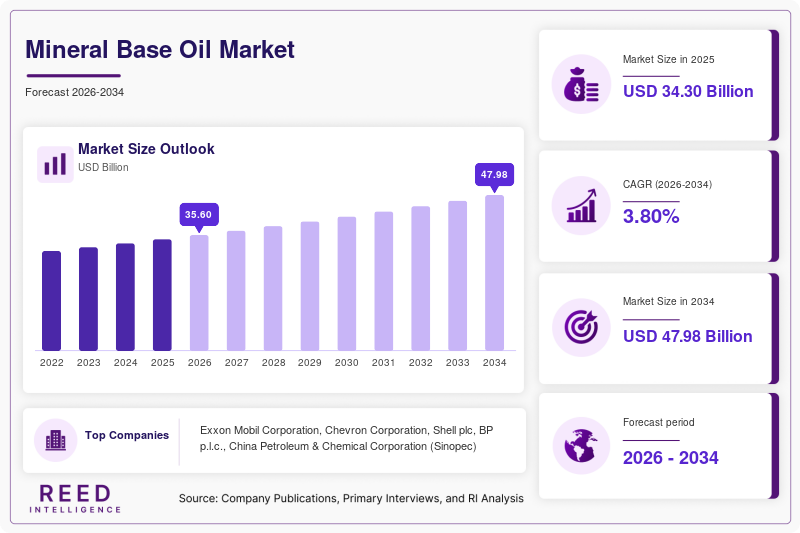
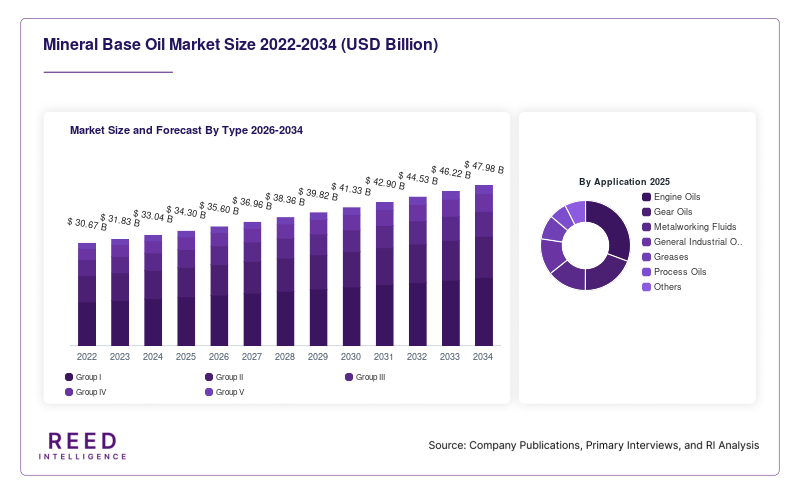
The global mineral base oil market was valued at USD 34.30 Billion in 2025 and is projected to grow from USD 35.60 Billion in 2026 to USD 47.98 Billion by 2034, registering a CAGR of 3.80% during the forecast period from 2026 to 2034.
Mineral base oil represents the fundamental hydrocarbon component used to formulate a broad range of lubricants and functional fluids. It is primarily obtained through petroleum refining and is classified into different API base-stock groups according to properties such as sulfur content, viscosity index, saturation level, volatility, and performance characteristics. Group I remains important in conventional lubricant applications, while Group II and Group III are increasingly preferred where improved oxidation stability, lower sulfur content, and better low-temperature performance are required.
Mineral Base Oil Market Drivers
The expansion of vehicle ownership, commercial transportation, industrial machinery, construction equipment, mining operations, power-generation assets, and manufacturing facilities continues to generate demand for lubricants formulated with mineral base oils. Emerging economies are particularly important because industrialization and increasing vehicle fleets create recurring requirements for engine oils, hydraulic fluids, gear oils, and industrial lubricants.
Modern engines and industrial equipment require lubricants with better oxidation resistance, thermal stability, cleanliness, and low-temperature performance. This is encouraging lubricant manufacturers to adopt higher-quality Group II and Group III base stocks. The shift toward premium base stocks is particularly visible in Asia Pacific, where Group II has become a major regional grade and Group III is expanding rapidly.
Growing manufacturing output in Asia Pacific, the Middle East, and other emerging markets supports consumption of hydraulic oils, metalworking fluids, compressor oils, turbine oils, gear oils, and process oils. Mining, construction, power generation, and heavy industrial operations also require large quantities of lubricants for equipment protection and operational reliability.
Mineral Base Oil Market Restraints
Electric vehicles generally require less conventional engine oil than internal-combustion vehicles, creating a long-term structural challenge for some automotive lubricant applications. Although EVs still require specialized fluids, greases, thermal-management fluids, and drivetrain lubricants, their growth can reduce demand for traditional engine-oil formulations and consequently affect mineral base oil consumption.
Mineral base oil production is closely linked to refinery economics, crude-oil availability, energy costs, and refining margins. Refinery closures, production adjustments, crude-price fluctuations, and changes in refinery configurations can affect the availability and pricing of different base-stock grades.
Demand is gradually shifting from conventional Group I grades toward Group II, Group III, and synthetic or semi-synthetic alternatives in applications requiring higher performance. This transition creates pressure on producers that depend heavily on legacy Group I capacity and can lead to excess supply in selected conventional grades.
Mineral Base Oil Market Opportunities
The transition toward cleaner and higher-performance lubricants is creating opportunities for investment in Group II and Group III production. Refiners and technology providers are upgrading hydroprocessing and hydrocracking capabilities to increase the availability of higher-quality base stocks.
Base oils continue to find applications in industrial lubricants, metalworking fluids, process oils, greases, rubber processing, transformer fluids, and other specialty formulations. Expansion of manufacturing, power generation, mining, and infrastructure development provides opportunities beyond traditional automotive lubrication.
Circular-economy policies are encouraging the collection and re-refining of used lubricants. Re-refined base oils can provide an alternative source of lubricant feedstock while reducing waste and dependence on virgin petroleum resources. The growing emphasis on sustainability therefore creates opportunities for producers to develop lower-impact base-stock solutions.
Mineral Base Oil Market Segmental Analysis
By Type
Group II represented the dominant base-stock segment in the broader Asia Pacific base-oil market, accounting for 38.05% of regional market volume in 2025. Its strong position is supported by lower sulfur content, improved oxidation performance, and suitability for modern automotive and industrial lubricant formulations. Group I remains important in conventional applications because of its cost competitiveness and established supply base.
Group III represents the fastest-growing premium mineral base-stock opportunity, supported by increasing demand for high-performance lubricants, modern engine technologies, improved fuel economy, and longer drain intervals. In the Asia Pacific market, Group III is projected to record approximately 3.30% CAGR through 2031, the fastest growth among the major base-stock grades covered by the cited regional analysis.
By Application
Engine Oils represent the dominant application segment, accounting for approximately 42.5% of the global Mineral Base Oil Market in 2025. The segment benefits from the large installed base of internal-combustion vehicles, commercial fleets, industrial engines, and machinery requiring periodic lubricant replacement.
Process Oils and industrial applications represent important growth opportunities as manufacturing, rubber processing, chemicals, textiles, machinery, and other industrial activities expand. In the broader Asia Pacific base-oil market, engine oils accounted for 54.75% of application demand in 2025, while process oils were identified as the fastest-growing application category.
Mineral Base Oil Market Regional Analysis
North America Mineral Base Oil Market
North America represents a mature but technologically important mineral base oil market, supported by established automotive, industrial, transportation, and lubricant-manufacturing sectors. Demand is increasingly concentrated on higher-quality Group II and Group III base stocks as lubricant specifications become more demanding. ExxonMobil's Baytown investment and Chevron's premium base-oil portfolio demonstrate continued industry investment in higher-performance grades.
The region is also experiencing changes in distribution and refining structures. Chevron announced in August 2026 that it would expand its North American base-oils distribution network through agreements with HF Sinclair Lubricants & Specialties and Renkert Oil, including expanded access to Group II and Group III products. Exact comparable 2025 global market share for North America within the Mineral Base Oil Market is not separately verified from the same dataset used for the supplied global market value.
Europe Mineral Base Oil Market
Europe maintains demand for mineral base oils through automotive lubricants, industrial oils, metalworking fluids, greases, and specialty applications. However, stringent environmental regulations, vehicle-efficiency requirements, electrification, and the transition toward higher-quality lubricants are changing the regional base-stock mix.
European refiners and lubricant suppliers are therefore emphasizing higher-performance and lower-impact base stocks. Shell has also been converting its Wesseling hydrocracker in Germany into a Group III base-oil production unit, illustrating the industry's shift toward premium base-stock production. Exact comparable regional market share and market value for Europe within the supplied Mineral Base Oil Market dataset are unavailable.
Asia Pacific Mineral Base Oil Market
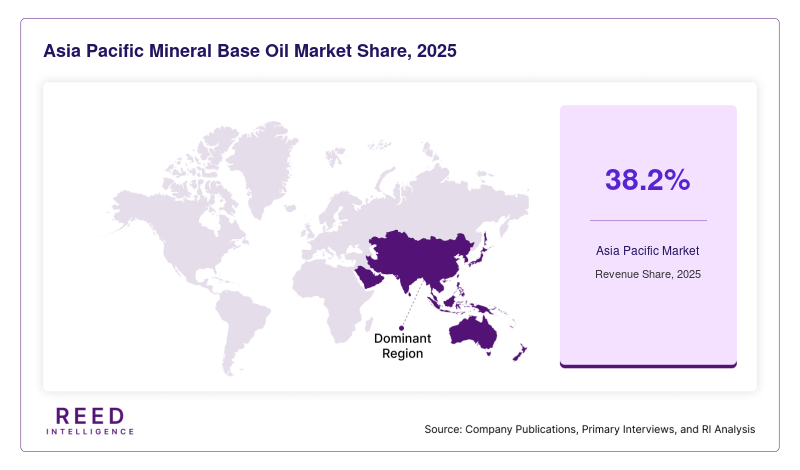
Asia Pacific was the dominant region in the global Mineral Base Oil Market in 2025, accounting for 38.2% of global revenue. Based on the supplied 2025 global market size of USD 34.30 Billion, the corresponding regional market value is approximately USD 13.10 Billion (derived from the reported 38.2% share). The region's leadership is supported by large automotive manufacturing bases, industrial machinery production, rapid industrialization, and substantial refining capacity.
China is the largest country-level market within Asia Pacific, while India is also experiencing increasing demand for lubricant base stocks. Group II held 38.05% of the Asia Pacific base-oil market in 2025, while Group III is projected to be the fastest-growing grade. India is also increasing domestic base-stock capabilities through refinery and lube-oil modernization projects.
Latin America Mineral Base Oil Market
Latin America represents an important developing market for mineral base oils, supported by automotive transportation, commercial fleets, agriculture, mining, construction, and industrial activity. Demand for engine oils and industrial lubricants remains closely associated with vehicle utilization and equipment maintenance cycles.
The region also presents opportunities for lubricant suppliers as vehicle fleets and industrial infrastructure expand. However, exact comparable market share, market value, and regional CAGR for Latin America's share of the supplied Mineral Base Oil Market are not independently verified and are therefore not stated as confirmed figures.
Middle East & Africa Mineral Base Oil Market
The Middle East & Africa market benefits from the region's petroleum infrastructure, refinery capabilities, transportation demand, industrial development, construction, mining, and power-generation activities. The availability of crude-oil resources and expanding downstream investments can support the production and distribution of lubricant base stocks.
The region also provides opportunities for premium lubricant and industrial-oil applications as infrastructure and manufacturing activities expand. However, an exact comparable 2025 market share and market value for the Mineral Base Oil Market could not be verified from the same dataset supporting the supplied global market figures.
Mineral Base Oil Market Competitive Landscape
The Mineral Base Oil Market is characterized by the presence of major integrated oil companies, independent refiners, and lubricant-base-stock producers. Competition is primarily based on base-stock quality, refinery integration, product consistency, geographic coverage, production capacity, technical support, and supply reliability.
ExxonMobil maintains a broad base-stock portfolio covering multiple API groups and continues to invest in premium base-stock production. Its Baytown complex introduced Group III base stocks to the North American market, with approximately 8,000 barrels per day of Group III production and a further expansion planned for startup in 2028. The company's Singapore Resid Upgrade Project also expanded base-stock capacity by 20,000 barrels per day.
Key Market Players
- Exxon Mobil Corporation
- Chevron Corporation
- Shell plc
- BP p.l.c.
- China Petroleum & Chemical Corporation (Sinopec)
- PetroChina Company Limited
- PETRONAS Chemicals Group Berhad
- SK Enmove Co., Ltd.
- Phillips 66 Company
- HollyFrontier Corporation
- Hindustan Petroleum Corporation Limited
Mineral Base Oil Market Recent Developments
- August 2026 Chevron expands North American base-oil distribution network
Chevron announced expanded distribution arrangements for Group II and Group III base oils in North America. The agreement includes HF Sinclair Lubricants & Specialties in Canada and Renkert Oil, strengthening Chevron's distribution network while HF Sinclair prepares for the planned closure of its Ontario Group II/III base-oil unit. - September 2026 European demand for re-refined base oils accelerates
ICIS reported that European lubricant blenders increasingly turned to re-refined base oils following shortages of Group I and disruptions affecting Group III supply. The supply disruption accelerated qualification and formulation changes toward circular base-oil alternatives, with producers such as Avista benefiting from increased demand.
Mineral Base Oil Market Segments
By Type
- Group I
- Group II
- Group III
- Group IV
- Group V
By Application
- Engine Oils
- Gear Oils
- Metalworking Fluids
- General Industrial Oils
- Greases
- Process Oils
- Others
By Region
- North America
- Europe
- APAC
- Middle East and Africa
- LATAM