Mineral Fiber Ceiling Tiles Market Size, Share & Trends Analysis Report By Type (Thickness Above 12 mm, Thickness Below 12 mm) and By Application (Residential, Commercial) and By Region (North America, Europe, Asia Pacific, Latin America, Middle East & Africa) Forecasts, 2026–2034
USD 3950
Mineral Fiber Ceiling Tiles Market Size
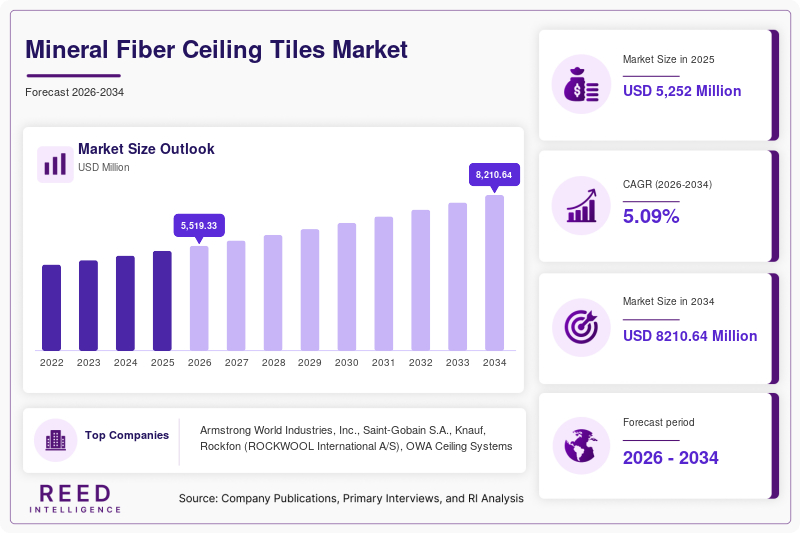
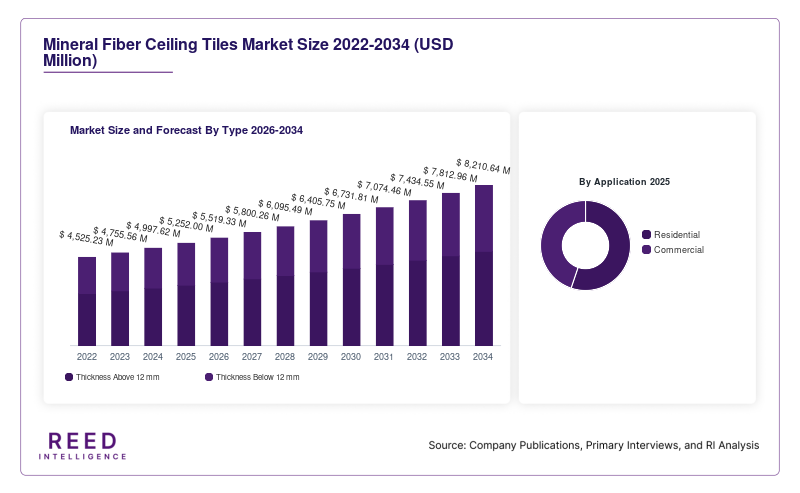
The global mineral fiber ceiling tiles market was valued at USD 5,252 million in 2025 and is projected to grow from USD 5,519 million in 2026 to USD 8,210.64 million by 2034, registering a CAGR of 5.09% during the forecast period from 2026 to 2034.
Mineral fiber ceiling tiles are suspended-ceiling products manufactured primarily from mineral wool, glass fiber, perlite, recycled materials, and related mineral-based components. They are designed to provide acoustic absorption, sound attenuation, fire performance, moisture resistance, thermal characteristics, and aesthetic flexibility.
The market is increasingly shifting toward higher-performance products incorporating recycled content, improved acoustic coefficients, better humidity resistance, low-VOC characteristics, enhanced fire classifications, and improved recyclability. Armstrong, for example, states that its mineral fiber ceiling products can provide NRC ratings of up to 0.90 and CAC ratings of up to 40 depending on the product.
Mineral Fiber Ceiling Tiles Market Drivers
Increasing construction and renovation of offices, educational institutions, healthcare facilities, retail properties, hotels, and other commercial buildings is supporting demand for mineral fiber ceiling tiles. Renovation projects particularly benefit from suspended ceiling systems because they provide access to building services while improving acoustic and visual performance.
Open-plan offices, classrooms, healthcare facilities, and public buildings require effective sound absorption and sound blocking. Mineral fiber ceiling tiles provide an established solution for controlling reverberation and improving speech intelligibility, making acoustic performance a major purchasing consideration.
Green-building certification and corporate sustainability requirements are encouraging architects and contractors to specify products containing recycled materials and offering lower environmental impacts. Manufacturers are increasingly emphasizing recycled content, low-VOC characteristics, recyclability, and environmental product declarations.
Mineral fiber ceiling products are valued for their fire-resistance characteristics and ability to satisfy demanding building-code requirements. Increasing attention to fire safety in commercial and institutional construction supports demand for higher-performance ceiling products.
Mineral Fiber Ceiling Tiles Market Restraints
Mineral fiber ceiling tiles compete with metal, gypsum, fiberglass, wood, PVC, and other ceiling systems. Certain applications favor alternative materials because of design requirements, moisture exposure, durability considerations, or project-specific cost constraints.
Mineral wool, glass fiber, perlite, binders, coatings, and other production inputs are exposed to energy and transportation costs. Changes in raw-material prices can affect manufacturing costs and product pricing.
Although suspended ceiling systems simplify maintenance access, installation requires compatible suspension grids, labor, and project coordination. In price-sensitive construction markets, lower-cost alternatives can create competitive pressure.
Mineral Fiber Ceiling Tiles Market Opportunities
Growing demand for quiet workplaces, educational environments, healthcare facilities, and hospitality spaces creates opportunities for mineral fiber tiles with higher NRC and CAC performance.
Products with higher recycled content, reduced embodied carbon, low-VOC characteristics, and end-of-life recycling capabilities can gain preference as building owners increasingly evaluate whole-building environmental performance.
Integration of thermal-management technologies with mineral fiber ceiling panels provides an opportunity to extend ceiling products beyond traditional acoustic and aesthetic functions. Armstrong's TEMPLOK technology combines phase-change materials with mineral fiber ceiling panels and is designed to support thermal comfort and energy savings.
Rapid urbanization and commercial construction in Asia Pacific, particularly China, India, Southeast Asia, and other developing economies, provides significant opportunities for ceiling manufacturers and distributors.
Mineral Fiber Ceiling Tiles Market Segmental Analysis
By Type
Thickness Above 12 mm represents the dominant product category in the Mineral Fiber Ceiling Tiles Market. Thicker mineral fiber tiles generally provide stronger acoustic absorption and sound-control characteristics and are therefore widely suited to offices, educational facilities, healthcare environments, and other spaces where acoustic performance is an important specification criterion. Comparable public data supporting a precise percentage share for this segment within the supplied USD 5,252 million market dataset are unavailable, so a numeric share is not assigned.
Thickness Below 12 mm represents an important value-oriented category, particularly where lighter weight, lower material consumption, easier handling, and cost efficiency are priorities. The segment benefits from applications where acoustic and fire-performance requirements can be satisfied with thinner constructions. A reliable comparable CAGR specific to the supplied market dataset is not publicly confirmed.
By Application
Commercial buildings represent the dominant application segment. Offices, schools, hospitals, retail stores, hospitality properties, and institutional buildings require ceiling systems that combine acoustic control, fire performance, aesthetics, maintainability, and access to building services. Commercial construction and renovation therefore represent the principal demand base for mineral fiber ceiling tiles. Public sources consistently identify commercial buildings as the leading application, although an exact share compatible with the supplied USD 5,252 million dataset is not publicly verifiable.
Residential buildings represent a smaller but established application segment. Demand is supported by apartments, housing developments, home offices, basements, and other residential environments where acoustic and aesthetic improvements are required. Growth remains dependent on residential construction activity, renovation rates, and consumer willingness to adopt suspended ceiling systems.
Mineral Fiber Ceiling Tiles Market Regional Analysis
North America Mineral Fiber Ceiling Tiles Market
North America is a major mineral fiber ceiling tile market because of its mature commercial construction sector, extensive installed ceiling base, renovation activity, and strong demand for acoustic and sustainable interior products. The United States represents the largest regional demand center, supported by offices, schools, healthcare facilities, retail properties, and institutional construction.
The region also has a highly developed manufacturer and specification ecosystem. Armstrong maintains a broad mineral fiber and fiberglass ceiling portfolio emphasizing acoustic performance, sustainability, design flexibility, and code compliance.
Europe Mineral Fiber Ceiling Tiles Market
Europe represents an important market supported by commercial renovation, institutional construction, energy-efficiency requirements, and increasing demand for sustainable building products. Germany, France, the United Kingdom, Italy, and other European economies provide substantial opportunities for ceiling manufacturers.
Sustainability and embodied-carbon reduction are increasingly influencing product selection. Manufacturers are investing in lower-carbon materials, recycled content, electrified production, and circular-economy initiatives. Knauf's European manufacturing investments and ROCKWOOL/Rockfon's focus on lower-carbon ceiling systems illustrate this broader transition.
Asia Pacific Mineral Fiber Ceiling Tiles Market
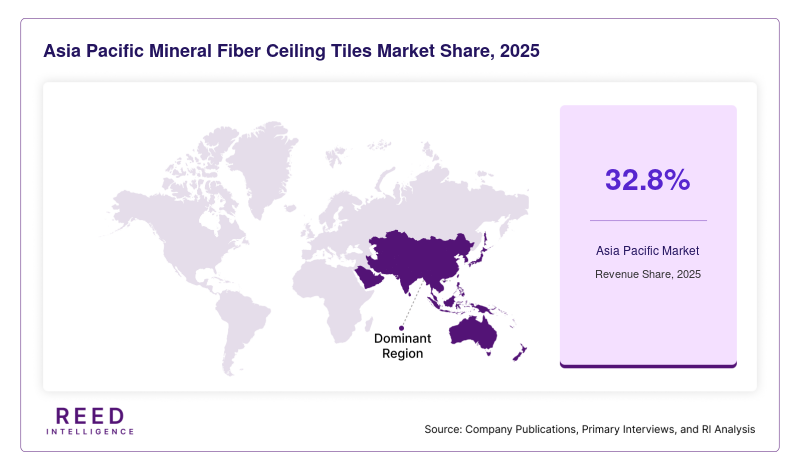
Asia Pacific dominated the Mineral Fiber Ceiling Tiles Market in 2025, accounting for approximately 32.8% of global revenue, equivalent to about USD 1,722.7 million based on the compatible 2025 global market value of USD 5,251.5 million. The regional figure and global figure are reported in the same market dataset, avoiding the use of an incompatible regional source.
Asia Pacific is also the fastest-growing regional market, with a reported CAGR of approximately 6.07% through the forecast period in the compatible dataset. China, India, Japan, South Korea, Southeast Asia, and Australia contribute to regional demand through commercial construction, urban development, healthcare infrastructure, education facilities, and office expansion.
Latin America Mineral Fiber Ceiling Tiles Market
Latin America represents an emerging opportunity for mineral fiber ceiling tiles, supported by commercial construction, urban development, hospitality projects, healthcare infrastructure, and renovation activity. Mexico and Brazil are particularly important markets because of their established construction and commercial-property sectors.
Market development remains influenced by construction investment, currency conditions, imported-material costs, and availability of local distribution networks. Demand is expected to increase gradually as commercial building standards and acoustic requirements become more sophisticated.
Middle East & Africa Mineral Fiber Ceiling Tiles Market
The Middle East & Africa region offers long-term opportunities through commercial real estate, hospitality, healthcare, education, airports, and large-scale infrastructure projects. The UAE, Saudi Arabia, Qatar, and other Gulf markets have particularly strong requirements for high-performance interior materials.
Demand is increasingly influenced by fire safety, acoustic comfort, sustainability certifications, and premium architectural finishes. However, market penetration remains lower than in established North American, European, and Asia Pacific markets.
Mineral Fiber Ceiling Tiles Market Competitive Landscape
The Mineral Fiber Ceiling Tiles Market is moderately competitive, with major manufacturers competing through acoustic performance, fire resistance, recycled content, sustainability certifications, design variety, manufacturing capacity, distribution networks, and product innovation.
Armstrong World Industries is one of the leading participants, with mineral fiber ceilings representing a core part of its portfolio. Its products emphasize acoustic performance, sustainability, design flexibility, and installation efficiency. Armstrong's CALLA High NRC products, for example, offer NRC of 0.90 and CAC of 35 while being positioned within its SUSTAIN portfolio.
Key Market Players
- Armstrong World Industries, Inc.
- Saint-Gobain S.A.
- Knauf
- Rockfon (ROCKWOOL International A/S)
- OWA Ceiling Systems
- DAIKEN Corporation
- USG Corporation
- BNBM
- Luofeier Building Material
- SAS International
Mineral Fiber Ceiling Tiles Market Recent Developments
- June 2026, Rockfon selected ArcelorMittal's XCarb steel for its T24 ceiling grid system, with the steel offering more than 50% lower embodied carbon compared with conventional steel in the referenced application. The development demonstrates the increasing importance of embodied-carbon reduction in ceiling-system specifications and procurement.
- Armstrong continued to develop mineral fiber ceiling solutions emphasizing sustainability, acoustic performance, occupant comfort, and energy efficiency. Its TEMPLOK ceiling systems integrate phase-change-material technology with mineral fiber ceiling panels and are designed to provide thermal-comfort benefits while supporting building sustainability objectives. Armstrong subsequently updated CALLA TEMPLOK and ULTIMA TEMPLOK panels with PVC-free metalized-film backers and Class A fire performance.
Mineral Fiber Ceiling Tiles Market Segments
By Type
- Thickness Above 12 mm
- Thickness Below 12 mm
By Application
- Residential
- Commercial
By Region
- North America
- Europe
- APAC
- Middle East and Africa
- LATAM