Mineral Fiber Market Size, Share & Trends Analysis Report By Product Type (Glass Wool, Rock Wool, Slag Wool, Others) and By Application (Construction, Automotive, Industrial, Others) and By End User (Residential, Commercial, Industrial, Others) and By Distribution Channel (Direct Sales, Distributors, Online Retail, Others) and By Region (North America, Europe, Asia Pacific, Latin America, Middle East & Africa) Forecasts, 2026–2034
USD 3950
Mineral Fiber Market Size
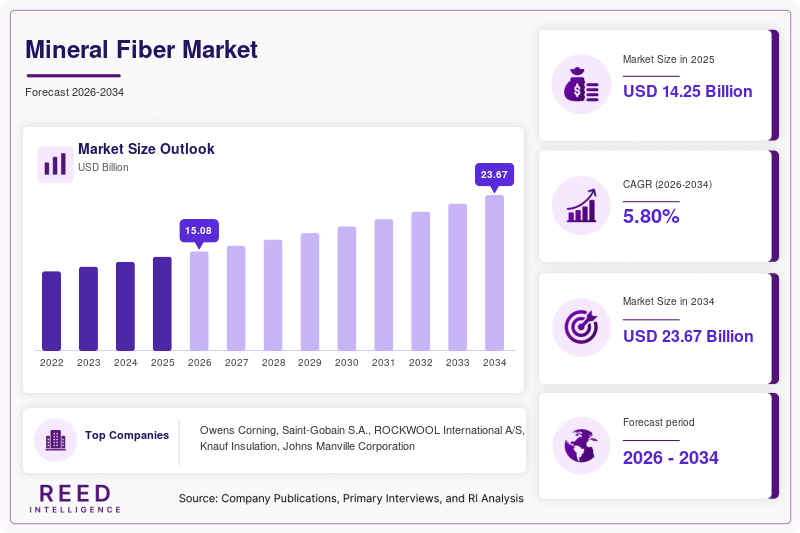
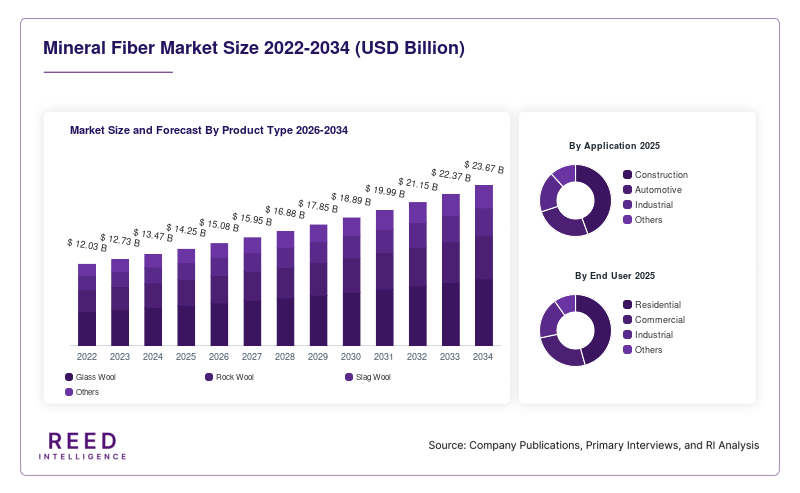
The global mineral fiber market was valued at USD 14.25 Billion in 2025 and is projected to grow from USD 15.08 Billion in 2026 to USD 23.67 Billion by 2034, registering a CAGR of 5.80% during the forecast period from 2026 to 2034.
Mineral fiber is a broad class of inorganic fibrous materials primarily manufactured from glass, rock, slag, and other mineral raw materials. Glass wool and rock wool are the two principal product categories, while slag wool and specialty mineral fibers serve selected industrial and high-temperature applications. These materials are extensively incorporated into walls, roofs, ceilings, HVAC systems, industrial equipment, automotive components, and other structures requiring thermal, acoustic, or fire protection.
The construction industry represents the principal demand center because mineral fiber products are widely used in building insulation and acoustic applications. In addition to new construction, renovation of aging buildings is becoming an increasingly important source of demand as governments and building owners seek to reduce energy consumption and improve building performance. Construction applications accounted for approximately 58.3% of the global market in 2025.
Mineral Fiber Market Drivers
Rising Demand for Energy-Efficient Buildings
Increasing energy costs and stricter building-efficiency regulations are driving demand for high-performance insulation. Mineral fiber products help reduce heat transfer through walls, roofs, floors, and HVAC systems while also providing acoustic and fire-protection benefits. Building renovation programs in Europe and new construction across Asia Pacific are creating sustained demand.
Increasing Construction and Infrastructure Activity
Residential, commercial, industrial, healthcare, educational, logistics, and infrastructure construction generates substantial demand for mineral fiber insulation. Rapid urbanization in China, India, Southeast Asia, and other developing markets is expanding the addressable customer base, while mature markets continue to generate demand through renovation and replacement activity.
Strong Fire-Safety Requirements
Rock wool and other mineral fiber materials provide strong fire-resistance characteristics and are increasingly specified in high-rise buildings, industrial facilities, data centers, hospitals, and other applications where fire safety is critical. Stricter building codes are encouraging architects and contractors to incorporate non-combustible insulation materials into building envelopes.
Growing Industrial Insulation Requirements
Mineral fiber is used to insulate boilers, furnaces, pipelines, tanks, ducts, process equipment, power-generation facilities, and industrial plants. Expansion of manufacturing, petrochemical, energy, and infrastructure facilities therefore provides an additional source of demand beyond conventional residential construction.
Mineral Fiber Market Restraints
Energy-Intensive Manufacturing
Mineral fiber production requires high-temperature melting processes, making energy costs a significant component of manufacturing economics. Volatility in electricity, natural gas, and other energy costs can pressure producer margins and increase product prices.
Competition from Alternative Insulation Materials
Mineral fiber competes with polyurethane, polyisocyanurate, expanded polystyrene, extruded polystyrene, cellulose, aerogel, and other insulation materials. In applications where lightweight construction, low thickness, or specialized thermal performance is prioritized, alternative materials can limit mineral fiber penetration.
Raw Material and Transportation Costs
Mineral fiber manufacturing depends on reliable supplies of silica, recycled glass, basalt, slag, binders, and other materials. Transportation costs can also be significant because insulation products are relatively bulky, making proximity to production facilities and construction markets an important competitive factor.
Mineral Fiber Market Opportunities
Building Renovation and Energy Retrofitting
Large stocks of older residential and commercial buildings require insulation upgrades to meet modern energy-performance requirements. Government-backed renovation programs, carbon-reduction targets, and rising energy costs are creating long-term opportunities for mineral fiber manufacturers.
Sustainable and Circular Mineral Fiber Products
The ability to incorporate recycled materials and recycle mineral wool waste provides an opportunity for producers to reduce embodied carbon and improve resource efficiency. Knauf's planned mineral wool recycling facility in Austria demonstrates the industry's movement toward closed-loop material systems.
Electrification of Mineral Fiber Manufacturing
Electric melting technology offers manufacturers an opportunity to reduce fossil-fuel consumption and lower production emissions. ROCKWOOL's acquisition of ScanArc Plasma Technologies and Knauf's electric melting line illustrate growing investment in lower-carbon manufacturing technologies.
Data Center and Advanced Industrial Construction
Rapid expansion of data centers, semiconductor facilities, advanced manufacturing plants, and other technically demanding facilities creates demand for insulation with thermal, acoustic, and fire-performance characteristics. Mineral fiber is well suited to applications requiring a combination of fire safety and thermal management.
Mineral Fiber Market Segmental Analysis
By Product Type
Glass Wool is the dominant product segment, accounting for approximately 42.5% of the global Mineral Fiber Market in 2025. Its leadership is supported by cost competitiveness, low thermal conductivity, relatively low weight, ease of installation, and broad use in residential and commercial insulation. Glass wool is particularly important in wall cavities, attics, ceilings, HVAC systems, and acoustic applications.
Rock Wool is the fastest-growing major product category, with approximately 6.8% CAGR projected through 2034 in the referenced market analysis. Its growth is supported by superior fire resistance, acoustic performance, durability, and increasing adoption in commercial, industrial, and high-performance building applications. Slag wool remains important in industrial insulation, while specialty mineral fibers serve more specialized applications.
By Application
Construction is the dominant application segment, representing approximately 58.3% of global Mineral Fiber Market revenues in 2025. Demand comes from residential walls and roofs, commercial building envelopes, ceilings, HVAC systems, acoustic applications, and renovation projects. Energy-performance requirements and increasingly stringent fire-safety standards are strengthening mineral fiber specifications in construction.
Automotive represents an important growth opportunity and is projected to record approximately 7.5% CAGR in the referenced market analysis. Mineral fiber is increasingly used for thermal and acoustic management in vehicles, including applications associated with electric and hybrid vehicles. Industrial applications also remain significant because of demand for high-temperature and process-equipment insulation.
By End User
Residential is the dominant end-user segment, accounting for approximately 44.5% of global mineral fiber revenues. New housing construction, multifamily development, residential renovation, attic insulation, wall insulation, and energy-efficiency upgrades collectively support demand. Residential retrofit activity is becoming increasingly important as building owners respond to energy costs and evolving energy-performance standards.
Commercial is the second-largest end-user segment, accounting for approximately 38.2% of market revenues. Office buildings, retail facilities, hospitals, educational buildings, hotels, data centers, and mixed-use projects increasingly require mineral fiber for thermal, acoustic, and fire-performance requirements. Commercial applications therefore represent an important growth opportunity alongside residential construction.
By Distribution Channel
Direct Sales is the dominant distribution channel, accounting for approximately 45.2% of market revenue. Large construction contractors, industrial users, developers, and infrastructure projects commonly purchase directly from manufacturers because of the scale of requirements and technical specifications involved.
Online Retail is the fastest-growing distribution channel, with approximately 9.5% CAGR in the referenced analysis. Digital purchasing is becoming more relevant for smaller contractors, installers, maintenance professionals, and residential consumers purchasing insulation products for renovation projects.
Mineral Fiber Market Regional Analysis
North America Mineral Fiber Market
North America represents a mature but technologically advanced mineral fiber market, supported by residential renovation, commercial construction, industrial facilities, data centers, and increasingly stringent building-performance requirements. The region accounted for approximately 21.5% of global mineral fiber market revenue in the referenced 2025 analysis. Demand is supported by both new construction and replacement or retrofit insulation.
The region is also attracting new production investments. ROCKWOOL broke ground in April 2026 on a USD 175 million stone wool manufacturing facility in Washington State, its fifth North American manufacturing facility and first in the western United States. The facility is expected to begin commercial production in 2028 and will use electric melting technology.
Europe Mineral Fiber Market
Europe is a highly regulation-driven market in which energy-efficiency standards, building renovation requirements, fire safety, and decarbonization targets support mineral fiber demand. Renovation of existing residential and commercial buildings is particularly important as European countries seek to improve building energy performance and reduce operational emissions.
Sustainability is becoming increasingly important to European producers. In September 2026, Knauf Group received a building permit for a €30 million mineral wool recycling plant in Austria, designed to recycle both glass and rock mineral wool and return recovered material to production. Commissioning is planned by the end of 2026.
Asia Pacific Mineral Fiber Market
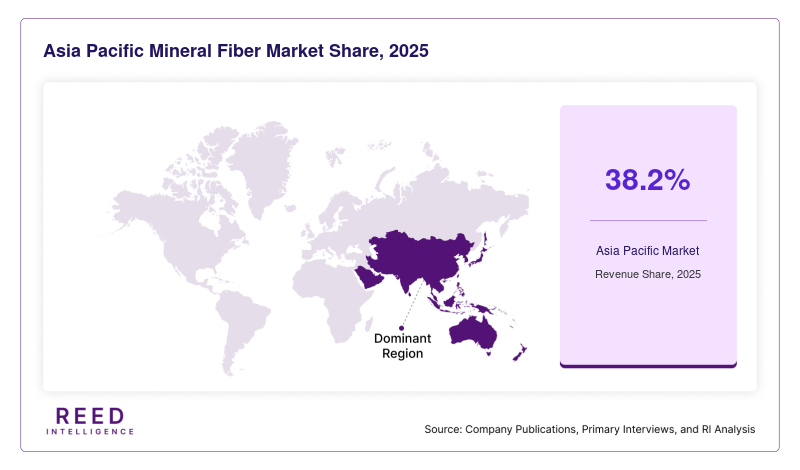
Asia Pacific was the dominant regional market in 2025, accounting for approximately 38.2% of global Mineral Fiber Market revenue. Based on the supplied global 2025 market size of USD 14.25 Billion, this corresponds to an estimated regional market value of approximately USD 5.44 Billion, derived using the verified 38.2% share. Rapid urbanization, construction activity, industrial development, and increasing energy-efficiency requirements support the region's leadership.
China, India, Japan, South Korea, and Southeast Asian economies represent major demand centers. Growing residential construction, commercial development, manufacturing facilities, data centers, and infrastructure projects are expanding mineral fiber consumption. Asia Pacific is also expected to remain one of the fastest-growing regional markets, with the cited analysis projecting approximately 7.2% CAGR through 2034.
Latin America Mineral Fiber Market
Latin America represents an emerging mineral fiber market supported by residential construction, commercial infrastructure, industrial development, and increasing awareness of energy-efficient building materials. Brazil and Mexico are important demand centers because of their large construction markets and industrial bases.
Growth opportunities are particularly associated with urbanization, building modernization, industrial facilities, and adoption of more stringent thermal and fire-performance standards. However, an exact 2025 market share and market value for Latin America that is fully comparable with the supplied global market dataset is not independently verified and is therefore not stated as a confirmed figure.
Middle East & Africa Mineral Fiber Market
The Middle East & Africa market is supported by commercial construction, industrial facilities, infrastructure development, hospitality projects, and large-scale urban development. Mineral fiber products are increasingly relevant to projects requiring thermal management, fire protection, and acoustic performance under demanding climatic conditions.
Industrial and infrastructure projects provide additional opportunities for mineral fiber products, particularly in process plants, power facilities, transportation infrastructure, and large commercial developments. However, an exact comparable 2025 market share and market value for the region could not be verified from the same dataset supporting the supplied global market size.
Mineral Fiber Market Competitive Landscape
The Mineral Fiber Market is moderately concentrated, with major global manufacturers competing through manufacturing capacity, product performance, sustainability, distribution networks, geographic expansion, and technical support. The leading participants include Owens Corning, Saint-Gobain, ROCKWOOL, Knauf Insulation, Johns Manville, Kingspan, CertainTeed, and other regional manufacturers.
Owens Corning is one of the leading global mineral fiber manufacturers, with a substantial insulation business serving residential and commercial construction. In its second-quarter 2026 results, the company reported USD 971 million in insulation net sales, compared with USD 934 million in the prior-year quarter, while continuing to invest in capital projects and its branded building-products portfolio.
Key Market Players
- Owens Corning
- Saint-Gobain S.A.
- ROCKWOOL International A/S
- Knauf Insulation
- Johns Manville Corporation
- CertainTeed Corporation
- Kingspan Group plc
- Guardian Fiberglass
- GAF Materials Corporation
- USG Corporation
- Armstrong World Industries
Mineral Fiber Market Recent Developments
- September 2026 – Knauf invests €30 million in mineral wool recycling plant in Austria
Knauf Insulation received the building permit for a €30 million mineral wool recycling facility in Ferndorf, Austria. The plant is designed to recycle both glass and rock mineral wool, with recovered material returned to the production cycle. Commissioning is planned by the end of 2026. The project is particularly relevant as Austria's landfill ban on artificial mineral fibers takes effect from January 2027. - June 2026 – ROCKWOOL acquires ScanArc to accelerate fossil-free mineral wool production
ROCKWOOL acquired the remaining stake in Swedish ScanArc Plasma Technologies, strengthening its technology capabilities for electric melting. The plasma technology can enable existing stone-wool production lines to transition from fossil fuels to lower-carbon electricity without completely replacing the melting furnace. ROCKWOOL said the first full-scale implementation is being finalized at its Roermond, Netherlands facility
Mineral Fiber Market Segments
By Product Type
- Glass Wool
- Rock Wool
- Slag Wool
- Others
By Application
- Construction
- Automotive
- Industrial
- Others
By End User
- Residential
- Commercial
- Industrial
- Others
By Distribution Channel
- Direct Sales
- Distributors
- Online Retail
- Others
By Region
- North America
- Europe
- APAC
- Middle East and Africa
- LATAM