Mineral Flotation Collectors Market Size, Share & Trends Analysis Report By Collector Type (Anionic Collectors, Non-Ionic Collectors) and By Application (Mining, Wastewater Treatment) and By Mineral Type (Sulfide Minerals, Non-Sulfide Minerals) and By End-User Industry (Mining, Metallurgy) and By Region (North America, Europe, Asia Pacific, Latin America, Middle East & Africa) Forecasts, 2026–2034
USD 3950
Mineral Flotation Collectors Market Size
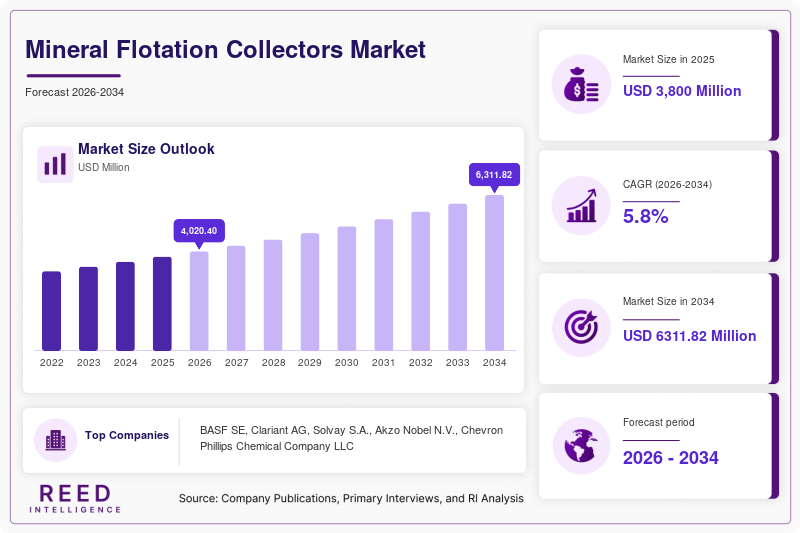
The global mineral flotation collectors market was valued at USD 3,800 Million in 2025 and is projected to grow from USD 4,020.40 Million in 2026 to USD 6,311.82 Million by 2034, registering a CAGR of 5.8% during the forecast period from 2026 to 2034.
Mineral flotation collectors are surface-active chemical reagents used to selectively modify mineral surfaces and make target particles hydrophobic so they can attach to air bubbles during froth flotation. They are essential to the beneficiation of sulfide ores, oxide minerals, industrial minerals, and increasingly complex polymetallic deposits. Collector performance depends on mineralogy, surface chemistry, pH, water quality, particle size, reagent dosage, and flotation-circuit configuration.
The market is closely linked to mining and mineral-processing activity for copper, gold, zinc, lead, nickel, molybdenum, phosphate, lithium, iron ore, and other minerals. The growing importance of copper, lithium, nickel, and rare-earth-related supply chains is encouraging mining companies to improve recovery from lower-grade and more complex ores. Clariant, for example, is developing customized flotation solutions for copper and other energy-transition minerals, while emphasizing improved recovery and concentrate grade.
Mineral Flotation Collectors Market Drivers
Rising Demand for Mineral Extraction
Global demand for copper, lithium, nickel, zinc, gold, and other minerals is increasing the need for efficient beneficiation technologies. As mining companies process lower-grade and more complex ores, flotation collectors become increasingly important for maintaining recovery rates and concentrate quality.
Increasing Processing of Complex and Low-Grade Ores
Declining ore grades require mining companies to process larger quantities of material to produce the same quantity of metal. Selective collectors can improve mineral recovery and concentrate grade, making advanced flotation chemistry increasingly important for mature and complex deposits.
Growth of Critical-Mineral Mining
The expansion of renewable energy, electric vehicles, grid infrastructure, batteries, and other energy-transition technologies is increasing demand for minerals such as copper and lithium. This creates opportunities for specialized collectors capable of improving recovery from difficult ore bodies.
Mineral Flotation Collectors Market Restraints
Environmental and Regulatory Concerns
Conventional collectors, particularly certain xanthate-based formulations, can raise concerns relating to degradation products, worker exposure, water quality, and environmental persistence. Increasing environmental requirements can increase formulation, testing, compliance, and operating costs.
Fluctuation in Mining Investment
Mineral flotation collector demand is closely tied to mine production, processing capacity, commodity prices, and mining capital expenditure. Lower commodity prices or delays in mine development can reduce reagent consumption and postpone investments in new processing facilities.
Complex Reagent Optimization
Collector selection is highly dependent on mineralogy and operating conditions. A formulation that performs well on one ore may not deliver equivalent results on another. This creates technical barriers for suppliers and can increase laboratory testing, pilot testing, and mine-site qualification requirements.
Mineral Flotation Collectors Market Opportunities
Development of Sustainable Collectors
Growing environmental pressure is creating opportunities for biodegradable, lower-toxicity, and lower-dosage collectors. Suppliers that can maintain or improve recovery while reducing environmental and occupational risks can gain competitive advantages.
Expansion of Lithium and Energy-Transition Mineral Processing
Lithium flotation and copper flotation are becoming important growth areas. Clariant's FLOTINOR and FLOTIGAM portfolios, for example, target lithium-bearing minerals and spodumene processing, while its copper portfolio focuses on improving recovery from complex sulfide ores.
Coarse Particle Flotation
Coarse-particle flotation can reduce grinding requirements and improve energy efficiency. Clariant's HOSTAFLOT collectors and FLOTANOL frothers are designed for coarse-particle flotation, including particles above 200 µm, creating opportunities for reagent suppliers as mining companies seek lower-energy processing routes.
Mineral Flotation Collectors Market Segmental Analysis
By Collector Type
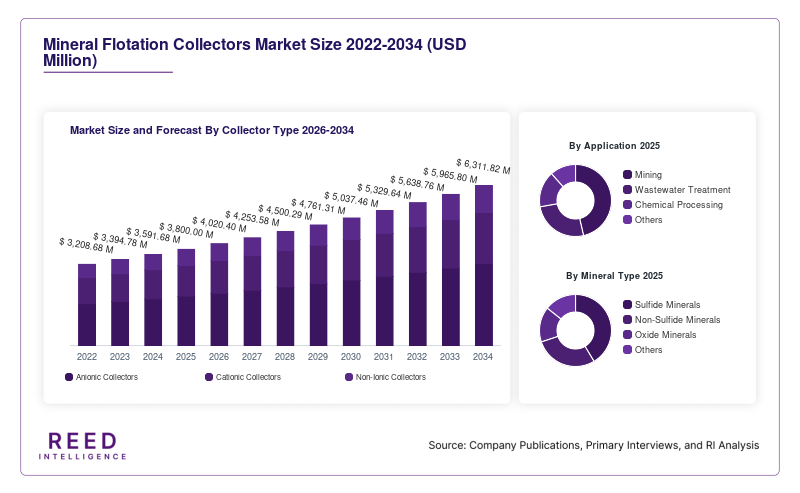
Anionic Collectors dominated the market in 2025 with approximately 42.5% of global revenue. Xanthates, dithiophosphates, and thiocarbamates are widely used for sulfide mineral flotation because of their strong interaction with mineral surfaces. The segment benefits from extensive use in copper, zinc, lead, nickel, and molybdenum processing.
Non-Ionic Collectors are identified as the fastest-growing collector-type segment, with an estimated 6.8% CAGR through 2034. Their growth is associated with specialized ore-processing requirements, complex polymetallic systems, and applications where conventional ionic collectors may have limitations.
By Application
Mining is the dominant application, accounting for approximately 56.2% of total demand. The segment is supported by large-scale copper, gold, zinc, nickel, and other mineral-processing operations. Mining remains the primary consumer because flotation collectors directly influence mineral recovery and concentrate grade.
Wastewater Treatment is the fastest-growing application, with approximately 7.2% CAGR through 2034. Increasing environmental requirements and the need to recover valuable materials from industrial wastewater are expanding the use of flotation-based separation technologies beyond conventional ore beneficiation.
By Mineral Type
Sulfide Minerals represent the dominant mineral category because flotation is extensively used for copper, zinc, lead, nickel, molybdenum, and other sulfide-bearing ores. Anionic collectors, particularly xanthates and related chemistries, remain central to these flotation circuits.
Non-Sulfide and oxide minerals represent important growth opportunities as mining companies increasingly process iron ore, phosphate, lithium-bearing minerals, silica, feldspar, and other industrial minerals. Specialized cationic and anionic collectors are increasingly tailored to individual mineralogical conditions.
By End-User Industry
Mining is the dominant end-user industry because flotation collectors are primarily consumed in mineral beneficiation plants. Large copper, gold, zinc, nickel, phosphate, and lithium operations require specialized reagent programs to optimize recovery and concentrate quality.
Metallurgy and chemical processing represent important secondary markets. These users increasingly require selective flotation chemistry for complex concentrates, secondary resources, industrial minerals, and process streams.
Mineral Flotation Collectors Market Regional Analysis
North America Mineral Flotation Collectors Market
North America represents a technologically advanced market for mineral flotation collectors, supported by established mining operations, mineral-processing infrastructure, and increasing interest in domestic critical-mineral supply chains. Copper, gold, phosphate, iron ore, and other mineral-processing operations provide demand for specialized collectors.
The region is also emphasizing processing efficiency and environmental performance. Growing interest in domestic critical minerals and new mineral projects provides additional opportunities for suppliers of selective and sustainable flotation reagents. An exact 2025 market share and market value for North America within the supplied USD 3.8 billion global dataset is not separately verified.
Europe Mineral Flotation Collectors Market
Europe represents a mature market with strong emphasis on environmental compliance, resource efficiency, recycling, and advanced mineral-processing technologies. Regulatory pressure encourages mining-chemical suppliers to develop lower-toxicity and more sustainable collector systems.
The region also has growing interest in recovering strategic minerals from domestic resources, tailings, industrial waste, and secondary materials. Exact comparable 2025 market share and market value for Europe are unavailable from the same dataset supporting the supplied global market value.
Asia Pacific Mineral Flotation Collectors Market
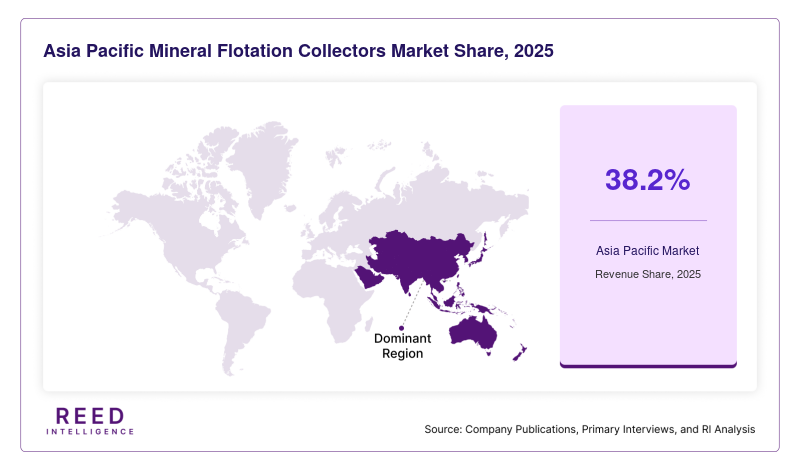
Asia Pacific was the dominant region in the Mineral Flotation Collectors Market in 2025, accounting for approximately 38.2% of global revenue, equivalent to about USD 1.45 Billion. The region's leadership is supported by extensive mineral-processing activity across China, Australia, India, Indonesia, and other mining markets.
The region is also expected to remain a major growth center because of copper, gold, zinc, nickel, lithium, rare-earth, and industrial-mineral processing. Increasing mining investment and industrialization are encouraging the adoption of more selective and efficient flotation chemistry. Asia Pacific's large mining base also provides significant opportunities for customized reagent solutions.
Latin America Mineral Flotation Collectors Market
Latin America is an important mineral-processing region because of its major copper, gold, silver, zinc, lithium, and other mineral deposits. Chile, Peru, Brazil, Argentina, and Mexico provide significant demand opportunities for flotation collectors, particularly for copper and polymetallic ores.
The region is increasingly focused on improving recovery from complex ores while reducing environmental impacts. Supplier opportunities include selective copper collectors, xanthate alternatives, lithium flotation reagents, and customized reagent programs. Exact comparable 2025 regional market share and value are unavailable.
Middle East & Africa Mineral Flotation Collectors Market
The Middle East & Africa region provides opportunities through gold, copper, phosphate, platinum-group metals, manganese, iron ore, and other mineral-processing activities. South Africa and several African mining markets remain particularly relevant to flotation-reagent demand.
Growing investment in mineral beneficiation and efforts to increase local value addition are expected to support demand for advanced flotation chemistry. However, an exact comparable 2025 market share and market value for the region could not be reliably verified from the same dataset.
Mineral Flotation Collectors Market Competitive Landscape
The Mineral Flotation Collectors Market is competitive, with major chemical companies differentiating through collector chemistry, mineral-specific formulations, technical service, sustainability performance, and global mining relationships. Competition is increasingly shifting toward customized reagents that improve recovery while reducing dosage, energy consumption, environmental impact, and operational risk.
BASF provides flotation reagents for phosphates, sulfide ores, and industrial minerals through its mining-solutions portfolio. Its collector systems emphasize improved recovery, lower dosage, customized formulations, and improved environmental profiles. BASF also works with mining customers through laboratory, pilot-plant, and industrial testing programs.
Key Market Players
- BASF SE
- Clariant AG
- Solvay S.A.
- Akzo Nobel N.V.
- Chevron Phillips Chemical Company LLC
- Cytec Industries Inc.
- Dow Inc.
- Huntsman Corporation
- Kemira Oyj
- Arkema Group
- Orica Limited
Mineral Flotation Collectors Market Recent Developments
- April 2026 – Clariant advances copper flotation collector technology
Clariant highlighted its customized flotation collectors for complex and low-grade copper ores. The company reported that selected collector technologies have increased copper recovery by up to 4% at certain operations. Its HOSTAFLOT™ xanthate-replacement collectors are designed to provide high-grade concentrates while reducing hazards associated with conventional xanthates. - May 2026 – New research improves selective copper flotation
A study published in Scientific Reports in May 2026 examined selective flotation of chalcopyrite over pyrite in low-grade copper sulfide ore using selective collectors and non-cyanide depressants. The research addresses one of the major technical challenges in copper flotation—maintaining selectivity when pyrite concentrations are high.
Mineral Flotation Collectors Market Segments
By Collector Type
- Anionic Collectors
- Cationic Collectors
- Non-Ionic Collectors
By Application
- Mining
- Wastewater Treatment
- Chemical Processing
- Others
By Mineral Type
- Sulfide Minerals
- Non-Sulfide Minerals
- Oxide Minerals
- Others
By End-User Industry
- Mining
- Metallurgy
- Chemical
- Others
By Region
- North America
- Europe
- APAC
- Middle East and Africa
- LATAM