Mineral Insulated Resistance Thermometers Global Market Size, Share & Trends Analysis Report By Type (Simplex, Duplex, Triplex) and By Application (Industrial, Aerospace, Automotive, Healthcare, Others) and By End User (Oil & Gas, Chemical, Power Generation, Food & Beverage, Others) and By Region (North America, Europe, Asia Pacific, Latin America, Middle East & Africa) Forecasts, 2026–2034
USD 3950
Mineral Insulated Resistance Thermometers Global Market Size
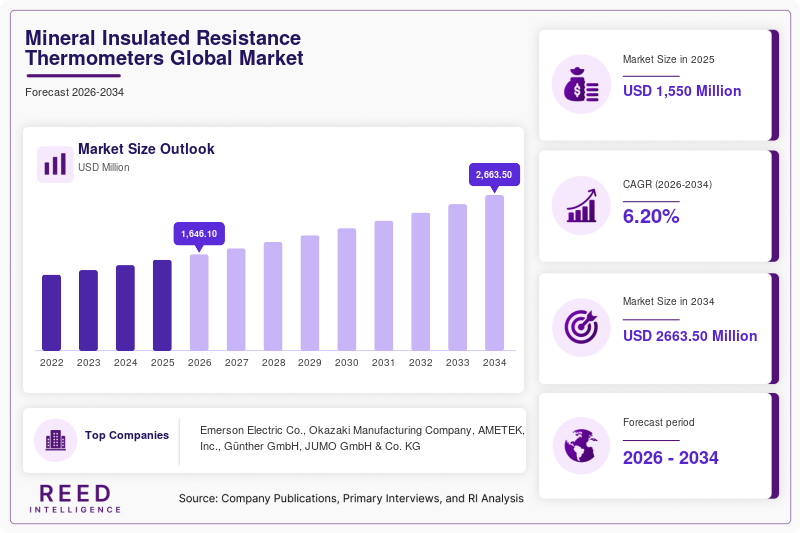
The global mineral insulated resistance thermometers (RTD) market was valued at USD 1,550 Million in 2025 and is projected to grow from USD 1,646.10 Million in 2026 to USD 2,663.50 Million by 2034, registering a CAGR of 6.20% during the forecast period from 2026 to 2034.
Mineral Insulated Resistance Thermometers are temperature sensors in which a resistance element, typically Pt100 or Pt1000, is embedded within mineral insulation and a protective metal sheath. The construction provides mechanical flexibility and strong resistance to vibration while allowing the sensing element to be installed in confined or difficult-to-access areas.
The technology is particularly important in chemical plants, power plants, pipelines, engine manufacturing, process industries, and other industrial environments. JUMO's current mineral-insulated RTD portfolio, for example, includes flexible-sheath probes with Pt100/Pt1000 elements, vibration-resistant measuring inserts, application-specific insertion lengths, and single or double RTD configurations.
Mineral Insulated Resistance Thermometers Global Market Drivers
Expansion of Industrial Automation
The expansion of automated manufacturing, process control, and instrumentation systems is a major driver for mineral insulated RTDs. Chemical plants, refineries, power facilities, food-processing plants, and advanced manufacturing facilities require continuous temperature monitoring across reactors, pipelines, heat exchangers, furnaces, turbines, and other equipment.
Rising Demand for High-Accuracy Temperature Measurement
Industrial operators increasingly require reliable temperature measurements to optimize energy consumption, maintain product quality, improve equipment life, and prevent thermal failures. RTDs generally provide high accuracy and stable resistance-temperature characteristics, making them attractive for process-control applications where precise measurement is more important than extremely high temperature ranges.
Growth of Oil & Gas and Chemical Processing
Oil and gas facilities use temperature sensors throughout exploration, production, refining, LNG processing, storage, and transportation. Chemical and petrochemical facilities similarly require temperature monitoring for reaction control, distillation, heat transfer, and safety systems. Oil and gas represented approximately 38.5% of mineral-insulated RTD end-user demand in the cited 2025 market analysis.
Mineral Insulated Resistance Thermometers Global Market Restraints
Competition from Thermocouples
Thermocouples remain a major alternative for high-temperature measurement because they can operate across extremely broad temperature ranges and provide rapid response. In applications where extreme temperatures rather than maximum measurement accuracy are the primary requirement, thermocouples can limit the addressable market for RTDs.
Higher Cost of Specialized RTDs
Mineral insulated RTDs designed for aerospace, nuclear, subsea, cryogenic, or hazardous-area applications can require specialized materials, precision manufacturing, calibration, and certification. These requirements increase the final sensor cost compared with standard temperature measurement products.
Raw-Material Price Fluctuations
Manufacturers can be exposed to fluctuations in platinum, nickel alloys, stainless steel, mineral insulation materials, and specialized electrical components. Volatility in these inputs can influence production costs and pricing, particularly for high-specification sensors.
Mineral Insulated Resistance Thermometers Global Market Opportunities
EV Battery Thermal Management
The transition toward electric vehicles is creating new requirements for accurate temperature monitoring of battery packs, motors, power electronics, charging systems, and thermal-management circuits. Mineral insulated RTDs can provide compact and robust sensing solutions for locations exposed to vibration and demanding thermal conditions.
Aerospace and Defense Applications
Aircraft engines, propulsion systems, avionics, thermal-management systems, and defense platforms require highly reliable temperature measurement. Aerospace applications are identified as one of the fastest-growing application opportunities for mineral-insulated RTDs, with the cited market study estimating approximately 7.5% CAGR through 2034.
Advanced Semiconductor and Precision Manufacturing
Semiconductor fabs and advanced manufacturing facilities require increasingly precise environmental and process monitoring. The combination of compact construction, accuracy, and application-specific designs creates opportunities for specialized RTDs in semiconductor processing, thermal chambers, and precision industrial equipment.
Mineral Insulated Resistance Thermometers Global Market Segmental Analysis
By Type
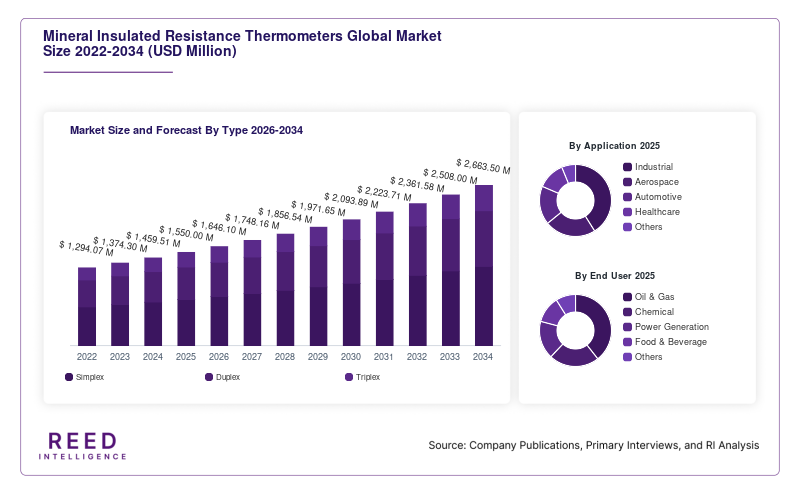
Simplex RTDs represented the dominant type segment, accounting for approximately 42.3% of the global market in 2025. Their single sensing element provides a comparatively simple and cost-effective architecture for applications where measurement redundancy is not mandatory. They are widely used in industrial equipment, process systems, automotive applications, and general temperature monitoring.
Triplex RTDs represent the fastest-growing type opportunity, although their exact CAGR is not independently verified across multiple compatible datasets. Their three-element configuration provides additional redundancy and can support high-reliability applications where temperature measurement failure carries significant operational or safety consequences. Duplex configurations remain important for aerospace, oil and gas, and other critical process applications.
By Application
Industrial applications represented the dominant application segment, accounting for approximately 48.2% of the market in 2025 in the cited market analysis. Chemical processing, petrochemical refining, power generation, manufacturing, furnaces, heat-treatment equipment, and automated process-control systems generate substantial demand for mineral-insulated temperature sensors.
Aerospace is the fastest-growing application segment, with the cited market analysis projecting approximately 7.5% CAGR through 2034. Aircraft engines, propulsion systems, thermal-management equipment, avionics, and defense platforms require highly reliable temperature measurement under vibration, pressure, and temperature extremes.
By End User
Oil & Gas was the dominant end-user segment, representing approximately 38.5% of total mineral-insulated RTD demand in 2025. Temperature monitoring is essential across upstream production, refining, pipelines, LNG processing, storage, and other hydrocarbon operations.
Chemical represents an important growth segment because precise temperature control is required for reactions, distillation, heat transfer, polymerization, and other chemical processes.
Mineral Insulated Resistance Thermometers Global Market Regional Analysis
North America Mineral Insulated Resistance Thermometers Global Market
North America represents a technologically mature market for mineral insulated RTDs, supported by extensive oil and gas infrastructure, chemical processing, aerospace manufacturing, power generation, food processing, and industrial automation. The region's large installed base of process equipment creates continuing replacement and retrofit demand for temperature sensors.
The United States remains the major country-level market because of its large process-industrial base and significant aerospace and energy industries. However, a directly comparable 2025 regional market-share percentage based on the supplied USD 1.55 billion global market value could not be independently verified, so a regional market value is not derived.
Europe Mineral Insulated Resistance Thermometers Global Market
Europe maintains strong demand for mineral insulated RTDs because of its chemical, pharmaceutical, automotive, aerospace, food-processing, and industrial-manufacturing sectors. Strict process-safety and quality requirements also encourage the use of accurately calibrated and traceable temperature instrumentation.
Germany, the United Kingdom, France, Italy, and other major industrial economies provide established demand for industrial temperature sensors. The region is also an important center for specialized sensor manufacturers and instrumentation suppliers, although an exact compatible 2025 market share and regional value are unavailable.
Asia Pacific Mineral Insulated Resistance Thermometers Global Market
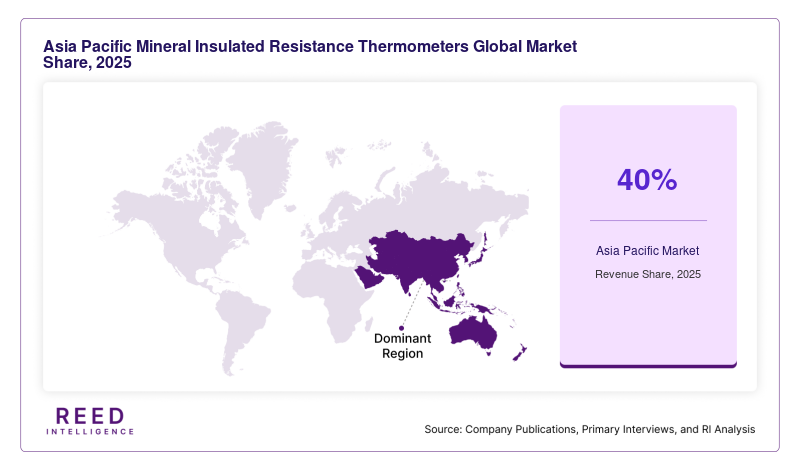
Asia Pacific was the dominant region in the Mineral Insulated Resistance Thermometers Market in 2025, accounting for approximately 40.0% of global market share and generating about USD 0.62 Billion in revenue. The region's leadership is supported by rapid industrialization, manufacturing expansion, semiconductor production, petrochemical investment, power generation, and growing automation across China, Japan, India, and other Asian economies.
China, Japan, and India are major demand centers, while South Korea and Southeast Asia provide additional opportunities through electronics, chemical, automotive, and manufacturing investments. The combination of industrial automation and process-equipment expansion is expected to maintain Asia Pacific's leadership during the forecast period. Based on the cited source, Asia Pacific's 2025 value is approximately USD 620 Million.
Latin America Mineral Insulated Resistance Thermometers Global Market
Latin America represents an emerging opportunity for mineral insulated RTDs, particularly in oil and gas, mining, chemical processing, food and beverage, power generation, and automotive manufacturing. Brazil and Mexico are expected to remain the most significant markets because of their industrial bases and established manufacturing ecosystems.
Expansion of industrial automation and modernization of process plants should support demand for accurate temperature instrumentation. Nevertheless, an exact comparable 2025 market share and regional market value for Latin America under the supplied global market definition could not be independently verified.
Middle East & Africa Mineral Insulated Resistance Thermometers Global Market
The Middle East & Africa market is supported primarily by oil and gas, petrochemicals, power generation, water infrastructure, and industrial processing. Mineral insulated RTDs are particularly relevant to hydrocarbon facilities because of their robustness and suitability for demanding process environments.
Saudi Arabia, the United Arab Emirates, Qatar, and other Gulf markets provide opportunities through refinery, petrochemical, LNG, and industrial investment. Africa offers longer-term potential as industrialization and energy infrastructure develop, although an exact compatible 2025 regional market share and value are not independently verified.
Mineral Insulated Resistance Thermometers Global Market Competitive Landscape
The Mineral Insulated Resistance Thermometers Market includes specialized temperature-sensor manufacturers as well as large industrial automation and process-instrumentation companies. Competition is based on measurement accuracy, response time, sheath construction, temperature range, mechanical durability, certification, customization capabilities, product reliability, and integration with industrial control systems.
Emerson is a major industrial automation and measurement technology provider with temperature-measurement products used across process industries. Its broad instrumentation portfolio and established relationships with oil and gas, chemical, power, and manufacturing customers provide a strong distribution and integration advantage in temperature-sensing applications. Industry research identifies Emerson among the leading mineral-insulated RTD manufacturers.
Key Market Players
- Emerson Electric Co.
- Okazaki Manufacturing Company
- AMETEK, Inc.
- Günther GmbH
- JUMO GmbH & Co. KG
- RÖSSEL-Messtechnik GmbH
- ARi Industries, Inc.
- SAB Bröckskes GmbH & Co. KG
- GEFRAN S.p.A.
- British Rototherm
- Omega Engineering, Inc.
- Honeywell International Inc.
- ABB Ltd.
Recent Market Developments
- JUMO 2026: Mineral-insulated RTD portfolio continues to target demanding industrial applications
JUMO currently offers its mineral-insulated RTD temperature probe (SKU 902250) for chemical plants, power plants, pipelines and engine manufacturing. The product supports Pt100/Pt1000 sensors, flexible mineral-insulated sheath construction, vibration-resistant measuring inserts and operating temperatures up to 415°C in listed configurations. - February 2026: Omega Engineering Continued development of mineral-insulated RTD cable products
Omega Engineering has an active mineral-insulated RTD cable product line, including Nickel 201 wire mineral-insulated RTD cable. The product platform supports specialized temperature-sensing applications where mineral-insulated construction is required for durability and high-temperature environments.
Mineral Insulated Resistance Thermometers Global Market Segments
By Type
- Simplex
- Duplex
- Triplex
By Application
- Industrial
- Aerospace
- Automotive
- Healthcare
- Others
By End User
- Oil & Gas
- Chemical
- Power Generation
- Food & Beverage
- Others
By Region
- North America
- Europe
- APAC
- Middle East and Africa
- LATAM