Mineral Insulated Stainless Steel Clad Cable Market Size, Share & Trends Analysis Report By Product Type (Single Core, Multi-Core) and By Application (Building Construction, Power Plants, Oil and Gas, Industrial, Others) and By End User (Residential, Commercial, Industrial) and By Region (North America, Europe, Asia Pacific, Latin America, Middle East & Africa) Forecasts, 2026–2034
USD 3950
Mineral Insulated Stainless Steel Clad Cable Market Size
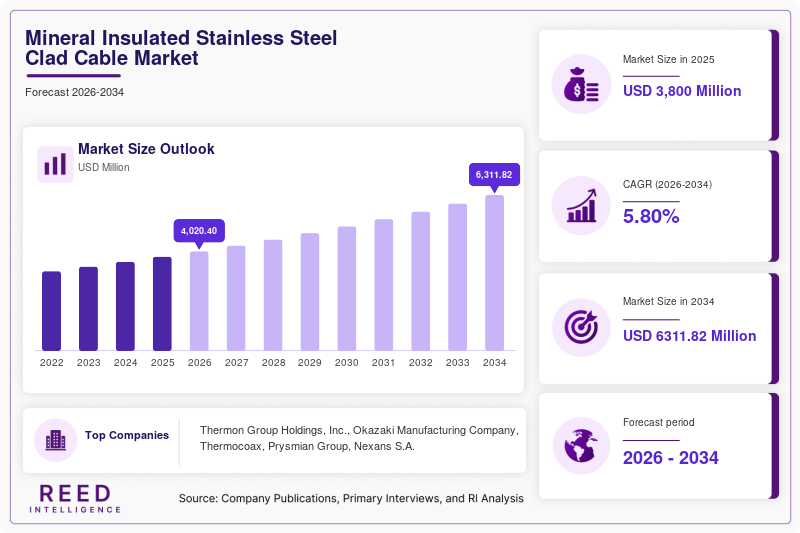
The global mineral insulated stainless steel clad cable market was valued at USD 3,800 Million in 2025 and is projected to grow from USD 4,020.40 Million in 2026 to USD 6,311.82 Million by 2034, registering a CAGR of 5.80% during the forecast period from 2026 to 2034.
Mineral insulated stainless steel clad cables are specialized electrical and instrumentation cables generally constructed with conductors surrounded by compacted magnesium-oxide insulation and protected by a stainless steel or other high-performance metallic sheath. The construction provides high-temperature stability, mechanical protection, low permeability, and resistance to corrosive environments.
These cables are particularly valuable in applications where conventional polymer-insulated cables may deteriorate because of fire, excessive heat, radiation, pressure, vibration, or chemical exposure. Stainless steel sheathing further improves corrosion resistance and durability, making the technology suitable for power plants, oil and gas facilities, industrial manufacturing, high-rise buildings, emergency systems, and specialized measurement and heating applications.
Mineral Insulated Stainless Steel Clad Cable Market Drivers
Stringent Fire-Safety Regulations
Increasing fire-safety requirements for commercial buildings, high-rise structures, hospitals, transportation infrastructure, and industrial facilities are supporting adoption of mineral insulated cables. Their inorganic insulation and metallic sheath provide strong fire resistance and help maintain circuit integrity under severe thermal conditions.
Expansion of Power Generation Infrastructure
Thermal, nuclear, hydroelectric, and renewable power facilities require highly reliable electrical and instrumentation systems. Mineral insulated cables are suitable for high-temperature environments and safety-critical circuits, creating opportunities as power infrastructure is modernized and new generation capacity is added.
Growth of Oil and Gas Infrastructure
Oil refineries, LNG facilities, offshore platforms, petrochemical plants, and other hydrocarbon facilities require electrical systems that can withstand heat, corrosive atmospheres, vibration, and potentially hazardous environments. Stainless steel-clad mineral insulated cables are particularly attractive where conventional cable jackets face accelerated degradation.
Increasing Industrial Automation
Industrial manufacturing facilities increasingly use sensors, temperature-control systems, process instrumentation, robotics, and automated equipment. Mineral insulated cables provide reliable connections for instrumentation and heating systems exposed to high temperatures, chemicals, vibration, and other demanding operating conditions.
Mineral Insulated Stainless Steel Clad Cable Market Restraints
Higher Initial Cost
Mineral insulated stainless steel clad cables generally have higher initial material and installation costs than conventional polymer-insulated cables. Their premium pricing can restrict adoption in applications where fire resistance and extreme-temperature performance are not essential.
Installation Complexity
The rigid or semi-rigid construction of mineral insulated cables requires specialized installation, bending, termination, and sealing procedures. Improper installation can affect insulation resistance and cable performance, increasing project labor and engineering requirements.
Competition From Alternative Cable Technologies
Fire-resistant polymer cables, armored cables, ceramic-insulated systems, and other specialized cable technologies compete with mineral insulated solutions. Where operating temperatures and environmental conditions are less severe, lower-cost alternatives can be preferred.
Mineral Insulated Stainless Steel Clad Cable Market Opportunities
Data Center Expansion
The rapid development of data centers creates opportunities for highly reliable electrical, fire-safety, temperature-monitoring, and backup-power systems. Thermon has specifically highlighted accelerating opportunities in data centers and related industrial applications, strengthening the potential for specialized thermal and MI cable solutions.
Nuclear and Advanced Energy Infrastructure
Nuclear power, fusion research, hydrogen, geothermal, and other advanced energy applications require electrical and instrumentation systems capable of operating under extreme temperatures, radiation, pressure, and corrosive conditions. These characteristics align closely with the technical advantages of mineral insulated cable technology.
High-Temperature Semiconductor Manufacturing
Semiconductor manufacturing requires precise heating and temperature measurement in vacuum and high-temperature processing environments. Thermocoax identifies MI cable applications capable of supporting semiconductor processes at temperatures up to approximately 1,000°C, creating opportunities for specialized cable suppliers.
Mineral Insulated Stainless Steel Clad Cable Market Segmental Analysis
By Product Type
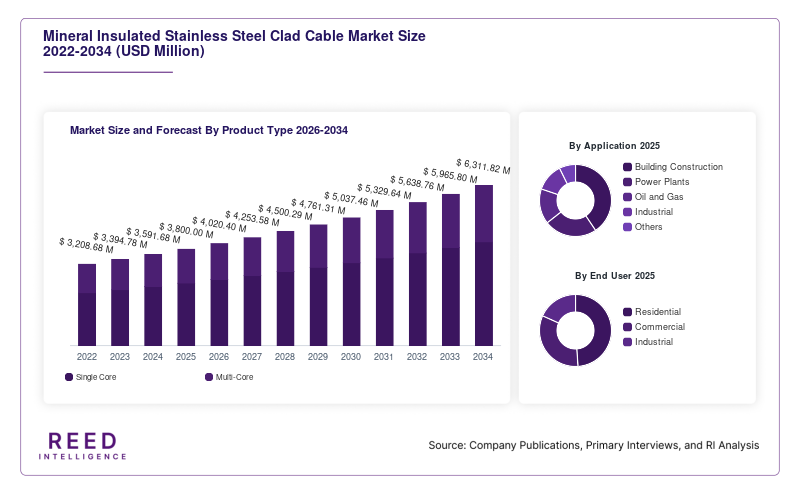
Single Core was the dominant product segment in 2025, accounting for approximately 58.6% of the market. Single-core cables are extensively used in power distribution, control circuits, instrumentation, temperature measurement, and safety-critical systems where independent circuit routing and high reliability are required. Their established use across power plants and industrial facilities supports their leading position.
Multi-Core is the fastest-growing product segment, with an estimated 7.2% CAGR during the forecast period according to available market analysis. Multi-core configurations can reduce the number of individual cable runs and simplify installation where multiple circuits must be routed through constrained spaces. Growing use in commercial buildings, data centers, and retrofit projects supports this segment.
By Application
Building Construction was the dominant application in 2025, accounting for approximately 38.2% of global market revenue. High-rise buildings, commercial properties, hospitals, educational facilities, hotels, and institutional infrastructure use mineral insulated cables for emergency lighting, fire alarms, safety systems, control circuits, and other applications where circuit integrity is critical.
Others represents the fastest-growing application opportunity, with available market analysis indicating approximately 6.8% CAGR through the forecast period. Aerospace, defense, research, telecommunications, semiconductor manufacturing, and other specialized applications increasingly require compact cables capable of operating in extreme thermal and mechanical environments.
By End User
Industrial was the dominant end-user segment in 2025, accounting for approximately 48.3% of market revenue. Power utilities, oil and gas companies, chemical manufacturers, steel producers, pharmaceutical manufacturers, and other industrial operators require high-reliability cable systems for process control, instrumentation, heating, and safety-critical equipment.
Commercial is the fastest-growing end-user opportunity as high-rise buildings, data centers, commercial offices, healthcare facilities, hotels, and retail properties increase investment in fire-resistant and mission-critical electrical infrastructure. The segment benefits from increasingly stringent safety requirements and the modernization of aging building electrical systems.
Mineral Insulated Stainless Steel Clad Cable Market Regional Analysis
North America Mineral Insulated Stainless Steel Clad Cable Market
North America represents a technologically advanced market supported by commercial construction, power infrastructure, oil and gas operations, industrial manufacturing, data centers, and specialized energy facilities. Demand is increasingly focused on high-performance cable systems capable of maintaining reliability in fire, high-temperature, hazardous, and mission-critical environments.
The region also benefits from established suppliers and strong industrial process-heating capabilities. Thermon's MIQ mineral insulated heating cable, for example, uses Alloy 825 sheathing and is designed for high-temperature maintenance and exposure applications, with maximum maintain temperatures reaching 500°C. Exact 2025 market share and market value for North America within the supplied global market dataset are not independently verified.
Europe Mineral Insulated Stainless Steel Clad Cable Market
Europe remains an important market because of strict fire-safety requirements, industrial automation, energy infrastructure modernization, nuclear power applications, and the region's emphasis on reliable electrical systems. Oil and gas, chemical processing, automotive manufacturing, aerospace, and power-generation facilities provide recurring demand for specialized mineral insulated cables.
The European market is also supported by demand for corrosion-resistant and high-temperature cabling in process industries. Mineral insulated technologies are increasingly relevant to applications where electrical performance must be maintained under severe thermal, mechanical, or chemical conditions. Exact comparable 2025 regional market share and market value are unavailable from the same dataset supporting the supplied global market figures.
Asia Pacific Mineral Insulated Stainless Steel Clad Cable Market
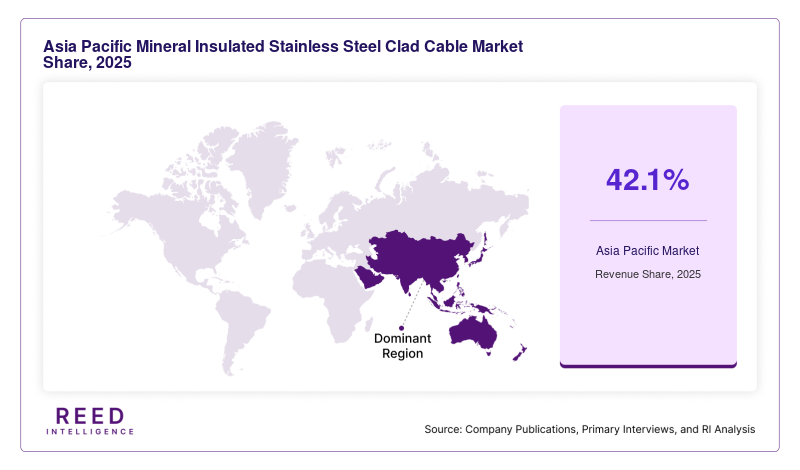
Asia Pacific was the dominant region in the Mineral Insulated Stainless Steel Clad Cable Market in 2025, accounting for approximately 42.1% of global revenue. Based on the supplied 2025 global market size of USD 3,800 Million, the corresponding regional market value is approximately USD 1,600 Million, consistent with the regional market value reported for Asia Pacific.
China, Japan, India, South Korea, and Southeast Asian economies are important demand centers because of rapid industrialization, power-generation investment, manufacturing expansion, semiconductor production, infrastructure construction, and oil and gas development. Japan's Okazaki Manufacturing Company maintains dedicated MI cable manufacturing capabilities using stainless steel and nickel-alloy sheaths for high-temperature and corrosive environments.
Latin America Mineral Insulated Stainless Steel Clad Cable Market
Latin America represents an emerging opportunity supported by oil and gas production, mining, power generation, industrial manufacturing, commercial construction, and infrastructure development. Mineral insulated stainless steel clad cables can provide particular value in petroleum, mining, and industrial facilities where corrosion resistance and high-temperature reliability are important.
Brazil, Mexico, and other industrializing markets are expected to remain important demand centers as infrastructure investment and industrial modernization continue. However, an exact comparable 2025 market share and market value for Latin America based on the supplied global market dataset are not independently verified.
Middle East & Africa Mineral Insulated Stainless Steel Clad Cable Market
The Middle East & Africa market is supported by oil and gas processing, LNG infrastructure, power-generation projects, commercial construction, petrochemical facilities, and large-scale infrastructure development. Harsh ambient conditions and the prevalence of hazardous industrial environments increase the value proposition of high-temperature and corrosion-resistant cable systems.
The region provides particularly strong opportunities in Saudi Arabia, the United Arab Emirates, Qatar, and other energy-producing economies investing in downstream processing, industrial diversification, and infrastructure. Exact comparable 2025 market share and market value are not independently verified from the same global dataset.
Mineral Insulated Stainless Steel Clad Cable Market Competitive Landscape
The Mineral Insulated Stainless Steel Clad Cable Market includes specialized MI cable manufacturers, industrial heating companies, instrumentation suppliers, and large electrical-equipment manufacturers. Competition is primarily based on temperature capability, sheath materials, cable dimensions, insulation quality, manufacturing consistency, customization, certification, application engineering, and global distribution.
Thermon is a major industrial process-heating supplier with mineral insulated cable capabilities through its MIQ product line. Its MIQ cables use Alloy 825 and compacted magnesium-oxide insulation and are designed for high-temperature maintenance, exposure, and high-watt-density applications.
In June 2026, CECO Environmental completed its acquisition of Thermon, creating a larger industrial technology platform. CECO stated that the combined business was seeing strong opportunities in power generation, data centers, semiconductors, and industrial reshoring projects.
Key Market Players
- Thermon Group Holdings, Inc.
- Okazaki Manufacturing Company
- Thermocoax
- Prysmian Group
- Nexans S.A.
- LS Cable & System Ltd.
- KME Germany GmbH
- Raychem RPG Pvt. Ltd.
- Brugg Kabel AG
- MICC Group
Recent Market Developments
- September 2026 Thermocoax expands focus on next-generation MI cable applications
Thermocoax's latest MI cable technology portfolio covers nuclear, aerospace and defense, semiconductor, industrial, and transmission applications, with stainless-steel and other alloy sheathing, multi-core/coaxial/triaxial configurations, and operation in extreme temperature, pressure, vacuum, and radiation environments. The company states that its MI cables can operate at temperatures up to 1,200°C. - July 2026 Thermon continues development of digital heat-trace systems alongside MI cable products
Thermon released Genesis Duo Firmware Version 1.5.0 on July 13, 2026, followed by Egis Platform Version 2.1.0 on July 7, 2026, as part of its heat-trace asset-management and controls/monitoring digitization initiative. Thermon's portfolio includes MIQ mineral-insulated heating cables for high-temperature maintenance and high-watt-density applications.
Mineral Insulated Stainless Steel Clad Cable Market Segments
By Product Type
- Single Core
- Multi-Core
By Application
- Building Construction
- Power Plants
- Oil and Gas
- Industrial
- Others
By End User
- Residential
- Commercial
- Industrial
By Region
- North America
- Europe
- APAC
- Middle East and Africa
- LATAM