Mineral Insulated Thermocouples Market Size, Share & Trends Analysis Report By Type (Base Metal Thermocouples, Noble Metal Thermocouples) and By Application (Aerospace and Defense, Automotive, Chemical and Petrochemical, Power Generation, Oil and Gas, Others) and By End User (Industrial, Commercial, Residential) and By Region (North America, Europe, Asia Pacific, Latin America, Middle East & Africa) Forecasts, 2026–2034
USD 3950
Mineral Insulated Thermocouples Market Size
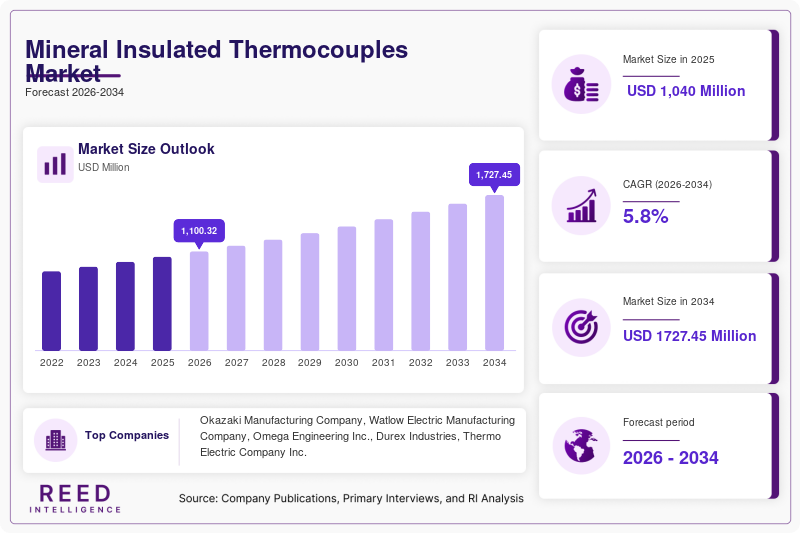
The global mineral insulated thermocouples market was valued at USD 1,040 Million in 2025 and is projected to grow from USD 1,100.32 Million in 2026 to USD 1,727.45 Million by 2034, registering a CAGR of 5.8% during the forecast period from 2026 to 2034.
Mineral insulated thermocouples are temperature sensors in which thermocouple conductors are surrounded by compacted mineral insulation and enclosed within a protective metallic sheath. This construction provides high mechanical strength, flexibility, electrical insulation, rapid response, and reliable operation under high-temperature and chemically aggressive conditions. Their compact construction enables installation in locations where conventional thermocouple assemblies are difficult to deploy.
The technology is particularly important in applications requiring continuous and accurate temperature measurement. Aerospace engine testing, petrochemical processing, furnaces, reactors, power-generation equipment, automotive exhaust systems, semiconductor processing equipment, and advanced manufacturing systems represent important demand centers. Leading manufacturers are increasingly developing customized sheath materials, miniature designs, specialized junction configurations, calibration capabilities, and application-specific assemblies.
Mineral Insulated Thermocouples Market Drivers
Rising Demand for High-Temperature Measurement
The growing use of high-temperature industrial processes is one of the primary drivers of the market. Mineral insulated thermocouples can operate in environments involving high temperatures, vibration, pressure, and corrosive media, making them suitable for furnaces, reactors, turbines, engines, and process equipment.
Expansion of Aerospace and Defense Applications
Aerospace and defense manufacturers require highly reliable thermal measurement during engine development, turbine testing, propulsion testing, flight testing, and thermal-management operations. Mineral insulated thermocouples provide compact and durable sensing capabilities for environments where conventional sensors may experience mechanical or thermal limitations.
Industrial Automation and Predictive Maintenance
Manufacturers are increasingly implementing continuous temperature monitoring as part of predictive maintenance and process optimization strategies. Temperature data can be integrated into control systems and monitoring platforms to identify abnormal operating conditions, equipment degradation, and process deviations before failures occur.
Growth of Semiconductor and Advanced Manufacturing
Semiconductor manufacturing requires highly controlled thermal environments for wafer processing, deposition, etching, furnace operations, and other fabrication stages. Miniaturized and fast-response mineral insulated thermocouples are increasingly suited to these applications because they can provide accurate temperature measurements within restricted equipment spaces.
Mineral Insulated Thermocouples Market Restraints
High Cost of Specialized Thermocouples
Advanced mineral insulated thermocouples using premium sheath materials, noble-metal elements, customized geometries, and certified calibration can carry higher costs than conventional temperature sensors. This can restrict adoption in price-sensitive applications.
Material and Supply-Chain Constraints
The production of specialized thermocouples depends on metals, mineral insulation materials, sheath alloys, connectors, and other precision components. Supply disruptions involving specialty materials can increase manufacturing costs and extend lead times.
Competition from Alternative Temperature Sensors
RTDs, infrared sensors, thermistors, and other temperature-measurement technologies compete with thermocouples in selected applications. Depending on temperature range, accuracy requirements, response time, and installation conditions, alternative technologies may provide more economical or technically appropriate solutions.
Mineral Insulated Thermocouples Market Opportunities
Battery and Hydrogen Applications
The expansion of battery manufacturing and hydrogen infrastructure creates opportunities for mineral insulated thermocouples in thermal runaway testing, electrolyzers, hydrogen storage, thermal processing, and high-temperature equipment. These environments require sensors capable of maintaining reliability under challenging thermal and chemical conditions.
Semiconductor Manufacturing
Expansion of semiconductor fabrication facilities is creating demand for miniature, fast-response, highly traceable temperature sensors. Mineral insulated designs can be customized for confined equipment spaces and demanding thermal-processing environments.
Advanced Nuclear and Energy Applications
Advanced nuclear systems, power-generation technologies, and other extreme-environment energy applications require temperature sensors capable of operating under high radiation, pressure, and temperature conditions. Specialized mineral insulated assemblies can provide an opportunity for suppliers with advanced materials and qualification capabilities.
Mineral Insulated Thermocouples Market Segmental Analysis
By Type
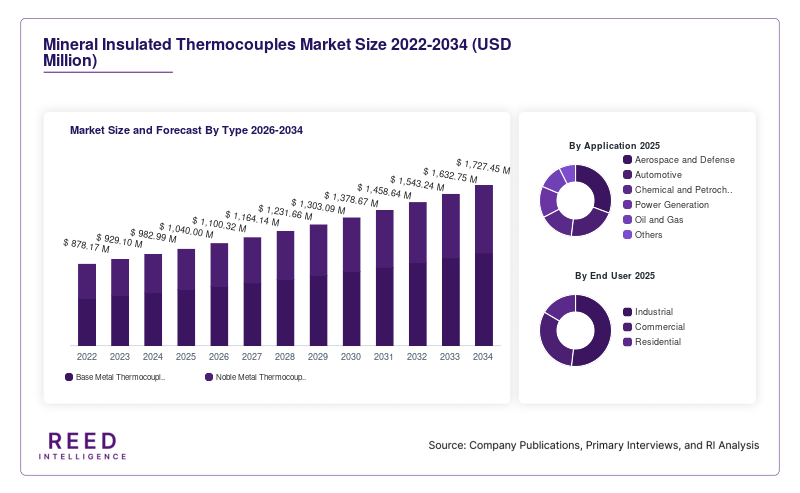
Base Metal Thermocouples dominated the Mineral Insulated Thermocouples Market in 2025, accounting for approximately 62.5% of market revenue. Type K, Type J, and Type N configurations provide a combination of cost efficiency, broad temperature ranges, durability, and suitability for general industrial applications. Their extensive use in furnaces, automotive systems, industrial equipment, and process-control applications supports their leading position.
Noble Metal Thermocouples represent the fastest-growing type segment, with a reported 6.8% CAGR. Their growth is supported by aerospace, advanced manufacturing, research, and other applications where superior accuracy, high-temperature capability, and extended operational performance justify higher sensor costs.
By Application
Aerospace and Defense was the dominant application segment in 2025, accounting for approximately 28.3% of market revenue. Mineral insulated thermocouples are widely used for engine testing, turbine monitoring, propulsion systems, flight testing, and thermal-management applications where sensors must withstand extreme temperature and mechanical conditions.
Chemical and Petrochemical applications represent another major demand center because refineries, chemical plants, reactors, furnaces, and processing equipment require continuous temperature measurement. Demand is also expanding toward specialized applications in hydrogen, advanced energy systems, and high-temperature process equipment.
By End User
Industrial end users dominated the market with approximately 67.4% of demand in 2025. The segment includes manufacturing facilities, process industries, power-generation plants, chemical facilities, refineries, and other industrial operations requiring continuous temperature monitoring and process control.
Industrial demand is expected to remain strong as manufacturers modernize equipment, implement predictive maintenance, automate thermal processes, and increase sensor deployment across production lines. Commercial and residential applications remain comparatively smaller and are primarily associated with specialized temperature-monitoring requirements.
Mineral Insulated Thermocouples Market Regional Analysis
North America Mineral Insulated Thermocouples Market
North America represents a major market for mineral insulated thermocouples due to its aerospace and defense manufacturing base, petrochemical infrastructure, advanced manufacturing sector, power-generation facilities, and semiconductor investments. Demand is increasingly focused on highly qualified, traceable, and application-specific temperature assemblies for critical industrial and aerospace applications.
The region is also benefiting from semiconductor, battery, hydrogen, and advanced manufacturing investments. However, an exact 2025 North American market share and market value compatible with the supplied global Mineral Insulated Thermocouples Market dataset are not independently verified and are therefore not stated as confirmed figures.
Europe Mineral Insulated Thermocouples Market
Europe maintains significant demand for mineral insulated thermocouples through aerospace, automotive, chemical, pharmaceutical, energy, semiconductor, and industrial manufacturing applications. The region's emphasis on process safety, measurement traceability, energy efficiency, and advanced manufacturing supports demand for high-quality thermal sensors.
Specialized manufacturers are increasingly focusing on customized and certified thermal systems. Thermocoax, for example, provides mineral-insulated measurement technologies for aerospace, semiconductor, nuclear, industrial, and other extreme-environment applications. Exact comparable regional market share and market value are unavailable from the same dataset supporting the supplied global market figures.
Asia Pacific Mineral Insulated Thermocouples Market
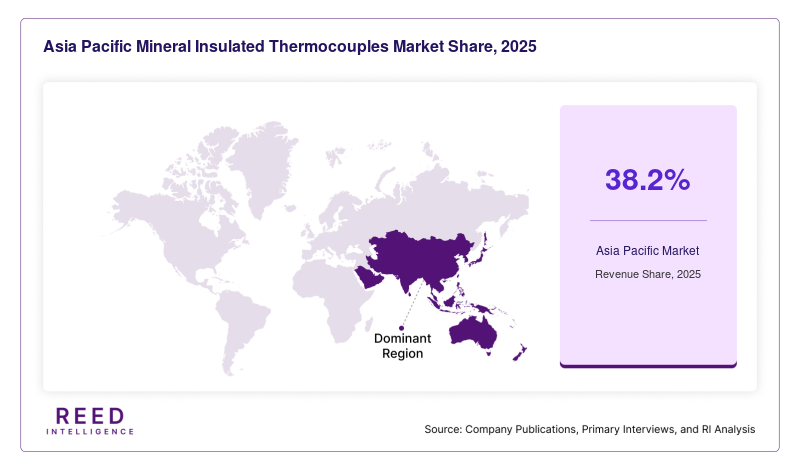
Asia Pacific was the dominant regional market in 2025, accounting for 38.2% of global revenue. Based on the supplied 2025 global market size of USD 1,040 Million, the corresponding derived regional market value is approximately USD 397.28 Million. The region's leadership is supported by industrialization, semiconductor manufacturing, automotive production, petrochemical processing, power generation, and expanding manufacturing capacity in China, India, Japan, and South Korea.
Asia Pacific also benefits from a strong presence of specialized Japanese sensor manufacturers. Okazaki Manufacturing Company, for example, maintains dedicated thermocouple and temperature-sensing capabilities and reported multiple product and industry activities during 2026. The fastest-growing regional CAGR could not be reliably verified for the exact Mineral Insulated Thermocouples Market, so no unsupported regional CAGR is provided.
Latin America Mineral Insulated Thermocouples Market
Latin America represents an emerging opportunity for mineral insulated thermocouple suppliers, supported by oil and gas, mining, chemical processing, power generation, automotive manufacturing, and industrial modernization. Demand is expected to increase as process industries upgrade temperature-monitoring systems and adopt more automated equipment.
The region's oil and gas and mining sectors provide particularly relevant applications because mineral insulated thermocouples can withstand demanding process environments. However, an exact comparable 2025 regional market share and market value could not be verified from the same global market dataset.
Middle East & Africa Mineral Insulated Thermocouples Market
The Middle East & Africa market is supported by petrochemical processing, oil and gas, power generation, industrial infrastructure, and emerging hydrogen and advanced-energy projects. Temperature monitoring remains critical in refineries, chemical plants, gas-processing facilities, and power-generation equipment.
The region also provides opportunities for specialized high-temperature and corrosion-resistant thermocouple assemblies. Nevertheless, an exact comparable 2025 market share and market value for the Mineral Insulated Thermocouples Market are not independently verified and are therefore not presented as confirmed figures.
Mineral Insulated Thermocouples Market Competitive Landscape
The Mineral Insulated Thermocouples Market is characterized by specialized temperature-sensor manufacturers competing through measurement accuracy, response time, operating-temperature capability, sheath materials, customization, calibration, certifications, lead times, and technical support. The market includes global thermal-management companies as well as specialized thermocouple manufacturers serving aerospace, industrial, semiconductor, energy, and process industries.
Okazaki Manufacturing Company is a major Japanese temperature-measurement manufacturer offering thermocouples, resistance thermometer sensors, protection tubes, and electric heaters. Its portfolio includes specialized mineral insulated thermocouples and explosion/flame-proof temperature sensors certified for several international hazardous-area requirements.
Key Market Players
- Okazaki Manufacturing Company
- Watlow Electric Manufacturing Company
- Omega Engineering Inc.
- Durex Industries
- Thermo Electric Company Inc.
- JUMO GmbH & Co. KG
- Yamari Industries Ltd.
- Conax Technologies
- Thermocoax
- TC Ltd.
Mineral Insulated Thermocouples Market Recent Developments
- April 2026 ASTM International introduces a new high-temperature, irradiation-resistant thermocouple specification
ASTM published E3536/E3536M-26, covering compacted mineral-insulated, niobium-sheathed thermocouples designed for high-temperature and high-radiation environments. The specification covers operation up to 1,600°C and neutron fluence up to 10²² n/cm², with specific dimensional, material, processing, testing, and quality-assurance requirements. This is particularly relevant to nuclear reactor instrumentation and other extreme-environment temperature-monitoring applications. - September 2026 Thermocoax strengthens mineral-insulated sensing technology for extreme environments
Thermocoax highlighted its mineral-insulated cable technology for nuclear, aerospace and defense, semiconductor, and industrial applications. Its MI systems are designed for high-temperature, high-pressure, high-vacuum, and radioactive environments, with ceramic-metal interfaces, multi-conductor configurations, EMC screening, and severe-environment testing.
Mineral Insulated Thermocouples Market Segments
By Type
- Base Metal Thermocouples
- Noble Metal Thermocouples
By Application
- Aerospace and Defense
- Automotive
- Chemical and Petrochemical
- Power Generation
- Oil and Gas
- Others
By End User
- Industrial
- Commercial
- Residential
By Region
- North America
- Europe
- APAC
- Middle East and Africa
- LATAM