Mineral Lubricant Market Size, Share & Trends Analysis Report By Product Type (Paraffinic Oils, Naphthenic Oils, Aromatic Oils) and By Application (Automotive, Industrial) and By End User (Manufacturing, Transportation) and By Distribution Channel (Online Stores, Specialty Stores) and By Region (North America, Europe, Asia Pacific, Latin America, Middle East & Africa) Forecasts, 2026–2034
USD 3950
Mineral Lubricant Market Size
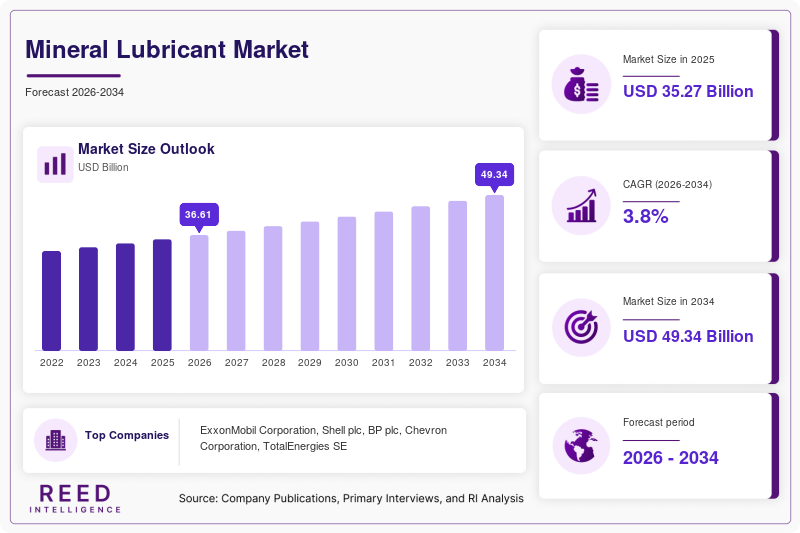
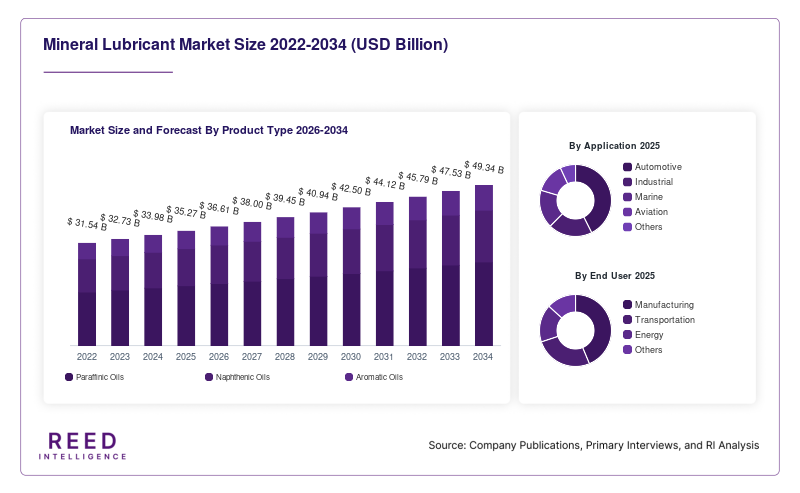
The global mineral lubricant market was valued at USD 35.27 billion in 2025 and is projected to grow from USD 36.61 billion in 2026 to USD 49.34 billion by 2034, registering a CAGR of 3.8% during the forecast period.
Mineral lubricants are petroleum-derived lubrication fluids primarily produced through the refining and processing of crude-oil fractions. They are widely used as base fluids in engine oils, hydraulic fluids, gear oils, turbine oils, compressor oils, metalworking fluids, and other industrial lubrication formulations. Their established manufacturing infrastructure, relatively competitive pricing, formulation flexibility, and broad availability continue to support their use across mature and emerging economies.
Automotive and industrial applications represent major demand centers. Automotive applications accounted for approximately 38.5% of mineral lubricant consumption in 2025, supported by vehicle maintenance, commercial transportation, engine lubrication, transmission systems, and aftermarket requirements. Industrial demand is reinforced by manufacturing automation, machinery utilization, power generation, mining, construction, and energy infrastructure.
Mineral Lubricant Market Drivers
Growth in Automotive Fleet and Vehicle Maintenance:
The expansion of passenger vehicles, commercial fleets, trucks, buses, and logistics vehicles continues to generate recurring demand for engine oils, transmission fluids, gear oils, and other mineral-based lubricants. Emerging economies remain particularly important because increasing vehicle ownership and expanding transportation activity generate sustained aftermarket consumption.
Industrialization and Manufacturing Expansion:
Growing manufacturing capacity in Asia Pacific, Latin America, and other developing markets is increasing the installed base of industrial machinery. Hydraulic systems, compressors, gearboxes, pumps, turbines, and production equipment require regular lubrication to reduce friction, wear, corrosion, and unplanned downtime.
Infrastructure and Energy Development:
Expansion of power generation, oil and gas infrastructure, construction, mining, and transportation networks supports lubricant consumption in heavy-duty equipment and machinery. Mineral lubricants continue to offer cost-effective lubrication for equipment operating under demanding industrial conditions.
Mineral Lubricant Market Restraints
Increasing Adoption of Synthetic Lubricants:
Synthetic lubricants provide advantages such as improved thermal stability, extended drain intervals, and enhanced performance under extreme conditions. Their increasing adoption in premium automotive and industrial applications can limit the volume growth of conventional mineral lubricant products.
Environmental Regulations:
Growing regulatory attention toward petroleum-derived products, lubricant disposal, emissions, and environmental contamination is encouraging manufacturers and end users to consider lower-impact alternatives. Compliance requirements can increase formulation, manufacturing, testing, and disposal costs.
Electrification of Transportation:
Battery electric vehicles generally require fewer conventional engine-lubrication products than internal-combustion vehicles. Increasing EV penetration can therefore reduce long-term demand for traditional engine oils, particularly in mature automotive markets.
Mineral Lubricant Market Opportunities
Advanced Mineral Lubricant Formulations:
Manufacturers can develop higher-performance mineral lubricant formulations using advanced additive technologies, improved viscosity control, oxidation resistance, corrosion protection, and extended-drain capabilities.
Emerging-Market Expansion:
Rapid industrialization, vehicle ownership growth, manufacturing expansion, and infrastructure investment across India, China, Southeast Asia, Latin America, and parts of the Middle East and Africa create opportunities for lubricant manufacturers.
Specialized Industrial Lubricants:
Demand for specialized hydraulic fluids, compressor oils, turbine oils, marine lubricants, and high-performance industrial fluids provides opportunities to increase value per unit rather than relying solely on volume growth.
Mineral Lubricant Market Segmental Analysis
By Product Type
Paraffinic oils represent the dominant product type in the mineral lubricant market, accounting for approximately 42.5% of market volume. Their strong position results from broad utilization in automotive and industrial lubrication, favorable oxidation stability, and their suitability for engine oils, hydraulic fluids, gear oils, and related formulations.
Naphthenic oils are positioned as the fastest-growing product category within the mineral lubricant market due to their low-pour-point characteristics, solvency, and suitability for specialized industrial applications. However, an exact comparable 2026–2034 CAGR for the segment could not be independently verified and is therefore not stated.
Aromatic Oils:
Aromatic oils remain a specialized segment used primarily where high solvency and compatibility are required. Applications include certain rubber-processing, sealant, adhesive, and specialty industrial formulations.
By Application
Automotive applications represent the dominant application segment, accounting for approximately 38.5% of mineral lubricant consumption. Demand is supported by engine oils, transmission fluids, differential oils, and aftermarket maintenance requirements across passenger and commercial vehicle fleets.
Industrial applications are expected to represent the fastest-growing major application area as manufacturing automation, industrial machinery deployment, infrastructure development, and equipment maintenance requirements increase. A reliable market-specific CAGR for this segment was not independently verified.
Marine lubricants are required for propulsion engines, auxiliary machinery, turbines, and other onboard systems. Growth in maritime transportation and global trade supports continued demand for specialized marine lubrication products.
Aviation applications require high-performance lubricants capable of maintaining reliability under demanding temperature and operating conditions. Aircraft fleet expansion and increasing air transportation activity support long-term demand.
By End User
Manufacturing represents the dominant end-user segment due to extensive utilization of mineral lubricants in production machinery, hydraulic systems, compressors, gearboxes, pumps, and other industrial equipment.
Transportation is positioned as the fastest-growing end-user segment, supported by expanding vehicle fleets, logistics activity, commercial transportation, and maintenance requirements in emerging economies. Exact segment-specific CAGR is unavailable from a sufficiently comparable source.
The energy sector uses mineral lubricants across turbines, compressors, pumps, generators, and other equipment. Expansion of power-generation and energy infrastructure supports demand.
Construction, agriculture, mining, and other heavy-equipment industries contribute additional demand through machinery and equipment maintenance.
By Distribution Channel
Specialty stores and technical distributors remain a dominant channel because automotive and industrial buyers often require product-specific recommendations, technical specifications, and application support.
Online stores represent the fastest-growing distribution channel as e-commerce penetration increases and customers increasingly purchase automotive and industrial products through digital platforms. Exact market-specific CAGR was not independently verified.
Supermarkets and hypermarkets remain relevant primarily for consumer automotive lubricants and household applications due to broad geographic reach and convenience. Authorized dealers, distributors, service centers, and direct industrial sales remain important for bulk and technically specified lubricant purchases.
Mineral Lubricant Market Regional Analysis
North America Mineral Lubricant Market
North America represents a mature mineral lubricant market supported by established automotive fleets, industrial manufacturing, energy infrastructure, construction, and transportation activity. The region has strong demand for automotive and industrial lubrication products, although growth is moderated by mature vehicle ownership and increasing adoption of synthetic formulations.
The United States remains the principal market in the region, supported by extensive manufacturing, transportation, energy, and heavy-equipment applications. Demand is increasingly shifting toward higher-performance formulations and specialized industrial fluids rather than simple volume expansion.
Europe Mineral Lubricant Market
Europe is a significant mineral lubricant market supported by automotive manufacturing, industrial machinery, transportation, marine activity, and established maintenance networks. The region's mature industrial base provides stable demand, while environmental regulations are encouraging manufacturers to improve formulation efficiency and develop lower-impact products.
Germany, France, Italy, and the United Kingdom remain important markets because of their manufacturing and automotive industries. The transition toward electric mobility is expected to constrain conventional engine-oil consumption over the long term, increasing the importance of industrial and specialized lubrication applications.
Asia Pacific Mineral Lubricant Market
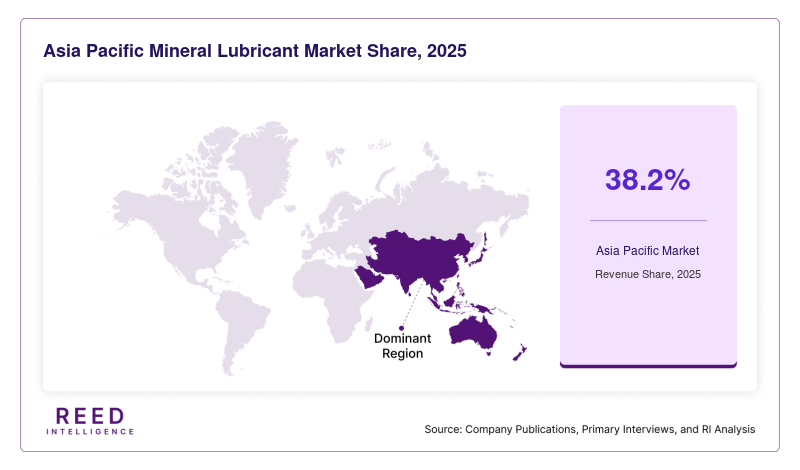
Asia Pacific accounted for 38.2% of global mineral lubricant revenue in 2025, making it the dominant regional market. Based on the supplied 2025 global market size of USD 35.27 billion, the corresponding regional market value is approximately USD 13.47 billion, derived using the verified 38.2% share.
The region is also expected to remain the fastest-growing regional market through 2034. China, India, Japan, South Korea, and Southeast Asian economies benefit from expanding vehicle fleets, manufacturing capacity, industrial infrastructure, construction activity, and energy projects. Asia Pacific's rapid industrialization and automotive production make it the principal incremental demand center for mineral lubricants.
Latin America Mineral Lubricant Market
Latin America represents an emerging mineral lubricant market supported by automotive activity, mining, agriculture, construction, manufacturing, and energy infrastructure. Demand is particularly linked to heavy equipment and transportation fleets requiring regular maintenance and lubrication.
Brazil and Mexico are major contributors to regional demand due to their manufacturing, automotive, mining, and transportation industries. Expansion of infrastructure and industrial activity is expected to provide additional opportunities for lubricant suppliers.
Middle East & Africa Mineral Lubricant Market
The Middle East & Africa market is supported by oil and gas operations, power generation, construction, mining, transportation, and infrastructure development. Heavy machinery and energy-sector equipment create recurring demand for hydraulic oils, engine oils, turbine lubricants, gear oils, and industrial fluids.
Saudi Arabia, the UAE, South Africa, and other industrializing economies provide significant opportunities for market participants. Infrastructure development and industrial diversification are expected to support lubricant consumption, although market growth varies considerably across individual countries.
Mineral Lubricant Market Competitive Landscape
The mineral lubricant market is highly competitive, with global integrated energy companies and specialized lubricant manufacturers competing through extensive distribution networks, product innovation, formulation capabilities, OEM relationships, and manufacturing scale.
ExxonMobil Corporation is one of the leading participants, offering Mobil-branded automotive and industrial lubrication solutions supported by integrated base-oil production and global distribution capabilities. The company continues to invest in higher-value base stocks and lubricant manufacturing capacity. In 2026, ExxonMobil highlighted investments in base-stock capacity and a new lubricant manufacturing facility in India with planned capacity of 159,000 kiloliters per year.
Key Market Players
- ExxonMobil Corporation
- Shell plc
- BP plc
- Chevron Corporation
- TotalEnergies SE
- PetroChina Company Limited
- China Petroleum & Chemical Corporation (Sinopec)
- Fuchs SE
- Valvoline Inc.
- Idemitsu Kosan Co., Ltd.
- PJSC LUKOIL
Mineral Lubricant Market Recent Developments
- September 2026 Shell: Shell officially inaugurated its new Grease Manufacturing Plant in Indonesia, with production capacity of up to 12 kilotonnes per year. The facility is located within Shell’s Marunda Lubricants Oil Blending Plant complex in Bekasi and is designed to supply grease products for manufacturing, mining, transportation, power generation, construction, and other industrial applications.
- June 2026 ExxonMobil: ExxonMobil reported that disruptions to premium base-oil supplies from the Middle East were placing pressure on the global lubricants supply chain. The company stated that it was responding through integrated global base-oil assets, lubricant reformulation capabilities, diversified sourcing, and continued investment in base-oil capacity.
Mineral Lubricant Market Segments
By Product Type
- Paraffinic Oils
- Naphthenic Oils
- Aromatic Oils
By Application
- Automotive
- Industrial
- Marine
- Aviation
- Others
By End User
- Manufacturing
- Transportation
- Energy
- Others
By Distribution Channel
- Online Stores
- Specialty Stores
- Supermarkets/Hypermarkets
- Others
By Region
- North America
- Europe
- APAC
- Middle East and Africa
- LATAM