Mineral Processing for Lubrication Systems Market Size, Share & Trends Analysis Report By Technology (Advanced Filtration Systems, Particle Separation Technologies, Other Technologies) and By Application (Automotive Lubrication, Industrial Machinery, Other Applications) and By Region (North America, Europe, Asia Pacific, Latin America, Middle East & Africa) Forecasts, 2026–2034
USD 3950
Mineral Processing for Lubrication Systems Market Size
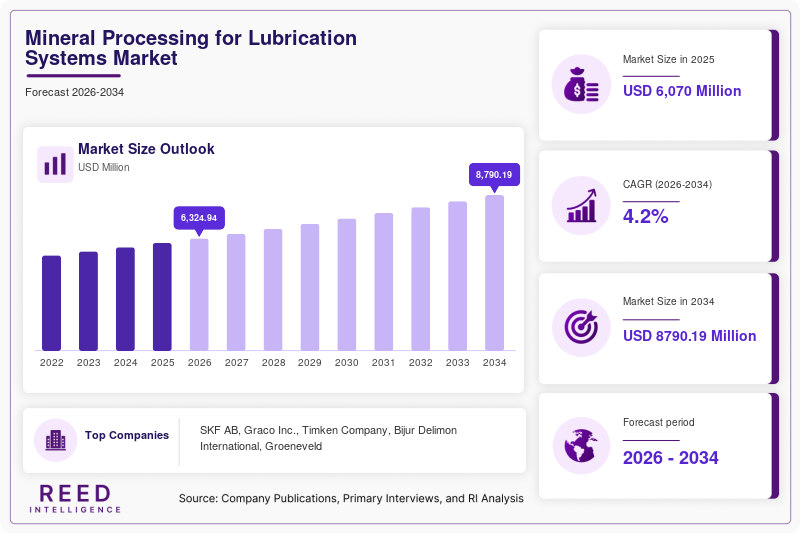
The global mineral processing for lubrication systems market was valued at USD 6,070 Million in 2025 and is projected to grow from USD 6,324.94 Million in 2026 to USD 8,790.19 Million by 2034, registering a CAGR of 4.2% during the forecast period from 2026 to 2034.
The Mineral Processing for Lubrication Systems Market is expanding as manufacturers and industrial operators increasingly prioritize lubricant cleanliness, equipment reliability, energy efficiency, and predictive maintenance. Lubricants operating in automotive and industrial machinery are exposed to dust, metallic particles, water, oxidation products, and other contaminants that can accelerate component degradation. Mineral processing technologies help remove these contaminants and maintain the required lubricant quality.
The transition from conventional maintenance practices toward condition-based and predictive maintenance is strengthening demand for advanced processing systems. Automated monitoring, particle counting, filtration, separation, and connected maintenance technologies are increasingly being integrated into industrial lubrication programs. Industry research also highlights the growing adoption of automated lubrication systems and IIoT-enabled predictive maintenance across mineral-processing and heavy-industrial applications.
Mineral Processing for Lubrication Systems Market Drivers
Increasing Demand for Equipment Reliability
Industrial equipment operates under high loads, elevated temperatures, contamination, and continuous operating cycles. Effective lubricant processing helps maintain lubricant cleanliness and performance, reducing friction, wear, and premature component failure. The need to extend equipment life and improve asset utilization is therefore increasing demand for mineral processing technologies.
Growth of Automotive and Industrial Machinery
The continued expansion of automotive manufacturing and industrial machinery is creating a larger installed base of engines, bearings, hydraulic systems, gears, compressors, pumps, and other components requiring controlled lubrication. As machinery becomes more sophisticated, operators require higher-quality lubricants and better contamination management.
Adoption of Predictive Maintenance
Predictive maintenance is encouraging companies to move beyond periodic manual maintenance toward continuous equipment monitoring. Lubricant cleanliness, particle concentration, temperature, viscosity, and other parameters can provide valuable indications of component condition. Integration of processing and monitoring technologies therefore supports more proactive maintenance strategies.
Mineral Processing for Lubrication Systems Market Restraints
High Initial Investment
Advanced filtration, separation, monitoring, and automated processing systems require higher upfront capital investment than conventional maintenance and basic filtration equipment. Smaller industrial operators may delay investments because of budget constraints, particularly when the return on investment depends on long-term reductions in downtime and maintenance costs.
Maintenance and Technical Complexity
Advanced processing systems require trained personnel, appropriate equipment configuration, periodic servicing, replacement filters, monitoring components, and technical support. Improper installation or maintenance can reduce system effectiveness and increase operating costs.
Fragmented Industrial Requirements
Lubrication requirements vary substantially according to machinery type, operating temperature, lubricant formulation, contamination profile, and industrial environment. The need for application-specific solutions can increase engineering complexity and limit standardization across customers.
Mineral Processing for Lubrication Systems Market Opportunities
Expansion of Automated Processing and Lubrication
The transition toward automated and centralized lubrication creates opportunities for manufacturers to integrate mineral processing, lubrication delivery, monitoring, and maintenance technologies into unified systems. Automated solutions can improve lubricant consistency while reducing manual intervention.
IIoT and Smart Monitoring Integration
Connected sensors and digital monitoring platforms create opportunities for real-time lubricant-quality assessment and predictive maintenance. Integration of particle monitoring, pressure measurement, temperature sensing, and lubricant-level monitoring can enable operators to identify contamination and equipment problems earlier.
Growth of Emerging Industrial Markets
India, China, Southeast Asia, Latin America, and selected Middle Eastern and African markets offer opportunities because of industrialization, infrastructure investment, automotive production, and mining expansion. Emerging markets can provide significant demand for reliable equipment-maintenance technologies as industrial assets become increasingly automated.
Sustainable Lubrication and Reclamation
Growing environmental pressure is encouraging the development of technologies that extend lubricant life, reduce waste, and improve recycling and reclamation. Mineral processing solutions capable of recovering usable lubricant and reducing disposal requirements can benefit from circular-economy initiatives.
Mineral Processing for Lubrication Systems Market Segmental Analysis
By Technology
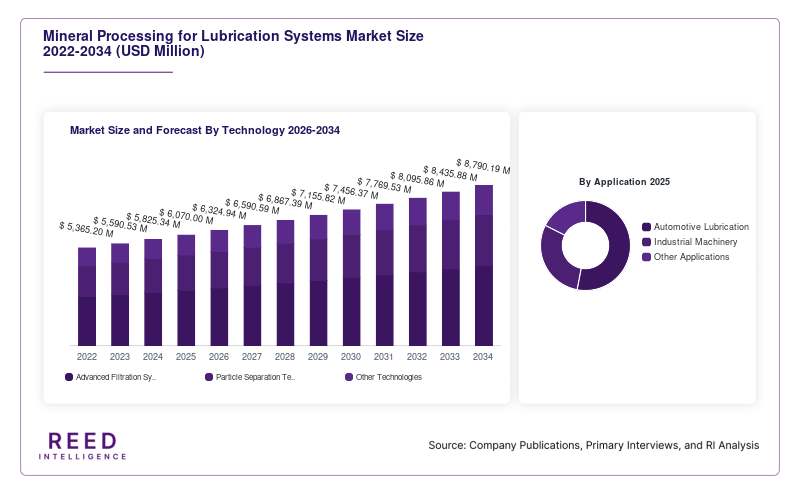
Advanced filtration systems represent the dominant technology segment, accounting for approximately 42.5% of the global market. Their leadership is supported by the widespread requirement to remove particulate contamination, protect precision components, improve lubricant cleanliness, and extend lubricant service intervals. Advanced filtration is particularly important in automotive and industrial machinery where contamination can accelerate component wear and reduce operational efficiency.
Particle separation technologies include solutions based on centrifugation, hydrocyclone-type separation, and related techniques used to remove contaminants from lubricants. These technologies are increasingly relevant where conventional filtration is insufficient or where operators require continuous processing and high contamination-removal efficiency. Their adoption is supported by growing awareness of lubricant cleanliness and the cost of equipment downtime.
Other technologies include complementary processing and conditioning solutions used to manage water, contaminants, degradation products, and lubricant quality. Demand for these technologies is increasing as industrial users seek integrated approaches combining filtration, separation, monitoring, and lubricant reclamation rather than relying on a single processing method.
By Application
Automotive lubrication represents the dominant application segment, accounting for approximately 48.7% of the market. High lubricant consumption across engines, transmissions, hydraulic systems, and other automotive components supports demand for processing technologies that improve lubricant cleanliness and performance. Increasing vehicle production and increasingly stringent requirements for engine and component efficiency further reinforce demand.
Industrial machinery represents another major application, supported by demand from manufacturing equipment, hydraulic systems, compressors, pumps, gears, bearings, conveyors, and heavy-duty machinery. Industrial operators increasingly use lubricant-processing technologies to reduce contamination-related failures and improve equipment availability.
Industrial Machinery is expected to remain a key growth area, particularly as manufacturers increasingly adopt automated maintenance, connected monitoring, and predictive-maintenance programs. Mineral processing and lubrication solutions are already widely applied across heavy mineral-processing equipment, including conveyors, crushers, grinders, kilns, and ball mills.
Other applications include specialized machinery and equipment requiring lubricant conditioning and contamination management. Demand is supported by equipment reliability requirements and the increasing adoption of maintenance programs focused on extending lubricant and component life.
Mineral Processing for Lubrication Systems Market Regional Analysis
North America Mineral Processing for Lubrication Systems Market
North America represents a mature market characterized by high adoption of industrial automation, advanced maintenance technologies, and sophisticated lubrication-management practices. Mining, manufacturing, automotive production, energy infrastructure, and heavy equipment applications generate demand for high-performance filtration and lubricant-processing technologies.
The region is increasingly emphasizing automated lubrication, connectivity, and condition-based maintenance. Industrial operators are using connected fluid-management and lubrication technologies to reduce manual intervention and improve equipment reliability, particularly in heavy-duty applications.
Europe Mineral Processing for Lubrication Systems Market
Europe represents an important market driven by advanced manufacturing, automotive production, machinery modernization, environmental requirements, and strong emphasis on resource efficiency. Industrial users are increasingly focused on extending lubricant life, reducing waste, and improving equipment energy efficiency.
European demand is also supported by the transition toward automated lubrication and predictive maintenance. Manufacturers are investing in solutions that improve maintenance visibility and reduce unnecessary lubricant consumption while maintaining equipment reliability.
Asia Pacific Mineral Processing for Lubrication Systems Market
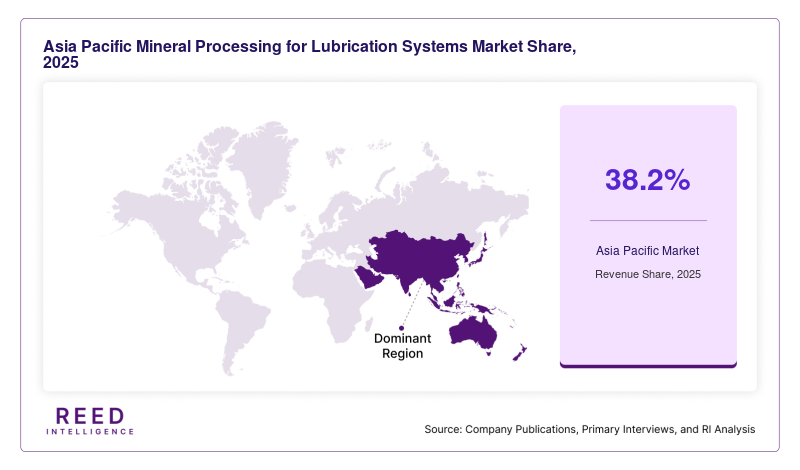
Asia Pacific is the dominant regional market, accounting for 38.2% of global market share in 2025. Based on the supplied global market size of USD 6,070 Million in 2025, this corresponds to approximately USD 2.32 Billion in regional market value. This regional value is consistent with the reported 38.2% share.
The region's leadership is supported by rapid industrialization, large-scale automotive manufacturing, mining activity, infrastructure development, and expanding machinery production. China and India are particularly important demand centers. Available industry analysis also identifies Asia Pacific as a high-growth regional market, although an exact comparable regional CAGR is not publicly disclosed in the same dataset used for the 38.2% market-share figure.
Latin America Mineral Processing for Lubrication Systems Market
Latin America offers substantial growth opportunities because of its mining resources, expanding industrial operations, and increasing investment in equipment modernization. Brazil, Chile, Peru, Mexico, and other markets generate demand for reliable lubrication solutions across mining, mineral processing, industrial machinery, and automotive applications.
Mining-intensive operations particularly benefit from automated lubrication and lubricant-processing technologies because equipment operates under severe contamination and load conditions. Increased focus on uptime, safety, and maintenance efficiency is expected to support market development.
Middle East & Africa Mineral Processing for Lubrication Systems Market
The Middle East & Africa market is supported by industrial diversification, mining activity, infrastructure development, energy projects, and increasing investment in heavy machinery. Mining operations in Africa represent a particularly important opportunity for automated lubrication and lubricant-processing systems.
Demand is also increasing for technologies that reduce manual maintenance requirements and improve equipment availability under harsh operating conditions. Expansion of mineral-processing capacity and modernization of industrial facilities should create additional opportunities for advanced filtration and particle-separation solutions.
Mineral Processing for Lubrication Systems Market Competitive Landscape
The Mineral Processing for Lubrication Systems Market is moderately fragmented, with global lubrication-equipment manufacturers, fluid-management companies, filtration specialists, and lubricant suppliers competing across different application areas. Competition is increasingly shifting toward automated systems, connectivity, monitoring, system integration, and application-specific engineering.
SKF is a major global supplier of bearings, seals, lubrication systems, condition-monitoring solutions, and related technologies. Its lubrication portfolio covers automatic lubrication and condition-monitoring applications designed to reduce friction, improve equipment reliability, and lower maintenance requirements. In September 2026, SKF launched its Progressive Lubrication Pump (PLP), expanding its automatic lubrication platform with improved lubricant-level visibility and connectivity options.
Key Market Players
- SKF AB
- Graco Inc.
- Timken Company
- Bijur Delimon International
- Groeneveld
- BEKA
- Lube Corporation
- Alemlube
- Baier Koppel
- Castrol-Lubecon
- Cenlub Industries Limited
Mineral Processing for Lubrication Systems Market Recent Developments
- September 2026 SKF launched Progressive Lubrication Pump (PLP)
SKF launched its new Progressive Lubrication Pump (PLP), an automatic lubrication solution designed to improve machine reliability, reduce maintenance effort, and lower total ownership costs. The system provides improved visibility of lubricant levels and system status and includes connectivity options. The launch is particularly relevant to industrial and mobile equipment lubrication applications. - March 2026 Graco introduced Pulse Mobile automated fluid-management system
Graco introduced Pulse Mobile at CONEXPO 2026, a wirelessly connected and automated fluid-management system for field equipment servicing. The system automatically tracks fluid dispensing from lubrication and service trucks, connects dispensed fluids with specific assets and work orders, and uploads data to a cloud platform. The solution specifically targets mining, construction, and logging applications.
Mineral Processing for Lubrication Systems Market Segments
By Technology
- Advanced Filtration Systems
- Particle Separation Technologies
- Other Technologies
By Application
- Automotive Lubrication
- Industrial Machinery
- Other Applications
By Region
- North America
- Europe
- APAC
- Middle East and Africa
- LATAM