Mineral Supplements Market Size, Share & Trends Analysis Report By Product (Calcium, Magnesium, Iron) and By Type (Individual Minerals, Multiminerals) and By Formulation (Capsule, Tablet, Powder) and By Age Group (Pediatrics, Adults) and By Application (General Health, Bone & Joint Health, Gastrointestinal Health,) and By Distribution Channel (Retail Pharmacies & Drug Stores, Online Channels, Others) and Forecasts 2026–2034
USD 3950
Mineral Supplements Market Size
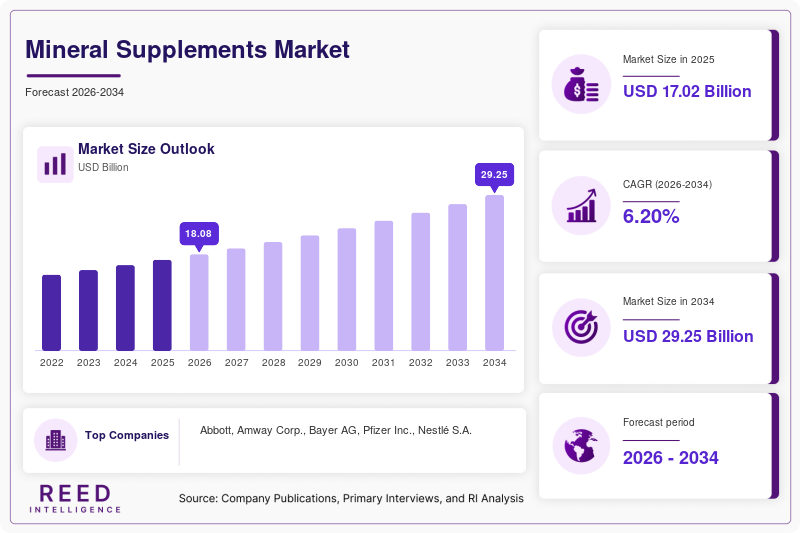
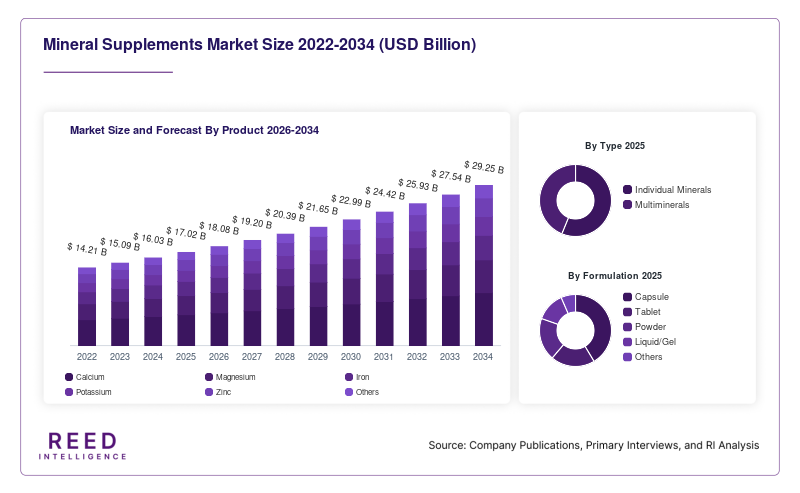
The global Mineral Supplements Market was valued at USD 17.02 Billion in 2025 and is projected to grow from USD 18.08 Billion in 2026 to USD 29.25 Billion by 2034, registering a CAGR of 6.20% during the forecast period from 2026 to 2034.
The Mineral Supplements Market comprises products containing essential minerals such as calcium, magnesium, iron, potassium, zinc, and other trace minerals that supplement dietary intake. These products are consumed across different age groups and are positioned around applications including general health, bone and joint health, gastrointestinal health, women's health, immunity, and other nutritional requirements. Calcium remains the leading product category, while individual-mineral products account for the largest type segment.
Demand is increasingly moving toward science-backed, bioavailable, convenient, and targeted formulations. Consumers are seeking products that address specific nutritional needs rather than relying exclusively on broad multivitamin products. Innovation in mineral forms, absorption characteristics, clean-label formulations, gummies, powders, and liquid products is creating additional opportunities for manufacturers. Earlier industry research also highlighted bioavailable magnesium, zinc, and calcium citrate innovations designed for improved formulation performance and consumer acceptance.
Mineral Supplements Market Drivers
Increasing Nutritional Deficiencies:
The prevalence of mineral deficiencies and inadequate dietary intake is a major factor supporting demand. Calcium, iron, magnesium, zinc, and other minerals are increasingly incorporated into preventive nutrition routines, particularly among aging populations, women, children, and consumers with restricted or unbalanced diets.
Growing Health and Wellness Awareness:
Consumers are increasingly adopting supplements as part of preventive healthcare and everyday wellness routines. Demand is expanding beyond deficiency correction toward bone health, muscle function, energy metabolism, immunity, cardiovascular wellness, and healthy aging.
Healthy Aging and Bone Health Demand:
Population aging is strengthening demand for calcium, magnesium, vitamin-mineral combinations, and other products positioned around bone and joint health. Companies are increasingly developing products specifically targeted at older adults and age-related nutritional requirements.
Product Innovation and Improved Bioavailability:
Manufacturers are investing in more effective mineral forms and consumer-friendly delivery formats. Micronized minerals, chelated minerals, gummies, powders, liquids, and targeted formulations are helping manufacturers address absorption, taste, convenience, and compliance challenges.
Mineral Supplements Market Restraints
Regulatory and Compliance Requirements:
Mineral supplements are subject to different regulatory requirements concerning ingredient safety, health claims, labeling, dosage, manufacturing, and advertising across countries. Increasing scrutiny can raise product-development costs and extend commercialization timelines.
Consumer Price Sensitivity:
Premium mineral formulations using specialized ingredients, advanced delivery technologies, and higher-quality raw materials can carry higher prices. Price-sensitive consumers may therefore shift toward private-label or conventional mineral products.
Potential Side Effects From Excessive Intake:
Excessive consumption of certain minerals can create health risks. This increases the importance of appropriate dosage, responsible marketing, scientific substantiation, and consumer education.
Raw Material and Supply Chain Volatility:
Mineral ingredients, specialty formulations, packaging materials, and manufacturing inputs can experience cost and availability fluctuations. Supply-chain disruptions can affect margins and product availability.
Mineral Supplements Market Opportunities
Expansion of Targeted Mineral Formulations:
Manufacturers can develop products specifically addressing women's health, children's nutrition, healthy aging, sports nutrition, bone health, immunity, and digestive wellness.
Growth of Online Supplement Sales:
Digital commerce provides manufacturers with direct access to consumers and enables personalized product recommendations, subscriptions, education, and broader geographic distribution.
Clean-Label and Bioavailable Minerals:
Demand for recognizable ingredients, natural sources, improved absorption, and transparent formulation creates opportunities for differentiated products.
Emerging-Market Expansion:
Increasing healthcare awareness, urbanization, rising disposable incomes, and growing access to modern retail and e-commerce provide opportunities across Asia Pacific, Latin America, and selected Middle Eastern markets.
Mineral Supplements Market Segmental Analysis
By Product
Calcium is the dominant product segment in the Mineral Supplements Market. The latest market assessment projects calcium to account for approximately 32.25% of the global market in 2026. Calcium's leading position is supported by widespread consumer awareness around bone health, osteoporosis prevention, muscle function, and nutritional requirements among aging populations and other demographic groups.
Magnesium is gaining importance because of increasing consumer interest in muscle function, sleep, stress management, energy metabolism, and general wellness. Iron remains important in nutritional deficiency management, particularly among women and children, while zinc benefits from demand associated with immunity and general nutritional support. Potassium and other trace minerals provide additional opportunities through targeted formulations.
The fastest-growing product opportunity cannot be assigned a reliable global CAGR from the same dataset without introducing an incompatible market estimate. However, magnesium, zinc, and specialized trace-mineral formulations are experiencing increasing product innovation and consumer interest.
By Type
Individual Minerals represent the dominant type segment and are projected to account for approximately 64.99% of the market in 2026. Their leadership is supported by targeted consumer demand, easier positioning around specific nutritional requirements, and established use of products such as calcium, magnesium, iron, and zinc supplements.
Multiminerals remain important for consumers seeking broader nutritional coverage from a single product. Their use is supported by convenience and simplified supplementation routines, particularly among consumers seeking general health and preventive nutrition products.
The fastest-growing type cannot be assigned a verified global CAGR from the available compatible dataset. Product-specific innovation is nevertheless strengthening opportunities for both targeted individual minerals and multi-mineral formulations.
By Formulation
Tablets and capsules remain important because of their defined dosage, portability, manufacturing efficiency, and established consumer familiarity. These formats are particularly suitable for calcium, magnesium, iron, and zinc products.
Powders and liquid/gel formulations are gaining relevance where manufacturers want to improve flexibility, flavor, absorption characteristics, or consumer convenience. Gummies and other innovative formats are also expanding the category by making supplementation more accessible to consumers who dislike conventional tablets. Industry research identifies innovation in delivery formats as an important market trend.
The fastest-growing formulation cannot be assigned a reliable global CAGR from the compatible 2026 market dataset without mixing estimates from different market definitions.
By Age Group
Adults represent the dominant age-group segment because mineral supplementation is widely adopted for general wellness, nutritional adequacy, bone health, muscle function, immunity, and healthy aging.
Pediatrics represent an important growth opportunity because nutritional deficiencies and inadequate dietary diversity can increase demand for age-specific supplementation. Abbott's August 2026 research, for example, reported improved growth, lean-mass, and bone-health outcomes among Indian children at risk of undernutrition receiving an oral nutritional supplement alongside dietary counseling.
By Application
General Health is a major application because consumers increasingly use mineral supplements as part of routine preventive nutrition. Products positioned around everyday nutritional adequacy have broad applicability across demographic groups.
Bone & Joint Health represents a particularly important application because calcium and magnesium supplementation are closely associated with bone-health positioning. Women's Health also presents significant opportunity because mineral requirements can vary across life stages, including pregnancy and later adulthood.
The fastest-growing application cannot be assigned a defensible global CAGR from the available exact-market dataset. Women's health, healthy aging, and targeted nutritional applications remain attractive areas for product innovation.
By Distribution Channel
Retail Pharmacies & Drug Stores remain a major distribution channel because consumers associate pharmacies with healthcare products and professional guidance. Pharmacies provide visibility for established brands and products targeting specific nutritional needs.
Supermarkets & Hypermarkets provide broad consumer access and encourage impulse and routine purchases. Online Channels are gaining importance through product discovery, direct-to-consumer models, subscriptions, personalized recommendations, and access to specialized formulations.
Mineral Supplements Market Regional Analysis
North America Mineral Supplements Market
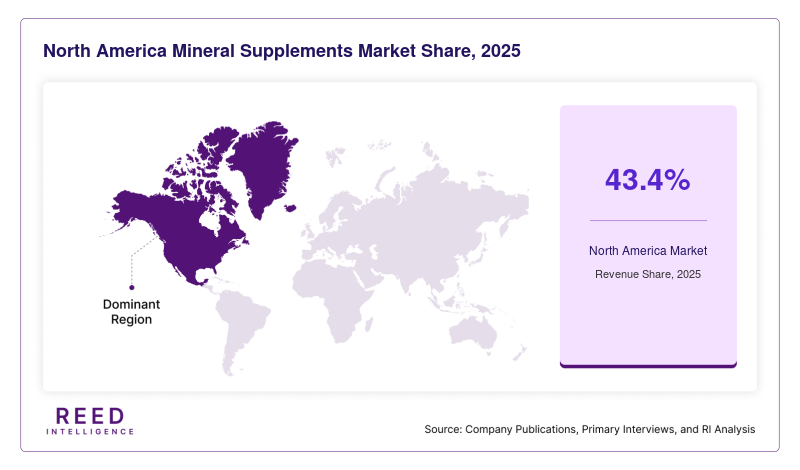
North America was the dominant region in the Mineral Supplements Market in 2025, accounting for 43.35% of global market share. Based on the supplied global market size of USD 17.02 Billion for 2025, the reported regional value is approximately USD 7.38 Billion, which is directly consistent with the regional estimate reported for North America. The region's leadership is supported by high supplement consumption, strong consumer awareness, established retail and pharmacy networks, and the presence of major global nutrition and consumer-health companies.
The United States represents the principal market within the region, supported by extensive supplement availability and strong demand for targeted nutrition. The region also benefits from sophisticated e-commerce infrastructure and premium product positioning. However, regulatory scrutiny and competition among established brands create a demanding environment for new entrants.
EuropeMineral Supplements Market
Europe represents another major market for mineral supplements, supported by aging demographics, preventive healthcare awareness, established pharmacy channels, and demand for nutritional products targeting bone health, immunity, and general wellness. The latest compatible market dataset places Europe at approximately 22.97% of global market share in 2025.
Germany, the United Kingdom, France, Italy, and other developed European markets provide strong opportunities for established supplement brands. Consumers increasingly value quality, traceability, scientific evidence, clean-label positioning, and responsible health claims. Manufacturers are therefore focusing on differentiated formulations and stronger scientific communication.
Asia Pacific Mineral Supplements Market
Asia Pacific is a major mineral supplements market with strong long-term potential driven by population size, nutritional deficiencies, increasing healthcare awareness, urbanization, rising disposable income, and expanding modern retail and e-commerce. A separate regional analysis reports that Asia Pacific represented 40.1% of the broader global mineral supplements market in 2024, demonstrating the region's substantial underlying demand, although that dataset uses a different global market definition from the supplied 2025–2034 dataset.
China, India, Japan, Australia, and Southeast Asian markets are important contributors. Within Asia Pacific, calcium was the largest product segment in 2024, while India was identified as the country expected to record the highest CAGR in the cited regional outlook. Because the regional source uses a different market-size framework, a compatible 2025 regional market value is not stated here to avoid mixing datasets.
Latin America Mineral Supplements Market
Latin America is supported by rising health awareness, expanding middle-class populations, increasing access to pharmacies and modern retail, and greater consumer interest in preventive nutrition. Brazil and Mexico represent important markets because of their large consumer bases and developing healthcare and retail infrastructure.
The region also provides opportunities for online supplement sales and affordable mineral formulations. A regional outlook identifies Latin America as a particularly fast-growing geographic opportunity; however, a comparable exact CAGR for the supplied Mineral Supplements Market dataset is not independently verified and therefore is not stated as a market-specific figure.
Middle East & Africa Mineral Supplements Market
The Middle East & Africa market is supported by increasing healthcare awareness, expanding pharmacy networks, urbanization, nutritional concerns, and growing interest in preventive health products. Gulf countries provide opportunities for premium nutritional products, while several African markets present longer-term opportunities linked to improving healthcare access and nutritional awareness.
Market expansion is also being supported by digital commerce and increasing availability of international supplement brands. However, market development varies considerably by country because of differences in purchasing power, healthcare infrastructure, regulatory frameworks, and consumer awareness.
Mineral Supplements Market Competitive Landscape
The Mineral Supplements Market is highly competitive, with major pharmaceutical, consumer-health, nutrition, and supplement companies competing through brand recognition, product innovation, scientific positioning, distribution networks, and geographic expansion. Major companies identified in current market research include Abbott, Amway, Bayer, Pfizer, Sanofi, Nestlé, Glanbia, Otsuka, DSM, Herbalife, GNC, Blackmores, Vitabiotics, Nature's Way, Pharmavite, and other regional manufacturers.
Abbott maintains a strong position through its nutrition and healthcare portfolio, including products positioned around healthy aging, children's nutrition, and targeted nutritional needs. In May 2026, Abbott launched Ensure Strength Pro in India with 31 nutrients, including calcium, vitamin D, vitamin K, phosphorus, zinc, iron, iodine, selenium, and other micronutrients.
Key Market Players
- Abbott
- Amway Corp.
- Bayer AG
- Pfizer Inc.
- Nestlé S.A.
- Sanofi
- Glanbia plc
- Otsuka Holdings Co., Ltd.
- DSM
- Herbalife International of America, Inc.
- GNC Holdings LLC
- Blackmores Limited
Mineral Supplements Market Recent Developments
- Nestlé September 2026: Nestlé agreed to sell its mainstream Vitamins, Minerals and Supplements (VMS) business, known as the Holistic Health portfolio, to Yellow Wood Partners for USD 1.0 billion. The transaction includes Nature's Bounty, Osteo Bi-Flex, Ester-C, Gard, Nuun, Puritan's Pride and Sisu, along with associated U.S. private-label operations. The transaction is expected to close in the first half of 2027, subject to regulatory approvals. Nestlé said it will focus more strongly on premium, science-led VMS brands including Solgar and Pure Encapsulations.
- Abbott May 2026: Abbott launched Ensure Strength Pro in India on May, 2026, targeting healthy aging and overall nutritional support. The formulation contains 31 nutrients and 30 grams of high-quality protein, including calcium, vitamin D, vitamin K, phosphorus, zinc, iron, iodine and selenium. The launch strengthens Abbott's positioning in targeted adult nutrition and mineral-enriched nutritional products.
Mineral Supplements Market Segments
By Product
- Calcium
- Magnesium
- Iron
- Potassium
- Zinc
- Others
By Type
- Individual Minerals
- Multiminerals
By Formulation
- Capsule
- Tablet
- Powder
- Liquid/Gel
- Others
By Age Group
- Pediatrics
- Adults
By Application
- General Health
- Bone & Joint Health
- Gastrointestinal Health
- Women's Health
- Others
By Distribution Channel
- Retail Pharmacies & Drug Stores
- Supermarkets & Hypermarkets
- Online Channels
- Others
By Region
- North America
- Europe
- APAC
- Middle East and Africa
- LATAM