Mineral Turpentine Market Size, Share & Demand Report By Type (Regular Grade, Low-Aromatic Grade, High Flash Point Grade), By Application (Paints & Coatings, Industrial Cleaning, Adhesives, Degreasing, Others), By End-Use (Construction, Automotive, Manufacturing, Household, Chemical Processing), By Region & Segment Forecasts, 2026–2034
USD 3950
Market Overview
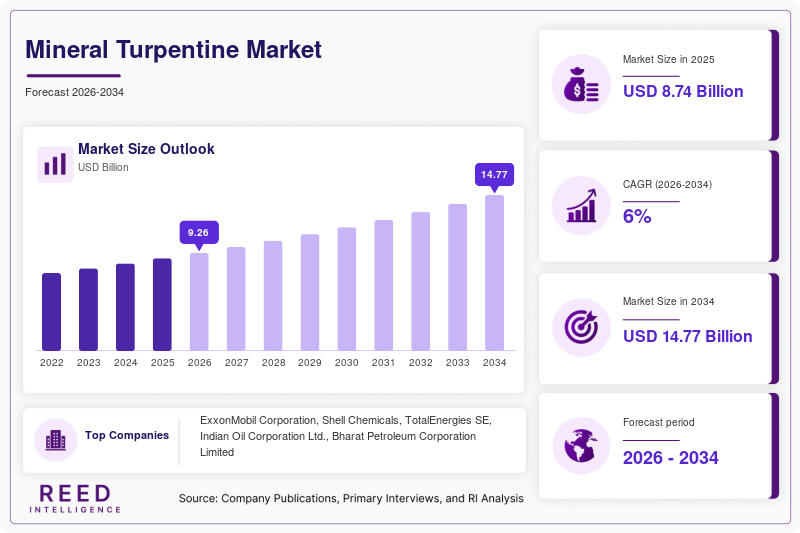
The global Mineral Turpentine Market size was valued at USD 8.74 billion in 2026 and is projected to reach USD 13.96 billion by 2034, expanding at a CAGR of 6.0% during the forecast period. Mineral turpentine, widely used as a solvent in paints, coatings, adhesives, degreasers, cleaning agents, and industrial formulations, continues to gain traction due to its broad compatibility with construction, automotive refinishing, and manufacturing processes. A major global factor supporting market expansion is the sustained rise in infrastructure modernization and urban construction activities across emerging and developed economies. Increased residential projects, industrial coating requirements, and refurbishment initiatives have accelerated demand for solvent-based paints and industrial cleaning compounds, where mineral turpentine remains a cost-efficient and effective input. Additionally, its role in automotive maintenance, machinery cleaning, and industrial degreasing has preserved steady consumption despite regulatory shifts toward cleaner solvents. Producers are also investing in improved refining technologies to enhance purity grades for specialized applications, including premium coatings and chemical processing. While sustainability trends are influencing product innovation, mineral turpentine retains strong relevance in markets where affordability, solvent strength, and industrial versatility are critical purchasing factors.
Key Highlights
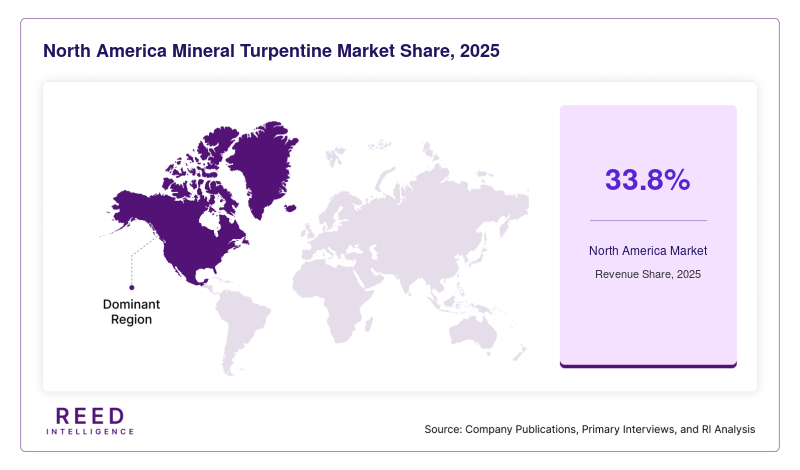
- North America dominated the market with a 33.8% share in 2025.
- Asia Pacific is expected to grow at the fastest CAGR of 7.8% during 2026–2034.
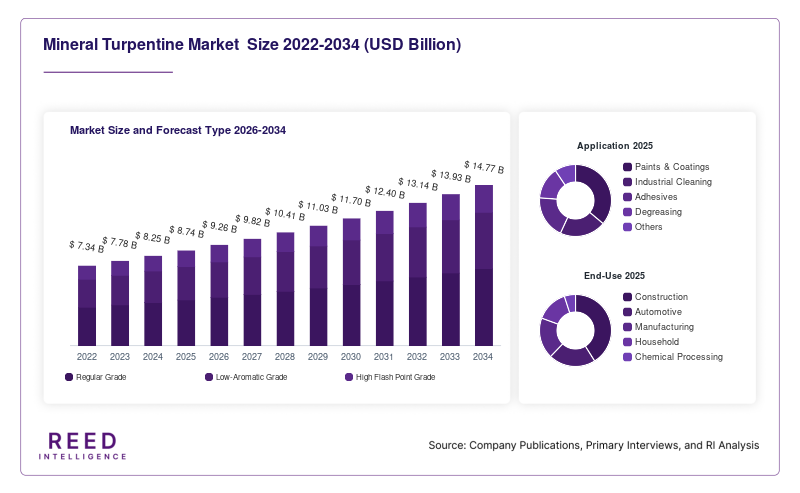
- By type, regular grade mineral turpentine accounted for the largest share of 46.9%, while low-aromatic grade is projected to grow at a CAGR of 7.4%.
- By application, paints & coatings led with a 39.6% share, whereas industrial cleaning is expected to expand at a CAGR of 7.1%.
- By end-use, construction remained dominant with a 35.4% share, while automotive is projected to grow at a CAGR of 6.9%.
- The United States remained the dominant country, with market values of USD 1.82 billion in 2024 and USD 1.95 billion in 2025.
Market Trends
Expansion of Low-Aromatic and Refined Product Grades
A notable trend shaping the Mineral Turpentine Market is the rising shift toward low-aromatic and higher-purity mineral turpentine formulations. Industrial users, especially in coatings, household products, and specialty chemical sectors, are increasingly prioritizing solvents with reduced odor, lower toxicity profiles, and improved environmental compliance. This has encouraged refiners to produce cleaner grades that maintain effective solvency while addressing stricter occupational safety requirements. Demand from decorative paints, premium wood finishes, and consumer cleaning products is particularly influencing this transition. Manufacturers are using advanced hydro-treatment and refining technologies to improve product quality, which also supports pricing advantages in developed markets where regulatory standards are more demanding.
Increasing Demand from Construction Maintenance and Renovation
Another major market trend is the growing use of mineral turpentine in renovation, repainting, and maintenance activities rather than only in new construction. Aging infrastructure in developed nations and urban property upgrades in emerging markets are creating sustained solvent demand for repainting, thinning, surface cleaning, and degreasing applications. Commercial buildings, transport infrastructure, and industrial plants require regular maintenance, supporting recurring purchases of mineral turpentine-based products. This trend is especially visible in Asia Pacific and Latin America, where urban housing stock expansion is creating aftermarket demand. The rise of DIY painting products and small-scale contractor purchases has also broadened retail channel penetration for mineral turpentine suppliers.
Market Drivers
Growth in Global Paints and Coatings Production
The continued expansion of the paints and coatings industry remains a primary driver for the Mineral Turpentine Market. Mineral turpentine is extensively used as a paint thinner and formulation solvent due to its affordability, evaporation rate, and effectiveness in improving application consistency. Rapid urbanization, industrial infrastructure projects, and increasing automotive refinishing activities are driving large-scale coating consumption worldwide. Industrial sectors such as marine, furniture, and heavy machinery also depend on solvent-based coatings, sustaining bulk demand. As emerging economies continue to invest in housing and infrastructure development, mineral turpentine consumption is expected to remain closely linked to construction material production and refurbishment cycles.
Rising Industrial Cleaning and Degreasing Applications
Mineral turpentine’s solvent strength has made it a preferred solution for industrial cleaning, metal surface preparation, and machinery maintenance. Manufacturing plants, engineering workshops, automotive garages, and shipbuilding facilities use mineral turpentine for grease removal, oil dissolution, and equipment cleaning. Expanding industrialization in countries such as India, Vietnam, Indonesia, and Brazil is supporting broader use across medium-scale enterprises. Its relatively lower cost compared to several specialized solvents further improves adoption among cost-sensitive industries. The increasing focus on machinery efficiency and preventive maintenance is reinforcing recurring solvent purchases, contributing to stable market growth across both developed and developing industrial economies.
Market Restraint
Environmental Regulations and Shift Toward Bio-Based Solvents
One of the primary restraints affecting the Mineral Turpentine Market is increasing regulatory scrutiny surrounding volatile organic compound emissions and worker safety standards. Mineral turpentine products, especially conventional grades, can face restrictions due to air quality regulations, workplace exposure concerns, and environmental compliance frameworks. Governments in Europe and parts of North America are encouraging lower-emission alternatives, including water-based formulations and bio-derived solvents. This transition may reduce demand in some premium industrial sectors over time. For example, certain decorative paint manufacturers are reformulating products to minimize solvent use, limiting mineral turpentine penetration. Compliance costs for refiners and distributors are also rising, especially when adapting to packaging, transport, and labeling regulations. While cost-sensitive sectors continue to rely on mineral turpentine, environmental policy shifts could slow growth in highly regulated markets.
Market Opportunities
Expansion in Emerging Industrial Economies
Emerging economies present substantial opportunities for Mineral Turpentine Market participants due to rapid industrialization, urbanization, and manufacturing base expansion. Countries across South Asia, Southeast Asia, Africa, and Latin America are increasing investments in housing, transportation networks, and industrial output. These sectors rely heavily on paints, coatings, adhesives, and maintenance chemicals, all of which support mineral turpentine demand. Local production capacity expansion and lower-cost supply chains can help regional manufacturers improve market share. Additionally, growing automotive repair sectors in these regions are increasing solvent consumption, creating favorable conditions for distributors and producers focused on volume-based growth strategies.
Product Diversification into Specialty and Consumer Applications
Another promising opportunity lies in developing specialized mineral turpentine variants for consumer and niche industrial segments. Manufacturers can target household cleaners, wood care products, art supplies, and premium coating solutions through odor-controlled and purified formulations. As DIY home improvement markets expand globally, retail-packaged mineral turpentine products can capture broader customer groups. Strategic branding, packaging innovation, and distribution through e-commerce and home improvement chains may strengthen product visibility. Specialty formulations tailored for electronics cleaning, precision tools, and customized industrial applications could also improve margins, helping suppliers reduce dependence on purely commodity-driven sectors.
Segmental Analysis
By Type
Regular grade mineral turpentine dominated the market in 2024, accounting for 46.9% of total share. This segment benefits from broad industrial acceptance, lower pricing, and high-volume usage in paints, coatings, and general-purpose cleaning. Construction firms, industrial workshops, and bulk chemical buyers favor regular grade products because they offer reliable solvency at economical rates. In emerging markets where cost remains a primary purchasing factor, regular grade products continue to outperform premium alternatives. Their widespread availability across industrial distributors and retail channels further reinforces market dominance.
Low-aromatic mineral turpentine is projected to grow at the fastest CAGR of 7.4% through 2034. This growth is driven by stricter safety regulations, odor-sensitive consumer markets, and premium industrial applications. Manufacturers are increasingly developing low-aromatic products for household products, decorative paints, and specialty formulations. Rising demand from developed economies and export-oriented product categories is strengthening this segment’s growth profile.
By Application
Paints & coatings represented the dominant application segment in 2024, with a 39.6% market share. Mineral turpentine remains a widely used thinner and solvent due to its effectiveness in viscosity control, surface preparation, and application consistency. Decorative paints, protective industrial coatings, wood finishes, and automotive repainting collectively support segment leadership. Infrastructure growth and renovation cycles continue to sustain strong purchasing volumes across both industrial and retail markets.
Industrial cleaning is anticipated to register the fastest CAGR of 7.1% over the forecast period. This segment is expanding due to machinery maintenance, automotive garages, engineering workshops, and manufacturing plants requiring effective degreasing solutions. Increased industrial productivity demands and preventive maintenance practices are driving recurring solvent purchases. Expanding manufacturing in developing economies further supports segment acceleration.
By End-Use
Construction emerged as the leading end-use segment in 2024, accounting for 35.4% of total market share. Mineral turpentine is heavily used in painting, thinning, cleaning tools, and wood treatment across residential, commercial, and industrial projects. The expansion of urban infrastructure and renovation activities supports recurring product demand. Builders, contractors, and maintenance providers remain major consumers.
Automotive is projected to grow at the fastest CAGR of 6.9% through 2034. This growth is linked to vehicle refinishing, surface cleaning, repair workshops, and aftermarket maintenance. Expanding vehicle ownership in developing nations and rising repair culture are increasing solvent demand. Automotive refinishing products continue to provide long-term growth potential for manufacturers targeting specialized applications.
Regional Analysis
North America
North America accounted for 33.8% of the Mineral Turpentine Market share in 2025 and is expected to grow at a CAGR of 5.4% during the forecast period. Stable demand from paints, coatings, industrial cleaning, and automotive refinishing sectors supports the region’s strong market position. The United States and Canada continue to rely on mineral turpentine in manufacturing maintenance, infrastructure repair, and protective coating applications. Mature industrial operations and established distribution systems provide consistent product accessibility.
The United States leads the regional market due to extensive construction maintenance and automotive aftermarket activities. One unique growth factor is the country’s large-scale renovation economy, where commercial buildings, housing upgrades, and industrial refurbishment generate recurring solvent demand. The prevalence of established coating manufacturers and hardware retail chains also supports broad product penetration, ensuring continued market maturity.
Europe
Europe held 26.4% of the global Mineral Turpentine Market in 2025 and is projected to grow at a CAGR of 4.8% through 2034. Demand is supported by industrial coatings, machinery cleaning, and specialized manufacturing sectors, particularly in Germany, France, Italy, and the UK. Regulatory pressures are shaping cleaner product adoption, but industrial applications continue to preserve market relevance. Refiners are increasingly focused on compliant low-aromatic formulations.
Germany dominates the European market due to its advanced industrial production and engineering base. A unique factor driving growth is the country’s strong machinery export ecosystem, which requires extensive metal treatment, cleaning, and coating operations. Industrial maintenance remains essential across automotive and manufacturing clusters, preserving steady demand despite environmental policy adjustments.
Asia Pacific
Asia Pacific represented 24.7% of the Mineral Turpentine Market in 2025 and is forecast to expand at the fastest CAGR of 7.8%. Rapid urbanization, industrialization, and construction development in China, India, Indonesia, and Vietnam are significantly boosting solvent demand. Paint production, furniture coatings, infrastructure expansion, and automotive maintenance are driving high-volume consumption. Cost-sensitive manufacturing sectors further support widespread adoption.
China leads the regional market, supported by extensive construction output and industrial production. A key growth factor is the country’s massive manufacturing ecosystem, including coatings, chemicals, and industrial maintenance. Rising domestic consumption and export-oriented product manufacturing continue to strengthen mineral turpentine requirements across multiple sectors.
Middle East & Africa
The Middle East & Africa held 8.1% of the Mineral Turpentine Market in 2025 and is expected to grow at a CAGR of 5.9%. Infrastructure projects, oilfield maintenance, and industrial coatings are key growth drivers. Countries in the Gulf Cooperation Council and parts of Africa are expanding commercial construction and industrial development, supporting solvent use in paints and machinery care.
Saudi Arabia dominates this region due to infrastructure diversification and industrial expansion programs. A distinctive growth factor is the country’s non-oil economic diversification strategy, which includes construction, logistics, and industrial facility development. These sectors support broader solvent demand for maintenance and coating applications.
Latin America
Latin America captured 7.0% of the Mineral Turpentine Market share in 2025 and is projected to grow at a CAGR of 6.2%. Growth is linked to housing construction, automotive servicing, and industrial maintenance sectors. Brazil, Mexico, and Argentina are major contributors, supported by expanding manufacturing and refurbishment demand. Consumer paint markets are also contributing to stable sales.
Brazil leads the regional market due to its strong construction and automotive repair industries. A unique growth factor is the country’s growing middle-income housing renovation sector, which supports decorative paints, wood finishes, and cleaning solvent demand. Increasing retail access further enhances product availability across urban and semi-urban areas.
Competitive Landscape
The Mineral Turpentine Market remains moderately fragmented, with global and regional producers competing through refining quality, pricing strategies, and distribution reach. Key companies include ExxonMobil, Shell Chemicals, Bharat Petroleum Corporation Limited, Indian Oil Corporation, and TotalEnergies. ExxonMobil remains a leading player due to strong refining capabilities, broad distribution infrastructure, and premium-grade product offerings. Recent developments include investments in cleaner solvent refining technologies to align with industrial quality preferences. Regional suppliers in Asia Pacific are also expanding production to address local infrastructure demand. Companies are increasingly focusing on low-aromatic variants, private labeling, and industrial partnerships to maintain competitiveness in both developed and emerging markets.
Key Players
- ExxonMobil Corporation
- Shell Chemicals
- TotalEnergies SE
- Indian Oil Corporation Ltd.
- Bharat Petroleum Corporation Limited
- Hindustan Petroleum Corporation Limited
- Chevron Phillips Chemical Company
- SK Energy
- Neste Oyj
- Idemitsu Kosan Co., Ltd.
- Sinopec Corporation
- PetroChina Company Limited
- Sasol Limited
- Gulf Chemicals and Industrial Oils
- Recochem Inc.
Recent Developments
- ExxonMobil expanded solvent refining upgrades in 2025 to improve low-aromatic mineral turpentine output.
- Bharat Petroleum increased specialty solvent distribution across South Asia in 2024 to strengthen industrial market access.
- Shell Chemicals introduced enhanced packaging solutions for industrial solvent safety and logistics efficiency in 2025.
Mineral Turpentine Market Segments
Type
- Regular Grade
- Low-Aromatic Grade
- High Flash Point Grade
Application
- Paints & Coatings
- Industrial Cleaning
- Adhesives
- Degreasing
- Others
End-Use
- Construction
- Automotive
- Manufacturing
- Household
- Chemical Processing
By Region
- North America
- Europe
- APAC
- Middle East and Africa
- LATAM