Mineral Waxes Market Size, Share & Trends Analysis Report By Product Type (Paraffin Wax, Microcrystalline Wax, Montan Wax, Ozokerite Wax), By Application (Cosmetics, Pharmaceuticals, Food Industry, Packaging), By Distribution Channel (Online Stores, Supermarkets/Hypermarkets) and By Region (North America, Europe, Asia Pacific, Latin America, Middle East & Africa) Forecasts, 2026–2034
USD 3950
Mineral Waxes Market Size
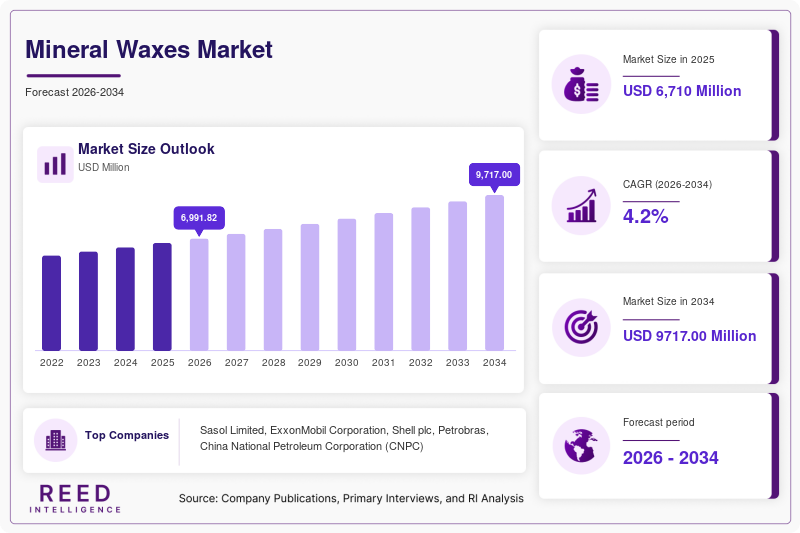
The global mineral waxes market was valued at USD 6,710 Million in 2025 and is projected to grow from USD 6,991.82 Million in 2026 to USD 9,717.00 Million by 2034, registering a CAGR of 4.2% during the forecast period from 2026 to 2034.
Mineral waxes are hydrocarbon-based materials primarily obtained from petroleum refining and mineral sources. The principal categories include paraffin wax, microcrystalline wax, Montan wax, and ozokerite wax. Their combination of water repellency, controlled melting behavior, lubricity, barrier properties, gloss, chemical stability, and compatibility with other ingredients makes them valuable across consumer and industrial applications.
Paraffin wax accounts for the largest product share, representing approximately 42.3% of the global Mineral Waxes Market in 2025. Microcrystalline wax follows because of its stronger adhesion, flexibility, and formulation characteristics, particularly in cosmetics, pharmaceuticals, coatings, and specialty applications.
Mineral Waxes Market Drivers
Growing Cosmetics and Personal Care Demand:
Mineral waxes are widely used as consistency agents, emollients, stabilizers, texture modifiers, and protective components in lipsticks, creams, lotions, balms, and other personal-care products. Rising skincare consumption and premium formulation development are supporting demand for refined and microcrystalline wax grades. The cosmetics and personal care segment accounts for approximately 28.6% of mineral wax consumption according to current market estimates.
Expansion of Pharmaceutical Manufacturing:
Paraffin and microcrystalline waxes are used in tablet coatings, controlled-release formulations, ointments, suppository bases, and other pharmaceutical applications. Increasing pharmaceutical production in Asia Pacific and other emerging markets is creating additional demand for pharmaceutical-grade mineral waxes.
Increasing Packaging and Food-Contact Applications:
Mineral waxes provide moisture resistance, grease resistance, surface protection, and barrier performance in packaging materials. Growth in packaged food, confectionery, bakery products, and consumer goods is supporting demand for suitable wax-based coatings.
Broad Industrial Application Base:
Mineral waxes continue to be used in rubber processing, PVC, adhesives, coatings, polishes, board sizing, textiles, and other manufacturing processes. This diversified application base provides stability against demand fluctuations in individual end-use industries.
Mineral Waxes Market Restraints
Environmental Concerns Associated with Petroleum-Derived Materials:
Mineral waxes are predominantly petroleum-derived, creating sustainability concerns as manufacturers and consumers increasingly evaluate renewable and lower-carbon alternatives.
Volatility in Crude Oil and Refining Economics:
Paraffin and other petroleum-derived wax prices can be influenced by crude-oil prices, refinery utilization, feedstock availability, transportation costs, and regional supply-demand conditions.
Availability of Bio-Based and Synthetic Alternatives:
Soy, palm, beeswax, Fischer-Tropsch waxes, polyethylene waxes, and other alternatives are increasingly competing in applications where sustainability, purity, or specialized performance is prioritized.
Regulatory Requirements:
Food-contact, pharmaceutical, and cosmetic applications require compliance with increasingly stringent quality and safety requirements, increasing qualification and production costs for suppliers.
Mineral Waxes Market Opportunities
Development of Lower-Carbon Wax Products:
Manufacturers have opportunities to develop waxes with lower product carbon footprints, biodegradable characteristics, and improved environmental profiles.
Growth of High-Purity Specialty Grades:
Pharmaceutical, medical, cosmetic, food-contact, and high-performance industrial applications create opportunities for suppliers offering tightly controlled melting points, low oil content, high purity, and consistent formulation performance.
Expansion in Asia Pacific:
Rapid industrialization, pharmaceutical manufacturing, cosmetics production, packaging expansion, and consumer-goods manufacturing are creating significant opportunities for mineral wax suppliers in China, India, Southeast Asia, Japan, and South Korea.
Water-Based and Solvent-Reduced Formulations:
Wax emulsions and dispersions are gaining importance as manufacturers seek alternatives to solvent-based systems, creating opportunities for specialized wax formulation technologies. Nippon Seiro, for example, identifies increasing use of wax emulsions as industries shift toward water-based products under tighter environmental requirements.
Mineral Waxes Market Segmental Analysis
By Product Type
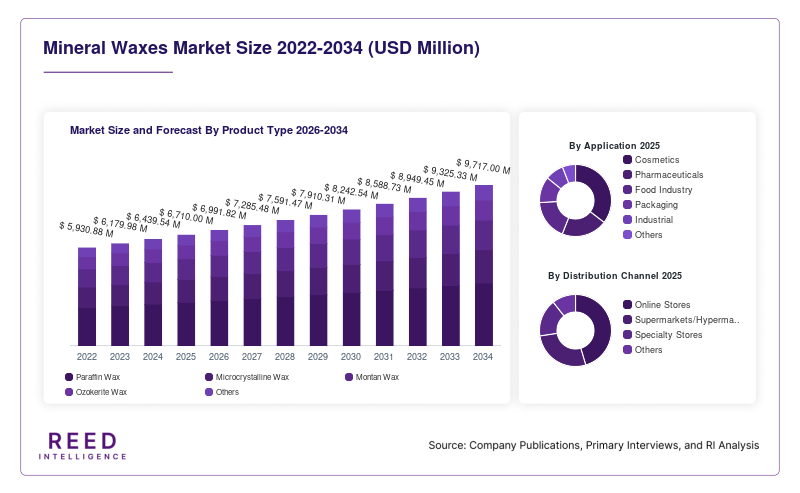
Paraffin Wax is the dominant product segment, accounting for approximately 42.3% of the global Mineral Waxes Market in 2025. Its leadership is supported by extensive use in candles, packaging coatings, cosmetics, food-related applications, polishing products, rubber processing, and industrial formulations. Its established production infrastructure and comparatively economical pricing continue to support its broad adoption.
Microcrystalline Wax represents the key growth opportunity within the product landscape. Its higher melting point, flexibility, adhesion, and fine crystalline structure make it particularly suitable for cosmetics, pharmaceuticals, coatings, adhesives, and specialty formulations. Available market analysis indicates a 5.1% CAGR for the microcrystalline segment during 2026–2034, making it faster-growing than paraffin wax.
By Application
Cosmetics represents the dominant application segment, accounting for approximately 28.6% of global mineral wax consumption. Mineral waxes are widely used in lip care, creams, moisturizers, color cosmetics, protective balms, and other formulations because they provide texture, consistency, stability, and moisture-barrier properties.
Pharmaceuticals represent a significant and attractive growth segment. Pharmaceutical-grade mineral waxes are used in tablet coatings, controlled-release systems, ointments, and suppository formulations. Current market analysis places pharmaceutical applications at approximately 24.3% of consumption, with the segment projected to expand at around 4.7% CAGR through 2034.
By Distribution Channel
Specialty Stores and Direct Industrial Distribution remain important for manufacturers requiring technical grades, customized specifications, bulk quantities, and quality documentation. Industrial customers often purchase directly from producers or through specialized distributors.
Online Stores represent the fastest-changing distribution opportunity as smaller manufacturers, laboratories, formulators, and specialty users increasingly source waxes through digital marketplaces. Online channels are estimated to account for approximately 15.3% of distribution volume, reflecting growing digital procurement adoption.
Mineral Waxes Market Regional Analysis
North America Mineral Waxes Market
North America represents a mature Mineral Waxes Market supported by established pharmaceutical, cosmetics, packaging, candle, rubber, and specialty chemical industries. The region benefits from sophisticated refining infrastructure and a strong base of specialty wax producers and distributors. Demand is increasingly focused on refined, high-purity, application-specific grades.
The United States remains the principal market in the region, with demand spanning cosmetics, pharmaceuticals, packaging, adhesives, coatings, and industrial processing. Manufacturers are also emphasizing customized formulations and improved sustainability characteristics as customers increasingly evaluate material performance alongside environmental considerations.
Europe Mineral Waxes Market
Europe maintains significant demand for mineral waxes across cosmetics, pharmaceuticals, packaging, coatings, rubber, and industrial applications. The regional market is strongly influenced by environmental regulations, product safety requirements, and the shift toward lower-emission and water-based formulation technologies.
European manufacturers are increasingly developing alternatives and complementary technologies that reduce dependence on conventional petroleum-derived materials. Specialty wax suppliers are therefore focusing on high-purity products, renewable alternatives, biodegradable waxes, and improved formulation efficiency.
Asia Pacific Mineral Waxes Market
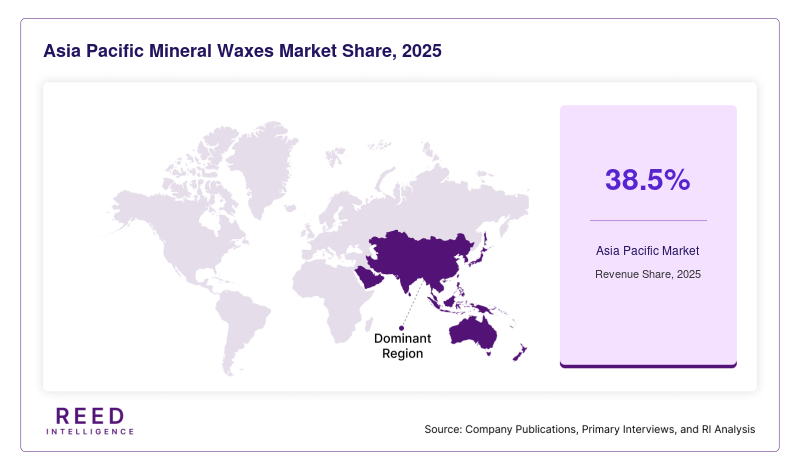
Asia Pacific is the dominant region, accounting for 38.5% of global Mineral Waxes Market revenue in 2025. Based on the supplied global 2025 market size of USD 6,710 Million, this corresponds to an estimated USD 2,582.35 Million in regional market value. The value is derived by applying the verified 38.5% regional share to the supplied global market size.
The region's leadership is supported by large-scale manufacturing in China and India, expanding pharmaceutical and cosmetics production, packaging demand, candle manufacturing, and strong petrochemical refining capabilities. Asia Pacific is also identified as the fastest-growing regional market, supported by industrial expansion and increasing consumption in China, India, Southeast Asia, Japan, and South Korea.
Latin America Mineral Waxes Market
Latin America represents an emerging market for mineral waxes, supported by growing packaged-food production, cosmetics, pharmaceuticals, candles, rubber processing, and industrial manufacturing. Brazil and Mexico are important markets because of their large manufacturing and consumer bases.
Increasing pharmaceutical production and packaged-food consumption are creating additional demand for higher-purity paraffin and microcrystalline waxes. Regional suppliers and importers are also expanding distribution capabilities to serve small and medium-sized manufacturers.
Middle East & Africa Mineral Waxes Market
The Middle East & Africa market is supported by petroleum refining capabilities, industrial development, packaging demand, cosmetics, pharmaceuticals, and consumer products. The availability of petroleum-based feedstocks provides opportunities for regional production and processing of wax materials.
Growth opportunities are particularly relevant in countries investing in refining, petrochemicals, manufacturing, and consumer-goods production. However, market development remains influenced by infrastructure availability, import dependence in several countries, and fluctuations in regional industrial activity.
Mineral Waxes Market Competitive Landscape
The Mineral Waxes Market is moderately competitive, with major petroleum, specialty chemical, and dedicated wax manufacturers competing through product quality, refining capabilities, geographic reach, specialty grades, technical support, and application-specific formulations.
Sasol Limited is one of the leading participants, with wax products based on Fischer-Tropsch technology and a broad specialty chemicals portfolio. The company has also been investing in lower-carbon wax solutions and specialty applications. ExxonMobil Corporation remains another major participant with its Prowaxx portfolio covering fully refined, semi-refined, slack, and hydrofined waxes for candles, cosmetics, packaging, rubber, and industrial applications.
Key Market Players
- Sasol Limited
- ExxonMobil Corporation
- Shell plc
- Petrobras
- China National Petroleum Corporation (CNPC)
- PetroChina Company Limited
- Nippon Seiro Co., Ltd.
- H&R Group
- Sonneborn LLC
- Koster Keunen
- IGI Wax
Mineral Waxes Market Recent Developments
- May 2026 Sasol plans to restart its paraffin production unit in Italy
May 2026 that it would restart the ISOSIV paraffin unit at Augusta, Italy, following constrained market supply of n-paraffins used in linear alkylbenzene (LAB) production. The planned restart was expected in the second half of 2026, subject to completion of required preparations and approvals. This development highlights the importance of supply reliability in the specialty wax value chain. - March 2026 DEUREX introduces specialty waxes for surface modificationDEUREX announced two polyvinylether wax products, DEUREX V 02 G and DEUREX V 0222 M, designed for surface modification and process optimization. Although these are specialty waxes rather than conventional mineral waxes, the launch demonstrates ongoing innovation in the broader wax industry for specialized industrial applications.
Mineral Waxes Market Segments
By Product Type
- Paraffin Wax
- Microcrystalline Wax
- Montan Wax
- Ozokerite Wax
- Others
By Application
- Cosmetics
- Pharmaceuticals
- Food Industry
- Packaging
- Industrial
- Others
By Distribution Channel
- Online Stores
- Supermarkets/Hypermarkets
- Specialty Stores
- Others
By Region
- North America
- Europe
- APAC
- Middle East and Africa
- LATAM