Mineral Wool Ceiling Tile Market Size, Share & Trends Analysis Report By Application (Residential, Non-Residential) and By Product Type (Standard Mineral Wool Tiles, Acoustic Mineral Wool Tiles, Fire-Resistant Mineral Wool Tiles, Moisture-Resistant Mineral Wool Tiles) and By End User (Commercial, Industrial, Residential, Institutional) and By Region (North America, Europe, Asia Pacific, Latin America, Middle East & Africa) Forecasts, 2026–2034
USD 3950
Mineral Wool Ceiling Tile Market Size
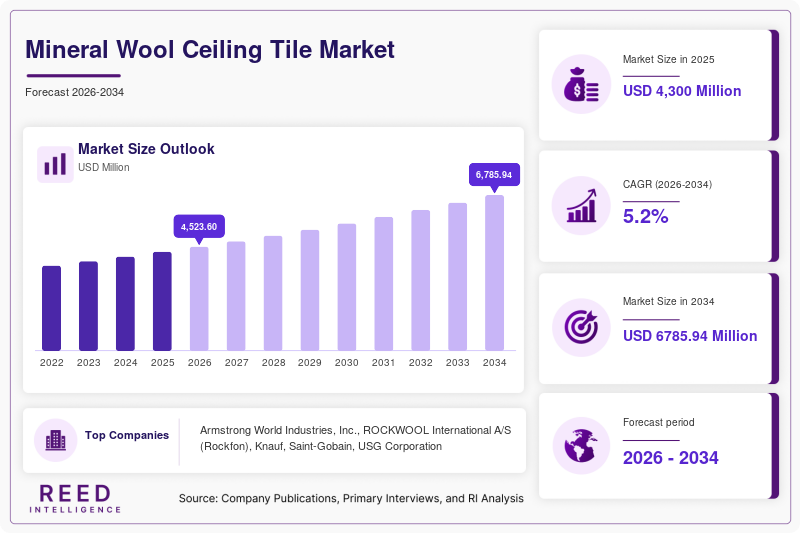
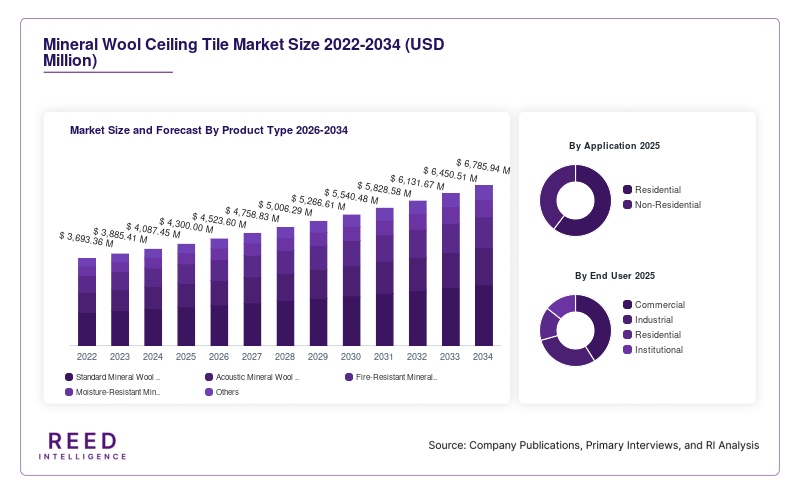
The global mineral wool ceiling tile market was valued at USD 4,300 million in 2025 and is projected to grow from USD 4,523.60 million in 2026 to USD 6,785.94 million by 2034, registering a CAGR of 5.2% during the forecast period from 2026 to 2034.
Mineral wool ceiling tiles are ceiling panels manufactured primarily from mineral fibers derived from materials such as rock, slag, or other mineral-based feedstocks. They are installed in suspended ceiling systems and are designed to improve room acoustics, conceal building services, provide a finished interior appearance, and contribute to thermal and fire performance.
The market serves several building categories, including corporate offices, hospitals, schools, universities, retail spaces, hotels, manufacturing facilities, and residential buildings. Non-residential construction is especially important because commercial and institutional buildings frequently require integrated acoustic ceiling systems to support occupant comfort, speech intelligibility, and building functionality.
Mineral Wool Ceiling Tile Market Drivers
Increasing Commercial Construction and Renovation
Growth in office buildings, educational institutions, healthcare facilities, retail developments, hotels, and public infrastructure is supporting demand for mineral wool ceiling tiles. Renovation projects also create replacement demand as building owners upgrade older ceiling systems to improve aesthetics, acoustic performance, fire safety, and interior functionality.
Rising Demand for Acoustic Comfort
Organizations are increasingly focused on controlling noise and improving speech intelligibility in offices, classrooms, hospitals, conference rooms, and shared workspaces. Mineral wool ceiling tiles offer sound-absorption capabilities that help address these requirements, making them attractive for buildings with demanding acoustic specifications.
Growing Focus on Fire Safety and Building Performance
Mineral wool ceiling products are selected for applications where fire performance, acoustic insulation, and durability are important. Building codes, project specifications, and safety considerations influence material selection, particularly in institutional and commercial developments.
Mineral Wool Ceiling Tile Market Restraints
Fluctuating Raw Material and Manufacturing Costs
Energy, mineral feedstock, binder, packaging, and transportation costs can affect manufacturing expenses and product prices. Price fluctuations may reduce margins for manufacturers and increase procurement costs for contractors and building owners.
Competition from Alternative Ceiling Materials
Gypsum boards, metal ceiling panels, fiberglass-based products, and other ceiling systems compete with mineral wool tiles. Buyers may select alternative materials based on price, moisture conditions, appearance, maintenance requirements, or specific architectural preferences.
Dependence on Construction Activity
Demand is closely connected to commercial building construction, renovation expenditure, and institutional infrastructure investment. Economic slowdowns, higher financing costs, delayed projects, and lower construction activity can postpone ceiling installations and weaken short-term demand.
Mineral Wool Ceiling Tile Market Opportunities
Sustainable and Circular Building Materials
Manufacturers can differentiate their products through recycled content, material transparency, reduced embodied carbon, and take-back or recycling programs. Circularity certifications and documented environmental performance can strengthen product positioning in projects with sustainability requirements.
High-Performance Acoustic Ceiling Systems
Demand for advanced acoustic solutions creates opportunities for products designed for classrooms, healthcare facilities, offices, data centers, and other specialized environments. Manufacturers can expand their portfolios through improved sound absorption, cleanability, moisture resistance, and design flexibility.
Infrastructure Development in Emerging Economies
Urbanization, commercial construction, healthcare infrastructure, education facilities, and industrial development across Asia Pacific, Latin America, and the Middle East create opportunities for ceiling tile suppliers. Partnerships with distributors, architects, contractors, and developers can improve access to these markets.
Mineral Wool Ceiling Tile Market Segmental Analysis
By Product Type
Acoustic Mineral Wool Ceiling Tiles
Acoustic ceiling tiles are important because noise control and speech intelligibility are key requirements in offices, schools, healthcare facilities, meeting rooms, and public buildings. Their sound-absorption performance can make them suitable for projects where interior acoustics are a major specification.
Moisture-Resistant and Specialized Tiles
Specialized products can benefit from demand in buildings requiring enhanced cleanability, humidity resistance, durability, or application-specific performance. However, a comparable market-specific growth rate establishing the fastest-growing mineral wool ceiling tile product subtype could not be independently verified.
Standard Mineral Wool Ceiling Tiles:
Standard products serve general suspended-ceiling applications where cost, availability, appearance, and practical performance are important. They remain relevant in commercial renovations, offices, and institutional buildings.
Fire-Resistant Mineral Wool Ceiling Tiles:
Fire performance can influence product selection in commercial, institutional, and industrial projects. Actual performance depends on the complete ceiling assembly and applicable product certifications, not solely on the material category.
By Application
Non-Residential
Non-residential buildings are a key demand center because offices, hospitals, educational institutions, retail facilities, and public buildings often require suspended ceiling systems with acoustic and functional performance. Industry research identifies non-residential construction as an important application category in the mineral wool ceiling tile market.
Residential
Residential applications can benefit from multifamily construction, interior renovation, and increasing attention to acoustic comfort. However, a comparable market-specific CAGR establishing residential or non-residential as the fastest-growing application through 2034 could not be independently verified.
By End User
Commercial
Commercial buildings are important consumers of mineral wool ceiling tiles because offices, retail facilities, hotels, and other business environments frequently require acoustic ceiling systems. Renovation activity also supports replacement demand.
Institutional
Schools, universities, healthcare facilities, and government buildings create opportunities for acoustic ceiling products with durability and application-specific performance. Institutional purchasing is often influenced by project specifications, safety requirements, maintenance considerations, and procurement budgets.
Industrial and Residential:
Industrial buildings and residential properties provide additional demand. Adoption varies according to building design, acoustic requirements, moisture conditions, budget, and local construction practices. Reliable comparative CAGR figures for individual end-user categories are unavailable.
By Distribution Channel
Direct Sales and Distributors
Direct sales and distributors serve large projects and contractor-led procurement. These channels provide access to technical specifications, ceiling-system components, installation guidance, and coordinated deliveries.
Online Channels
Online channels can improve product discovery and access to specifications, samples, and smaller-quantity purchases. However, a reliable market-specific growth rate establishing online sales as the fastest-growing distribution channel could not be independently verified.
Mineral Wool Ceiling Tile Market Regional Analysis
North America Mineral Wool Ceiling Tile Market
North America is an established market for mineral wool ceiling tiles, supported by commercial offices, healthcare facilities, educational institutions, retail properties, and renovation projects. Demand is influenced by acoustic performance, building safety, sustainability specifications, and replacement of aging ceiling systems.
The United States represents a major market within the region, with Canada contributing through commercial construction, institutional infrastructure, and renovation activity. Manufacturers can differentiate through documented environmental performance, local production, recycled-content programs, and compliance with project requirements. A reliable mineral-wool-ceiling-tile-specific regional share and 2025 regional market value were not independently verified.
Europe Mineral Wool Ceiling Tile Market
Europe represents an important market because of its established construction sector, commercial renovation activity, institutional buildings, and focus on energy efficiency and sustainable construction materials. Demand is influenced by building modernization, acoustic requirements, product durability, and environmental documentation.
Germany, France, the United Kingdom, Italy, and other European markets provide opportunities for suppliers of acoustic and specialized ceiling systems. Manufacturers are increasingly expected to document product composition, environmental performance, and circularity credentials. A comparable, independently verified regional market share and market value for this specific market were not available.
Asia Pacific Mineral Wool Ceiling Tile Market
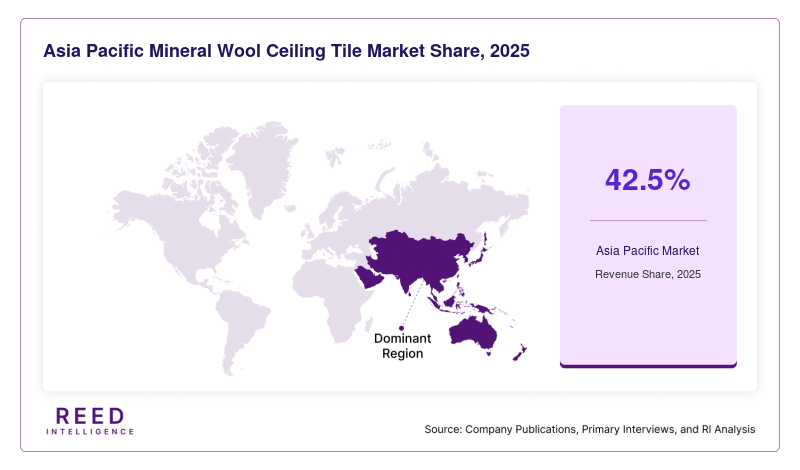
Asia Pacific Dominant Region Asia Pacific dominated the global mineral wool ceiling tile market in 2025, accounting for approximately 42.5% of global market revenue, equivalent to an estimated USD 1,827.5 million (USD 1.83 billion) based on the supplied global market value of USD 4,300 million. The region's leadership is supported by rapid urbanization, commercial construction, infrastructure development, and rising demand for acoustic ceiling systems across China, India, Japan, and Southeast
The region's development outlook is supported by expanding building stock and increasing interest in acoustic comfort and building performance. However, a reliable numeric market-share figure and corresponding 2025 market value for the mineral wool ceiling tile market specifically could not be verified from the available sources. Overall ceiling tile market shares are not used as substitutes because they include other materials and have a different market scope.
Latin America Mineral Wool Ceiling Tile Market
Latin America is an emerging opportunity for mineral wool ceiling tile manufacturers. Commercial construction, retail development, education and healthcare infrastructure, and modernization of office buildings contribute to potential demand.
Brazil and Mexico are important construction markets, while other countries offer opportunities through public infrastructure and private-sector investment. Market expansion depends on construction spending, product availability, distribution networks, imported material costs, and awareness of acoustic ceiling solutions. A reliable regional share and market value specific to mineral wool ceiling tiles could not be independently verified.
Middle East & Africa Mineral Wool Ceiling Tile Market
The Middle East & Africa market is supported by commercial construction, hospitality, healthcare facilities, education infrastructure, public buildings, and urban development. Ceiling systems are used in offices, hotels, shopping centers, airports, and other projects where appearance and acoustic performance are important.
Saudi Arabia, the United Arab Emirates, and South Africa provide opportunities for suppliers serving commercial and institutional construction. Demand varies by project type, procurement budgets, climate conditions, and the availability of local distribution. A comparable mineral-wool-ceiling-tile-specific regional market share and value were not independently verified.
Mineral Wool Ceiling Tile Market Competitive Landscape
The mineral wool ceiling tile market includes established manufacturers that compete through acoustic performance, fire safety, design, product certifications, environmental credentials, distribution networks, and compatibility with suspended ceiling systems. Major competitive participants include Armstrong World Industries, ROCKWOOL's Rockfon business, Knauf, and Saint-Gobain.
Armstrong World Industries, Inc. is a major manufacturer of ceiling and interior building products. Its portfolio includes mineral fiber ceiling systems and specialized products designed to address acoustic and building-energy requirements. In July 2026, Armstrong reported a commercial installation of its Templok Energy Saving Ceilings at Swinerton Builders' Northwest office, demonstrating the application of phase-change-material ceiling technology in an energy-efficiency project.
Key Market Players
- Armstrong World Industries, Inc.
- ROCKWOOL International A/S (Rockfon)
- Knauf
- Saint-Gobain
- USG Corporation
- OWA Odenwald Faserplattenwerk GmbH
- SAS International
- Hunter Douglas Architectural
- CertainTeed
- Beijing New Building Materials Public Limited Company
Mineral Wool Ceiling Tile Market Recent Developments
-
September 2026 Rockfon: Rockfon announced that 93% of its North American stone wool ceiling tile portfolio had achieved certifications in circularity and leading human-health standards. The announcement highlights the growing importance of verified sustainability credentials and product transparency in ceiling specifications.
-
July 2026 Armstrong World Industries: Armstrong reported that the Swinerton Inland Northwest office in Spokane, Washington, used Templok Energy Saving Ceilings to access federal tax credits. The 9,000-square-foot office installation demonstrates the application of phase-change-material ceiling technology to reduce operational energy use and carbon emissions. Although this is an adjacent ceiling technology rather than a mineral wool tile launch, it reflects innovation in the wider ceiling systems market.
Mineral Wool Ceiling Tile Market Segments
By Product Type
- Standard Mineral Wool Ceiling Tiles
- Acoustic Mineral Wool Ceiling Tiles
- Fire-Resistant Mineral Wool Ceiling Tiles
- Moisture-Resistant Mineral Wool Ceiling Tiles
- Others
By Application
- Residential
- Non-Residential
By End User
- Commercial
- Industrial
- Residential
- Institutional
By Distribution Channel
- Direct Sales
- Distributors and Dealers
- Specialty Building Material Retailers
- Online Channels
- Others
By Region
- North America
- Europe
- APAC
- Middle East and Africa
- LATAM