Mineral Wool Insulated Metal Panel Market Size, Share & Trends Analysis Report By Product Type (Composite Panels, Single Skin Panels, Others) and By Application (Roofing, Wall Cladding, Floors, Others) and By End-Use Industry (Commercial, Industrial, Residential, Others) and By Region (North America, Europe, Asia Pacific, Latin America, Middle East & Africa) Forecasts, 2026–2034
USD 3950
Mineral Wool Insulated Metal Panel Market Size
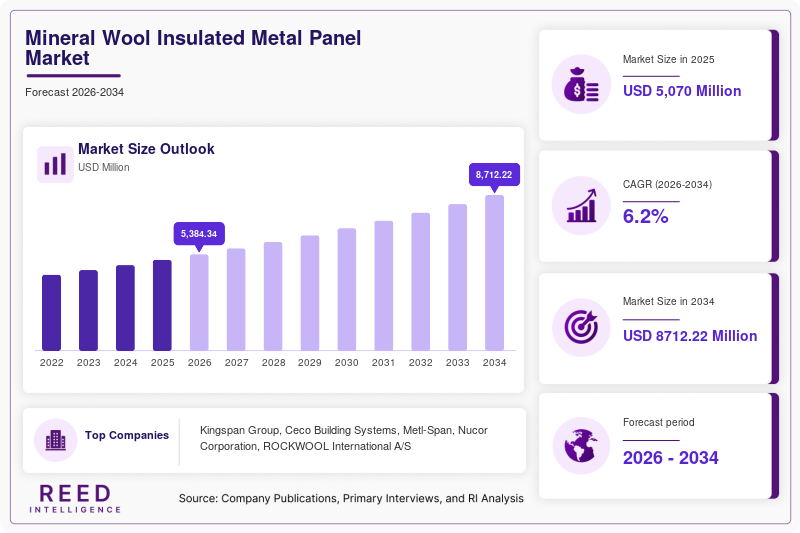
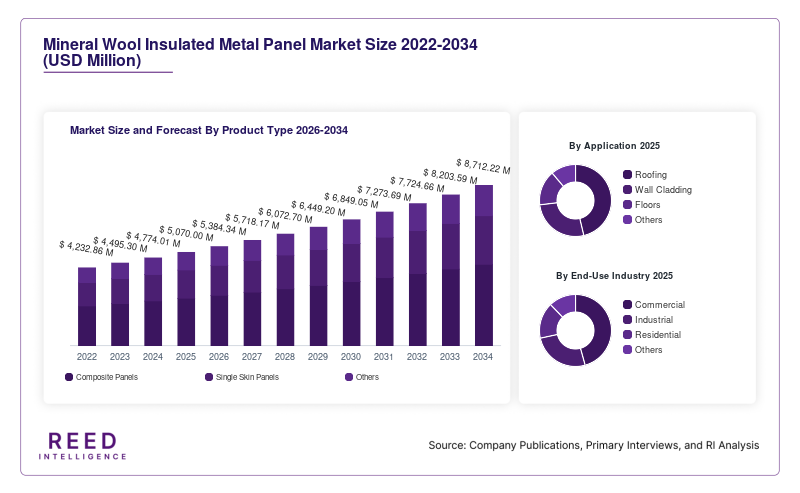
The global mineral wool insulated metal panel market was valued at USD 5,070 Million in 2025 and is projected to grow from USD 5,384.34 Million in 2026 to USD 8,712.22 Million by 2034, registering a CAGR of 6.2% during the forecast period from 2026 to 2034.
The Mineral Wool Insulated Metal Panel Market is developing as construction companies, industrial operators, and commercial property developers increasingly prioritize building-envelope performance, fire safety, energy efficiency, and rapid installation. Mineral wool insulation is particularly relevant in applications where non-combustibility, temperature control, and acoustic insulation are important design requirements.
These panels are manufactured by combining protective metal facings with an insulating mineral wool core. Their prefabricated construction can reduce installation time and simplify the building process compared with conventional multi-layer wall and roof assemblies. Applications include industrial buildings, logistics facilities, manufacturing plants, commercial complexes, cold-storage facilities, and other specialized structures.
Mineral Wool Insulated Metal Panel Market Drivers
Increasing Demand for Fire-Resistant Building Materials
Fire safety is an important factor in the selection of insulation materials for industrial and commercial buildings. Mineral wool is valued for its non-combustible characteristics and thermal stability, making mineral wool insulated metal panels suitable for applications where fire performance is a major design consideration. Industrial facilities, warehouses, and specialized commercial buildings are important demand sources.
Growth in Industrial and Commercial Construction
Expansion of manufacturing facilities, logistics centers, warehouses, commercial buildings, and infrastructure projects is creating demand for prefabricated wall and roofing systems. Insulated metal panels combine structural facings and insulation in a factory-produced product, supporting faster installation and helping construction projects meet performance requirements.
Increasing Focus on Energy Efficiency
Building owners are increasingly seeking solutions that reduce heat transfer and improve the thermal performance of building envelopes. Mineral wool insulated panels can help reduce heating and cooling requirements when appropriately specified and installed. Energy-efficiency targets and building modernization programs therefore support the adoption of insulated panel systems.
Mineral Wool Insulated Metal Panel Market Restraints
Higher Initial Material and Installation Costs
Mineral wool insulated metal panels can involve higher initial costs than some conventional wall and roofing materials. Costs may be influenced by panel thickness, insulation density, metal facings, fire-performance requirements, transportation, and installation complexity. Budget-sensitive projects may therefore favor less expensive insulation alternatives.
Design and Installation Requirements
Panel systems must be selected according to structural loading, building geometry, thermal performance, moisture control, fire-safety requirements, and installation conditions. Incorrect detailing or installation can affect joint performance, weather resistance, and thermal continuity. Specialized installation knowledge may increase project complexity.
Competition from Alternative Insulation Materials
Polyisocyanurate, polyurethane, expanded polystyrene, and other insulation materials compete with mineral wool in insulated metal panel applications. Alternatives may offer advantages in initial cost, insulation performance per unit thickness, or weight, depending on the project. This competition can limit mineral wool adoption where non-combustibility and fire performance are not primary purchasing criteria.
Mineral Wool Insulated Metal Panel Market Opportunities
Expansion of Prefabricated Construction
The increasing use of prefabricated and modular construction creates opportunities for insulated metal panel manufacturers. Factory-produced panels can simplify building-envelope installation and improve construction scheduling. Growing demand for industrial facilities and logistics infrastructure is expected to support this opportunity.
Rising Demand for High Fire-Performance Buildings
Industrial facilities, manufacturing plants, warehouses, and specialized commercial buildings increasingly require building materials that satisfy demanding fire-performance specifications. Mineral wool insulated metal panels can benefit from projects where non-combustible insulation and fire-rated building assemblies are preferred or required.
Industrial Facility Modernization
Renovation and expansion of manufacturing facilities, distribution centers, and commercial properties create opportunities for insulated panel suppliers. Building owners are increasingly evaluating insulation upgrades, improved weather resistance, and building-envelope performance as part of broader facility-modernization programs.
Sustainable and Energy-Efficient Building Solutions
Growing attention to building energy consumption, environmental product declarations, and lifecycle performance creates opportunities for manufacturers that can demonstrate the environmental and operational attributes of their products. Recyclable metal facings, durable panel construction, and improved thermal performance can support adoption in sustainability-focused construction projects.
Mineral Wool Insulated Metal Panel Market Segmental Analysis
By Product Type
Composite panels represent the dominant product segment, accounting for approximately 42.5% of market share in 2025, according to Dataintelo's market-specific analysis. Their position is supported by their integrated construction, combining metal facings and an insulation core into a single panel system. This configuration can simplify installation and provide thermal, structural, and fire-performance characteristics for industrial and commercial buildings.
Single skin panels serve building-envelope applications where the required construction specification and insulation configuration differ from composite panel systems. Demand depends on building design, insulation requirements, installation method, and project-specific performance standards. In mineral wool-focused projects, the precise definition of single skin panels varies across suppliers, so the segment's share should be interpreted according to the market research classification used.
Other product types include specialized panel configurations designed for particular building geometries, performance specifications, and construction requirements. Demand is influenced by customization, architectural design, insulation requirements, and the need to meet project-specific fire and thermal standards.
Composite panels are the verified leading product category in the cited market dataset. A reliable, comparable CAGR identifying the fastest-growing product segment was not available in the same source; therefore, a fastest-growing segment is not assigned here.
By Application
Roofing applications benefit from the need for thermal insulation, weather protection, and durable building-envelope systems. Mineral wool insulated metal roof panels can be used in industrial and commercial facilities where thermal performance and fire-safety requirements influence material selection. Demand is supported by warehouse construction, manufacturing expansion, and renovation of existing industrial roofs.
Wall cladding is an important application because insulated metal panels can provide external enclosure, thermal insulation, and a finished building surface within an integrated system. Applications include factories, warehouses, distribution centers, and commercial buildings. Demand is influenced by building aesthetics, insulation specifications, fire performance, and construction speed.
Floor-related applications represent a more specialized category, with demand dependent on the market's classification of insulated panel systems and the requirements of particular buildings. Use depends on structural design, load-bearing needs, thermal insulation, and the suitability of the selected panel assembly.
Other applications include specialized building-envelope and enclosure requirements that do not fall directly under roofing, wall cladding, or floor applications. Demand is shaped by project-specific design, temperature control, insulation, and fire-performance requirements.
By End-Use Industry
Commercial buildings represent an important demand category, supported by the construction and renovation of retail properties, offices, distribution facilities, and other commercial structures. Mineral wool insulated metal panels can help address thermal insulation, fire performance, and building-envelope requirements.
Industrial facilities are significant users of insulated metal panels because manufacturing plants, warehouses, workshops, and processing facilities often require durable enclosures with controlled thermal performance. Demand is influenced by new factory construction, facility expansion, and the modernization of existing industrial buildings.
Residential applications represent opportunities where prefabricated construction and fire-performance requirements align with the properties of mineral wool insulated panel systems. Adoption depends on local building practices, regulations, project economics, and the suitability of panel systems for residential design.
Other end-use industries include institutional and specialized facilities requiring insulated building envelopes. Demand depends on fire-safety specifications, energy-efficiency objectives, acoustic requirements, and project-specific construction standards.
Mineral Wool Insulated Metal Panel Market Regional Analysis
North America Mineral Wool Insulated Metal Panel Market
North America is an important market for mineral wool insulated metal panels, supported by industrial construction, warehouse development, manufacturing investment, and demand for energy-efficient building envelopes. The region benefits from an established insulated metal panel industry and suppliers serving commercial and industrial construction projects.
Demand is also supported by building renovation, fire-safety specifications, and efforts to improve thermal performance in existing facilities. Panel manufacturers can benefit from projects involving distribution centers, manufacturing plants, food-processing facilities, and specialized commercial buildings.
Europe Mineral Wool Insulated Metal Panel Market
Europe represents an established market for insulated building-envelope products. Demand for mineral wool insulated metal panels is supported by fire-safety requirements, building-energy performance objectives, industrial facility modernization, and renovation projects. The region's focus on building efficiency and material performance creates opportunities for mineral wool products in commercial and industrial applications.
Market adoption is influenced by national building codes, project specifications, energy-efficiency requirements, and the need to satisfy fire-performance standards. Manufacturers that provide certified systems, detailed technical documentation, and reliable installation support are positioned to serve demanding construction projects.
Asia Pacific Mineral Wool Insulated Metal Panel Market
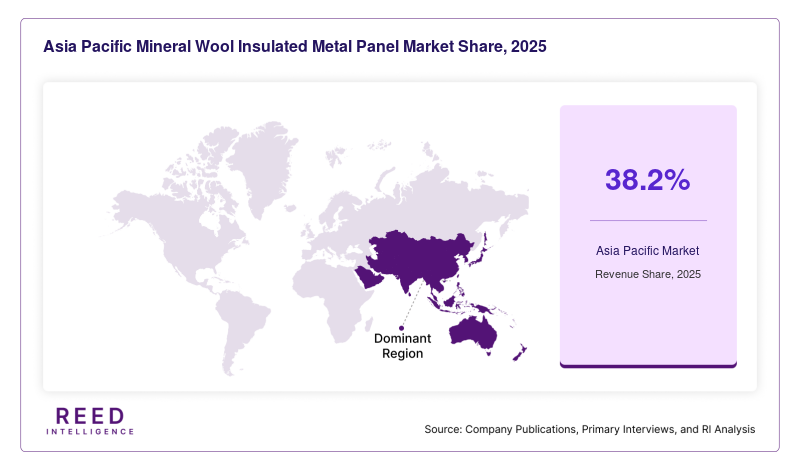
Asia Pacific is the dominant regional market, accounting for 38.2% of global revenue share in 2025. Based on the supplied global market value of USD 5,070 Million in 2025, this share corresponds to an estimated regional market value of approximately USD 1,936.74 Million (USD 1.94 Billion). This is a calculated estimate based on the reported regional share and the supplied global market size.
The region's leadership is supported by industrialization, manufacturing investment, infrastructure development, urbanization, and expanding warehouse and logistics capacity. China and India are significant demand centers, while Southeast Asian markets also offer opportunities as industrial facilities and commercial infrastructure expand. Demand for insulated panel systems is further supported by the need for efficient construction methods and building envelopes that meet thermal and fire-performance requirements.
Latin America Mineral Wool Insulated Metal Panel Market
Latin America offers growth opportunities as industrial infrastructure, logistics facilities, and commercial construction expand. Brazil and Mexico are important potential demand centers because of manufacturing activity, warehousing, and investment in modern industrial facilities.
Adoption is influenced by construction budgets, availability of specialized panel systems, local building regulations, and awareness of fire-resistant insulation. Suppliers that can provide cost-effective products and technical support may be well positioned to serve regional projects.
Middle East & Africa Mineral Wool Insulated Metal Panel Market
The Middle East & Africa market is supported by industrial diversification, infrastructure development, commercial construction, and investment in manufacturing and logistics facilities. Industrial buildings and specialized facilities can create demand for insulated panel systems that provide thermal performance and fire protection.
Market growth depends on construction activity, project financing, regulatory requirements, local manufacturing and distribution capabilities, and the economics of mineral wool panels compared with alternative materials. Industrial expansion and modernization of commercial infrastructure are expected to provide additional opportunities.
Mineral Wool Insulated Metal Panel Market Competitive Landscape
The Mineral Wool Insulated Metal Panel Market includes manufacturers of insulated metal panels, building-envelope systems, mineral wool insulation, and prefabricated construction products. Competition is influenced by insulation performance, fire certifications, product quality, installation efficiency, manufacturing capacity, technical support, and the ability to satisfy project-specific requirements.
Kingspan Group is a major global manufacturer of high-performance insulation and building-envelope products. Its insulated-panel portfolio serves industrial and commercial construction, while its mineral-fibre product offerings support applications where fire performance and thermal insulation are important. Kingspan's 2025 annual-report information identifies a new manufacturing facility in Mattoon, Illinois, focused on Kingspan K-Roc mineral-fibre products. The company also reported launching PowerPanel 2.0, an integrated photovoltaic solution combining an insulated panel with solar technology. These developments support its broader building-envelope portfolio, although PowerPanel 2.0 should not be treated as a mineral-wool-specific launch.
Key Market Players
- Kingspan Group
- Ceco Building Systems
- Metl-Span
- Nucor Corporation
- ROCKWOOL International A/S
- ArcelorMittal
- Tata Steel
- Ruukki Construction
- Isopan
- Panel Built, Inc.
- All Weather Insulated Panels
Mineral Wool Insulated Metal Panel Market Recent Developments
2025 Kingspan Group opened a mineral-fibre manufacturing facility in Mattoon, Illinois. Kingspan's annual-report materials state that the new facility focuses on producing K-Roc mineral-fibre products. The investment expands the company's mineral-fibre manufacturing footprint in North America and supports its wider insulated-building-envelope business. This is a verified mineral-fibre manufacturing development, rather than a claim of a new mineral wool metal-panel product launch.
2026 – Metl-Span continued promoting certified insulated metal panel systems and technical resources. Metl-Span's official website highlights its insulated metal panels, certifications, testing, approvals, and technical resources for building-envelope specification. These materials support the specification and adoption of insulated metal panels in commercial and industrial projects. The available page is a current product and technical resource, not a dated announcement of a new mineral wool panel.
Mineral Wool Insulated Metal Panel Market Segments
By Product Type
- Composite Panels
- Single Skin Panels
- Others
By Application
- Roofing
- Wall Cladding
- Floors
- Others
By End-Use Industry
- Commercial
- Industrial
- Residential
- Others
By Region
- North America
- Europe
- APAC
- Middle East and Africa
- LATAM