Minerals Thickening Agents Market Size, Share & Trends Analysis Report By Product Type (Natural Minerals, Synthetic Minerals), By Application (Food and Beverages, Pharmaceuticals, Cosmetics, Paints and Coatings), By Distribution Channel (Online Retail, Supermarkets/Hypermarkets, Specialty Stores) and By End-User Industry (Food and Beverage, Pharmaceutical, Personal Care, Industrial) and By Region (North America, Europe, Asia Pacific, Latin America, Middle East & Africa) Forecasts, 2026–2034
USD 3950
Minerals Thickening Agents Market Size
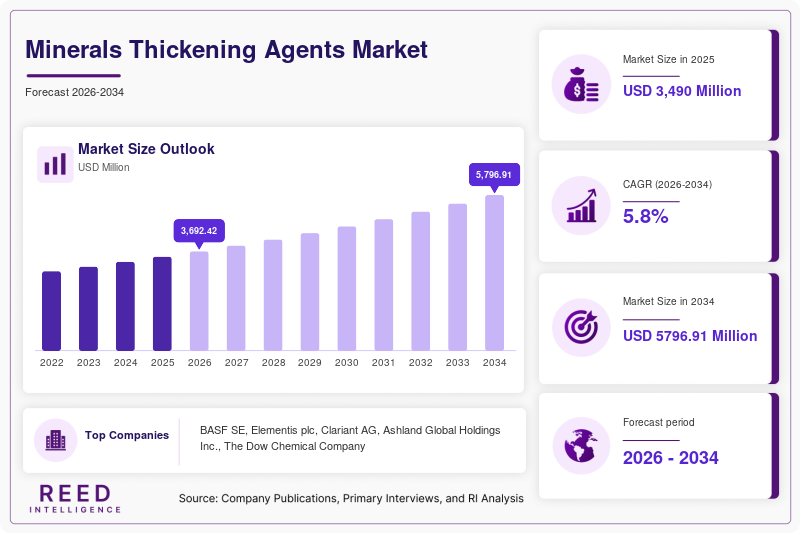
The global Minerals Thickening Agents Market was valued at USD 3,490 Million in 2025 and is projected to grow from USD 3,692.42 Million in 2026 to USD 5,796.91 Million by 2034, registering a CAGR of 5.8% during the forecast period from 2026 to 2034.
Minerals thickening agents are inorganic materials used to increase viscosity, control flow, stabilize suspensions, and improve the consistency of liquid, semi-solid, and paste-based products. Their performance depends on mineral composition, particle size, surface treatment, concentration, and compatibility with the formulation. Bentonite and attapulgite are used in suspension control and rheology modification, while hectorite and other specialty clays support applications requiring controlled flow, sag resistance, and formulation stability.
The market serves multiple industries, including food and beverages, pharmaceuticals, personal care, construction, paints and coatings, adhesives, and industrial chemicals. In coatings, mineral thickeners help reduce settling and improve sag resistance. In construction products, they can enhance workability, open time, and vertical slip resistance. In personal-care and household formulations, selected mineral additives help stabilize suspensions and maintain a consistent texture.
Minerals Thickening Agents Market Drivers
Growing Demand for Processed Food and Beverages
Food processors require ingredients and functional additives that help maintain texture, consistency, and product stability. Mineral-based thickening agents and related functional minerals can be used in selected food-processing applications, subject to applicable food-safety regulations and product specifications. Growth in packaged foods and beverages supports demand for reliable formulation ingredients.
Expansion of Pharmaceutical Manufacturing
Pharmaceutical manufacturers use selected mineral materials as excipients, suspension aids, and formulation components. Increasing production of oral suspensions, topical medicines, and other pharmaceutical preparations creates opportunities for suitable high-purity mineral ingredients. Suppliers that meet relevant pharmacopeial specifications and quality requirements can benefit from demand for consistent, application-specific materials.
Increasing Use in Paints, Coatings, and Construction Materials
Mineral thickeners provide viscosity control, suspension stability, sag resistance, and improved workability in paints, coatings, adhesives, sealants, and cementitious products. Growth in construction, infrastructure development, and industrial maintenance supports demand for mineral-based rheology modifiers. Specialty clay additives can also help manufacturers simplify formulations while maintaining performance.
Preference for Natural and Mineral-Based Ingredients
Some manufacturers are evaluating naturally derived materials to meet formulation, processing, and product-positioning objectives. Mineral-based additives can provide useful rheological functionality without relying exclusively on organic thickener technologies. Demand is supported by the need for performance, formulation flexibility, and reliable ingredient sourcing, although suitability depends on the application and regulatory requirements.
Minerals Thickening Agents Market Restraints
Variability in Raw-Material Quality
Natural minerals can vary in mineral composition, particle size, moisture content, and impurities depending on the source and processing method. Such variation may affect viscosity, dispersion, suspension stability, and finished-product consistency. Producers must invest in quality control and mineral processing to maintain predictable performance across batches.
Competition from Organic and Synthetic Thickeners
Cellulose derivatives, acrylic polymers, associative thickeners, and other organic or synthetic materials compete with mineral-based products in many applications. Depending on the formulation, these alternatives may offer specific advantages in efficiency, transparency, ease of use, or performance at low concentrations. This competition can constrain pricing and adoption in selected markets.
Processing and Transportation Costs
Mining, drying, milling, surface treatment, and fine-particle processing can contribute substantially to production costs. Transportation expenses may also affect profitability because mineral additives are often sold in bulk. Energy prices, logistics constraints, and the distance between mineral deposits, processing facilities, and end users can influence supply economics.
Regulatory and Application-Specific Requirements
Food, pharmaceutical, cosmetic, and industrial applications have different safety, purity, labeling, and performance requirements. Not every mineral thickener is suitable for every use. Suppliers may need application-specific testing, quality documentation, and customer qualification processes, increasing the time and cost required to enter regulated end markets.
Minerals Thickening Agents Market Opportunities
Development of High-Efficiency Mineral Additives
Manufacturers can create opportunities through mineral additives that deliver improved viscosity control, suspension stability, and performance at lower dosage levels. Products that are easier to disperse or that provide more predictable results under different processing conditions can help customers reduce formulation complexity and improve production efficiency.
Expansion in Construction and Infrastructure
Construction chemicals, tile adhesives, cementitious systems, protective coatings, and related materials require reliable workability and rheological control. Mineral thickeners that provide improved open time, sag resistance, and formulation stability can benefit from infrastructure investment and demand for large-format tile installation and advanced construction products.
Growth in Personal Care and Household Products
Mineral-based rheology modifiers can support viscosity control and suspension stability in selected personal-care and household formulations. Opportunities exist for easy-to-process, low-abrasion, and temperature-stable products that maintain texture and stability throughout storage and use.
Emerging-Market Manufacturing Expansion
Expanding pharmaceutical, cosmetics, coatings, construction-materials, and industrial manufacturing in Asia Pacific and other emerging markets creates opportunities for mineral suppliers. Local production, dependable distribution, technical support, and application-specific product development can help suppliers serve customers seeking consistent quality and competitive costs.
Minerals Thickening Agents Market Segmental Analysis
By Product Type
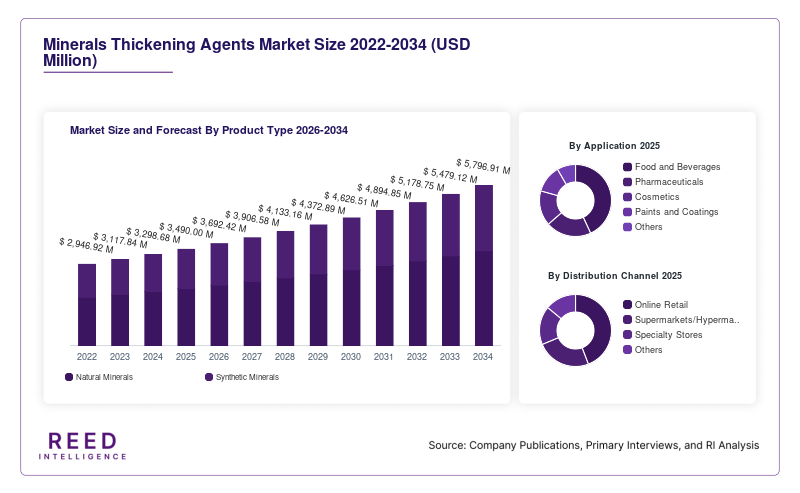
Natural Minerals represent the dominant product segment, accounting for approximately 58.2% of the global market in 2025, according to available market research. This category includes mineral-based materials such as bentonite, attapulgite, kaolin, and other clays used for thickening, gelling, and suspension control. Natural minerals benefit from established industrial supply chains and a broad range of applications across coatings, construction products, personal care, and selected pharmaceutical and food-related formulations. Product suitability depends on grade, purity, and the requirements of the end application.
Synthetic Minerals represent a growth opportunity for specialized formulations. Engineered mineral products can offer more controlled particle characteristics, consistent quality, and tailored performance for demanding applications. Available market research estimates that the synthetic-minerals segment could grow faster than natural minerals over the forecast period. However, performance and growth vary by mineral chemistry, application, and product specification, so a single growth rate should not be applied to all engineered mineral products.
By Application
Food and Beverages is identified as the dominant application category in available market research, with an estimated 42.5% share in 2025. Mineral ingredients can contribute to processing and formulation performance in specific applications, but the permitted function and use level depend on applicable regulations and product specifications. Demand is influenced by packaged-food production, formulation consistency, and the need for stable finished products.
Pharmaceuticals represent another important application area. Selected mineral materials are used as excipients or suspension aids in certain formulations, subject to purity requirements and regulatory approval. Pharmaceutical manufacturers require consistent raw materials, suitable documentation, and reliable performance. Growth in pharmaceutical production and demand for stable liquid and topical preparations can support the adoption of qualified mineral ingredients.
By Distribution Channel
Specialty Stores and Direct Industrial Sales are important channels for mineral thickening agents because industrial customers often require bulk supply, technical documentation, application guidance, and reliable delivery schedules. Specialty distributors can provide formulation support and help customers select products based on viscosity targets, compatibility, and processing conditions.
Online Retail offers an additional purchasing channel, particularly for smaller quantities, specialty ingredients, samples, and smaller manufacturers. Digital product catalogs and online procurement can improve product discovery and simplify ordering. However, bulk industrial transactions and regulated applications generally continue to require supplier qualification, technical review, and appropriate documentation.
By End-User Industry
Food and Beverage is a major end-user industry because manufacturers require functional ingredients and processing aids that meet product-specific quality and regulatory standards. The role of mineral thickening agents varies by product and jurisdiction, and not all mineral thickeners are permitted for direct food use.
Industrial applications provide a broad demand base across paints and coatings, adhesives, sealants, construction products, and related formulations. Mineral additives help manufacturers control flow, limit settling, improve sag resistance, and maintain stable formulations. Construction and coatings applications offer opportunities for suppliers developing high-efficiency, easy-to-disperse mineral products.
Minerals Thickening Agents Market Regional Analysis
North America Minerals Thickening Agents Market
North America represents an established market for mineral thickening agents, supported by paints and coatings, construction materials, industrial chemicals, personal care, and pharmaceutical manufacturing. The region benefits from established mineral processing capabilities, mature distribution networks, and customers that place strong emphasis on product consistency, technical performance, and quality documentation. Demand is influenced by construction activity, industrial maintenance, and the continued development of specialized formulations.
The United States is the principal market in the region, supported by industrial coatings, construction chemicals, and specialty formulation industries. Canada contributes through mining, industrial production, construction, and related chemical applications. Suppliers that provide technical support, dependable supply, and application-specific mineral grades can compete effectively in the region.
Europe Minerals Thickening Agents Market
Europe is an important market for mineral thickening agents because of its established coatings, construction chemicals, specialty chemicals, personal care, and pharmaceutical industries. Demand is influenced by product-performance standards, environmental requirements, and the need for efficient formulations. Mineral-based rheology modifiers are used in selected applications where suspension stability, controlled flow, and formulation robustness are important.
Germany, France, Italy, and the United Kingdom represent significant national markets through their manufacturing and chemical industries. European suppliers are also focused on developing specialized products that improve processing efficiency and support changing formulation requirements. Regulatory compliance, quality assurance, and raw-material traceability remain important competitive factors.
Asia Pacific Minerals Thickening Agents Market
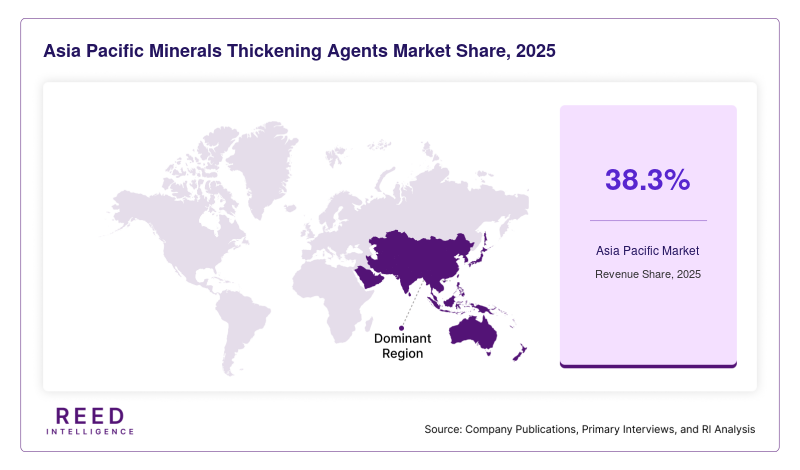
Asia Pacific is the dominant regional market, accounting for an estimated 38.3% of global revenue in 2025, according to available market research. Applying this share to the supplied global market size of USD 3,490 Million gives an indicative regional value of approximately USD 1,337.67 Million in 2025. This value is calculated from the supplied global market size and the cited regional share, rather than taken from a separately reported regional-value estimate.
Regional demand is supported by manufacturing activity in China, India, Japan, South Korea, and Southeast Asia. Expanding construction, coatings, pharmaceutical production, cosmetics manufacturing, and industrial processing create opportunities for natural and engineered mineral additives. The region also benefits from mineral-resource availability and established chemical-manufacturing supply chains. Growth prospects will depend on industrial investment, regulatory requirements, end-user demand, and the ability of suppliers to maintain consistent product quality.
Latin America Minerals Thickening Agents Market
Latin America represents an emerging market for mineral thickening agents, supported by construction materials, paints and coatings, mining-related applications, cosmetics, and industrial manufacturing. Brazil and Mexico are important markets because of their manufacturing bases, construction activity, and consumer industries. Demand depends on industrial production, infrastructure investment, and the availability of suitable mineral additives through local suppliers and distributors.
Market opportunities include improving access to application-specific mineral products, expanding technical support, and developing distribution relationships with coatings, construction-chemical, and industrial customers. Suppliers must also manage transportation costs, currency fluctuations, and differences in product standards across national markets.
Middle East & Africa Minerals Thickening Agents Market
The Middle East & Africa market is supported by construction, infrastructure development, industrial coatings, mining, oilfield-related applications, and manufacturing activity. Mineral thickeners can help control rheology and suspension stability in selected industrial formulations, including construction products and specialty coatings. Demand varies by country according to industrial diversification, construction activity, and access to mineral processing and distribution infrastructure.
The Middle East offers opportunities associated with infrastructure development and industrial investment, while selected African markets present opportunities in mining, construction materials, and manufacturing. Growth will depend on dependable supply chains, product qualification, competitive pricing, and the availability of technical support for industrial customers.
Minerals Thickening Agents Market Competitive Landscape
The Minerals Thickening Agents Market includes global specialty-chemical companies, industrial mineral producers, and suppliers of natural and engineered mineral additives. Competition is based on product performance, consistency, processing characteristics, price, distribution reach, and technical service. Companies serving coatings and construction customers often emphasize rheology control, anti-settling performance, workability, and compatibility with different formulations.
BASF SE offers Attagel attapulgite-clay products designed for thickening, suspension, and thixotropic rheology control across industrial applications. Its portfolio supports applications such as architectural and industrial coatings, where suspension stability and controlled viscosity are important. Elementis plc supplies specialty rheological additives, including clay-based products for coatings and other formulation applications. Its portfolio includes BENTONE LT for water-borne industrial coatings and BENAQUA 6000, a hectorite-clay additive developed for cementitious tile adhesives. These examples illustrate competition around mineral-based performance, formulation efficiency, and application-specific functionality.
Key Market Players
- BASF SE
- Elementis plc
- Clariant AG
- Ashland Global Holdings Inc.
- The Dow Chemical Company
- Evonik Industries AG
- 20 Microns Limited
- Active Minerals International, LLC
- BYK-Chemie GmbH
- Imerys S.A.
- Wacker Chemie AG
Minerals Thickening Agents Market Recent Developments
- 2026, Elementis highlights hectorite-based rheology technology for tile adhesives
Elementis promotes BENAQUA 6000, a hectorite-clay-based additive for cementitious tile adhesives. The product is designed to improve workability, open time, and sag resistance while helping simplify formulations. Elementis reports an open time exceeding 30 minutes and slip below 0.5 mm under its stated test conditions. - July 2026, Clariant updates its TERRANA clay-specialties portfolio
Clariant's TERRANA product information, dated 7 July 2026, describes specialty products based on bentonite and attapulgite. The portfolio serves applications including wastewater treatment, water preparation, ceramics, rubber, plastics, and agriculture, with mineral products supporting viscosity and rheology adjustment.
Minerals Thickening Agents Market Segments
By Product Type
- Natural Minerals
- Synthetic Minerals
By Application
- Food and Beverages
- Pharmaceuticals
- Cosmetics
- Paints and Coatings
- Others
By Distribution Channel
- Online Retail
- Supermarkets/Hypermarkets
- Specialty Stores
- Others
By End-User Industry
- Food and Beverage
- Pharmaceutical
- Personal Care
- Industrial
- Others
By Region
- North America
- Europe
- APAC
- Middle East and Africa
- LATAM