Mini C Arm Market Size, Share & Demand Report By Type (Mini C-Arm, Portable Mini C-Arm), By Application (Orthopedic, Podiatry, Sports Medicine), By End-Use (Hospitals, Ambulatory Surgical Centers, Specialty Clinics) & Segment Forecasts, 2025–2034
USD 3950
Market Overview
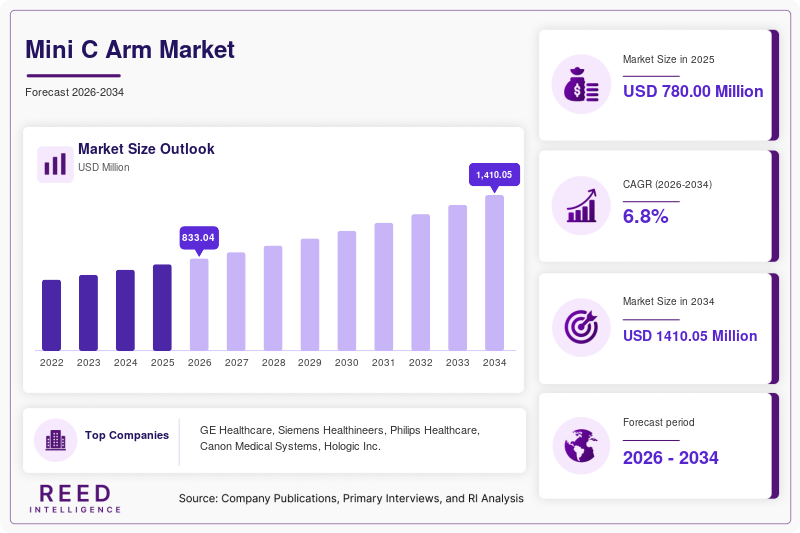
The Mini C Arm Market size is witnessing steady expansion driven by the rising demand for compact imaging solutions in orthopedic and extremity procedures. The global market size was valued at approximately USD 780 million in 2025 and is projected to reach around USD 835 million in 2026. Over the forecast period from 2025 to 2034, the market is expected to grow at a compound annual growth rate (CAGR) of 6.8%, reaching nearly USD 1550 million by 2034. The increasing preference for minimally invasive procedures, along with technological advancements in imaging systems, is significantly shaping the industry landscape.
One of the primary growth factors is the increasing incidence of orthopedic disorders, including fractures, arthritis, and sports injuries. These conditions require precise imaging during diagnosis and treatment, which mini C-arm systems can provide with lower radiation exposure compared to full-sized systems. Another key factor is the rising adoption of outpatient and ambulatory surgical centers, where space-saving and portable imaging devices are essential. Mini C-arms are particularly suitable in such environments due to their compact design and ease of mobility.
Key Highlights
- Market size reached USD 780 million in 2025
- Expected to grow at a CAGR of 6.8% (2025–2034)
- Projected to reach USD 1.55 billion by 2034
- Rising orthopedic procedures boosting demand
- Increasing adoption in ambulatory surgical centers
Market Trends
Integration of Advanced Digital Imaging Technologies
The integration of advanced digital imaging technologies is a prominent trend in the Mini C Arm Market. Manufacturers are focusing on incorporating high-resolution flat-panel detectors and real-time image processing capabilities to improve diagnostic accuracy. These advancements enable clinicians to obtain clearer images with reduced exposure time, which enhances patient safety. The shift from traditional image intensifiers to digital systems is also improving workflow efficiency and reducing maintenance requirements. As healthcare providers prioritize precision and speed, the adoption of technologically advanced mini C-arms continues to increase across orthopedic and podiatric applications.
Growing Preference for Portable and Compact Imaging Systems
Another notable trend is the increasing demand for portable and compact imaging systems. Healthcare facilities, especially outpatient centers, are opting for mini C-arms due to their small footprint and ease of use. These systems can be easily transported between rooms, making them suitable for facilities with limited space. Additionally, the growing trend of decentralized healthcare services is driving the need for flexible imaging solutions. Portable mini C-arms support point-of-care diagnostics, enabling faster decision-making and improved patient outcomes in various clinical settings.
Market Drivers
Increasing Prevalence of Orthopedic Disorders
The rising prevalence of orthopedic conditions is a major driver of the Mini C Arm Market. Factors such as aging populations, sedentary lifestyles, and increasing participation in sports activities are contributing to a higher incidence of bone-related injuries and disorders. Mini C-arms are widely used in procedures involving hands, wrists, ankles, and feet, where precise imaging is essential. The ability of these devices to provide real-time visualization during surgeries enhances procedural accuracy and reduces complications, thereby driving their adoption among healthcare professionals.
Expansion of Ambulatory Surgical Centers
The rapid growth of ambulatory surgical centers is significantly boosting demand for mini C-arm systems. These centers focus on providing cost-effective and efficient surgical services without the need for prolonged hospital stays. Mini C-arms are ideal for such settings due to their compact size, lower cost, and ease of operation. As healthcare systems shift toward outpatient care models, the demand for portable imaging devices is expected to rise. This trend is further supported by favorable reimbursement policies and increasing patient preference for minimally invasive procedures.
Market Restraint
High Initial Investment and Maintenance Costs
Despite their advantages, the high initial cost of mini C-arm systems remains a key restraint for market growth. Although these devices are more affordable than full-sized C-arms, they still require significant capital investment, which can be challenging for small clinics and healthcare facilities with limited budgets. Additionally, maintenance costs, including software upgrades and servicing, add to the overall expense. This financial burden can delay purchasing decisions and limit adoption, particularly in developing regions. For example, smaller healthcare providers may opt for refurbished equipment instead of investing in new systems, which can slow the growth of the primary market.
Market Opportunities
Growth in Emerging Healthcare Markets
Emerging economies present significant opportunities for the Mini C Arm Market. Countries in Asia Pacific, Latin America, and parts of Africa are investing heavily in healthcare infrastructure and diagnostic capabilities. The increasing number of hospitals and clinics in these regions is creating demand for cost-effective imaging solutions. Mini C-arms offer an ideal balance between performance and affordability, making them attractive for healthcare providers in developing markets. As awareness of advanced diagnostic technologies grows, the adoption of mini C-arm systems is expected to increase substantially.
Technological Innovations and Product Development
Continuous innovation in imaging technology is opening new growth avenues for the market. Manufacturers are developing systems with improved ergonomics, enhanced software integration, and lower radiation exposure. Features such as wireless connectivity, cloud-based image storage, and AI-assisted diagnostics are gaining traction. These advancements not only improve clinical outcomes but also enhance user experience. As healthcare providers seek more efficient and advanced imaging solutions, companies that invest in research and development are likely to gain a competitive advantage.
Segmental Analysis
By Type
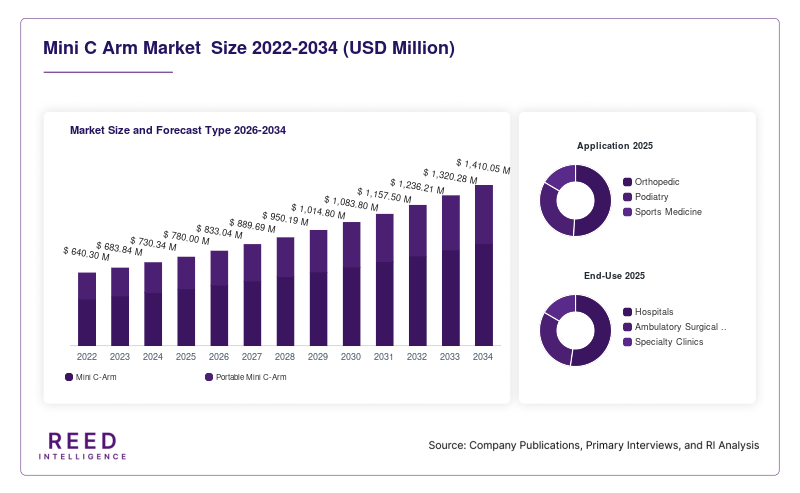
The mini C-arm segment dominated the market in 2024, accounting for approximately 62% of the total share. These systems are widely used for extremity imaging due to their compact size and ease of use. Their ability to provide high-quality images with lower radiation exposure makes them suitable for various clinical applications. Hospitals and clinics prefer mini C-arms for procedures involving hands, feet, and other small anatomical areas. The growing demand for efficient and cost-effective imaging solutions is further supporting the dominance of this segment.
The portable mini C-arm segment is expected to witness the fastest growth, with a CAGR of 7.5% during the forecast period. The increasing demand for mobility and flexibility in healthcare settings is driving the adoption of portable systems. These devices can be easily transported and used in different locations, making them ideal for outpatient facilities. The rising trend of point-of-care diagnostics and decentralized healthcare services is a key factor contributing to the growth of this segment.
By Application
Orthopedic applications held the largest market share in 2024, accounting for nearly 55% of total revenue. The high prevalence of bone-related disorders and injuries is driving the demand for imaging systems in this segment. Mini C-arms are widely used in orthopedic surgeries to provide real-time imaging, which helps surgeons achieve better outcomes. The increasing number of joint replacement procedures and fracture treatments is further supporting segment growth.
Podiatry applications are expected to grow at the fastest rate, with a CAGR of 7.8% during the forecast period. The rising incidence of foot-related disorders, particularly among diabetic patients, is driving demand for imaging systems in this segment. Mini C-arms provide detailed images of the foot, enabling accurate diagnosis and treatment. The growing awareness of foot health and increasing number of podiatry clinics are key factors supporting this segment’s growth.
By End-Use
Hospitals dominated the Mini C Arm Market in 2024, holding a share of approximately 60%. Large hospitals have the financial resources to invest in advanced imaging equipment, making them the primary users of mini C-arm systems. These facilities perform a high volume of surgical procedures, requiring reliable imaging solutions. The presence of skilled healthcare professionals and advanced infrastructure further supports the dominance of this segment.
Ambulatory surgical centers are expected to register the fastest growth, with a CAGR of 8.0% during the forecast period. The increasing preference for outpatient procedures is driving demand for compact and cost-effective imaging systems. Mini C-arms are ideal for these settings due to their portability and ease of use. The shift toward value-based healthcare and shorter hospital stays is a key factor contributing to the growth of this segment.
Regional Analysis
North America
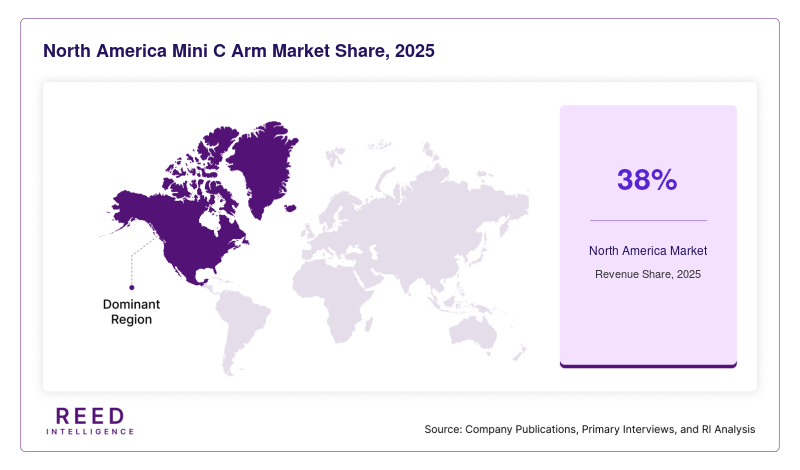
North America held the largest share of the Mini C Arm Market in 2025, accounting for approximately 38% of global revenue. The region is expected to maintain steady growth with a CAGR of around 6.2% during the forecast period. The presence of advanced healthcare infrastructure and high adoption of innovative medical technologies are key factors driving market growth. Additionally, strong reimbursement frameworks and increased spending on healthcare services support the widespread use of mini C-arm systems.
The United States dominates the regional market due to its well-established healthcare system and high volume of orthopedic procedures. A unique growth factor in the country is the strong focus on outpatient care and same-day surgeries. This shift toward minimally invasive procedures is increasing the demand for compact imaging devices, thereby supporting market expansion.
Europe
Europe accounted for nearly 27% of the Mini C Arm Market share in 2025 and is projected to grow at a CAGR of 6.5% through 2034. The region benefits from a well-developed healthcare system and increasing adoption of advanced imaging technologies. Government initiatives aimed at improving diagnostic capabilities and patient care are further supporting market growth.
Germany is a leading country in the European market, driven by its strong medical device manufacturing sector. A unique growth factor in the region is the increasing focus on precision medicine and specialized orthopedic care. This has led to higher demand for accurate imaging systems, including mini C-arms, in clinical settings.
Asia Pacific
Asia Pacific is expected to witness the fastest growth, with a CAGR of 8.1% during the forecast period, and held a market share of around 20% in 2025. Rapid urbanization, increasing healthcare expenditure, and rising awareness of advanced medical technologies are key drivers in the region. The expanding patient pool and growing incidence of orthopedic conditions are also contributing to market growth.
China dominates the regional market due to its large population and expanding healthcare infrastructure. A unique growth factor is the government's investment in modernizing healthcare facilities, particularly in rural areas. This is driving the adoption of compact and cost-effective imaging systems such as mini C-arms.
Middle East & Africa
The Middle East & Africa region accounted for approximately 8% of the Mini C Arm Market in 2025 and is expected to grow at a CAGR of 6.9%. Increasing investments in healthcare infrastructure and rising demand for diagnostic imaging are supporting market expansion. The region is gradually adopting advanced medical technologies to improve patient care.
Saudi Arabia is a key market in the region, driven by government initiatives to enhance healthcare services. A unique growth factor is the increasing number of specialized medical centers focusing on orthopedic care. This is creating demand for mini C-arm systems for accurate imaging during procedures.
Latin America
Latin America held around 7% of the global Mini C Arm Market share in 2025 and is projected to grow at a CAGR of 6.7%. The region is experiencing gradual improvements in healthcare infrastructure and increased adoption of modern diagnostic equipment. Economic development and rising healthcare awareness are key contributors to market growth.
Brazil leads the regional market due to its expanding healthcare sector and growing number of hospitals. A unique growth factor is the increasing prevalence of sports-related injuries, which is driving demand for orthopedic imaging solutions. This is supporting the adoption of mini C-arm systems across medical facilities.
Competitive Landscape
The Mini C Arm Market is moderately competitive, with several global and regional players focusing on product innovation and strategic partnerships. Companies are investing in research and development to introduce advanced imaging systems with improved performance and user-friendly features. The market is characterized by continuous technological advancements and increasing competition among key players.
One of the leading companies in the market is GE Healthcare, which has a strong presence in the imaging solutions segment. The company recently introduced an upgraded mini C-arm system with enhanced digital imaging capabilities and improved ergonomics. Other major players are also focusing on expanding their product portfolios and strengthening their market position through mergers and acquisitions. The competitive landscape is expected to remain dynamic, with companies striving to gain a larger share of the growing market.
Key Players List
- GE Healthcare
- Siemens Healthineers
- Philips Healthcare
- Canon Medical Systems
- Hologic Inc.
- OrthoScan Inc.
- Carestream Health
- Ziehm Imaging
- Shimadzu Corporation
- Eurocolumbus S.r.l.
- BMI Biomedical International
- Genoray Co., Ltd.
- DMS Imaging
- Allengers Medical Systems
- Intermedical S.r.l.
Recent Developments
- In 2024, a major imaging company launched a mini C-arm system with AI-based image enhancement features to improve diagnostic accuracy.
- In 2023, a leading manufacturer expanded its production capacity to meet the growing demand for portable imaging devices.
- In 2024, a healthcare technology firm introduced a wireless mini C-arm system with cloud integration capabilities for better data management.
Mini C Arm Market Segments
Type
- Mini C-Arm
- Portable Mini C-Arm
Application
- Orthopedic
- Podiatry
- Sports Medicine
End-Use
- Hospitals
- Ambulatory Surgical Centers
- Specialty Clinics
By Region
- North America
- Europe
- APAC
- Middle East and Africa
- LATAM