Mini Dustbin Market Size, Share & Trends Analysis Report By Product Type (Plastic Mini Dustbins, Metal Mini Dustbins, Ceramic Mini Dustbins, Others) and By Application (Residential, Commercial, Others) and By Distribution Channel (Online, Offline) and By Region (North America, Europe, Asia Pacific, Latin America, Middle East & Africa) Forecasts, 2026–2034
USD 3950
Mini Dustbin Market Size
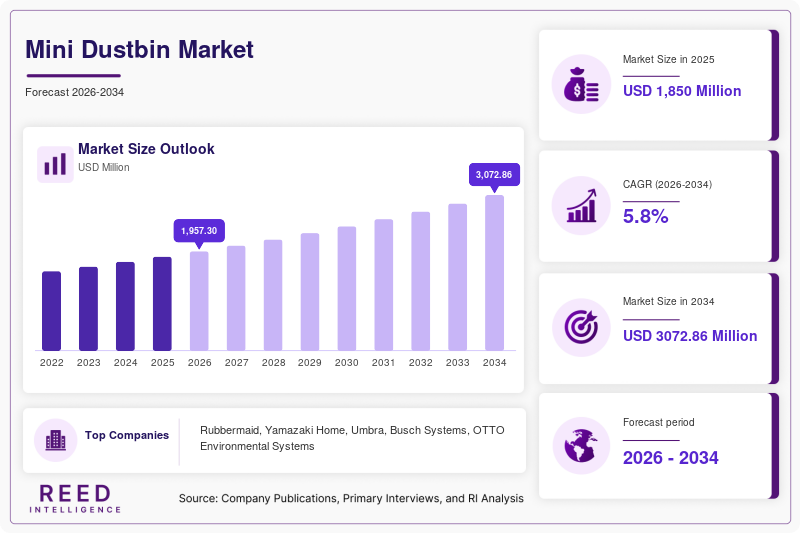
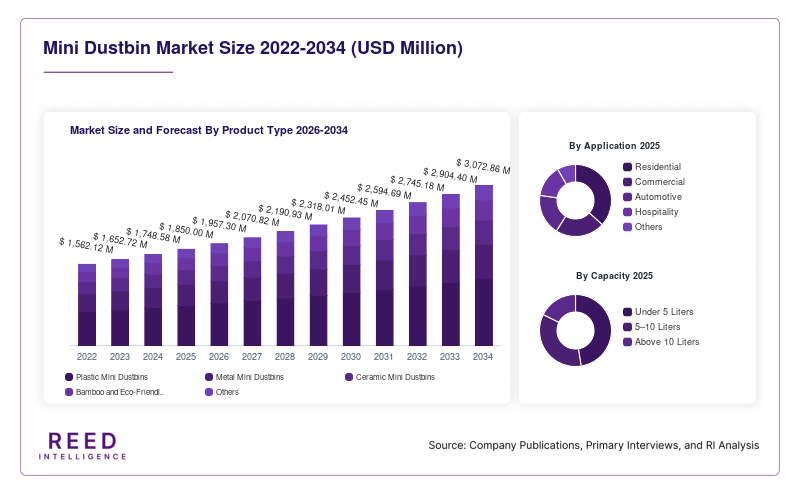
The global mini dustbin market was valued at USD 1,850 million in 2025 and is projected to grow from USD 1,957.30 million in 2026 to USD 3,072.86 million by 2034, registering a CAGR of 5.8% during the forecast period from 2026 to 2034.
Mini dustbins are small-capacity waste containers designed for localized waste collection in bedrooms, kitchens, bathrooms, office desks, vehicle interiors, hotel rooms, and other compact spaces. They are manufactured from materials such as plastic, stainless steel, ceramic, bamboo, and other composite or sustainable materials.
The market serves residential consumers, offices, hospitality businesses, commercial facilities, and selected institutional applications. Residential use remains important because households use mini dustbins for personal-care waste, desk waste, small packaging, and other everyday disposal needs. Commercial demand comes from workstations, hotel rooms, reception areas, washrooms, and compact service spaces.
Mini Dustbin Market Drivers
Urbanization and Compact Living Spaces
Urbanization and the development of apartments, smaller homes, shared accommodation, and compact workspaces are increasing demand for space-efficient household accessories. Mini dustbins fit easily into bedrooms, bathrooms, kitchens, and workstations, making them practical for consumers seeking convenient waste disposal without using large containers.
Growing Focus on Hygiene and Organization
Consumers increasingly prioritize clean and organized living and working environments. Mini dustbins provide accessible waste collection near desks, dressing tables, kitchen counters, and personal spaces. Easy-to-clean surfaces, covered lids, and odor-control features further strengthen demand among households and commercial users.
Growth of E-commerce and Home-Organization Products
Online retail platforms enable consumers to compare different sizes, materials, colors, and designs. Social media, interior-design content, and home-organization trends also encourage purchases of products that combine utility with decorative appeal, creating opportunities for differentiated and premium mini dustbins.
Mini Dustbin Market Restraints
Intense Price Competition
The market contains many low-cost manufacturers and private-label products. Similar designs and limited differentiation in basic models can increase price competition and reduce margins, particularly for suppliers that rely on conventional plastic mini dustbins.
Availability of Substitute Products
Consumers may use reusable containers, small baskets, repurposed packaging, or conventional wastebaskets instead of dedicated mini dustbins. These alternatives can limit demand when buyers prioritize price over specialized features or design.
Raw Material and Transportation Costs
Plastic resins, stainless steel, packaging, and transportation expenses can affect production costs. Changes in material prices and international freight rates may place pressure on manufacturers and retailers, especially those operating with narrow margins.
Mini Dustbin Market Opportunities
Eco-Friendly and Recycled Materials
Manufacturers can develop products using recycled plastics, responsibly sourced bamboo, and other materials that appeal to sustainability-conscious consumers. Clear material disclosures and durable designs may help distinguish products from conventional low-cost alternatives.
Premium and Design-Led Products
Decorative metal, ceramic, minimalist, and coordinated home-accessory collections offer opportunities to increase product value. Consumers furnishing modern homes, offices, and hospitality spaces may be willing to pay more for attractive finishes, compact designs, and convenient cleaning features.
Smart and Odor-Control Features
Sensor-operated lids, removable inner containers, odor-control components, and touchless operation can improve convenience. These features may appeal to users seeking enhanced hygiene in bathrooms, kitchens, offices, and hospitality environments.
Mini Dustbin Market Segmental Analysis
By Product Type
Plastic Mini Dustbins Dominant Segment: Plastic mini dustbins are the leading product category, accounting for approximately 42.3% of market revenue in 2025 according to DataIntelo. Their dominance is supported by affordability, lightweight construction, manufacturing scalability, and availability in multiple shapes, colors, and capacities.
Other Materials Potential Growth Opportunity: Metal, ceramic, bamboo, and other alternative-material products provide opportunities through premium designs, durability, and sustainability positioning. DataIntelo identifies other materials as a category with growth potential, but its reported growth estimates are not treated as independently verified forecasts for every mini dustbin material.
Metal Mini Dustbins: Metal mini dustbins are attractive to consumers seeking durability and a premium finish. Stainless steel models are commonly used in bathrooms, offices, kitchens, and hospitality settings.
Ceramic and Eco-Friendly Mini Dustbins: Ceramic and alternative-material products serve design-oriented consumers. Their demand depends on aesthetics, durability, price, and preferences for environmentally differentiated household products.
By Application
Residential Dominant Segment: Residential applications are the principal demand center. DataIntelo estimates that residential uses accounted for approximately 64.2% of market revenue in 2025, reflecting the widespread use of compact waste containers in kitchens, bedrooms, bathrooms, and home offices.
Commercial and Hospitality Growth Opportunity: Offices, hotels, restaurants, and other commercial facilities provide opportunities as businesses improve workspace organization and customer-facing interiors. A comparable, independently verified CAGR establishing the fastest-growing application segment through 2034 was not available.
Automotive: Vehicle mini dustbins provide compact waste collection for drivers and passengers. Demand is influenced by convenience, portability, easy cleaning, and compatibility with vehicle interiors.
By Capacity
Under 5 Liters Core Product Category: Small-capacity products are suited to desks, car interiors, dressing tables, and other limited spaces. Their compact form makes them convenient for localized waste collection.
5–10 Liters Household Opportunity: Medium mini dustbins serve bathrooms, bedrooms, small kitchens, and home offices. They offer a balance between capacity and space efficiency.
Above 10 Liters: Larger compact bins serve applications where users need additional capacity without moving to a full-size waste container. Reliable comparative market-share and CAGR data for these capacity categories could not be independently verified.
By Distribution Channel
Online Expanding Channel: E-commerce platforms enable consumers to compare designs, materials, dimensions, prices, and reviews. Digital channels are particularly suitable for visually differentiated products and smaller household accessories.
Offline Established Channel: Household-goods retailers, supermarkets, department stores, and specialty stores remain important because consumers can inspect product quality and size before buying. No sufficiently comparable market-specific data was found to confirm which channel has the highest share or fastest CAGR for this forecast period.
Mini Dustbin Market Regional Analysis
North America Mini Dustbin Market
North America represents an established market for mini dustbins, supported by household accessory purchases, home renovation, office organization, and demand for convenient waste-disposal products. Consumers purchase products across plastic, stainless steel, ceramic, and premium design categories.
The United States is a major contributor because of its broad retail infrastructure, e-commerce penetration, and demand for household and office organization products. Canada also contributes through residential and commercial applications. A reliable market-specific North American share and corresponding 2025 revenue figure were not independently verified for this report.
Europe Mini Dustbin Market
Europe is an important market for mini dustbins, supported by established household-goods retail networks, home improvement activity, and demand for functional products with coordinated interior designs. Sustainability preferences can also create opportunities for recycled plastics, durable metal products, and alternative materials.
Germany, the United Kingdom, France, Italy, and other European countries contribute through residential, commercial, and hospitality applications. Demand is influenced by household spending, interior-design preferences, product durability, and retail availability. A comparable regional share and market value specific to mini dustbins were not independently verified.
Asia Pacific Mini Dustbin Market
Asia Pacific — Dominant Region: Asia Pacific accounted for 38.5% of global mini dustbin market revenue in 2025, according to DataIntelo. Based on the supplied global market value of USD 1,850 million in 2025, the implied regional market value is approximately USD 712.25 million (USD 712.3 million). This is a calculated estimate using the published regional share and the supplied global market size, rather than a separately reported regional revenue figure.
The region benefits from urbanization, household formation, e-commerce growth, and demand for space-efficient home accessories. China, India, Japan, South Korea, and Southeast Asian markets provide opportunities across economical plastic products and premium metal or design-oriented models. Regional expansion will depend on household spending, retail distribution, local manufacturing capabilities, and consumer preferences for convenience and appearance.
Latin America Mini Dustbin Market
Latin America offers growth opportunities through urbanization, household formation, retail development, and expanding online shopping. Brazil and Mexico are relevant markets for household accessories, while other countries provide demand through residential, office, and hospitality applications.
Market performance depends on purchasing power, imported-product costs, local manufacturing, retail availability, and competition from low-cost alternatives. A reliable 2025 regional share and market value specific to mini dustbins were not independently verified.
Middle East & Africa Mini Dustbin Market
The Middle East & Africa market is supported by residential construction, hospitality development, office facilities, and demand for household and commercial accessories. Mini dustbins are used in homes, hotels, offices, bathrooms, and other compact spaces.
The United Arab Emirates, Saudi Arabia, and South Africa provide opportunities through retail development and residential or hospitality demand. Market expansion varies by country, purchasing power, product availability, and distribution networks. A comparable regional share and market value for mini dustbins were not independently verified.

Mini Dustbin Market Competitive Landscape
The mini dustbin market is fragmented, with global household-product brands competing alongside regional plastic manufacturers, stainless-steel product suppliers, private-label businesses, and e-commerce sellers. Competitive factors include product design, price, material quality, capacity, durability, brand recognition, and distribution reach.
Rubbermaid: Rubbermaid offers waste-management and household organization products through an established retail and commercial distribution network. Its brand recognition and broad product portfolio support its position in conventional waste containers and related organizational products.
Yamazaki Home: Yamazaki Home focuses on minimalist household organization and space-saving designs. Its design-led product approach is relevant to consumers seeking compact waste containers that complement modern interiors.
Key Market Players
Mini Dustbin Market Recent Market Developments
- August 2025 Brabantia expands its compact Bo bin range
Brabantia announced new 4-liter, 7-liter and 12-liter Bo pedal bins, alongside larger models, with availability beginning in September 2025. The compact bins feature space-saving designs, soft-close lids and convenient opening mechanisms, targeting bathrooms, kitchens and other small spaces. This is directly relevant to the mini dustbin segment. - March 2026 Yamazaki Home launches in Canada
Yamazaki Home announced its Canadian market launch on March 4, 2026, expanding access to its household organization products designed around minimalist styling and small-space living. This provides a distribution-expansion example relevant to compact household waste bins, although the announcement does not identify a new mini dustbin launch specifically.
Mini Dustbin Market Segments
By Product Type
- Plastic Mini Dustbins
- Metal Mini Dustbins
- Ceramic Mini Dustbins
- Bamboo and Eco-Friendly Mini Dustbins
- Others
By Application
- Residential
- Commercial
- Automotive
- Hospitality
- Others
By Capacity
- Under 5 Liters
- 5–10 Liters
- Above 10 Liters
By Distribution Channel
- Online
- Offline
- Specialty Retailers
- Supermarkets and Hypermarkets
- Others
By Region
- North America
- Europe
- APAC
- Middle East and Africa
- LATAM