Mini SLR Camera Lens Market Size, Share & Trends Analysis Report By Product Type (Wide-Angle Lens, Telephoto Lens, Standard Lens, Macro Lens, Others) and By Application (Professional Photography, Amateur Photography) and By Distribution Channel (Online Stores, Specialty Camera Stores, Supermarkets) and By End User (Professional Photographers, Hobbyists) and By Region (North America, Europe, Asia Pacific, Latin America, Middle East & Africa) Forecasts, 2026–2034
USD 3950
Mini SLR Camera Lens Market Size
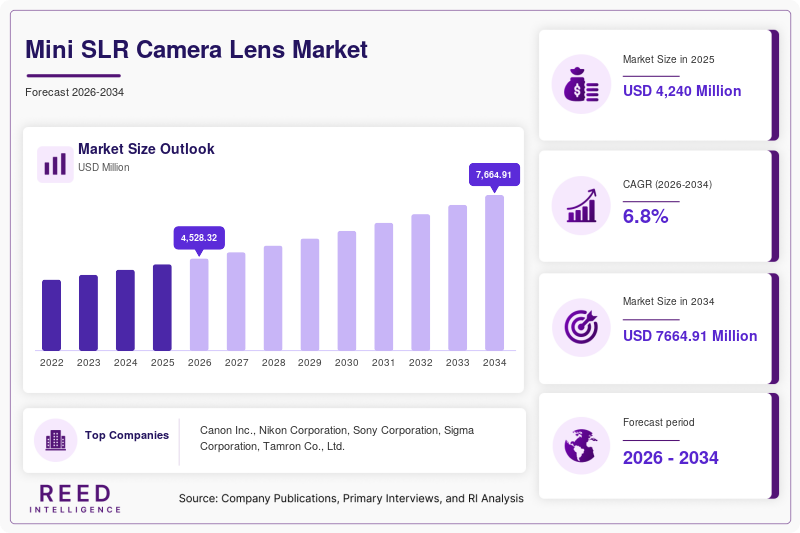
The global mini SLR camera lens market was valued at USD 4,240 Million in 2025 and is projected to grow from USD 4,528.32 Million in 2026 to USD 7,664.91 Million by 2034, registering a CAGR of 6.8% during the forecast period from 2026 to 2034.
The Mini SLR Camera Lens Market is part of the broader photographic optics industry, supplying lenses for professional photography, amateur photography, travel, portraiture, wildlife, landscape photography, and other imaging applications. The market encompasses manufacturers of camera bodies and optics, independent lens producers, distributors, specialty camera retailers, and online sellers.
Technological developments in optical design, advanced coatings, precision glass elements, autofocus motors, and image stabilization are influencing product differentiation. Compact lens construction is particularly valuable for photographers who prioritize portability without sacrificing image quality. Manufacturers are also developing lenses that support hybrid photography and video workflows, including reduced focus breathing, quieter autofocus, and improved handling.
Mini SLR Camera Lens Market Drivers
Growing Demand for Professional and Enthusiast Photography:
Professional photographers, hobbyists, and photography enthusiasts continue to seek lenses that deliver improved sharpness, low-light performance, focal-length flexibility, and subject separation. Specialized optics support portrait, landscape, wildlife, sports, macro, and commercial photography, encouraging demand for interchangeable lenses across different price ranges.
Advancements in Optical Engineering:
Improvements in optical glass, aspherical elements, lens coatings, autofocus systems, and stabilization technologies are improving image quality and usability. Compact designs and lighter lens bodies also make interchangeable-lens systems more convenient for travel, documentary photography, and extended professional assignments.
Expansion of Video and Content Creation:
Content creators increasingly use interchangeable-lens cameras for short-form video, streaming, commercial production, interviews, and cinematic content. Lenses with quiet autofocus, wide apertures, smooth focus transitions, and versatile zoom ranges are becoming important to hybrid photo-video workflows.
Product Innovation and Lens-System Expansion:
Camera and lens manufacturers are expanding their product portfolios across wide-angle, standard, telephoto, and specialty optics. New products and mount-compatible alternatives allow photographers to build equipment systems around specific budgets, shooting requirements, and preferred camera platforms.
Mini SLR Camera Lens Market Restraints
High Prices of Premium Lenses:
Professional lenses with large apertures, advanced optical elements, stabilization, and durable construction can be expensive. High prices may discourage casual users and price-sensitive consumers from upgrading, particularly when entry-level lenses already satisfy their basic photography requirements.
Competition From Smartphone Cameras:
Smartphone cameras provide increasingly capable imaging, computational photography, and convenient sharing features. These capabilities reduce the need for dedicated camera equipment among some casual users, although smartphones cannot fully replace interchangeable lenses for every professional or specialized application.
Camera-Mount Compatibility Limitations:
Lens compatibility depends on camera mounts, sensor formats, electronic communication, and autofocus protocols. Photographers may face additional costs when changing camera systems, while manufacturers must invest in mount-specific designs and testing.
Market Transition Toward Mirrorless Systems:
The broader camera industry has shifted substantially toward mirrorless systems. This transition creates opportunities for new lens designs but may constrain demand for certain legacy DSLR-compatible lenses as camera manufacturers prioritize newer mounts and product ecosystems.
Mini SLR Camera Lens Market Opportunities
Growth in Compact and Lightweight Lens Designs:
Demand for portable equipment creates opportunities for manufacturers to develop smaller lenses with competitive optical performance. Compact primes and versatile zoom lenses can appeal to travel photographers, enthusiasts, and professionals seeking to reduce equipment weight.
Expansion of Third-Party Lens Portfolios:
Independent manufacturers can capture demand through competitive pricing, specialized focal lengths, alternative mounts, and innovative designs. Strategic compatibility agreements and broader mount availability can improve access to customers across camera ecosystems.
Hybrid Photography and Videography:
Lenses designed for both still photography and video can serve a wider customer base. Features such as reduced focus breathing, quiet autofocus, and improved manual control offer opportunities for differentiation in the creator economy.
Online Distribution and Direct-to-Consumer Sales:
Online retailers and manufacturer-operated stores enable customers to compare specifications, prices, and compatibility before purchasing. Digital distribution also provides opportunities to reach emerging markets and niche photography communities.
Mini SLR Camera Lens Market Segmental Analysis
By Product Type
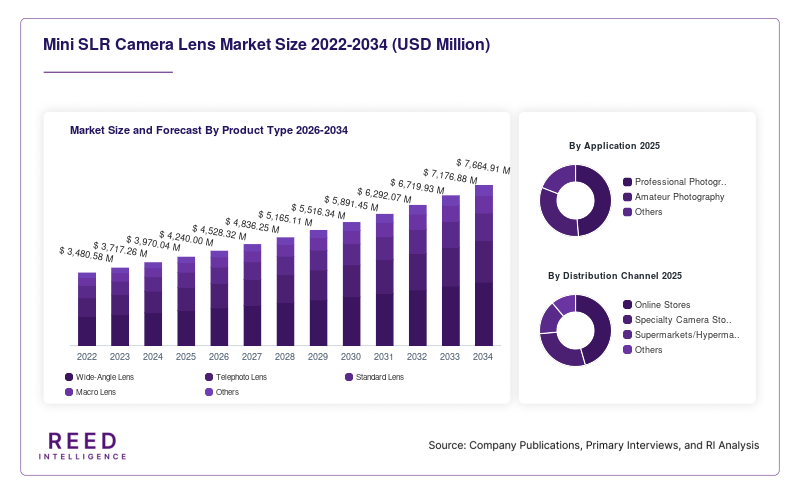
Wide-Angle Lenses represent the dominant product segment, accounting for approximately 28.5% of the market in the 2025 market assessment. These lenses are widely used in landscape photography, architecture, interiors, travel, events, and video production. Their broad field of view makes them suitable for capturing expansive scenes and working in confined spaces. Recent optical designs have also improved edge sharpness, distortion control, and low-light performance.
Telephoto Lenses are important for wildlife, sports, events, portraiture, and other applications requiring longer focal lengths. Demand is influenced by autofocus speed, stabilization, aperture, and portability. Standard Lenses offer versatility for everyday photography, while Macro Lenses serve close-up photography and specialized imaging requirements.
The available market assessment does not provide a sufficiently comparable, independently verified growth rate for every product category. Therefore, a definitive fastest-growing product segment and its CAGR cannot be stated reliably.
By Application
Professional Photography is the dominant application segment, accounting for approximately 58.3% of the market in the 2025 assessment. Professional users require consistent optical quality, reliable autofocus, specialized focal lengths, and durable equipment for commercial, editorial, portrait, sports, wildlife, and event assignments. Equipment performance can directly influence workflow efficiency and the quality of paid photographic work.
Amateur Photography remains important because hobbyists purchase lenses for travel, landscapes, portraits, family events, wildlife, and creative experimentation. Online tutorials, photography communities, and easier access to specialist equipment can encourage enthusiasts to expand their lens collections.
The market data reviewed does not establish a reliable comparable CAGR for each application segment. Consequently, the fastest-growing application cannot be assigned a verified ranking or percentage growth rate.
By Distribution Channel
Online Stores provide customers with access to broad product portfolios, price comparisons, technical specifications, compatibility information, and customer reviews. Online distribution is particularly relevant to photography equipment because buyers often compare lens mounts, focal lengths, apertures, weight, and autofocus features before making a purchase.
Specialty Camera Stores continue to provide value through product demonstrations, expert advice, compatibility checks, and after-sales support. These services are particularly important for expensive professional lenses and customers transitioning between camera systems.
Supermarkets/Hypermarkets and Other Channels serve selected entry-level or general consumer needs, although specialist photographic products are more commonly purchased through dedicated retailers and online channels. A verified market-wide fastest-growing channel CAGR is not available from the same market assessment.
By End User
Professional Photographers represent the dominant end-user group, supported by demand for high-performance lenses for commercial, editorial, event, portrait, wildlife, sports, and studio photography. Professionals typically evaluate optical quality, autofocus consistency, durability, and compatibility with existing camera equipment.
Hobbyists contribute to demand through personal photography, travel, creative projects, and equipment upgrades. Their purchasing decisions are often influenced by price, portability, versatility, and reviews from other photographers.
The fastest-growing end-user segment and its CAGR cannot be independently verified from the available market-specific data. Demand trends vary by region, camera format, and photography application.
Mini SLR Camera Lens Market Regional Analysis
North America Mini SLR Camera Lens Market
North America represents a major market for interchangeable camera lenses because of its established professional photography industry, high consumer purchasing power, commercial media sector, and demand for advanced imaging equipment. The United States is the principal market in the region, supported by professional photographers, creative agencies, production companies, specialty camera retailers, and online sales platforms.
Demand is influenced by sports, wildlife, commercial, event, portrait, and video production applications. Customers often prioritize optical quality, autofocus performance, durable construction, and compatibility with established camera systems. However, a reliable North American market-share percentage and 2025 regional revenue value compatible with the supplied global market-size series could not be independently verified. These figures are therefore not stated.
Europe Mini SLR Camera Lens Market
Europe has an established photographic equipment market supported by professional imaging, commercial content creation, travel photography, cultural documentation, and a strong network of specialist camera retailers. Germany, the United Kingdom, France, Italy, and other European markets contribute to demand for lenses across professional and enthusiast segments.
Consumers value optical quality, build quality, portability, and product longevity. Demand is also influenced by mirrorless-system adoption and the availability of premium and third-party optics. A comparable regional market-share percentage and market value for the supplied global forecast are not independently verified.
Asia Pacific Mini SLR Camera Lens Market
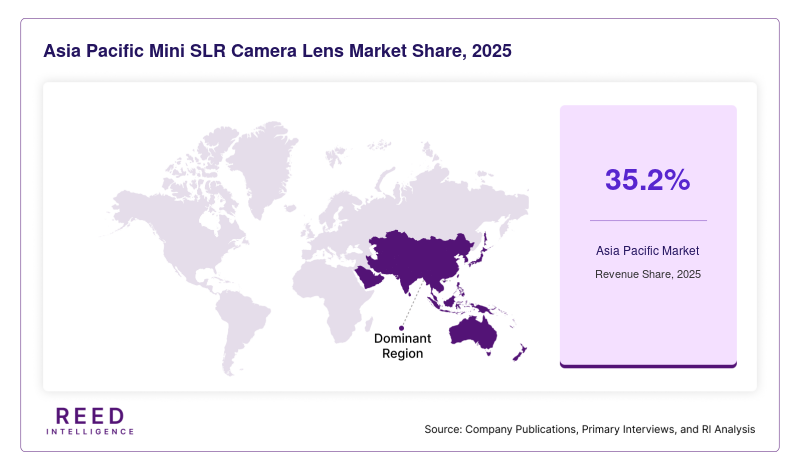
Asia Pacific is the dominant region in the Mini SLR Camera Lens Market, accounting for approximately 35.2% of global revenue in the 2025 market assessment. Applying this share to the supplied 2025 global market size of USD 4,240 Million gives an indicative regional market value of approximately USD 1,492.48 Million in 2025. This is a calculated estimate based on the reported regional share and the supplied global market value.
The region benefits from established camera and optical manufacturing ecosystems, precision-engineering capabilities, strong photography communities, and demand across professional and enthusiast markets. Japan is a major center for camera and lens manufacturing, while China and other Asian markets contribute through manufacturing, distribution, and consumer demand. India and Southeast Asia offer additional growth opportunities as consumers gain access to interchangeable-lens cameras and specialized photography equipment.
Latin America Mini SLR Camera Lens Market
Latin America represents an emerging opportunity for camera lens manufacturers as photography, social media content production, commercial advertising, tourism, and independent creative businesses support demand for imaging equipment. Brazil and Mexico are important regional markets because of their consumer bases and developed retail sectors.
Market expansion depends on consumer purchasing power, import costs, currency movements, product availability, and access to authorized service. Online channels can improve availability of specialized lenses, while third-party manufacturers may appeal to price-sensitive buyers. A comparable regional market share, regional revenue value, and fastest-growing regional CAGR are not independently verified for the supplied global market definition.
Middle East & Africa Mini SLR Camera Lens Market
The Middle East & Africa market is supported by professional photography, events, tourism, media production, commercial content, and demand for high-quality imaging equipment. Gulf markets provide opportunities for premium products, while expanding digital commerce can improve access to specialized lenses across other countries.
Regional demand varies with income levels, import duties, retail infrastructure, professional production activity, and camera-system adoption. Manufacturers can address these differences through a mix of premium lenses, versatile standard zooms, compact primes, and competitively priced third-party products. A reliable market-share percentage and regional revenue value for this region are not available from the compatible market dataset.
Mini SLR Camera Lens Market Competitive Landscape
The Mini SLR Camera Lens Market is characterized by established camera manufacturers, specialist optical companies, and independent lens producers competing through optical quality, autofocus performance, lens selection, mount compatibility, pricing, and brand reputation.
Canon Inc. is a major imaging manufacturer with a broad portfolio of interchangeable lenses for its camera systems. Its product strategy includes wide-angle, standard, telephoto, and specialist optics designed for photography and video. In February 2026, Canon announced two ultra-wide RF-mount lenses, expanding its optical portfolio for professional photographers and hybrid creators.
Nikon Corporation maintains a strong position through its NIKKOR lens portfolio, professional imaging products, and established photography customer base. Its lens development focuses on optical performance, portability, autofocus, and specialized telephoto capabilities. In February 2026, Nikon announced the NIKKOR Z 70-200mm f/2.8 VR S II, a lighter professional telephoto zoom.
Key Market Players
- Canon Inc.
- Nikon Corporation
- Sony Corporation
- Sigma Corporation
- Tamron Co., Ltd.
- Fujifilm Holdings Corporation
- Ricoh Imaging Company, Ltd.
- Tokina Co., Ltd.
- Samyang Optics
- Leica Camera AG
- Carl Zeiss AG
Recent Market Developments
- September 2026: Launch of the 20–60mm F2.8–4 DG Contemporary lens. Sigma announced the release of a compact full-frame standard zoom lens for L-Mount and Sony E-mount cameras, with availability beginning September 30, 2026. The lens weighs approximately 385 grams in L-Mount and combines a 20–60mm focal range with close-focus capabilities and high-response linear-actuator autofocus. The launch reflects demand for versatile, portable optics suited to travel, everyday photography, and video creation.
- September 2026: Development of nine NIKKOR Z CINEMA lenses. Nikon announced the development of nine cinema lenses in its NIKKOR Z CINEMA T1.9 VV series. The lineup is designed for cinema and high-end production and includes lenses capable of covering a large image circle for advanced cinema sensors. The development reflects Nikon's continued expansion into professional video and cinema optics.
Mini SLR Camera Lens Market Segments
By Product Type
- Wide-Angle Lens
- Telephoto Lens
- Standard Lens
- Macro Lens
- Others
By Application
- Professional Photography
- Amateur Photography
- Others
By Distribution Channel
- Online Stores
- Specialty Camera Stores
- Supermarkets/Hypermarkets
- Others
By End User
- Professional Photographers
- Hobbyists
- Others
By Region
- North America
- Europe
- APAC
- Middle East and Africa
- LATAM