Mini Speakers Market Size, Share & Trends Analysis Report By Product Type (Bluetooth Mini Speakers, Wi-Fi Mini Speakers, Wired Mini Speakers), By Application (Home Entertainment, Commercial, Automotive, Others), By Distribution Channel (Online Retail, Offline Retail) and By End User (Residential, Commercial, Automotive) and By Region (North America, Europe, Asia Pacific, Latin America, Middle East & Africa) Forecasts, 2026–2034
USD 3950
Mini Speakers Market Size
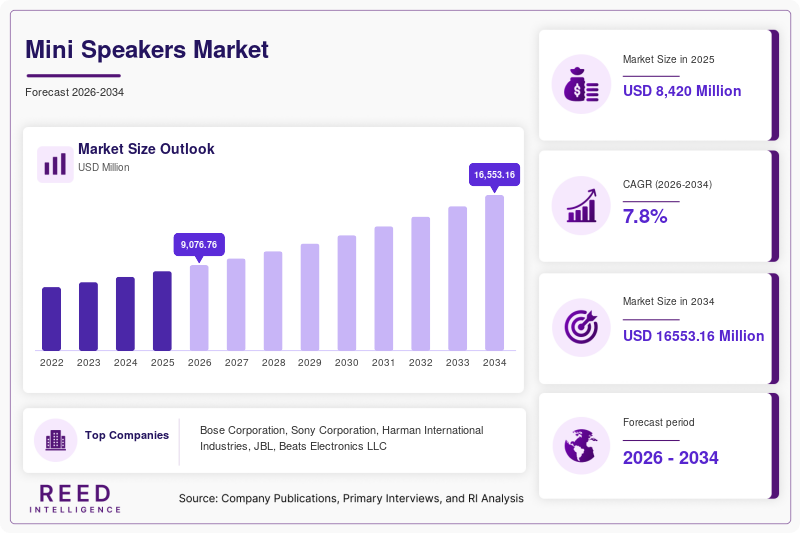
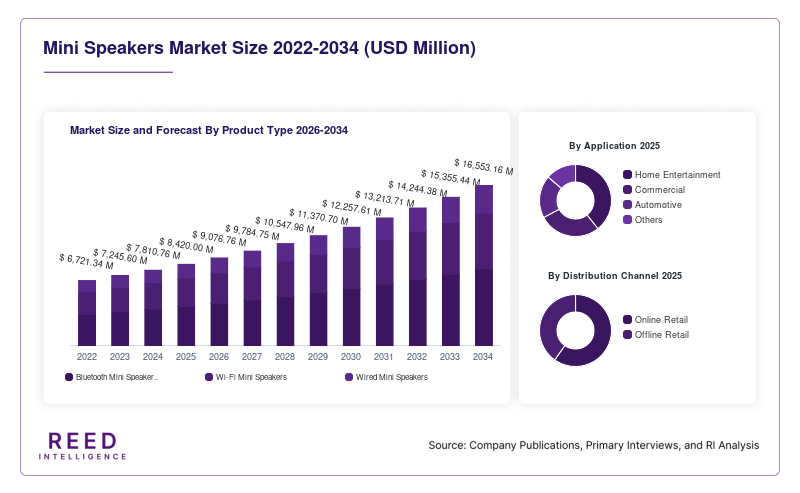
The global mini speakers market was valued at USD 8,420 Million in 2025 and is projected to grow from USD 9,076.76 Million in 2026 to USD 16,553.16 Million by 2034, registering a CAGR of 7.8% during the forecast period from 2026 to 2034.
Mini speakers are compact audio devices designed to deliver sound reproduction in a portable or space-efficient form. They include Bluetooth-enabled speakers, Wi-Fi-connected smart speakers, wired compact speakers, and specialized models for residential, commercial, and automotive applications. Their small form factor, ease of installation, wireless connectivity, and compatibility with digital devices make them attractive to consumers and businesses.
Bluetooth mini speakers benefit from straightforward pairing and portability, while Wi-Fi mini speakers support connected-home applications, networked audio, and voice-assistant integration. Wired mini speakers continue to serve applications that prioritize stable connections, fixed installations, or integration into existing audio systems.
Mini Speakers Market Drivers
Increasing Adoption of Wireless Audio Devices
The growing use of smartphones, tablets, laptops, and connected entertainment devices is supporting demand for mini speakers. Bluetooth connectivity allows users to play audio without complex installation, making compact speakers suitable for homes, offices, travel, and outdoor activities. Continued improvements in wireless connectivity and device compatibility are helping manufacturers expand their addressable customer base.
Growing Demand for Portable Entertainment
Consumers increasingly use compact speakers for travel, camping, outdoor gatherings, fitness activities, and personal entertainment. Improvements in battery life, water resistance, dust protection, and portable designs are making mini speakers suitable for a wider range of environments. These features are encouraging manufacturers to introduce differentiated models for lifestyle and recreational use.
Expansion of Smart-Home and Connected-Audio Ecosystems
Smart-home adoption is increasing demand for connected speakers that integrate with voice assistants, home networks, streaming services, and other smart devices. Wi-Fi-enabled mini speakers can support multi-room audio and connected-home routines, while software-based audio features improve usability. The expansion of connected ecosystems provides opportunities for manufacturers to differentiate products beyond basic sound reproduction.
Growth of E-Commerce and Affordable Consumer Electronics
Online retail allows consumers to compare speaker specifications, prices, designs, and reviews before purchasing. Digital distribution also helps manufacturers reach smaller cities and international markets without relying exclusively on physical retail networks. Affordable products, promotional campaigns, and a wider selection of portable audio devices are supporting market penetration among price-sensitive consumers.
Mini Speakers Market Restraints
Intense Competition and Price Pressure
The mini-speaker market includes premium audio manufacturers, consumer-electronics companies, smartphone accessory brands, and numerous budget-oriented suppliers. Strong competition can result in price reductions, shorter product cycles, and pressure on profit margins. Manufacturers must balance affordability with sound quality, battery performance, component costs, and after-sales support.
Audio and Battery Limitations in Compact Designs
Small speaker enclosures limit the physical space available for drivers, acoustic chambers, and batteries. Although engineering improvements can enhance performance, compact devices may struggle to reproduce the low-frequency response and soundstage of larger speakers. Battery capacity also creates trade-offs between portability, output power, and playback duration.
Product Commoditization and Rapid Technology Changes
Bluetooth connectivity and basic audio functionality are widely available across competing products. Manufacturers must therefore differentiate through durability, design, connectivity, software, and audio processing. Rapid changes in consumer preferences and technology can shorten product lifecycles and increase research, development, and marketing costs.
Dependence on Electronic Components and Supply Chains
Mini speakers depend on components such as batteries, wireless chipsets, amplifiers, drivers, and circuit boards. Supply disruptions, component-price fluctuations, and international trade restrictions can affect production costs and delivery schedules. Companies with diversified sourcing, efficient manufacturing, and dependable distribution can better manage these risks.
Mini Speakers Market Opportunities
Development of AI-Enhanced Audio Products
Manufacturers can differentiate mini speakers through adaptive audio processing, automatic sound optimization, noise management, and voice-assistant integration. AI-enabled features can help adjust playback to the environment and improve ease of use. As these capabilities become more accessible, companies may incorporate them into compact products at different price points.
Expansion of Rugged and Waterproof Speakers
Demand for outdoor entertainment creates opportunities for products featuring water resistance, dust protection, impact-resistant enclosures, and extended battery life. Manufacturers can target camping, travel, beach activities, outdoor fitness, and recreational use with specialized compact speakers.
Growth in Emerging Markets
Increasing smartphone adoption, expanding disposable income, and wider access to online shopping are creating opportunities in India, Southeast Asia, Latin America, and other emerging markets. Affordable wireless speakers can appeal to consumers seeking portable entertainment without investing in larger home-audio systems.
Integration with Smart Homes and Multi-Device Audio
Mini speakers can become part of broader connected-audio ecosystems, allowing users to synchronize playback across rooms, connect multiple devices, and integrate speakers with televisions and other home electronics. Interoperability, simple setup, and reliable software support will be important competitive factors in this segment.
Mini Speakers Market Segmental Analysis
By Product Type
Bluetooth Mini Speakers represent the dominant product segment, accounting for approximately 48.5% of the global Mini Speakers Market in 2025, according to the referenced market analysis. Their leading position is supported by smartphone compatibility, simple pairing, portability, and widespread use in personal entertainment. Bluetooth products span a broad range of price points and designs, including compact everyday speakers, rugged outdoor models, and premium portable audio devices.
Wi-Fi Mini Speakers represent an important growth opportunity as connected-home ecosystems and networked audio become more established. These devices can support streaming services, multi-room playback, voice assistants, and smart-home integration. The referenced market analysis estimates Wi-Fi speakers at 25.2% of the market in 2025 and projects faster growth than wired speakers. The pace of adoption will depend on affordability, network availability, ecosystem compatibility, and consumer demand for connected-home features.
By Application
Home Entertainment is a major application for mini speakers because consumers use compact audio devices for music streaming, podcasts, television audio, gaming, and everyday listening. Wireless connectivity, space-efficient designs, and simple installation make mini speakers suitable for apartments, bedrooms, home offices, and secondary listening areas. Smart-home integration further expands their usefulness in residential environments.
Commercial Applications offer growth opportunities across hospitality, retail, offices, restaurants, and small business environments. Compact speakers can provide background music, announcements, and localized audio without requiring large sound systems. Demand depends on sound coverage, installation requirements, durability, wireless management, and compatibility with existing commercial audio equipment.
By Distribution Channel
Online Retail is a significant distribution channel because it allows buyers to compare product specifications, prices, reviews, and features across multiple brands. Online marketplaces and direct-to-consumer websites help manufacturers reach geographically dispersed customers and offer a wide selection of models. The referenced market research projects online retail to account for an increasing share of sales by 2034.
Offline Retail remains important for customers who want to assess product design, controls, build quality, and perceived sound performance before purchase. Electronics stores, department stores, and specialist audio retailers also provide product demonstrations and in-person support. The channel remains particularly relevant for premium products and consumers who value after-sales assistance.
By End User
Residential Users represent a major end-user group, driven by demand for portable entertainment, music streaming, compact home audio, and connected-home functionality. Residential buyers range from budget-conscious consumers seeking basic wireless playback to premium customers prioritizing sound quality, industrial design, and ecosystem integration.
Commercial Users create demand for compact speakers across offices, retail stores, hospitality, restaurants, and other customer-facing environments. Commercial purchasers typically evaluate reliability, sound coverage, installation flexibility, connectivity, and maintenance requirements. Automotive-related demand is more specialized and depends on integration with vehicle audio systems and the distinction between aftermarket compact speakers and built-in audio components.
Mini Speakers Market Regional Analysis
North America Mini Speakers Market
North America is an established market for mini speakers, supported by high consumer-electronics adoption, strong e-commerce infrastructure, widespread music streaming, and demand for connected-home products. The United States represents a major national market, with consumers purchasing portable speakers for residential listening, travel, recreation, and outdoor entertainment. Brand recognition, product reviews, and integration with smartphones and home ecosystems influence purchasing decisions.
Competition in the region emphasizes audio quality, durability, software capabilities, premium design, and connectivity. Consumers have access to products across a broad range of price points, from entry-level portable devices to premium compact speakers. Canada contributes through similar residential and outdoor use cases, while commercial demand comes from hospitality, retail, and office applications.
Europe Mini Speakers Market
Europe represents a significant market supported by consumer demand for portable audio, premium electronics, smart-home technology, and compact residential entertainment. Major markets include Germany, the United Kingdom, France, Italy, and other European economies with established electronics retail and online distribution. Buyers often consider design, durability, sound quality, and compatibility with their existing devices when selecting mini speakers.
Manufacturers compete through premium acoustics, connected-audio features, efficient designs, and specialized outdoor products. The region's established retail networks and high availability of international audio brands support product choice. Commercial demand also comes from hospitality, offices, and retail environments requiring background music and flexible audio solutions.
Asia Pacific Mini Speakers Market
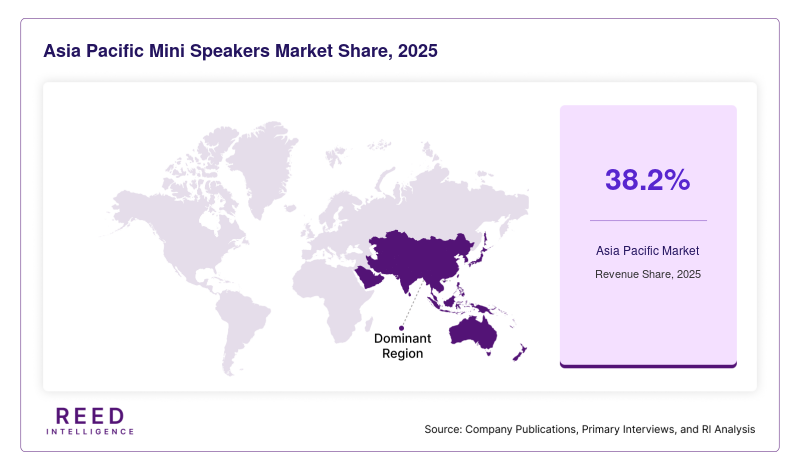
Asia Pacific is the dominant regional market, accounting for approximately 38.2% of global Mini Speakers Market revenue in 2025. Applying this share to the supplied global base-year market size of USD 8,420 Million gives an estimated regional value of USD 3,218.44 Million in 2025. This value is calculated from the supplied global market size and the referenced regional share.
The region benefits from extensive consumer-electronics manufacturing, large smartphone user populations, expanding e-commerce, and growing demand for affordable portable audio. China is a major production hub, while India and Southeast Asian markets provide opportunities through rising digital-device adoption and increasing consumer spending. Japan and South Korea contribute through established electronics markets and demand for connected audio products. Regional growth will depend on purchasing power, product affordability, brand competition, and the expansion of smart-home ecosystems.
Latin America Mini Speakers Market
Latin America represents an emerging opportunity for mini speakers as consumers increasingly adopt wireless audio devices and shop through digital channels. Brazil and Mexico are important markets because of their large consumer populations and established electronics distribution networks. Demand is supported by portable entertainment, smartphone use, music streaming, and the availability of products at different price points.
Growth opportunities include affordable Bluetooth speakers, rugged outdoor models, and products offering extended battery life. Online marketplaces can improve product accessibility outside major cities, while offline electronics retailers continue to provide demonstrations and customer support. Exchange-rate volatility, import costs, and consumer purchasing power remain important market considerations.
Middle East & Africa Mini Speakers Market
The Middle East & Africa market is supported by expanding consumer-electronics distribution, demand for portable entertainment, and growing access to smartphones and digital streaming. Countries such as the United Arab Emirates, Saudi Arabia, and South Africa offer opportunities through established retail channels and demand for connected devices. Outdoor entertainment and travel-related use cases also support interest in durable portable speakers.
Market development varies significantly by country according to income levels, import availability, infrastructure, and access to online retail. Affordable models can attract price-sensitive consumers, while premium products appeal to customers seeking stronger audio performance, advanced connectivity, and established international brands. Distribution partnerships, product availability, and after-sales support remain important factors in regional expansion.
Mini Speakers Market Competitive Landscape
The Mini Speakers Market is competitive, with global audio brands, consumer-electronics companies, smart-home manufacturers, and portable-audio specialists competing through sound quality, product design, connectivity, battery life, durability, software features, and pricing. Companies pursue product differentiation through wireless technologies, multi-device pairing, waterproof construction, adaptive audio, and integration with broader entertainment ecosystems.
Bose Corporation competes in premium portable audio through compact speaker designs, sound engineering, and wireless connectivity. Sony Corporation participates across portable Bluetooth speakers and broader consumer-audio products, emphasizing sound performance, durability, battery features, and connectivity. Other prominent participants include Harman International, JBL, Ultimate Ears, Anker Innovations, Marshall, Sonos, Samsung, LG, and Philips. Competition spans budget, mid-range, and premium segments, with brand strength and distribution reach influencing customer acquisition.
Key Market Players
- Bose Corporation
- Sony Corporation
- Harman International Industries
- JBL
- Beats Electronics LLC
- Bang & Olufsen
- Ultimate Ears
- Anker Innovations
- Marshall Group
- Sonos, Inc.
Mini Speakers Market Recent Developments
- October 2026, JBL announced the Pulse 6 with AI Sound Boost, a customizable 360-degree lightshow, Bluetooth 6.0, Auracast multi-speaker connectivity, USB-C audio, and up to 12 hours of battery life. The launch highlights continued innovation in compact audio through integrated lighting, wireless connectivity, and sound optimization.
- August 2026, LG announced the global launch of the xboom Blast, a portable Bluetooth speaker with up to 220 watts of output, up to 36 hours of battery life, IP68-rated protection, AI Sound, and multi-speaker connectivity. The product targets outdoor entertainment and reflects demand for durable speakers with longer playback times.
Mini Speakers Market Segments
By Product Type
- Bluetooth Mini Speakers
- Wi-Fi Mini Speakers
- Wired Mini Speakers
By Application
- Home Entertainment
- Commercial
- Automotive
- Others
By Distribution Channel
- Online Retail
- Offline Retail
By End User
- Residential
- Commercial
- Automotive
By Region
- North America
- Europe
- APAC
- Middle East and Africa
- LATAM