Miniature Fuseblocks and Holder Market Size, Share & Trends Analysis Report By Product Type (Panel-Mount Fuseblocks, Enclosed Fuseblocks, DIN Rail Fuseblocks, and Others), By Application (Industrial Automation, Power Distribution, Electronics Manufacturing, and Others) and By Region (North America, Europe, Asia Pacific, Latin America, Middle East & Africa) Forecasts, 2026–2034
USD 3950
Miniature Fuseblocks and Holder Market Size
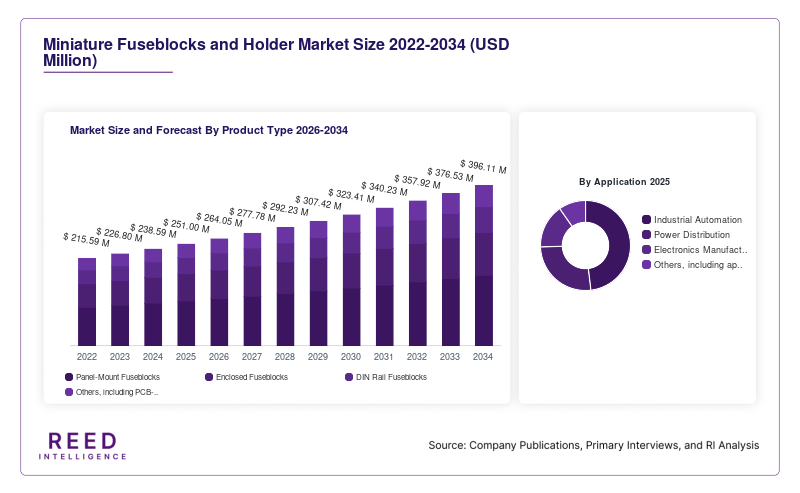
The global miniature fuseblocks and holder market was valued at USD 251 million in 2025 and is projected to grow from USD 264.05 million in 2026 to USD 396.11 million by 2034, registering a CAGR of 5.2% during the forecast period (2026–2034).
Miniature fuseblocks and holders are electrical components designed to securely accommodate fuses and facilitate circuit protection in electronic and electrical systems. They provide a mounting interface for fuses, support replacement during maintenance, and help protect equipment against overcurrent conditions. Common configurations include printed circuit board (PCB)-mounted fuse holders, panel-mounted fuseblocks, DIN rail-mounted holders, enclosed fuseblocks, and in-line holders.
Demand comes from industrial automation, power distribution, electronics manufacturing, telecommunications equipment, consumer appliances, automotive electronics, and control panels. As electrical systems become more compact and complex, manufacturers require components that combine reliable electrical contact, efficient installation, space-saving designs, and compliance with applicable safety requirements.

Miniature Fuseblocks and Holder Market Drivers
Growth in industrial automation: Industrial control panels, programmable logic controllers, sensors, and automation equipment require reliable circuit-protection components. The expansion of automated production lines and smart manufacturing systems supports demand for miniature fuseblocks and holders.
Increasing electronic equipment miniaturization: Compact power supplies, communication devices, medical electronics, and household appliances require circuit-protection components that fit within restricted spaces. Smaller footprints and flexible mounting configurations are therefore important purchasing considerations.
Rising emphasis on electrical safety: Equipment manufacturers increasingly prioritize overcurrent protection, dependable fuse connections, safe servicing, and compliance with applicable electrical standards. These requirements encourage the use of appropriately rated fuse holders and fuseblocks.
Infrastructure and power-system investment: Expansion of electrical distribution systems, renewable energy installations, and industrial infrastructure creates opportunities for circuit-protection components in control equipment, power supplies, and associated electrical assemblies.
Miniature Fuseblocks and Holder Market Restraints
Competition from alternative protection technologies: Resettable protection devices and integrated circuit-protection solutions may replace conventional fuse-based designs in some applications, limiting demand for specific fuse holder categories.
Price competition and standardization: Many fuseblocks and holders are mature components with standardized configurations. Competition among manufacturers can put pressure on selling prices and margins, particularly in high-volume applications.
Technical and compliance requirements: Manufacturers must meet the electrical ratings, temperature limits, material requirements, and safety certifications applicable to their intended markets. Testing and certification can add development costs and extend product qualification timelines.
Raw-material and supply-chain fluctuations: Changes in the cost or availability of conductive metals, engineering plastics, and other component materials can affect manufacturing costs and delivery schedules.
Miniature Fuseblocks and Holder Market Opportunities
Expansion of electric mobility and power electronics: Electrified vehicles, charging equipment, battery-related systems, and power-conversion equipment create opportunities for appropriately rated circuit-protection components. Suppliers must match product specifications to each application’s voltage, current, temperature, and environmental requirements.
Advanced industrial equipment: Compact machinery, smart control panels, and connected industrial devices create demand for components that are easier to install, inspect, and replace.
Product innovation: Manufacturers can differentiate their offerings through touch-safe construction, improved thermal performance, indication features, tool-free installation, and designs compatible with automated assembly processes.
Emerging-market electronics manufacturing: Investment in electronics production, industrial infrastructure, and power distribution in developing economies may create additional demand for reliable miniature circuit-protection components.
Miniature Fuseblocks and Holder Market Segmental Analysis
By Product Type
Panel-mount fuseblocks are an important product category because they can be integrated into electrical enclosures, industrial control panels, and equipment assemblies. Their suitability for maintenance access and organized wiring makes them useful in commercial and industrial applications. Enclosed fuseblocks provide additional physical protection around fuse connections, while DIN rail fuseblocks support modular installation in control cabinets and distribution equipment.
The dominant product type and its exact market share have not been independently verified from a sufficiently detailed, comparable public source. Product leadership may differ depending on whether the market includes PCB-mounted, in-line, cartridge-fuse, and industrial power fuse holders.
DIN rail-mounted and enclosed designs may benefit from the growth of industrial automation and modular electrical control systems. However, the fastest-growing product type and its CAGR cannot be confirmed from the available public evidence without a market-specific segment forecast.
By Application
Industrial automation uses fuseblocks and holders in control cabinets, machinery, motor-control systems, sensors, and other electrical assemblies. The growing deployment of automated manufacturing equipment creates a broad application base for reliable circuit protection. Power distribution is another important application, particularly in electrical panels and equipment where properly rated fuses protect individual circuits.
Electronics manufacturing also supports demand through power supplies, control boards, communication equipment, and other devices requiring compact fuse-mounting solutions. Other applications include appliances and specialized electronic or electrical equipment.
Industrial automation is identified as a leading application in one published market-specific estimate, which reports a 34.5% share; this figure should be treated as a third-party estimate rather than an independently confirmed market statistic.
Miniature Fuseblocks and Holder Market Regional Analysis
North America Miniature Fuseblocks and Holder Market
North America represents an established market for miniature fuseblocks and holders, supported by industrial automation, electronic equipment manufacturing, power infrastructure, and demand for electrical safety. The United States contributes through industrial equipment, data-center infrastructure, aerospace, automotive electronics, and other applications requiring circuit protection. Canada also supports demand through industrial and power-related investments.
Growth opportunities include modernization of manufacturing facilities, expansion of data centers, and development of power electronics. However, the region’s precise share of the miniature fuseblocks and holder market and its regional CAGR have not been independently verified.
Europe Miniature Fuseblocks and Holder Market
Europe benefits from established industrial machinery, automotive manufacturing, electrical equipment, and electronics industries. Demand is influenced by industrial modernization, equipment safety requirements, and the need for dependable circuit protection in manufacturing and control systems. Germany, France, Italy, and other industrial economies provide relevant application markets.
The transition toward electrification and investment in energy infrastructure may support demand for suitable fuse-mounting components. Nevertheless, the exact European market share and fastest-growing country or application cannot be confirmed from the available public information.
Asia Pacific Miniature Fuseblocks and Holder Market
Asia Pacific is an important market because of its electronics manufacturing base, industrial expansion, power infrastructure investment, and production of electrical equipment. China, Japan, South Korea, and India contribute through manufacturing, electronics, automotive systems, and industrial automation. Regional production capacity also creates opportunities for suppliers serving original equipment manufacturers.
One published market-specific estimate identifies Asia Pacific as the dominant region, with a reported 42.8% revenue share. This is a third-party estimate and has not been independently confirmed against a transparent market dataset. Applying that share to the supplied 2025 global market value of USD 251 million would imply approximately USD 107.43 million, but this is a derived estimate not a verified regional revenue figure and assumes that both figures use the same market definition. A reliable regional CAGR or fastest-growing country has not been verified.
Latin America Miniature Fuseblocks and Holder Market
Latin America presents opportunities through industrial modernization, electrical infrastructure investment, manufacturing, and demand for circuit protection in commercial and industrial equipment. Brazil and Mexico are relevant markets because of their industrial activity and electrical equipment requirements.
Market development may depend on capital investment, manufacturing activity, imported component availability, and the pace of infrastructure projects. The region’s precise market share, leading product segment, and forecast CAGR are not available from sufficiently comparable public data.
Middle East & Africa Miniature Fuseblocks and Holder Market
The Middle East & Africa market is supported by power distribution projects, industrial facilities, construction, energy infrastructure, and investment in electrical systems. Demand for miniature fuseblocks and holders is linked to the protection requirements of control panels, equipment, and electronic assemblies used in these applications.
Opportunities may emerge from infrastructure expansion and industrial diversification, although market performance varies across countries. A verified regional share, dominant subregion, and fastest-growing country or application have not been established from the available public information.

Miniature Fuseblocks and Holder Market Competitive Landscape
The Miniature Fuseblocks and Holder Market includes established circuit-protection manufacturers and electronic-component suppliers. Competition is based on product reliability, electrical ratings, safety compliance, mounting options, thermal performance, availability, and technical support. Manufacturers serve a range of customers, including industrial equipment makers, electronics manufacturers, panel builders, distributors, and original equipment manufacturers.
Littelfuse is a major circuit-protection supplier with fuse holders and fuseblocks for industrial and electronic applications. Its product portfolio includes touch-safe fuse holders and configurations designed for DIN rail installation. Eaton also supplies PCB-mounted fuse holders and other electrical protection products for electronic and industrial equipment.
Key Market Players
- Littelfuse, Inc.
- Eaton Corporation plc
- Mersen
- SCHURTER Group
- TE Connectivity Ltd.
- Keystone Electronics Corp.
- Schneider Electric
- Siemens AG
- ABB Ltd.
- Wurth Elektronik
Miniature Fuseblocks and Holder Market Recent Developments
August 2025, SCHURTER introduced the FPR high-performance fuse holder. SCHURTER announced an FPR fuse holder for vertical PCB mounting and 5 × 20 mm fuse links. The company reported 30% higher power acceptance than its FPG4 predecessor while retaining the same compact footprint. The product is designed for applications such as industrial automation, mechanical engineering, and building automation. This is a documented product announcement, although it falls just outside a strict 12-month window as of October 2026.
Product portfolio update, Mersen miniature fuseblocks. Mersen’s published miniature fuseblock documentation describes 5 × 20 mm and 6 × 32 mm single-pole fuseblocks, including quick-connect terminals and stated electrical ratings. These products illustrate the availability of compact fuse-mounting solutions for electronic and electrical assemblies. The cited document is technical product documentation, not evidence of a newly launched product in 2026.
Miniature Fuseblocks and Holder Market Segments
By Product Type
- Panel-Mount Fuseblocks
- Enclosed Fuseblocks
- DIN Rail Fuseblocks
- Others, including PCB-mounted and in-line configurations where included in the market definition
By Application
- Industrial Automation
- Power Distribution
- Electronics Manufacturing
- Others, including appliances, communication equipment, and specialized electrical systems
By Region
- North America
- Europe
- APAC
- Middle East and Africa
- LATAM