Miniature Load Cells Market Size, Share & Trends Analysis Report By Type (Compression, Tension, Universal, Others), By Application (Medical Devices, Industrial Automation, Aerospace and Defense, Robotics, Consumer Electronics, Others), By End User (Healthcare, Manufacturing, Automotive, Aerospace, Others) and By Region (North America, Europe, Asia Pacific, Latin America, Middle East & Africa) Forecasts, 2026–2034
USD 3950
Miniature Load Cells Market Size
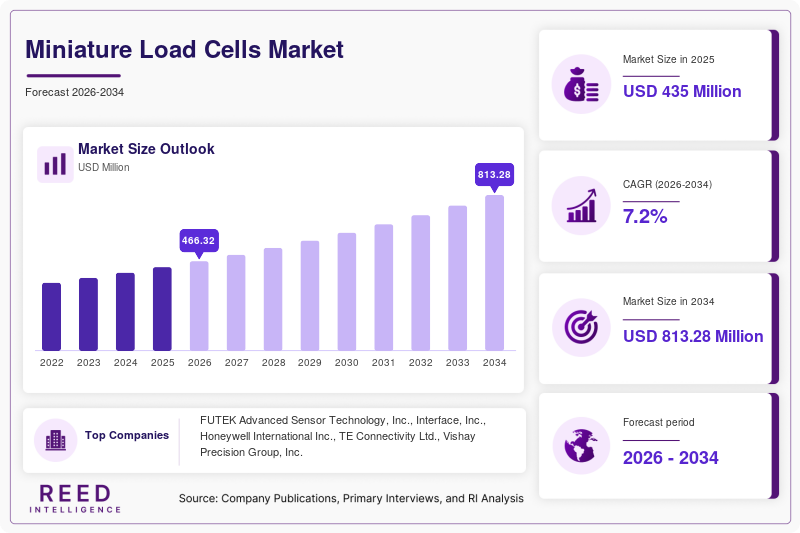
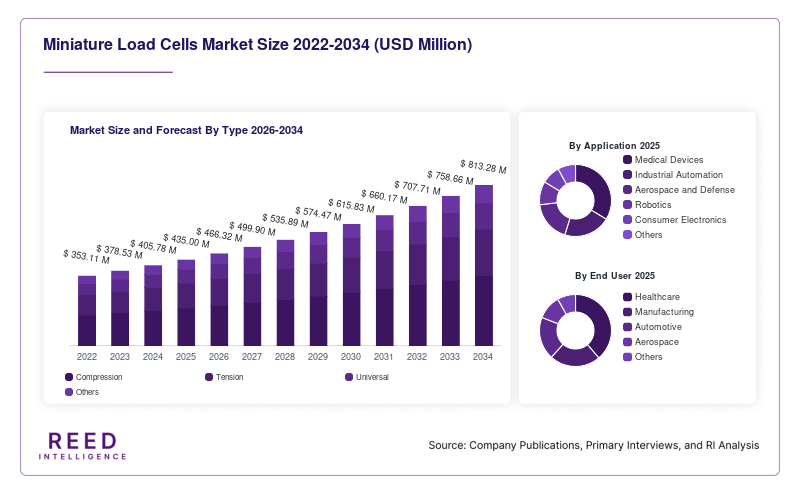
The global Miniature Load Cells Market was valued at USD 435 million in 2025 and is projected to grow from USD 466.32 million in 2026 to USD 813.28 million by 2034, registering a compound annual growth rate (CAGR) of 7.2% during the forecast period (2026–2034).
Miniature load cells are compact force-measurement sensors designed to measure tension, compression, and other applied forces in applications where installation space is limited. These devices convert mechanical force into an electrical signal, enabling accurate measurement and monitoring in testing equipment, industrial machinery, medical devices, robotics, aerospace systems, and consumer electronics. Their compact size, sensitivity, and ability to integrate into complex assemblies make them useful in both original equipment manufacturing and specialized testing applications.
Demand is supported by the expansion of industrial automation, precision manufacturing, medical-device engineering, and robotics. Engineers increasingly need reliable force measurement in smaller equipment and assemblies, including automated inspection systems, laboratory instruments, surgical equipment, and miniature robotic mechanisms. Manufacturers are responding through compact sensor designs, different load capacities, improved calibration, and customized mounting configurations. The market's development will depend on measurement accuracy, durability, integration requirements, and the ability to deliver consistent performance in demanding operating conditions.
Miniature Load Cells Market Drivers
Growth in industrial automation and precision manufacturing: Automated production lines use force sensors to monitor pressing, assembly, clamping, material handling, and quality-control operations. Miniature load cells are suitable for machinery with restricted installation space, helping manufacturers integrate force feedback into compact equipment and testing stations.
Increasing adoption of medical devices and laboratory equipment: Medical and laboratory applications require precise force measurement in equipment such as syringe testing systems, rehabilitation devices, medical bag weighing applications, and research instruments. Compact sensors help designers incorporate measurement capabilities without significantly increasing device size.
Expansion of robotics and advanced testing: Industrial robots, collaborative robots, and research platforms increasingly rely on force feedback to perform controlled manipulation and testing. Miniature load cells can support tactile sensing, component testing, and force monitoring in applications where conventional sensors may be too large.
Miniature Load Cells Market Restraints
High precision and calibration requirements: Small load cells must maintain dependable performance despite limited physical dimensions. Calibration, temperature compensation, signal conditioning, and mechanical alignment can increase design complexity and production costs, especially for applications requiring high accuracy.
Integration and compatibility challenges: Load cells must match the required force range, mounting arrangement, electrical interface, and operating environment. Poor alignment or unwanted side loads can affect measurement accuracy, requiring careful mechanical design and application-specific engineering.
Price sensitivity in high-volume applications: In cost-sensitive products, manufacturers may prioritize low-cost sensors or alternative measurement methods. Premium miniature load cells can face purchasing pressure when customers require high volumes but do not need advanced accuracy or specialized environmental protection.
Miniature Load Cells Market Opportunities
Miniaturization of medical and diagnostic equipment: Continued development of compact diagnostic systems, medical instruments, and laboratory devices creates opportunities for sensors that deliver reliable measurements in increasingly restricted spaces.
Integration with smart manufacturing systems: Combining miniature load cells with digital signal processing, data acquisition, and machine-monitoring systems can support real-time quality control and equipment monitoring. These applications may increase demand for sensors compatible with automated measurement and analytics workflows.
Growth in robotics and material testing: Robotic manipulation, component testing, and advanced materials research require precise measurement of applied forces. Suppliers offering compact designs, custom geometries, and suitable measurement ranges can address specialized engineering needs.
Miniature Load Cells Market Segmental Analysis
By Type
Compression load cells are a leading type segment because they measure compressive forces in weighing, material testing, industrial pressing, and equipment monitoring. Their use across manufacturing and testing applications supports demand for compact sensors that can be integrated into machinery and assemblies with limited space. One published market analysis estimates compression load cells held 38.5% of the market in 2025; this should be treated as a third-party estimate rather than a universally verified industry figure.
Universal load cells can measure forces in more than one loading direction, depending on their design, and are relevant to applications requiring flexible testing configurations. Their use in materials testing, robotics, and multipurpose force measurement offers growth opportunities. A third-party market analysis identifies universal load cells as a potentially faster-growing type, but a reliable independent CAGR for this segment could not be confirmed.
By Application
Industrial automation is a key application area because production equipment uses force measurement for assembly, pressing, clamping, quality inspection, and process control. Miniature designs are particularly useful when equipment layouts limit sensor size. Demand is also supported by the need for repeatable measurement and integration with automated testing systems.
Medical devices represent an important growth opportunity, as compact force sensors can be incorporated into medical equipment, laboratory instruments, and testing systems. Applications include syringe testing, medical bag weighing, and force measurement in research or rehabilitation equipment. The fastest-growing application segment cannot be established confidently from independently verified data, so no specific application CAGR is assigned.
By End User
Manufacturing is a core end-user segment due to its demand for precision measurement, automated inspection, and process monitoring. Miniature load cells can be incorporated into production machinery and testing equipment to measure applied forces and help maintain consistent product quality.
Healthcare and medical equipment manufacturers use compact force sensors in specialized instruments and testing systems. The need for precise measurements in space-constrained designs provides opportunities for suppliers that can meet application-specific accuracy, durability, and integration requirements. A reliably verified fastest-growing end-user segment and CAGR were not available.
Miniature Load Cells Market Regional Analysis
North America Miniature Load Cells Market
North America benefits from demand across aerospace and defense, medical equipment, advanced manufacturing, robotics, and testing laboratories. Established sensor suppliers and engineering-intensive industries support adoption of miniature force measurement in product development, industrial testing, and specialized equipment. The region's demand is influenced by accuracy requirements, application-specific engineering, and the adoption of automated testing systems.
The region is also positioned to benefit from investment in robotics, medical technology, and precision manufacturing. However, a reliable, independently verifiable market-share percentage for North America under the exact market definition used in this report could not be confirmed. A numeric share or regional market value is therefore not assigned.
Europe Miniature Load Cells Market
Europe's market is supported by precision engineering, industrial automation, automotive manufacturing, aerospace systems, and medical technology. Miniature load cells are used in force measurement, product validation, production equipment, and laboratory testing. Requirements for dependable performance and integration into complex assemblies support demand for specialized sensor designs.
Further opportunities arise from factory automation, advanced manufacturing, and testing of engineered materials and components. A verified market-share percentage and a reliable CAGR identifying Europe's growth ranking were not available from sufficiently independent sources, so no regional share or fastest-growth claim is assigned.
Asia Pacific Miniature Load Cells Market
Asia Pacific is an important demand center due to its manufacturing base, electronics production, industrial automation, automotive supply chains, and expanding medical-device sector. The need for compact sensors in production equipment and testing systems supports the adoption of miniature load cells across several end-use industries.
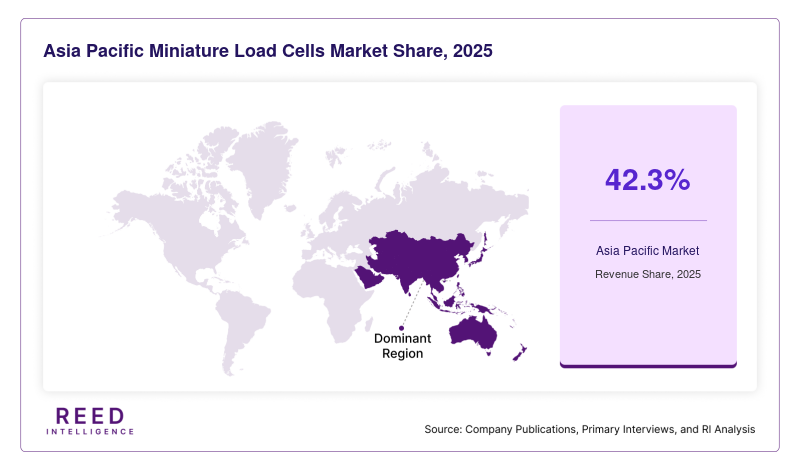
Investment in automated manufacturing, robotics, and electronics testing provides further opportunities for suppliers. One third-party market report estimates that Asia Pacific accounted for 42.3% of the global market in 2025. This is a published estimate and should be verified against the underlying research methodology before being used as a definitive share. Applying that estimate to the supplied global 2025 market value of USD 435 million gives a derived regional value of approximately USD 184.0 million; this calculation is conditional on the share and global market definition being comparable. A dependable fastest-growing-region CAGR could not be independently verified.
Latin America Miniature Load Cells Market
Latin America's market is associated with manufacturing, industrial processing, automotive supply chains, laboratory testing, and the gradual adoption of automated equipment. Miniature load cells can serve applications requiring force monitoring in production machinery, weighing systems, and quality-control equipment.
Market expansion will depend on industrial investment, equipment modernization, availability of technical support, and access to calibrated sensor products. A reliable numeric market share and independently verified regional CAGR were not available for this report; accordingly, no unsupported percentage or regional ranking is provided.
Middle East & Africa Miniature Load Cells Market
Demand in the Middle East & Africa can arise from industrial equipment, energy-related operations, manufacturing, laboratory testing, and specialized engineering applications. Miniature load cells may be used where compact force measurement is needed in monitoring equipment, maintenance operations, and product testing.
Growth opportunities depend on industrial diversification, automation investment, local technical capabilities, and the availability of suitable sensor and calibration services. A verified numeric share of the global miniature load cells market and a comparable regional growth rate could not be established from reliable independent data.
Miniature Load Cells Market Competitive Landscape
The Miniature Load Cells Market includes specialist force-sensor manufacturers and larger measurement-technology suppliers. Competition centers on measurement accuracy, sensor dimensions, load capacity, durability, calibration support, customization, delivery times, and the ability to integrate with testing or automation systems. Suppliers also differentiate through product breadth, engineering support, and experience serving highly regulated or technically demanding industries.
FUTEK Advanced Sensor Technology, Inc. offers miniature and micro-miniature load cells designed for force measurement in space-constrained applications. Its portfolio includes sensors for tension and compression, with a range of capacities and configurations suited to industrial testing, medical applications, and specialized engineering.
Key Market Players
- FUTEK Advanced Sensor Technology, Inc.
- Interface, Inc.
- Honeywell International Inc.
- TE Connectivity Ltd.
- Vishay Precision Group, Inc.
- Mettler-Toledo International Inc.
- Flintec Group AB
- OMEGA Engineering, Inc.
- PCB Piezotronics, Inc.
- Kistler Group
Miniature Load Cells Market Recent Developments
-
August, 2026 Interface published information on miniature sensor systems used in test and measurement equipment, describing miniature bending-beam, force-disc, force-button, S-type, and other specialized sensor configurations. The article highlights the engineering challenges of integrating force measurement into systems with limited installation space. This is a technical product-family update rather than confirmation of a newly launched load-cell model.
-
FUTEK Miniature and nano-scale force-sensor portfolio: FUTEK's product information describes miniature load cells for tension and compression, with capacities spanning low-force to higher-force applications, including nano-scale sensor options. This portfolio supports the market trend toward smaller force sensors for space-constrained applications; the product page does not by itself establish a new launch date.
Miniature Load Cells Market Segments
By Type
- Compression
- Tension
- Universal
- Others
By Application
- Medical Devices
- Industrial Automation
- Aerospace and Defense
- Robotics
- Consumer Electronics
- Others
By End User
- Healthcare
- Manufacturing
- Automotive
- Aerospace
- Others
By Region
- North America
- Europe
- APAC
- Middle East and Africa
- LATAM