Miniature Microphones Market Size, Share & Trends Analysis Report By Type (MEMS Microphones, Electret Condenser Microphones, Dynamic Microphones), By Application (Consumer Electronics, Wearable and Hearable Devices, Smart Home and IoT Devices, Automotive), By Technology (Analog Microphones, Digital Microphones) and By Region (North America, Europe, Asia Pacific, Latin America, Middle East & Africa) Forecasts, 2026–2034
USD 3950
Miniature Microphones Market Size
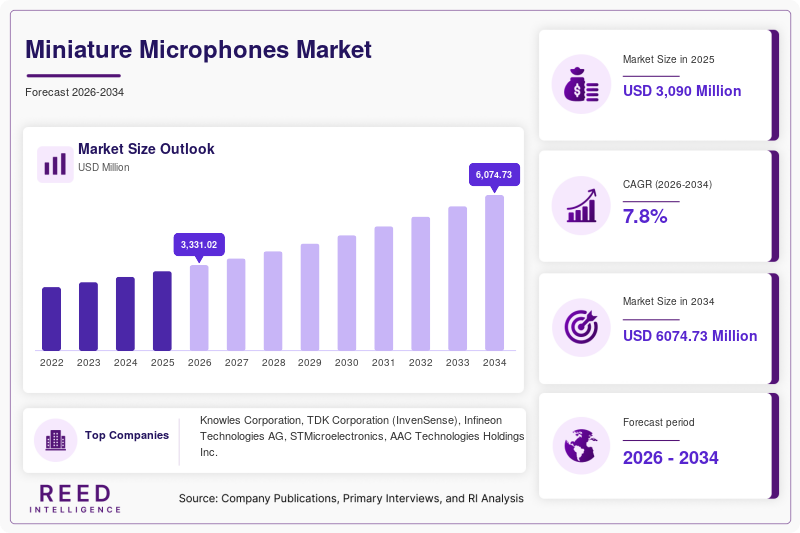
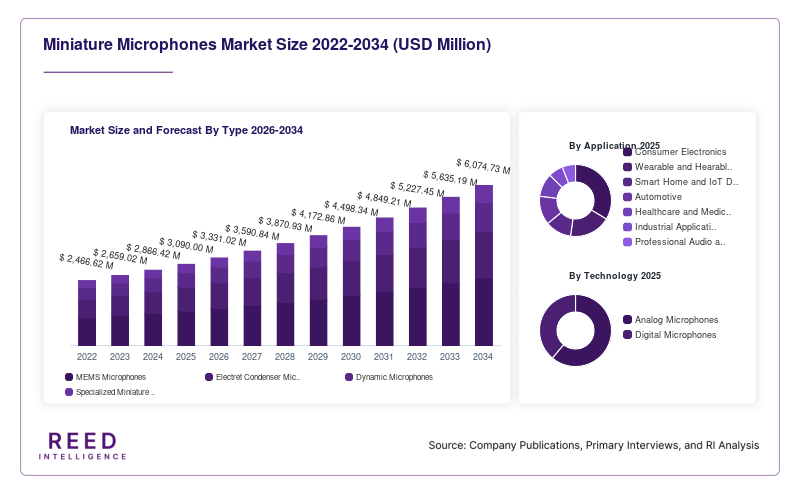
The global Miniature Microphones Market was valued at USD 3,090 million in 2025 and is projected to grow from USD 3,331.02 million in 2026 to USD 6,074.73 million by 2034, registering a CAGR of 7.8% during the forecast period (2026–2034).
The Miniature Microphones Market comprises compact acoustic transducers designed to capture sound in devices where space, power consumption, acoustic performance, and integration requirements are critical. These microphones are used in smartphones, laptops, wireless earbuds, hearing aids, smart speakers, wearable electronics, automotive systems, security equipment, medical devices, and industrial monitoring applications.
Market growth is supported by the expanding use of voice-enabled devices, artificial intelligence applications, connected electronics, and compact audio recording systems. Manufacturers are developing smaller microphones with improved signal-to-noise ratios, low power consumption, enhanced acoustic sensitivity, and better performance in environments with background noise.
Miniature Microphones Market Drivers
Increasing Demand for Consumer Electronics
The growing adoption of smartphones, tablets, laptops, wireless earbuds, smartwatches, and other connected electronics is supporting demand for miniature microphones. Manufacturers require compact components that can be integrated into increasingly thin devices without compromising voice clarity. Multiple-microphone configurations for noise reduction, voice capture, and audio recording also create additional demand.
Expansion of Voice Assistants and Artificial Intelligence Applications
Voice assistants and AI-enabled devices depend on accurate sound capture to interpret spoken commands and environmental audio. Miniature microphones with low power requirements and improved acoustic performance are increasingly relevant to smart speakers, connected appliances, wearable devices, and intelligent interfaces. Demand for better voice input is encouraging manufacturers to improve sensitivity, signal processing compatibility, and noise-handling capabilities.
Growing Adoption of Wearable and Hearing Devices
Wireless hearables, hearing aids, health-monitoring devices, and compact communication products require microphones that fit within restricted physical dimensions. These applications place importance on low power consumption, durability, acoustic quality, and dependable performance. Advances in miniature microphone design are enabling manufacturers to develop smaller products with more sophisticated audio and hearing functions.
Miniature Microphones Market Restraints
Price Competition and Manufacturing Costs
High-volume consumer electronics markets place pressure on component prices, while specialized microphones require investment in research, semiconductor processing, packaging, testing, and quality control. Manufacturers must balance miniaturization and acoustic performance with cost targets. Price competition can constrain margins, particularly in high-volume applications where buyers may qualify multiple suppliers.
Technical Challenges in Miniaturization
Reducing microphone size while maintaining sensitivity, signal-to-noise ratio, frequency response, and durability can be technically challenging. Tiny acoustic ports and compact packaging can also affect performance under certain environmental conditions. Applications such as hearing aids, automotive systems, and industrial monitoring may require additional reliability testing and specialized design.
Dependence on Electronics Manufacturing Supply Chains
Miniature microphone production depends on semiconductor fabrication, specialized materials, precision packaging, and electronic component supply chains. Manufacturing disruptions, production-capacity constraints, and geographic concentration can affect lead times and procurement costs. Suppliers must also meet the technical and quality requirements of device manufacturers operating across multiple markets.
Miniature Microphones Market Opportunities
Development of AI-Optimized Microphones
AI-enabled applications create opportunities for microphones designed to deliver reliable audio input under demanding power and space constraints. Specialized microphones for hearing aids, voice interfaces, smart glasses, and intelligent devices can support improved speech recognition and noise handling. Suppliers that combine strong acoustic performance with compact design may gain opportunities in higher-value applications.
Expansion of Automotive and Industrial Applications
Miniature microphones are used in vehicle voice interfaces, hands-free communication, cabin monitoring, noise management, and selected industrial acoustic sensing applications. Increasing electronic content in vehicles and connected industrial systems provides opportunities beyond traditional consumer electronics. Automotive and industrial applications can also require longer product lifecycles and stringent reliability standards.
Integration with Wearables and Connected Devices
The development of smart glasses, health-related wearables, wireless hearables, and connected home devices is creating opportunities for lower-power microphones and integrated audio components. Suppliers can differentiate through smaller footprints, improved acoustic performance, low standby consumption, and compatibility with digital audio interfaces and signal-processing platforms.
Miniature Microphones Market Segmental Analysis
By Type
MEMS microphones are an important component category because their compact construction and compatibility with semiconductor manufacturing support integration into smartphones, wireless earbuds, smart speakers, wearables, and other electronic products. Digital MEMS microphones can also simplify integration with modern audio-processing systems.
Electret condenser microphones remain relevant in consumer electronics, communications, recording equipment, and other applications that require compact and cost-effective sound capture. Miniature dynamic microphones serve applications where their construction and acoustic characteristics are appropriate, including selected professional audio and communication products.
Dominant segment: MEMS microphones. One published market estimate assigns MEMS microphones approximately 45.2% of the global market in 2025. This is a third-party estimate and should be interpreted within that source's market definition.
Fastest-growing segment: MEMS microphones are positioned to benefit from increasing integration into connected electronics, wearables, and voice-enabled devices. However, a reliable comparative CAGR for all miniature microphone types under the same market definition is unavailable.
By Application
Consumer electronics is a major application area because smartphones, laptops, tablets, gaming devices, smart speakers, and wireless audio products require compact sound-capture components. Multiple microphones can be incorporated into a single device to support clearer voice pickup, noise reduction, and directional recording.
Wearables and hearables require particularly small, power-efficient components, while smart home and IoT devices use microphones for voice interaction and acoustic detection. Automotive applications include hands-free communication and in-cabin audio systems. Healthcare applications include hearing aids and selected diagnostic or monitoring devices, while industrial applications may involve acoustic sensing and specialized communications.
Dominant segment: Consumer electronics. One published estimate places this application at approximately 38.5% of the global Miniature Microphones Market in 2025. The figure is source-reported rather than independently audited.
Fastest-growing segment: Wearable and hearable devices, along with AI-enabled connected products, offer attractive growth opportunities. A definitive fastest-growing application and comparable segment-specific CAGR cannot be verified from consistent public data.
By Technology
Analog microphones provide analog audio signals and can be suitable for systems designed around analog front-end circuitry. Digital microphones integrate or pair with circuitry that delivers digital output, allowing direct connection to compatible processors and audio interfaces. Digital microphone designs are relevant to devices that need compact integration, consistent signal handling, and low-power operation.
Technology selection depends on the application, signal-processing architecture, acoustic requirements, power budget, cost, and compatibility with the device's electronic components. Both analog and digital technologies remain relevant across different microphone categories.
Dominant segment: A verified global market-share comparison between analog and digital miniature microphones is unavailable.
Fastest-growing segment: Digital microphones may benefit from integration with modern consumer electronics and connected devices, but a comparable, verified CAGR for the two technologies is unavailable.
By End User
Consumer electronics manufacturers are important buyers because microphones are integrated into smartphones, computers, wearables, smart speakers, and wireless audio products. Automotive manufacturers and suppliers use microphones in communication and cabin-audio systems. Hearing device manufacturers require small microphones that balance sound quality, power consumption, reliability, and physical fit.
Industrial equipment manufacturers and professional audio providers use specialized microphones for monitoring, communication, recording, and other technical applications. Procurement requirements vary by production volume, operating environment, qualification standards, and expected product lifecycle.
Miniature Microphones Market Regional Analysis
North America Miniature Microphones Market
North America is an important market for miniature microphones due to demand from consumer electronics, automotive systems, professional audio, healthcare technology, and connected devices. The region has an established ecosystem of technology companies, electronics designers, audio specialists, and manufacturers that integrate compact microphones into increasingly sophisticated products. Demand is influenced by product innovation, the adoption of voice interfaces, and the use of connected devices across residential, commercial, and industrial settings.
Growth opportunities include microphones for hearing health, automotive communication, industrial sensing, smart devices, and AI-enabled products. However, many components are sourced through international manufacturing networks, so supply-chain resilience, supplier qualification, and cost competitiveness remain important considerations. A comparable, verified global market-share percentage for North America is unavailable in the sources reviewed.
Europe Miniature Microphones Market
Europe's miniature microphone demand is supported by automotive electronics, industrial equipment, professional audio, healthcare technology, and consumer electronics. Automotive manufacturers and suppliers use compact microphones in hands-free communication and in-cabin audio systems, while industrial applications require dependable components for monitoring and communication. Hearing health and specialized audio equipment also provide relevant demand opportunities.
The region's prospects depend on vehicle production, consumer electronics demand, healthcare innovation, and the integration of digital audio technologies. Manufacturers must address requirements for product quality, reliability, and application-specific compliance. A verified global market-share percentage for Europe under the same market definition is unavailable.
Asia Pacific Miniature Microphones Market
Asia Pacific is a major region for miniature microphone manufacturing and demand because of its extensive electronics supply chain and production of smartphones, wireless audio products, wearables, and connected devices. Component manufacturers and electronics assembly operations across China, Taiwan, South Korea, Japan, and other Asian markets support large-volume production. Demand is also influenced by expanding consumer electronics adoption and the growing use of microphones in smart devices.
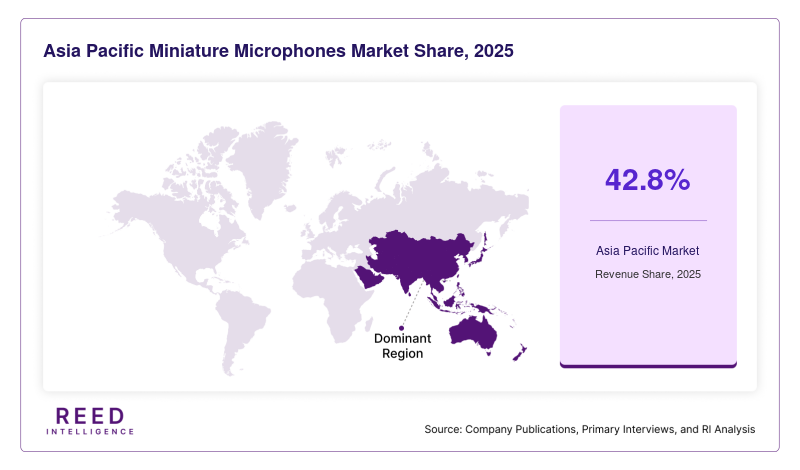
One published market estimate identifies Asia Pacific as the dominant region, with 42.8% of global market share in 2025. Applying that percentage to the supplied 2025 global market size of USD 3,090 million gives an indicative regional value of approximately USD 1,322.5 million. This value is mathematically derived, not an independently reported regional valuation, and relies on the compatibility of the source's market definition with the supplied figures.
Regional growth opportunities include MEMS microphone integration, wearable devices, hearing technology, automotive electronics, and AI-enabled consumer products. However, a verified fastest-growing regional CAGR for the exact market definition is unavailable.
Latin America Miniature Microphones Market
Latin America's miniature microphone demand is linked to consumer electronics, telecommunications equipment, automotive systems, professional audio, and connected devices. Increasing use of smartphones, computers, wireless headsets, and smart home products supports demand for compact audio components. Regional market performance also depends on consumer purchasing power, electronics imports, local device assembly, and investment in communications infrastructure.
Opportunities may arise from wider adoption of connected electronics and the integration of improved voice capture into consumer and commercial products. However, the region's component supply chain relies substantially on international manufacturing and distribution. A verified global market-share percentage and comparable regional CAGR are unavailable.
Middle East & Africa Miniature Microphones Market
The Middle East & Africa market is influenced by demand for smartphones, telecommunications equipment, connected devices, professional audio, automotive electronics, and selected healthcare technologies. Urbanization, digital infrastructure development, and the expansion of connected services can support the use of compact microphones in consumer and commercial products.
Demand varies by country according to electronics distribution, industrial development, consumer spending, and access to healthcare and communications technology. Manufacturers and distributors must consider supply availability, product pricing, and technical support.
Miniature Microphones Market Competitive Landscape
The Miniature Microphones Market includes semiconductor microphone developers, acoustic component suppliers, specialized microphone manufacturers, and companies supplying components for hearing devices and consumer electronics. Competition is based on acoustic performance, size, power consumption, reliability, integration capability, production scale, and cost.
Knowles Corporation: Knowles has a history in miniature acoustic components, including MEMS microphones and hearing health technologies. Its MM60 MEMS microphone, announced in October 2025, was designed for AI-enabled hearing aids, combining a new MEMS motor with an advanced application-specific integrated circuit. The product reflects the importance of acoustic input quality and compact, power-conscious designs in next-generation hearing devices.
Key Market Players
- Knowles Corporation
- TDK Corporation (InvenSense)
- Infineon Technologies AG
- STMicroelectronics
- AAC Technologies Holdings Inc.
- Goertek Inc.
- Hosiden Corporation
- Omron Corporation
- Syntiant Corp.
- CUI Devices
- PUI Audio
Miniature Microphones Market Recent Developments
- October 2025 Knowles announced its MM60 MEMS microphone at the European Hearing Aid Acousticians Convention. The product combines a new MEMS motor with an advanced application-specific integrated circuit and is designed to support the acoustic input needs of next-generation AI-enabled hearing aids. The launch illustrates continued development of miniature microphones for hearing health applications, where compact dimensions, durability, and audio quality are important.
- January 2026 At CES 2026, TDK highlighted ultra-low-power MEMS microphones for applications including keyboards and acoustic activity detection. The company's broader showcase covered AI-related sensor technologies, smart devices, and connected electronics. This development reflects demand for microphone components that can support always-available audio functions while managing energy consumption.
Miniature Microphones Market Segments
By Type
- MEMS Microphones
- Electret Condenser Microphones
- Dynamic Microphones
- Specialized Miniature Microphones
By Application
- Consumer Electronics
- Wearable and Hearable Devices
- Smart Home and IoT Devices
- Automotive
- Healthcare and Medical Devices
- Industrial Applications
- Professional Audio and Communications
By Technology
- Analog Microphones
- Digital Microphones
By End User
- Consumer Electronics Manufacturers
- Automotive Manufacturers
- Healthcare and Hearing Device Manufacturers
- Industrial Equipment Manufacturers
- Professional Audio and Communications Providers
By Region
- North America
- Europe
- APAC
- Middle East and Africa
- LATAM