Miniature Solenoid Valve Market Size, Share & Trends Analysis Report By Type (Direct Acting, Pilot Operated, Proportional), By Material (Plastic, Brass, Stainless Steel), By Application (Medical Devices, Laboratory and Analytical Instruments, Automotive, Industrial Automation, Aerospace), and By Region (North America, Europe, Asia Pacific, Latin America, Middle East & Africa) Forecasts, 2026–2034
USD 3950
Miniature Solenoid Valve Market Size
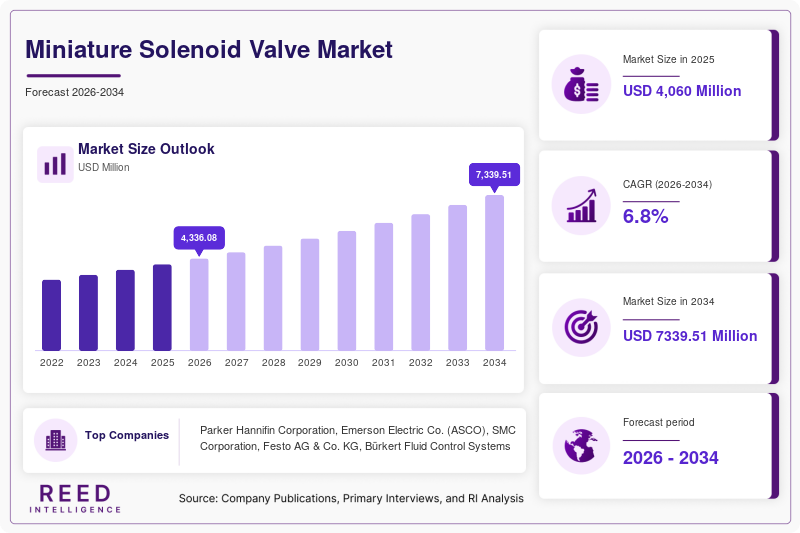
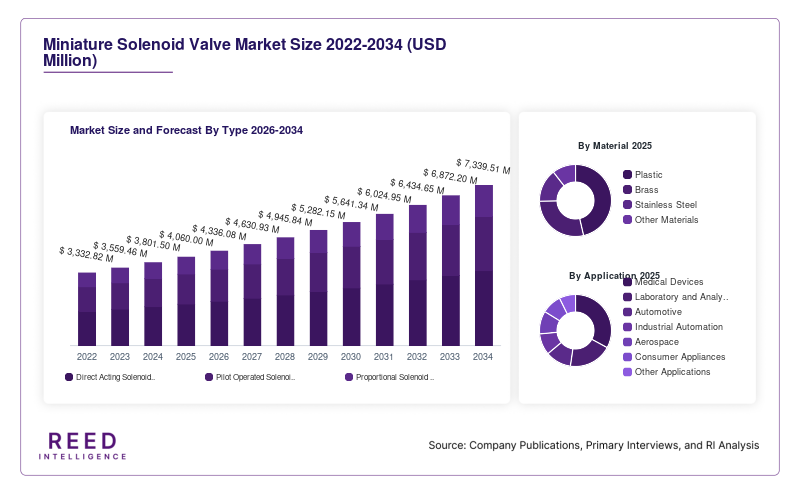
The global Miniature Solenoid Valve Market was valued at USD 4,060 million in 2025 and is projected to grow from USD 4,336.08 million in 2026 to USD 7,339.51 million by 2034, registering a CAGR of 6.8% during the forecast period (2026–2034).
The Miniature Solenoid Valve Market comprises compact electromechanical valves that regulate the flow of liquids and gases using electromagnetic actuation. These valves are designed for applications where space efficiency, precise fluid control, low power consumption, fast response, and dependable operation are essential. They are used in medical devices, laboratory instruments, analytical equipment, automotive systems, industrial automation, aerospace equipment, and consumer appliances.
Increasing product miniaturisation across medical diagnostics and analytical instrumentation is supporting demand for smaller fluid-control components. Manufacturers are also focusing on compact valve architectures, lower energy consumption, improved sealing, corrosion-resistant materials, and longer operating life. In industrial applications, miniature solenoid valves support pneumatic control, automated machinery, precision equipment, and fluid-handling systems.
Miniature Solenoid Valve Market Drivers
Medical device miniaturisation: The growing use of portable diagnostic equipment, respiratory devices, infusion systems, and laboratory instruments increases demand for compact valves that deliver accurate and dependable fluid control.
Industrial automation expansion: Automated production lines, robotics, pneumatic equipment, and precision manufacturing systems require reliable solenoid valves to control air, gases, and compatible liquids.
Growth in laboratory and analytical instruments: Diagnostic analysers, gas chromatography equipment, sample preparation systems, and other analytical devices require small valves that provide precise flow switching within confined spaces.
Demand for energy-efficient components: Manufacturers are developing valves with lower power consumption, improved coil designs, and efficient actuation mechanisms to help equipment manufacturers reduce energy use and heat generation.
Miniature Solenoid Valve Market Restraints
Technical complexity of miniaturisation: Reducing valve dimensions while maintaining flow capacity, sealing performance, durability, and response speed can increase engineering and manufacturing complexity.
High precision manufacturing costs: Miniature components often require tight tolerances, specialised machining, high-quality materials, and extensive testing, which can raise production costs.
Fluid compatibility limitations: Seals, valve bodies, and internal components must be compatible with the intended gases or liquids. Incorrect material selection can cause leakage, contamination, corrosion, or premature failure.
Qualification and compliance requirements: Medical, aerospace, and other regulated applications may require rigorous testing, traceability, documentation, and validation before components can be adopted.
Miniature Solenoid Valve Market Opportunities
Advanced medical and diagnostic equipment: Demand for compact point-of-care testing, portable diagnostic systems, respiratory devices, and automated laboratory equipment creates opportunities for specialised miniature valves.
Semiconductor manufacturing: Precision gas and fluid management in semiconductor production equipment offers opportunities for high-reliability valves designed for demanding process conditions.
Low-power and compact valve designs: Improvements in coil technology, materials, and internal flow paths can support products that combine reduced dimensions with improved energy efficiency and performance.
Customised and integrated fluid-control systems: Manufacturers can develop application-specific valve manifolds and integrated control assemblies that simplify installation and improve equipment design flexibility.
Miniature Solenoid Valve Market Segmental Analysis
By Type
Direct-acting miniature solenoid valves are used where electromagnetic force directly moves the valve mechanism. Their relatively straightforward actuation design can support compact equipment, low-pressure applications, and precise switching requirements. They are relevant to medical devices, analytical instruments, and selected industrial fluid-control systems.
Pilot-operated valves use the pressure differential of the controlled fluid to assist valve operation and can be suitable for applications requiring greater flow capacity under appropriate operating conditions. Proportional valves offer variable control of flow or pressure and are relevant to applications requiring more than simple on/off switching.
Direct-acting valves are reported as the dominant type, with an estimated 54.2% market share in the cited market analysis. This figure should be treated as a third-party market estimate because independently audited segment data are not publicly available. The fastest-growing valve type and its CAGR cannot be established reliably from a comparable public dataset.
By Material
Stainless steel is used in miniature solenoid valves where corrosion resistance, mechanical strength, durability, and compatibility with demanding operating environments are important. These properties make it relevant to analytical equipment, medical applications, industrial systems, and equipment handling selected gases or liquids.
Plastic valve bodies can reduce weight and manufacturing costs and may be suitable for applications requiring compact dimensions and compatibility with specific fluids. Brass is used in applications where machinability, durability, and suitable fluid compatibility are required. Material selection depends on pressure, temperature, fluid characteristics, sealing requirements, and applicable industry standards.
The stainless steel segment is a significant category in the wider miniature solenoid valve industry, but a consistent market-share estimate for the precise scope used in this report could not be independently verified. A defensible fastest-growing material segment and corresponding CAGR are also unavailable.
By Application
Medical devices and laboratory equipment use miniature solenoid valves to control fluids and gases in diagnostic analysers, respiratory systems, sample handling equipment, and other precision instruments. Compact size and reliable switching are especially important where internal space is limited and flow control must remain consistent.
Industrial automation represents another important application area. Miniature valves support pneumatic circuits, automated equipment, robotic systems, and precision manufacturing. Automotive and aerospace applications require products designed for their respective operating environments, performance expectations, and qualification requirements.
Medical devices are a key demand category in published analyses of miniature solenoid valves, while industrial automation benefits from expanding factory automation and robotics. However, the leading application share and fastest-growing application CAGR cannot be quantified reliably for this report without a consistent, market-specific dataset.
Miniature Solenoid Valve Market Regional Analysis
North America Miniature Solenoid Valve Market
North America benefits from demand for miniature fluid-control components across medical equipment, laboratory instrumentation, aerospace, automotive systems, and industrial automation. The region's established medical technology industry and advanced manufacturing base create opportunities for suppliers offering precise, dependable, and application-specific valve designs.
Manufacturers serving North American customers must address quality requirements, equipment integration needs, reliability expectations, and relevant industry standards. Demand is also influenced by investments in diagnostic equipment, laboratory automation, and advanced manufacturing. A comparable, independently verified regional market-share figure for North America was not established from the selected source for this report.
Europe Miniature Solenoid Valve Market
Europe's market is supported by industrial automation, precision engineering, medical equipment production, laboratory instruments, and automotive manufacturing. Manufacturers of compact valves serve applications where dependable operation, controlled fluid flow, and compatibility with demanding operating conditions are essential.
Demand also reflects investment in advanced production equipment and specialised instrumentation. Product quality, compliance, material selection, and energy efficiency remain important considerations for manufacturers and customers. A reliable regional market-share percentage and fastest-growing regional CAGR for this specific market definition could not be independently verified.
Asia Pacific Miniature Solenoid Valve Market
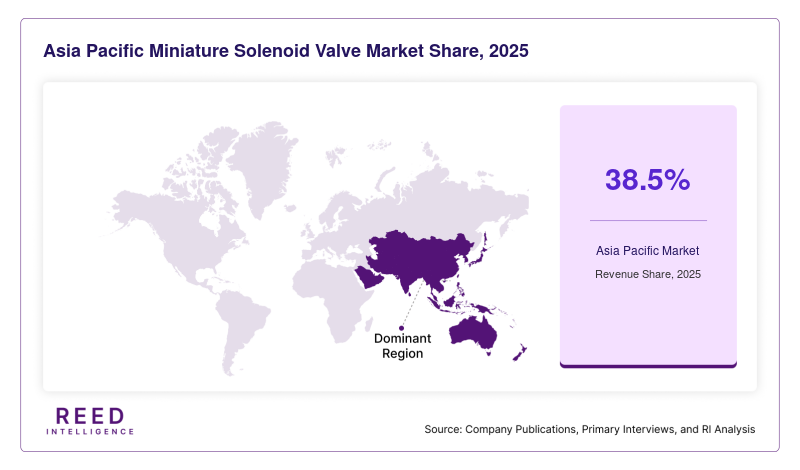
Asia Pacific was the dominant region in 2025, accounting for an estimated 38.5% of global Miniature Solenoid Valve Market revenue, according to the cited Dataintelo market analysis. Demand is supported by the region's extensive electronics and industrial manufacturing base, automotive production, medical equipment manufacturing, and increasing adoption of industrial automation. China, Japan, South Korea, and India contribute to regional demand through their manufacturing and engineering activities.
Applying the reported 38.5% share to the supplied global market value of USD 4,060 million in 2025 gives an implied Asia Pacific market value of approximately USD 1,563.1 million (USD 1.56 billion). This is a calculated estimate based on the reported regional share and your supplied global market value, rather than a separately verified regional revenue figure. Continued investment in automation, diagnostic equipment, precision instruments, and advanced manufacturing may support regional demand.
Latin America Miniature Solenoid Valve Market
Latin America's market is influenced by industrial modernisation, automotive production, medical equipment demand, and the gradual expansion of automated manufacturing. Miniature solenoid valves can serve fluid-control requirements in industrial machinery, laboratory instruments, and selected healthcare applications.
Market development depends on industrial investment, equipment imports, local distribution networks, technical support, and the availability of application-specific components. Adoption also varies by country and end-use industry. A comparable, verified market-share percentage and regional growth rate for Latin America were not established from the selected market-specific data.
Middle East & Africa Miniature Solenoid Valve Market
The Middle East & Africa market is supported by industrial development, healthcare infrastructure investment, laboratory equipment requirements, and demand for automation in selected manufacturing and processing sectors. Miniature solenoid valves can be incorporated into analytical equipment, medical systems, industrial control assemblies, and other compact fluid-control applications.
Regional demand depends on capital investment, industrial diversification, procurement activity, equipment imports, and technical service availability. Market opportunities differ across countries according to manufacturing capabilities and the scale of local end-use industries. A reliable numeric regional market share and comparable fastest-growing regional CAGR could not be independently verified for this market definition.
Miniature Solenoid Valve Market Competitive Landscape
The Miniature Solenoid Valve Market is characterised by established fluid-control manufacturers, automation technology suppliers, and specialised component producers. Competition centres on valve size, flow capacity, power consumption, response time, leakage performance, material compatibility, durability, and application-specific engineering.
Companies serving medical and analytical instrumentation customers may differentiate themselves through low-power designs, compact manifolds, reliable operation, and product configurations suited to specialised equipment. Industrial automation suppliers focus on dependable switching, system compatibility, modular installation, and performance across a broad range of operating conditions.
Key Market Players
- Parker Hannifin Corporation
- Emerson Electric Co. (ASCO)
- SMC Corporation
- Festo AG & Co. KG
- Bürkert Fluid Control Systems
- IMI Norgren
- Danfoss A/S
- Kendrion N.V.
- The Lee Company
- Gems Sensors & Controls
Miniature Solenoid Valve Market Recent Developments
January 2026 SMC published an update for its JSY1000/3000/5000 series plug-in compact five-port solenoid valves on January 7, 2026. The update highlights space-saving design, reduced weight, increased flow, manifold options, and power consumption as low as 0.1 W with an optional power-saving circuit. These features are relevant to the broader market trend toward compact, energy-efficient pneumatic control components.
November 2025 SMC published an update to the direct-operated and pilot-operated JSX series on November 3, 2025. The listed improvements include a 25% reduction in valve volume and a 30% reduction in weight compared with the existing model, alongside lower power consumption and improved environmental resistance. This development illustrates continuing efforts to reduce component size while maintaining performance and durability.
Miniature Solenoid Valve Market Segments
By Type
- Direct Acting Solenoid Valves
- Pilot Operated Solenoid Valves
- Proportional Solenoid Valves
By Material
- Plastic
- Brass
- Stainless Steel
- Other Materials
By Application
- Medical Devices
- Laboratory and Analytical Instruments
- Automotive
- Industrial Automation
- Aerospace
- Consumer Appliances
- Other Applications
By End User
- Healthcare and Medical Equipment Manufacturers
- Industrial Equipment Manufacturers
- Automotive Manufacturers
- Laboratory and Analytical Instrument Manufacturers
- Aerospace and Defense Companies
- Consumer Appliance Manufacturers
By Region
- North America
- Europe
- APAC
- Middle East and Africa
- LATAM