Miniature Speaker Market Size, Share & Trends Analysis Report By Product Type (Wireless Miniature Speakers, Wired Miniature Speakers), By Application (Consumer Electronics, Automotive,), By Distribution Channel (Online Stores, Supermarkets), By End User (Residential, Commercial, Industrial) and By Region (North America, Europe, Asia Pacific, Latin America, Middle East & Africa) Forecasts, 2026–2034
USD 3950
Miniature Speaker Market Size
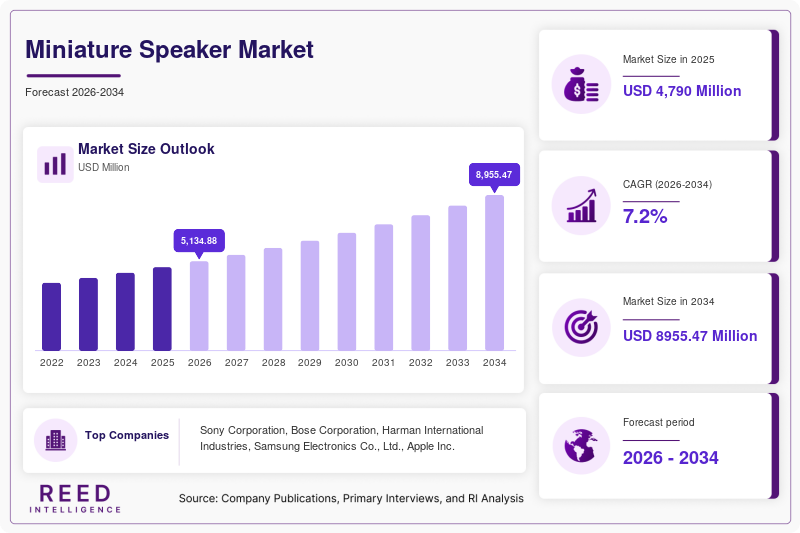
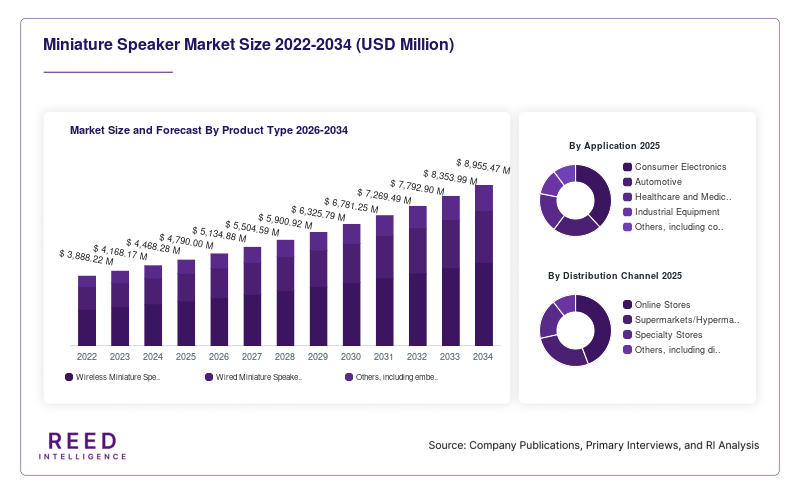
The global Miniature Speaker Market was valued at USD 4,790 million in 2025 and is projected to grow from USD 5,134.88 million in 2026 to USD 8,955.47 million by 2034, registering a CAGR of 7.2% during the forecast period (2026–2034).
The Miniature Speaker Market comprises compact sound-producing components and small-format speakers designed to deliver audio within limited installation spaces. These products are integrated into consumer electronics, communication devices, automotive systems, medical equipment, industrial devices, and portable audio products. Their design focuses on dimensions, sound clarity, power consumption, frequency response, durability, and compatibility with the host device.
The growing adoption of smartphones, wireless audio devices, smart wearables, and connected home products is increasing demand for miniature audio components. Manufacturers are developing compact speaker designs that deliver stronger output, improved acoustic performance, and greater energy efficiency while meeting the size constraints of modern electronics.
Miniature Speaker Market Drivers
Increasing Demand for Consumer Electronics: Smartphones, tablets, laptops, wearable devices, gaming products, and smart home equipment increasingly require compact audio components. Miniature speakers enable audio playback, voice communication, notifications, and multimedia functionality without requiring large enclosures, supporting continued demand from electronics manufacturers.
Growth of Wireless and Portable Audio: Consumers increasingly use compact Bluetooth speakers and other portable audio products for personal entertainment, travel, outdoor activities, and home listening. Manufacturers are improving connectivity, battery performance, acoustic output, and durability to meet these requirements.
Expansion of Automotive Infotainment Systems: Modern vehicles incorporate speakers for entertainment, navigation, voice assistants, alerts, and communication. Demand for compact components is supported by increasingly sophisticated infotainment systems, connected-car functions, and the need to accommodate multiple audio zones within vehicle interiors.
Miniature Speaker Market Restraints
Sound Performance Limitations: Small speaker enclosures restrict the space available for acoustic chambers and larger diaphragms. Producing strong bass, high output, and clear sound from a compact component requires careful acoustic design and can increase engineering complexity.
Price and Manufacturing Pressure: Miniature speakers must meet tight dimensional tolerances and performance requirements while remaining cost-effective. Variations in materials, production yields, and component availability can affect manufacturing costs and supplier profitability.
Intense Competition and Product Substitution: Manufacturers compete on price, sound quality, power efficiency, reliability, and customization. Alternative audio technologies and different acoustic configurations may be selected when they better satisfy the size, performance, or cost requirements of a particular application.
Miniature Speaker Market Opportunities
Integration with Wearable and Connected Devices: Smartwatches, hearables, compact communication devices, and other connected products create opportunities for speakers with smaller footprints and lower power consumption. Suppliers that develop application-specific acoustic components can benefit from increasing device miniaturization.
Growth in Medical and Industrial Applications: Diagnostic equipment, patient communication devices, industrial alarms, and specialized instruments require compact and dependable audio components. These applications offer opportunities for products designed around specific durability, reliability, and environmental requirements.
Advances in Acoustic Engineering: Improvements in diaphragm materials, magnetic assemblies, acoustic chambers, and digital sound processing can help manufacturers improve sound quality without significantly increasing component dimensions. Custom designs and partnerships with original equipment manufacturers can also create opportunities for differentiation.
Miniature Speaker Market Segmental Analysis
By Product Type
Wireless Miniature Speakers: Wireless miniature speakers support portable and connected audio applications where cable-free operation and convenient connectivity are important. Demand is supported by Bluetooth-enabled audio devices, portable speakers, smart home products, and other compact electronics. Product development increasingly emphasizes reliable wireless connectivity, battery efficiency, durability, and sound performance.
Wired Miniature Speakers: Wired miniature speakers are integrated into devices where direct electrical connections, compact construction, predictable performance, and straightforward system integration are required. Applications include embedded electronics, communication equipment, industrial devices, medical instruments, and selected automotive systems.
Wireless miniature speakers are identified as the dominant product type in one third-party market estimate, which reports a 58.3% share. This figure should be treated as a published estimate rather than an independently audited market statistic. Wireless products benefit from the growth of portable and connected audio applications. However, a comparable and independently verified growth-rate comparison is unavailable to establish conclusively whether wireless or wired miniature speakers will grow faster.
By Application
Consumer Electronics: Consumer electronics is a major application area for miniature speakers. Smartphones, tablets, laptops, wearable devices, gaming products, smart home equipment, and other electronic products use compact audio components for communication, media playback, notifications, and voice interaction. Device miniaturization and product refresh cycles support continuing demand.
Automotive: Automotive applications include infotainment systems, hands-free communication, navigation, warning signals, and cabin audio systems. The integration of connected technologies and increasingly sophisticated vehicle interfaces supports opportunities for compact speaker components.
Healthcare: Medical and healthcare applications include diagnostic equipment, patient communication systems, hearing-related devices, and selected monitoring instruments. Product requirements may include clear speech reproduction, compact dimensions, reliability, and suitability for the operating environment.
Industrial: Industrial applications include alarms, signaling devices, communication equipment, instrumentation, and connected machinery. Demand is influenced by industrial automation and the integration of audio alerts into monitoring and control systems.
Others: Other applications include specialized communication devices, security equipment, educational electronics, toys, and other compact products requiring audio output.
Consumer electronics is a key demand area because miniature speakers are widely integrated into personal and connected devices. However, the leading application by revenue and the fastest-growing application should be confirmed against a consistent segment-level dataset before assigning exact market shares or growth rates.
By Distribution Channel
Online Stores: Online channels provide product comparison, convenient ordering, and broad access to miniature audio products and replacement components. E-commerce is particularly relevant to consumer-facing compact speakers and electronic accessories.
Supermarkets/Hypermarkets: These retail channels can support sales of portable audio products and consumer electronics accessories through physical retail displays and promotional campaigns.
Specialty Stores: Specialist electronics and audio retailers offer product demonstrations, technical guidance, and curated product ranges. They are relevant to buyers who prioritize product features, sound quality, and compatibility.
Others: Other distribution channels include direct manufacturer sales, authorized distributors, electronics component suppliers, and business-to-business procurement platforms.
By End User
Residential: Residential demand includes smartphones, personal audio devices, portable speakers, smart home equipment, and entertainment electronics. Adoption is influenced by consumer preferences, disposable income, device replacement cycles, and the growth of connected living.
Commercial: Commercial end users include offices, retail outlets, hospitality businesses, educational institutions, and service providers. Applications range from communication and announcements to customer-facing audio systems.
Industrial: Industrial end users incorporate miniature speakers into machinery, control panels, communication systems, alarms, monitoring equipment, and specialized electronic products. Reliability and compatibility with operating conditions are important purchasing considerations.
Miniature Speaker Market Regional Analysis
North America Miniature Speaker Market
North America benefits from demand for consumer electronics, portable audio products, connected home devices, automotive infotainment, and specialized medical and industrial equipment. Established technology companies and product developers contribute to demand for compact audio components with reliable performance and consistent quality.
The United States is an important market for branded audio products and electronics innovation, while Canada and Mexico contribute through consumer demand and manufacturing activities. Product launches, connected-device adoption, and automotive technology development support market opportunities. A comparable independent regional dataset is not available to confirm a precise North American market-share percentage within the supplied market definition.
Europe Miniature Speaker Market
Europe's miniature speaker market is supported by consumer electronics, automotive manufacturing, industrial equipment, medical technology, and demand for connected products. Automotive manufacturers and electronics developers require compact components that meet performance, reliability, and integration requirements.
Germany, the United Kingdom, France, and other European economies contribute through automotive production, industrial engineering, retail audio, and specialized electronic applications. Opportunities depend on product innovation, consumer purchasing patterns, and industrial investment. A consistently comparable regional market-share figure could not be independently verified.
Asia Pacific Miniature Speaker Market
Asia Pacific is a leading region for miniature speakers because of its large consumer electronics manufacturing base, extensive smartphone supply chain, and strong presence in electronic component production. China, Japan, South Korea, Taiwan, and other Asian manufacturing centers support demand through the production of mobile devices, connected electronics, automotive systems, and portable audio products.
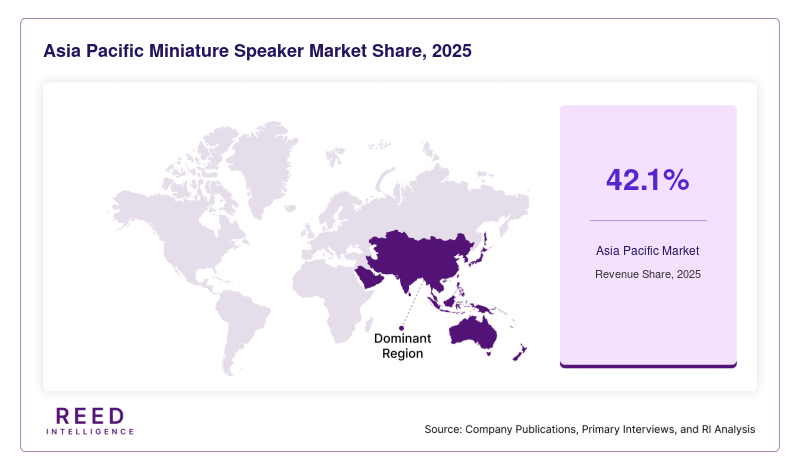
One third-party market estimate places Asia Pacific's 2025 share at 42.1%, equivalent to around USD 2,017 million when applied to the supplied global market size of USD 4,790 million. The value is a calculation based on that reported share, not a separately verified regional revenue figure. Asia Pacific is therefore identified as the leading region in this estimate. Its status as the fastest-growing region cannot be confirmed without comparable regional CAGR data.
Latin America Miniature Speaker Market
Latin America's market is supported by demand for smartphones, consumer electronics, portable audio products, automotive systems, and industrial equipment. Retail expansion and wider access to connected devices can increase demand for compact audio components.
Brazil and Mexico are relevant markets because of their consumer bases and manufacturing activities. Market development depends on economic conditions, purchasing power, import costs, distribution networks, and the availability of affordable audio products. A precise regional share could not be verified using comparable independent data.
Middle East & Africa Miniature Speaker Market
The Middle East & Africa market is influenced by demand for consumer electronics, connected devices, automotive systems, commercial audio, and industrial equipment. Increasing adoption of smartphones and connected home technologies can support demand for miniature audio components.
Miniature Speaker Market Competitive Landscape
The Miniature Speaker Market includes consumer audio brands, electronics manufacturers, acoustic-component suppliers, and companies that develop integrated audio solutions. Competition is shaped by sound quality, component dimensions, connectivity, power efficiency, durability, customization, manufacturing scale, and pricing.
Sony Corporation and Bose Corporation are identified among the leading companies in a third-party market overview. Other important participants in the broader miniature and compact speaker ecosystem include Harman International Industries, Samsung Electronics, Apple, Panasonic, LG Electronics, Yamaha, Sennheiser, Bang & Olufsen, Logitech, Creative Technology, and Anker Innovations.
Key Market Players
- Sony Corporation
- Bose Corporation
- Harman International Industries
- Samsung Electronics Co., Ltd.
- Apple Inc.
- Panasonic Corporation
- LG Electronics Inc.
- Yamaha Corporation
- Pioneer Corporation
- JBL
- Sennheiser Electronic GmbH & Co. KG
- Bang
Miniature Speaker Market Recent Market Developments
October 2026, JBL announced the Pulse 6, featuring AI Sound Boost, a customizable 360-degree lightshow, Bluetooth 6.0, Auracast connectivity, USB-C lossless audio playback, and up to 12 hours of battery life. The launch reflects continued product development around compact portable audio, connected listening, and combining sound with lighting features. It is a finished portable speaker product rather than a standalone miniature speaker component.
October 2026, JBL announced the BassPro Go2, a compact system that functions as a powered subwoofer when docked and a portable full-range Bluetooth speaker when removed. The product is designed for marine and outdoor use, demonstrating how manufacturers are developing versatile compact audio systems for specialized environments. Its positioning is broader than miniature embedded speaker components, so it should be treated as an adjacent product development.
Miniature Speaker Market Segments
By Product Type
- Wireless Miniature Speakers
- Wired Miniature Speakers
- Others, including embedded and specialized miniature speaker configurations where included in the market definition
By Application
- Consumer Electronics
- Automotive
- Healthcare and Medical Devices
- Industrial Equipment
- Others, including communication devices, smart home systems, and specialized electronic equipment
By Distribution Channel
- Online Stores
- Supermarkets/Hypermarkets
- Specialty Stores
- Others, including direct sales and authorized distributors
By End User
- Residential
- Commercial
- Industrial
By Region
- North America
- Europe
- APAC
- Middle East and Africa
- LATAM