Miniature Valves Market Size, Share & Trends Analysis Report By Type (Solenoid Valves, Check Valves, Needle Valves, Ball Valves, Proportional Valves, and Others), By Application (Medical Devices, Analytical Instruments, Industrial Automation, Automotive, Aerospace, and Others) and By Region (North America, Europe, Asia Pacific, Latin America, Middle East & Africa) Forecasts, 2026–2034
USD 3950
Miniature Valves Market Size
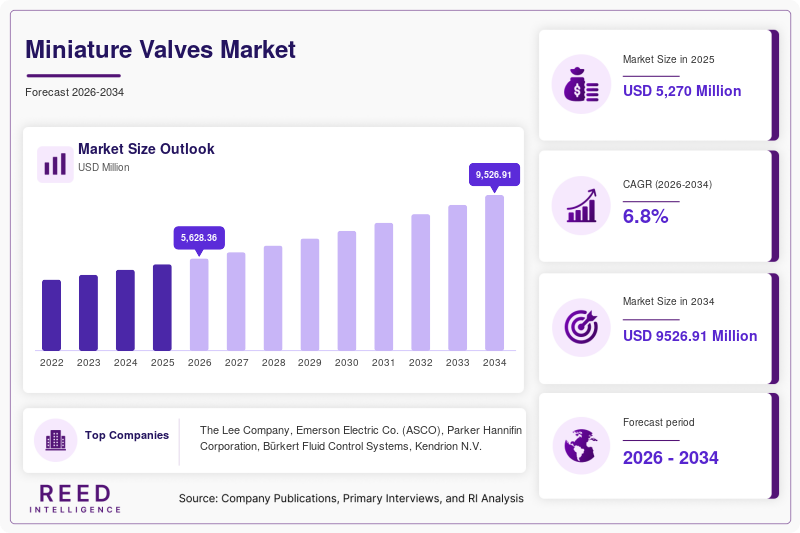
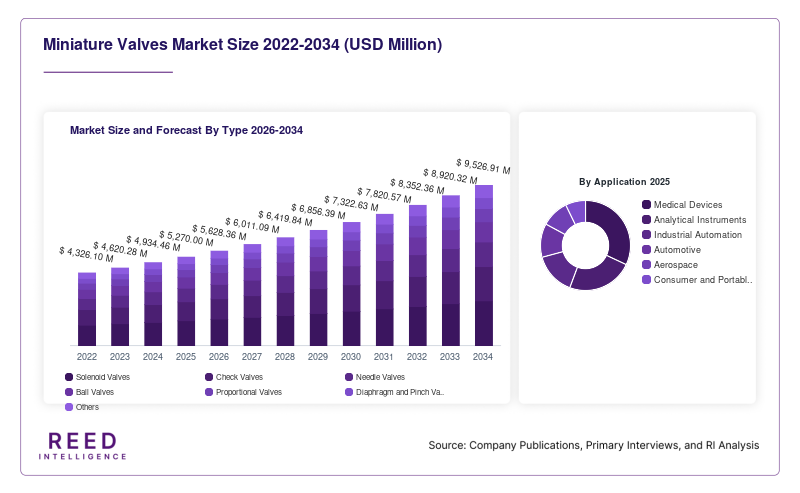
The global miniature valves market was valued at USD 5,270 million in 2025 and is projected to grow from USD 5,628.36 million in 2026 to USD 9,526.91 million by 2034, registering a CAGR of 6.8% during the forecast period (2026–2034).
Miniature valves are compact mechanical or electromechanical devices designed to regulate, direct, isolate, or control the flow of liquids and gases. They are used in systems where installation space is limited and accurate fluid management is essential. Depending on the application, miniature valves may operate through solenoid actuation, manual control, pneumatic mechanisms, pressure differences, or proportional control.
Common product categories include miniature solenoid valves, check valves, needle valves, ball valves, diaphragm valves, pinch valves, and proportional valves. Their applications range from respiratory and diagnostic equipment to laboratory instruments, industrial machinery, automotive systems, and specialized aerospace equipment.
Miniature Valves Market Drivers
Increasing adoption of medical devices: Miniature valves are used in oxygen concentrators, respiratory equipment, patient-monitoring devices, diagnostic instruments, and other medical systems. Demand for portable and compact medical equipment supports the need for reliable, low-power fluid-control components.
Growth in industrial automation: Automated manufacturing equipment, pneumatic controls, analytical systems, and precision machinery require dependable flow-control components. Compact valves enable manufacturers to integrate more functions into smaller assemblies and complex control systems.
Miniaturization of analytical instruments: Laboratory equipment, gas analyzers, chromatography systems, and diagnostic platforms require precise management of gases and liquids within confined spaces. Miniature valves help control flow while supporting compact instrument designs.
Demand for precision and energy efficiency: Manufacturers are developing valves with fast switching, reduced leakage, lower power consumption, and longer service life. These capabilities are important for battery-powered devices, portable equipment, and systems requiring repeated actuation.
Miniature Valves Market Restraints
High engineering and qualification requirements: Medical, aerospace, and other demanding applications may require extensive testing to validate reliability, material compatibility, leakage performance, and operating life. These requirements can increase development costs and extend qualification timelines.
Sensitivity to operating conditions: Miniature valves may have strict limits relating to pressure, temperature, viscosity, particulate contamination, and chemical compatibility. Selecting an unsuitable design can affect flow performance, sealing, and service life.
Cost pressure in high-volume applications: Equipment manufacturers often seek compact valves at competitive prices. This can place pressure on suppliers to reduce manufacturing costs while maintaining consistent quality and performance.
Technical complexity of customization: Custom valve designs may require specialized tooling, application engineering, and integration testing. These requirements can increase costs for customers with low production volumes or unusual operating specifications.
Miniature Valves Market Opportunities
Expansion of portable healthcare equipment: Growth in home respiratory care, diagnostic equipment, and portable medical devices creates opportunities for compact valves with low power requirements, quiet operation, and long service life.
Advanced analytical and laboratory instruments: Increasing requirements for precise fluid handling in diagnostics, life sciences, environmental testing, and industrial analysis create opportunities for specialized miniature valves.
Development of smart fluid-control systems: Integration of sensors, electronic controls, and monitoring capabilities may allow miniature valves to support more responsive and efficient fluid-control systems. Adoption depends on application-specific performance and cost requirements.
Aerospace and specialized propulsion systems: Compact, lightweight, and highly reliable valves are important in satellite systems and specialized propulsion applications. Suppliers with proven engineering and qualification capabilities may benefit from these technically demanding markets.
Miniature Valves Market Segmental Analysis
By Type
Miniature solenoid valves are an important product category because electrical actuation allows flow to be controlled through automated systems. They are used in medical equipment, analytical instruments, pneumatic systems, and other applications requiring repeatable switching. Direct-acting, latching, and proportional configurations serve different requirements for power consumption, flow control, response time, and installation space.
Check valves are used to prevent reverse flow, while needle valves support fine flow adjustment. Miniature ball, diaphragm, and pinch valves serve applications requiring specific shut-off, sealing, or fluid-compatibility characteristics.
The dominant valve type and its exact market share have not been independently verified using a sufficiently detailed, comparable market-specific dataset. Solenoid valves are a significant category, but a definitive market-leadership claim would require consistent data covering the full market definition.
Proportional and other precision-control valves may benefit from increasing demand for accurate fluid management in analytical, medical, and automated equipment. However, the fastest-growing type and its CAGR cannot be confirmed from the available evidence.
By Application
Medical devices are an important application area for miniature valves because respiratory equipment, oxygen concentrators, diagnostic systems, and patient-monitoring devices require precise control of gases or liquids. Compact valve designs can support portable equipment, while low power consumption and long service life are important for battery-operated and continuously used devices.
Analytical instruments also use miniature valves to regulate gases and liquids in chromatography, gas analysis, and laboratory systems. Industrial automation uses them in pneumatic control systems, precision machinery, and equipment requiring compact flow-control assemblies. Automotive and aerospace applications have specialized requirements relating to operating conditions, reliability, weight, and safety.
Medical devices and analytical instruments are important application categories, but the dominant application and its exact share have not been independently verified for the overall miniature valves market. Portable medical equipment and precision analytical systems represent potential growth areas, although a fastest-growing application .
Miniature Valves Market Regional Analysis
North America Miniature Valves Market
North America has a developed market for precision fluid-control components, supported by medical-device manufacturing, analytical instrumentation, industrial automation, aerospace, and specialized engineering. The United States is an important market for miniature valves used in respiratory care, diagnostic systems, laboratory equipment, and advanced industrial applications. Demand is influenced by product reliability, engineering support, and the qualification requirements of equipment manufacturers.
Opportunities include portable healthcare equipment, laboratory automation, and specialized aerospace systems. However, a reliable numeric share of the global miniature valves market and a comparable regional CAGR have not been verified. North America’s precise ranking against other regions should therefore not be presented as confirmed.
Europe Miniature Valves Market
Europe has established capabilities in medical technology, laboratory equipment, industrial automation, automotive systems, and precision engineering. These industries use miniature valves where compact dimensions, reliable flow control, material compatibility, and long operating life are important. Germany and other industrial economies contribute to demand for precision components and automated equipment.
Growth opportunities include laboratory automation, medical-device development, and advanced manufacturing. Nevertheless, a verified regional market share, leading country by revenue, and fastest-growing application have not been established from sufficiently comparable public data.
Asia Pacific Miniature Valves Market
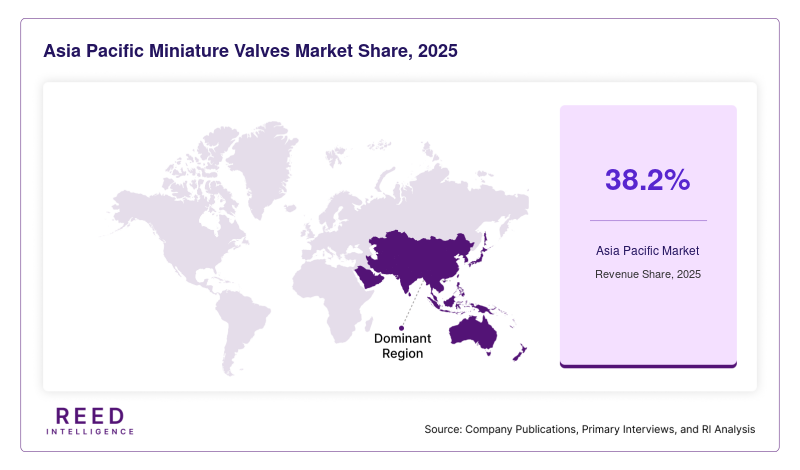
Asia Pacific is estimated to account for 38.2% of the global Miniature Valves Market in 2025, according to a published market-specific estimate. Based on your supplied 2025 global market value of USD 5,270 million, this represents an estimated regional market value of USD 2,012.14 million. This regional value is calculated by applying the reported share to your global market figure; it is a derived estimate, not independently verified regional revenue.Latin America Miniature Valves Market
Latin America presents opportunities for miniature valves through medical-equipment demand, industrial manufacturing, laboratory instrumentation, and automation projects. Brazil and Mexico are relevant industrial and healthcare markets, although adoption varies according to local manufacturing capacity, investment, and access to specialized components.
Middle East & Africa
The Middle East & Africa market is associated with healthcare investment, industrial development, laboratory facilities, energy-related applications, and demand for specialized equipment. Miniature valves may be used in medical devices, analytical systems, and industrial equipment where compact and dependable fluid control is required.
Market development varies by country and application. Investment in healthcare infrastructure, technical services, and industrial facilities may create opportunities, but the region’s numeric market share, leading country, and fastest-growing application have not been established from sufficiently comparable public sources.
Miniature Valves Market Competitive Landscape
The Miniature Valves Market includes specialist fluid-control manufacturers and diversified automation companies. Competition is based on valve dimensions, actuation method, flow characteristics, pressure and temperature ratings, leakage performance, material compatibility, service life, customization capabilities, and application-specific testing.
The Lee Company is a specialist in miniature precision fluid-control products, supplying valves for diagnostic, analytical, medical, and other technically demanding applications. Its portfolio includes compact control solenoid valves, including 7 mm designs and magnetically latching configurations intended to reduce energy consumption in battery-powered equipment.
Key Market Players
- The Lee Company
- Emerson Electric Co. (ASCO)
- Parker Hannifin Corporation
- Bürkert Fluid Control Systems
- Kendrion N.V.
- Humphrey Products Company
- Valcor Engineering Corporation
- Staiger GmbH
- SMC Corporation
- Festo SE & Co. KG
Miniature Valves Market Recent Developments
- February 2026, VERSA announced a compact direct-acting solenoid valve series intended for applications where installation space, dependable operation, and configuration flexibility are important. This development illustrates continued product engineering around compact valve architecture. The announcement describes a compact solenoid valve; it should not be interpreted as proof that the product is a miniature valve under every market definition.
- March 2025, Staiger announced a miniature proportional valve incorporating a sensor to measure pressure and temperature. The integrated design allows monitoring at the valve inlet or outlet, depending on flow direction, without requiring separate sensor interfaces. The company highlighted potential reductions in installation effort and potential leak points. This development is relevant to precision fluid-control systems, although it falls outside a strict 12-month window as of October 2026.
Miniature Valves Market Segments
By Type
- Solenoid Valves
- Check Valves
- Needle Valves
- Ball Valves
- Proportional Valves
- Diaphragm and Pinch Valves
- Others
By Application
- Medical Devices
- Analytical Instruments
- Industrial Automation
- Automotive
- Aerospace
- Consumer and Portable Equipment
By Region
- North America
- Europe
- APAC
- Middle East and Africa
- LATAM