Miniaturized Bistable Relay Market Size, Share & Trends Analysis Report By Type (Single-Coil, Dual-Coil, Magnetic Latching, Others), By Application (Consumer Electronics, Automotive, Industrial Automation, Telecommunications, Energy and Power Systems, Others) and By Region (North America, Europe, Asia Pacific, Latin America, Middle East & Africa) Forecasts, 2026–2034
USD 3950
Miniaturized Bistable Relay Market Size
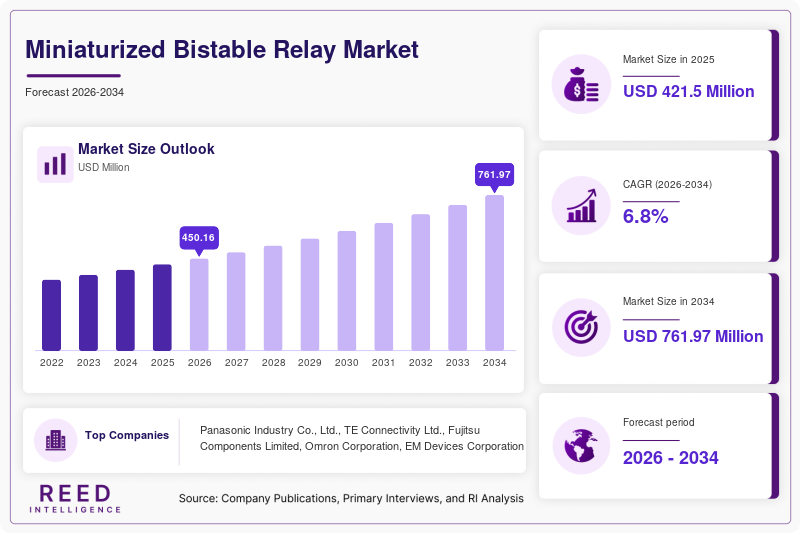
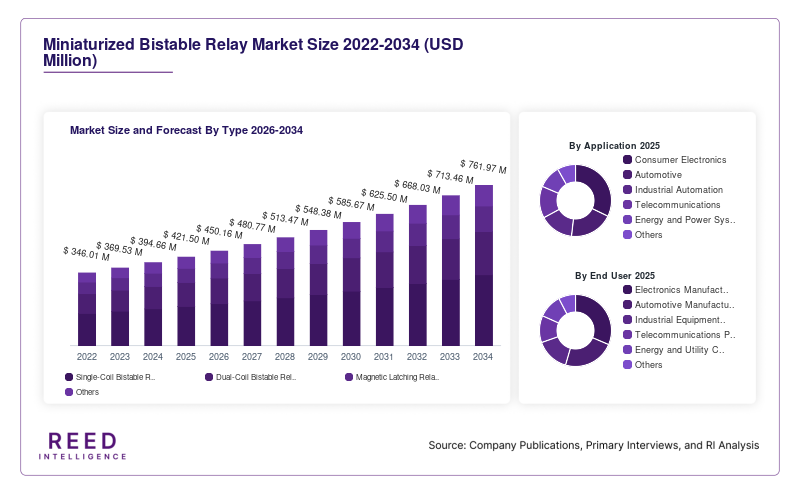
The global Miniaturized Bistable Relay Market was valued at USD 421.5 million in 2025 and is projected to grow from USD 450.16 million in 2026 to USD 761.97 million by 2034, registering a compound annual growth rate (CAGR) of 6.8% during the forecast period (2026–2034).
The Miniaturized Bistable Relay Market comprises compact electrically operated switching devices that maintain one of two stable contact positions without requiring continuous coil power. Also known as miniature latching relays, these components typically change state when an electrical pulse is applied and retain the selected position after the pulse ends. This operating principle can reduce energy consumption and heat generation compared with conventional non-latching relays.
Miniaturized bistable relays are used in electronic control boards, telecommunications equipment, automotive electrical systems, smart meters, industrial automation, power-management equipment, and other space-constrained applications. Their compact construction and low holding-power requirements make them valuable in equipment where circuit-board area, thermal performance, and energy efficiency are important. Market development is influenced by electronic-device miniaturization, the expansion of connected infrastructure, increasing automation, and demand for efficient electrical switching.
Miniaturized Bistable Relay Market Drivers
Increasing demand for energy-efficient electronic components: Bistable relays retain their switching state without continuously energizing the coil. This characteristic can reduce standby power consumption and heat generation in electronic equipment, making these relays attractive for applications that require a switching state to remain unchanged for extended periods.
Miniaturization of electronic and control systems: Manufacturers are developing smaller electronic assemblies with greater functionality and tighter packaging constraints. Miniaturized relays help engineers integrate switching functions into compact circuit boards, control panels, communication devices, and embedded systems.
Growth in automotive electronics and industrial automation: Automotive power distribution, battery management, control modules, industrial equipment, and automated systems require dependable electrical switching. Compact bistable relays can support these applications while reducing continuous coil-power requirements and facilitating space-efficient designs.
Miniaturized Bistable Relay Market Restraints
Design and manufacturing complexity: Miniaturized relays must maintain contact reliability, insulation performance, switching endurance, and mechanical stability within a small enclosure. Achieving these requirements can increase engineering complexity and manufacturing costs.
Limitations in switching capacity: Smaller relays may not be suitable for every high-current, high-voltage, or high-inrush application. Buyers must evaluate contact ratings, electrical endurance, insulation, temperature limits, and switching loads before selecting a miniature relay.
Competition from alternative switching technologies: Semiconductor switches and other electronic switching solutions may be preferred in applications requiring silent operation, very high switching frequency, or specific control characteristics. This competition can limit adoption in selected use cases.
Miniaturized Bistable Relay Market Opportunities
Expansion of smart meters and connected infrastructure: Smart electricity meters, building controls, and energy-management systems require compact components for switching and circuit control. Miniaturized bistable relays can support energy-conscious designs where the switching state must be retained without continuous coil energization.
Growth in AI-server and power-management equipment: High-performance computing infrastructure requires reliable power-supply systems, including switching and automatic transfer functions. Compact latching relays designed for these environments present an opportunity for suppliers that can satisfy demanding electrical and safety requirements.
Advances in high-density electronic packaging: Improvements in relay design, contact materials, magnetic circuits, and manufacturing can support smaller components with dependable switching performance. Suppliers offering application-specific designs and engineering support may benefit from demand for increasingly compact electronic systems.
Miniaturized Bistable Relay Market Segmental Analysis
By Type
Single-coil bistable relays use one coil to change the switching state, commonly relying on different-polarity pulses for set and reset operations. Their comparatively straightforward coil arrangement can support compact designs for circuit-board applications, control equipment, and electronic devices. Their suitability depends on the required drive circuit, switching capacity, and application-specific electrical characteristics.
Dual-coil bistable relays use separate set and reset coils, allowing the switching state to be controlled through dedicated electrical inputs. They are useful where independent switching commands and predictable control behavior are required. Both configurations serve different design requirements; independently verified market-share data establishing the dominant type and reliable comparative growth rates were not available for this report.
By Application
Consumer electronics and electronic control equipment are relevant application areas because manufacturers need compact switching components that can be integrated into increasingly dense circuit boards. Bistable relays can reduce continuous coil-power consumption in suitable designs, particularly when a switching state needs to remain stable for long periods.
Automotive and industrial applications offer opportunities through power distribution, control circuits, automation equipment, and energy-management systems. Requirements vary considerably by application, particularly in current rating, vibration resistance, thermal tolerance, electrical endurance, and safety. A reliable independently verified fastest-growing application segment and CAGR could not be established.
By End User
Electronics manufacturers are important customers because they integrate miniature relays into circuit boards, control equipment, and electronic systems. Their purchasing decisions depend on package dimensions, contact configuration, rated switching performance, power consumption, reliability, and long-term component availability.
Automotive and industrial equipment manufacturers require switching components suitable for demanding operating environments. Relays used in these settings may need to withstand temperature variation, vibration, electrical transients, and repeated switching cycles. Application-specific engineering and compliance with relevant safety standards can influence supplier selection.
Miniaturized Bistable Relay Market Regional Analysis
North America Miniaturized Bistable Relay Market
North America represents a relevant market for miniaturized bistable relays because of its electronics manufacturing, automotive engineering, telecommunications infrastructure, industrial automation, and data-center ecosystem. Demand can arise from power-supply systems, control boards, connected devices, and equipment requiring efficient switching in compact enclosures.
Further opportunities are associated with investments in computing infrastructure, electrical equipment, and automation. However, a reliable, independently verifiable market-share percentage for North America under the exact market definition used here could not be confirmed. No unsupported regional share or market value is assigned.
Europe Miniaturized Bistable Relay Market
Europe's market is supported by automotive electronics, industrial automation, electrical equipment, telecommunications, and energy-management applications. Manufacturers require compact and dependable switching components that can meet application-specific expectations for electrical safety, endurance, energy efficiency, and operating conditions.
The transition toward more electronically controlled systems and efficient power management can provide opportunities for suppliers. Nevertheless, a comparable regional market-share percentage and independently verified CAGR establishing Europe's growth ranking were not available. A numerical share or fastest-growing-region claim is therefore not included.
Asia Pacific Miniaturized Bistable Relay Market
Asia Pacific dominated the global Miniaturized Bistable Relay Market in 2025, accounting for an estimated 38.5% market share, equivalent to approximately USD 162.3 million. This estimate is based on the reported regional share of 38.5% and the supplied global market value of USD 421.5 million in 2025.
Continued electronic-device production and investment in automation can support demand for miniature switching components. However, a dependable numeric market-share percentage for the Miniaturized Bistable Relay Market could not be independently verified against the supplied global market valuation.
Latin America Miniaturized Bistable Relay Market
Latin America's demand for miniaturized bistable relays is associated with industrial equipment, automotive supply chains, telecommunications systems, electrical controls, and electronic-device assembly. Adoption can increase as manufacturers modernize equipment and integrate more sophisticated electronic control functions.
Market development depends on industrial investment, access to electronic components, supply-chain reliability, and the cost of integrating specialized relays. A reliable market-share percentage and comparable regional growth rate were not available from sufficiently robust independent evidence, so no numerical estimates are presented.
Middle East & Africa Miniaturized Bistable Relay Market
The Middle East & Africa market can benefit from investment in power infrastructure, telecommunications, industrial automation, building controls, and electronic systems. Compact latching relays can be relevant where control circuits need low holding-power consumption and a stable switching state.

Miniaturized Bistable Relay Market Competitive Landscape
The Miniaturized Bistable Relay Market includes global electronic-component manufacturers and specialist relay suppliers. Competition is based on package size, switching capacity, coil-power requirements, contact configuration, electrical endurance, insulation performance, reliability, and compliance with relevant standards. Manufacturers also compete through product availability, customization, engineering support, and the ability to serve high-volume electronics customers.
Panasonic Industry Co., Ltd. supplies latching relays for electronic switching applications. Its relay portfolio includes compact circuit-board models with different coil configurations, contact arrangements, operating voltages, and switching ratings. These characteristics allow designers to select components according to board-space and electrical-performance requirements.
TE Connectivity Ltd. offers bistable relays across signal, automotive, and industrial applications. Its portfolio includes latching relays that retain contact position without continuous coil power, along with higher-current designs intended for vehicle power distribution, battery management, and demanding operating environments. These broader product lines are relevant to the market, although not every product is a miniature relay.
Key Market Players
- Panasonic Industry Co., Ltd.
- TE Connectivity Ltd.
- Fujitsu Components Limited
- Omron Corporation
- EM Devices Corporation
- Hongfa Technology Co., Ltd.
- Zettler Group
- Finder S.p.A.
- Littelfuse, Inc.
- Same Sky
- Standex Electronics
Miniaturized Bistable Relay Market Recent Developments
-
September , 2026 FCL Components announced the FTR-L1 and FTR-L1R series for power-supply units with built-in automatic transfer switches. The dual-coil latching relays are rated at 25 A and 40 A at 277 VAC, respectively, and use a compact 50 × 20 × 27 mm body. The company states that the series is designed for AI-server power systems, including high-power rack applications. This is a relevant development in compact latching relay technology, although the products are not necessarily classified as miniature signal relays.
-
June 2025 EM Devices announced the EM1KT, a 40 A-class latching relay measuring 12.4 × 14.4 × 16.3 mm and weighing 8 g. The company positioned the design for automotive junction boxes and power-distribution modules where space constraints and higher current capacity are important. This development illustrates the trend toward combining compact dimensions with higher current ratings.
Miniaturized Bistable Relay Market Segments
By Type
- Single-Coil Bistable Relays
- Dual-Coil Bistable Relays
- Magnetic Latching Relays
- Others
By Application
- Consumer Electronics
- Automotive
- Industrial Automation
- Telecommunications
- Energy and Power Systems
- Others
By End User
- Electronics Manufacturers
- Automotive Manufacturers
- Industrial Equipment Manufacturers
- Telecommunications Providers
- Energy and Utility Companies
- Others
By Region
- North America
- Europe
- APAC
- Middle East and Africa
- LATAM