Miniaturized Wireless Communication Systems Market Size, Share & Trends Analysis Report By Component (Transceivers, Antennas, Sensors, Others), By Technology (Bluetooth, Wi-Fi, Zigbee, NFC, Others), By Application (Consumer Electronics, Healthcare, Automotive, Industrial, Others) and By Region (North America, Europe, Asia Pacific, Latin America, Middle East & Africa) Forecasts, 2026–2034
USD 3950
Miniaturized Wireless Communication Systems Market Size
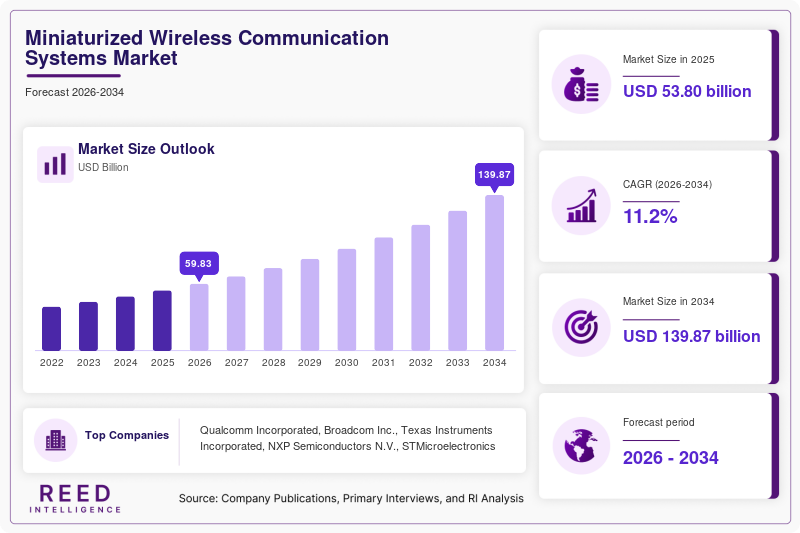
The global miniaturized wireless communication Systems Market was valued at USD 53.80 billion in 2025 and is projected to grow from USD 59.83 billion in 2026 to USD 139.87 billion by 2034, registering a CAGR of 11.2% during the forecast period (2026–2034).
The Miniaturized Wireless Communication Systems Market includes compact communication components and integrated systems that enable wireless data transmission within devices with limited space, power, and antenna capacity. These systems include radio-frequency transceivers, antennas, wireless connectivity modules, sensors with communication capabilities, and integrated circuits supporting technologies such as Bluetooth, Wi-Fi, Zigbee, near-field communication (NFC), cellular connectivity, and other wireless protocols.
Demand is supported by the expansion of the Internet of Things (IoT), wearable electronics, connected healthcare devices, automotive electronics, smart homes, industrial automation, and telecommunications infrastructure. Device manufacturers increasingly require smaller components that deliver reliable connectivity, efficient power consumption, reduced latency, and strong performance in environments with limited physical space.
Miniaturized Wireless Communication Systems Market Drivers
Increasing Adoption of IoT and Connected Devices
The proliferation of connected sensors, wearables, smart appliances, asset trackers, and industrial monitoring devices is increasing demand for compact wireless communication systems. Manufacturers require components that combine small dimensions with dependable connectivity and low power consumption. Integrated wireless modules help support connected products while reducing board space and simplifying hardware design.
Growing Demand for Consumer Electronics and Wearables
Smartphones, smartwatches, wireless earbuds, tablets, laptops, and connected accessories depend on compact communication components. These products often combine multiple wireless technologies within restricted physical dimensions. Continued development of connected consumer devices is encouraging manufacturers to improve radio integration, antenna performance, energy efficiency, and coexistence between communication protocols.
Expansion of Automotive Connectivity and Industrial Automation
Modern vehicles increasingly incorporate wireless connectivity for infotainment, diagnostics, tracking, connected services, and selected vehicle-to-everything applications. Industrial operators also use compact wireless systems for asset monitoring, predictive maintenance, factory automation, and sensor networks. These applications are creating demand for reliable communication components capable of operating in demanding environments.
Miniaturized Wireless Communication Systems Market Restraints
Power Consumption and Thermal Management Challenges
Miniaturized wireless systems must balance transmission range, data throughput, processing capability, and battery life within restricted physical dimensions. High-performance radios can generate heat and consume substantial power under demanding workloads. Manufacturers must optimize chip architecture, radio design, antennas, and firmware to meet application-specific power and thermal requirements.
Radio-Frequency Interference and Antenna Constraints
Small devices provide limited space for antennas and separation between wireless components. Coexistence between Bluetooth, Wi-Fi, cellular, and other radio technologies can create interference and reduce performance. Antenna placement, materials, device enclosures, and surrounding electronic components can further affect signal quality and reliability.
Design Complexity and Certification Requirements
Wireless devices must meet applicable radio-frequency, electromagnetic compatibility, safety, and cybersecurity requirements. Product developers may need extensive testing and certification before commercial deployment. These requirements can increase engineering costs and lengthen development cycles, particularly for medical devices, automotive electronics, and industrial applications with demanding reliability standards.
Miniaturized Wireless Communication Systems Market Opportunities
Development of Low-Power Wireless Modules
There are opportunities for compact modules that combine multiple wireless protocols with energy-efficient processing. Such products can support battery-powered sensors, smart accessories, healthcare devices, and industrial monitoring systems. Suppliers that improve battery life without compromising communication reliability may gain opportunities across connected-device applications.
Integration of Advanced Wireless Standards
Newer wireless standards are encouraging the development of compact components with improved throughput, latency, coverage, and reliability. Wi-Fi 7 and emerging Wi-Fi 8 technologies, alongside evolving cellular and Bluetooth capabilities, provide opportunities for chipmakers to develop integrated solutions for next-generation consumer and industrial products.
Expansion of Connected Healthcare and Industrial IoT
Wireless patient monitoring, wearable health devices, smart medical equipment, industrial asset tracking, and predictive maintenance create opportunities for miniaturized communication systems. These applications require compact components with dependable connectivity and application-specific security and reliability. Suppliers can differentiate through specialized designs, reference platforms, and engineering support.
Miniaturized Wireless Communication Systems Market Segmental Analysis
By Component
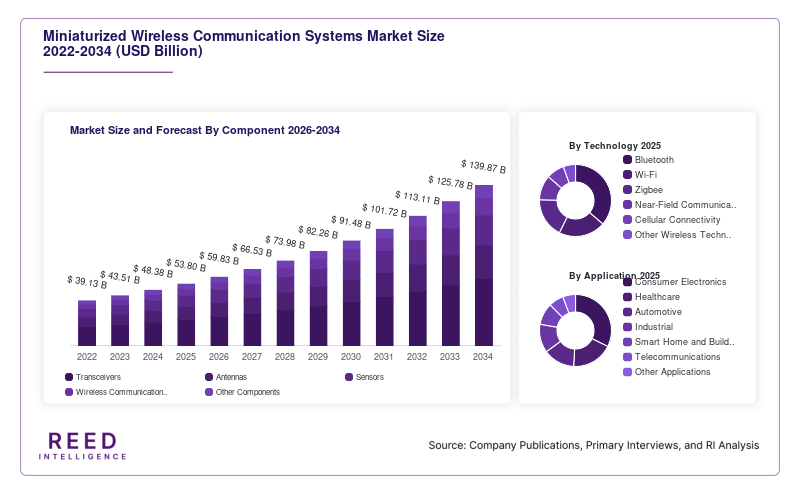
Transceivers are a core component of miniaturized wireless systems because they enable the transmission and reception of radio-frequency signals. Integrated transceivers can combine several functions into a single chip, reducing component count and supporting smaller device designs. Their use spans smartphones, wearables, IoT modules, connected medical devices, and industrial sensors.
Antennas are equally important because they determine how efficiently devices transmit and receive wireless signals. Miniaturized antenna designs must balance physical size, operating frequency, bandwidth, efficiency, and interference. Sensors with wireless connectivity enable data collection and transmission in healthcare, industrial monitoring, smart buildings, and connected consumer products.
Dominant segment: Transceivers. A published market estimate assigns transceivers approximately 38.5% of market share in 2025. This is a third-party estimate and should be interpreted within the source's definition of the market.
Fastest-growing segment: Antennas and integrated wireless modules may benefit from the increasing number of connected devices and demand for multi-standard connectivity. A reliable, comparable CAGR ranking across all component categories is unavailable.
By Technology
Bluetooth is widely used for short-range connections in wireless earbuds, wearables, peripherals, smart accessories, and selected healthcare devices. Its low-energy capabilities make it suitable for battery-powered applications. Wi-Fi supports higher-throughput applications such as home networking, video transmission, connected appliances, and industrial data communication.
Zigbee is used in selected low-power mesh networks, including smart lighting and building automation. NFC supports short-range communication for contactless interactions, identification, pairing, and selected tracking applications. Cellular and other wireless technologies serve applications that require wider-area connectivity, specialized network coverage, or specific reliability and range characteristics.
Dominant segment: Bluetooth. One published estimate places Bluetooth at approximately 42.3% of technology-segment revenue in 2025.
Fastest-growing segment: Wi-Fi, cellular IoT, and newer integrated wireless standards offer opportunities as devices require higher throughput, wider coverage, and improved reliability. A comparable verified CAGR ranking across all technologies is unavailable.
By Application
Consumer electronics is a major application area because smartphones, laptops, tablets, wearables, and wireless accessories rely on compact connectivity components. Multiple wireless technologies may be integrated into a single device to support communication, data synchronization, location services, and wireless audio.
Healthcare applications include connected monitoring devices, wearable sensors, medical equipment, and remote patient monitoring systems. Automotive applications include connected vehicle systems, diagnostics, tracking, and selected communication features. Industrial applications encompass sensor networks, asset monitoring, factory automation, and predictive maintenance.
Dominant segment: Consumer electronics. A published market estimate attributes approximately 42.1% of application-segment revenue in 2025 to this category.
Fastest-growing segment: Healthcare is a potential high-growth application due to increasing demand for connected monitoring and wearable medical devices. One published estimate reports a healthcare application CAGR of 13.4% for 2025–2034. Because the period differs from the report's forecast period, it should not be directly treated as the 2026–2034 CAGR.
By End User
Consumer electronics manufacturers use miniaturized wireless systems in smartphones, computers, wearable devices, connected accessories, and smart appliances. Telecommunications companies use compact radio-frequency components and connectivity modules in networking equipment, customer-premises devices, and other communication infrastructure.
Healthcare providers and medical device manufacturers rely on compact wireless systems for patient monitoring, wearable medical equipment, and connected diagnostic devices. Automotive manufacturers and suppliers integrate wireless components into connected vehicle systems, while industrial enterprises use them for sensor networks, asset tracking, and operational monitoring.
Dominant segment: Consumer electronics is a leading end-user category. A published market estimate assigns it approximately 38.9% of end-user market share in 2025.
Miniaturized Wireless Communication Systems Market Regional Analysis
North America Miniaturized Wireless Communication Systems Market
North America is an important market for miniaturized wireless communication systems, supported by consumer electronics demand, semiconductor innovation, connected healthcare, automotive technology, and industrial IoT adoption. Technology companies and wireless component suppliers in the region contribute to the development and integration of compact radio-frequency systems. Demand is also influenced by connected-device adoption, industrial modernization, and the use of wireless monitoring equipment.
Opportunities include connected medical devices, automotive communications, industrial sensors, smart home products, and advanced wireless networking. The region's performance depends on electronics demand, component sourcing, product innovation, and investment in connected infrastructure. A verified regional share for this specific market definition should be sourced from a consistent market dataset before publication; estimates from different market reports may not be comparable.
Europe Miniaturized Wireless Communication Systems Market
Europe's market is supported by automotive electronics, industrial automation, connected healthcare, smart building systems, and consumer electronics. Automotive suppliers and industrial equipment manufacturers use compact wireless systems for vehicle connectivity, equipment monitoring, and communication between devices. Demand for reliable wireless components is also influenced by industrial digitalization and the development of connected infrastructure.
Regional opportunities include industrial IoT, smart buildings, connected mobility, and healthcare monitoring. Market growth depends on manufacturing activity, technology investment, wireless infrastructure, and the adoption of connected products. A comparable, independently verified global market-share percentage for Europe is unavailable.
Asia Pacific Miniaturized Wireless Communication Systems Market
Asia Pacific is a major manufacturing and consumption region for miniaturized wireless communication systems. Its electronics ecosystem includes smartphone, wearable, computer, networking, and component manufacturing, creating demand for compact transceivers, antennas, sensors, and integrated wireless modules. China, Japan, South Korea, Taiwan, and other regional economies contribute to electronics production and component supply chains.
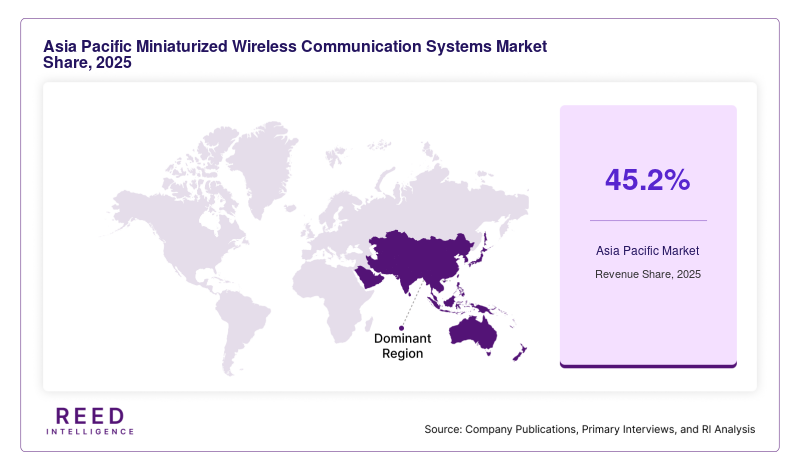
One published market estimate identifies Asia Pacific as the leading region, accounting for approximately 45.2% of global market value in 2025. Applying this percentage to the supplied 2025 global market size of USD 53.80 billion gives an indicative regional value of approximately USD 24.32 billion. This is a mathematically derived estimate, not an independently reported regional valuation, and assumes that the source's market definition is compatible with the supplied global figure.
Regional opportunities include connected consumer electronics, industrial IoT, smart devices, healthcare technology, and compact wireless modules. A comparable, verified regional CAGR for the 2026–2034 period is unavailable.
Latin America Miniaturized Wireless Communication Systems Market
Latin America's market is influenced by consumer electronics adoption, telecommunications infrastructure, connected industrial equipment, automotive systems, and smart building applications. Demand for compact wireless modules may increase as connected devices become more common in homes, businesses, and industrial operations.
Market development depends on economic conditions, electronics imports, network investment, local manufacturing, and the affordability of connected devices. Industrial monitoring and smart infrastructure offer potential opportunities, but a verified global market-share percentage and comparable regional CAGR for this market definition are unavailable.
Middle East & Africa Miniaturized Wireless Communication Systems Market
The Middle East & Africa market is influenced by telecommunications development, smart city projects, connected infrastructure, industrial modernization, and consumer electronics demand. Miniaturized wireless communication systems can support connected building controls, tracking devices, smart utilities, and remote monitoring applications.
Miniaturized Wireless Communication Systems Market Competitive Landscape
The Miniaturized Wireless Communication Systems Market includes semiconductor companies, radio-frequency component manufacturers, wireless connectivity specialists, and suppliers of integrated communication modules. Competition is shaped by power efficiency, component size, signal performance, protocol support, manufacturing scale, reliability, and integration capabilities.
Qualcomm Incorporated: Qualcomm develops cellular modem-RF platforms, wireless connectivity systems, and integrated chipsets for mobile devices and connected products. Its technologies address high-speed connectivity, power efficiency, and integration of multiple wireless functions. In March 2026, Qualcomm announced its X105 5G Modem-RF platform, which incorporates a 6 nm RF transceiver and supports advanced cellular and satellite-related connectivity capabilities.
Key Market Players
- Qualcomm Incorporated
- Broadcom Inc.
- Texas Instruments Incorporated
- NXP Semiconductors N.V.
- STMicroelectronics
- Infineon Technologies AG
- MediaTek Inc.
- Murata Manufacturing Co., Ltd.
- Skyworks Solutions, Inc.
- Qorvo, Inc.
Miniaturized Wireless Communication Systems Market Recent Developments
- March 2, 2026 Qualcomm announced the X105 5G Modem-RF platform, designed for 5G-Advanced connectivity and future 6G development. The platform includes a 6 nm RF transceiver, quad-band GNSS support, and integrated non-terrestrial network capabilities. Qualcomm also reported a smaller board footprint and lower power consumption compared with the previous generation. The announcement illustrates continuing integration and miniaturization of advanced wireless communication components.
- January 5, 2026 MediaTek introduced its Filogic 8000 family to support the emerging Wi-Fi 8 ecosystem. The company positioned the technology for gateways, enterprise access points, smartphones, laptops, televisions, streaming devices, tablets, and IoT products. The announcement emphasizes efforts to improve reliability and responsiveness in increasingly congested wireless environments.
Miniaturized Wireless Communication Systems Market Segments
By Component
- Transceivers
- Antennas
- Sensors
- Wireless Communication Modules
- Other Components
By Technology
- Bluetooth
- Wi-Fi
- Zigbee
- Near-Field Communication (NFC)
- Cellular Connectivity
- Other Wireless Technologies
By Application
- Consumer Electronics
- Healthcare
- Automotive
- Industrial
- Smart Home and Building Automation
- Telecommunications
- Other Applications
By End User
- Consumer Electronics Manufacturers
- Telecommunications Companies
- Healthcare Providers and Medical Device Manufacturers
- Automotive Manufacturers and Suppliers
- Industrial Enterprises
- Other End Users
By Region
- North America
- Europe
- APAC
- Middle East and Africa
- LATAM