Minicard Market Size, Share & Trends Analysis Report By Product Type (Standard MiniCards, High-Speed MiniCards, Ultra-Compact MiniCards, Others), By Application (Consumer Electronics, Industrial Devices, Automotive Systems, Others) and By Region (North America, Europe, Asia Pacific, Latin America, Middle East & Africa) Forecasts, 2026–2034
USD 3950
Minicard Market Size
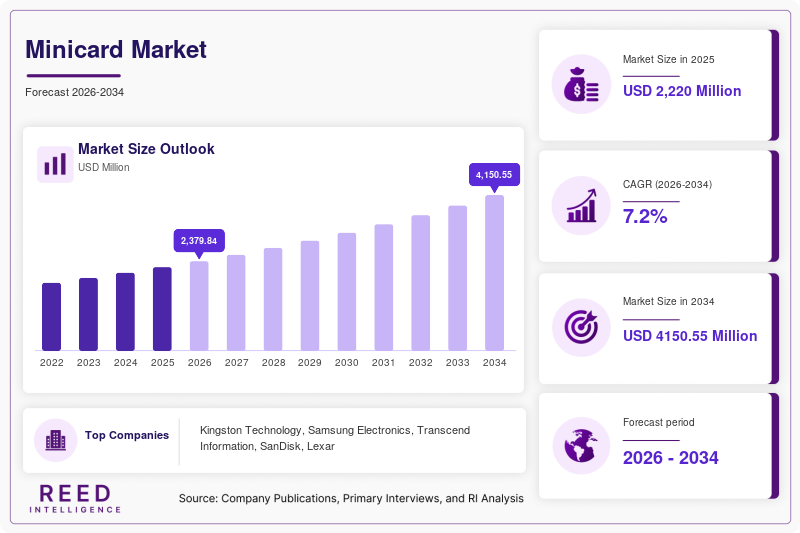
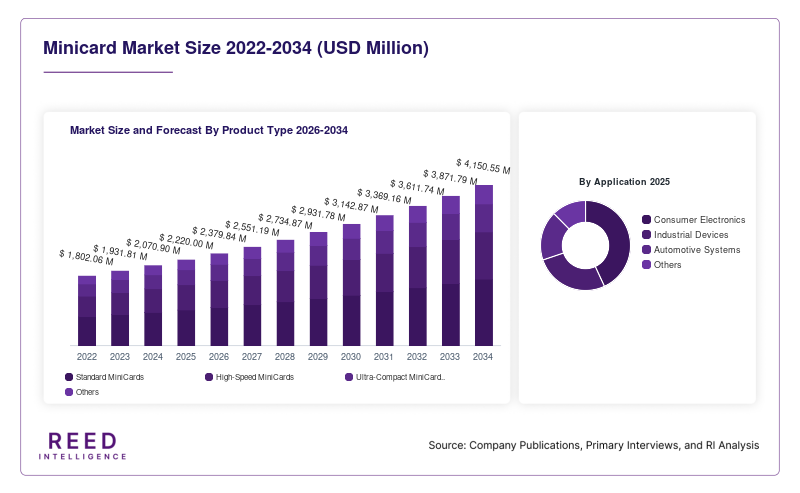
The global Minicard Market was valued at USD 2,220 million in 2025 and is projected to grow from USD 2,379.84 million in 2026 to USD 4,150.55 million by 2034, registering a CAGR of 7.2% during the forecast period (2026–2034).
The Minicard Market, as defined in the referenced market estimates, covers compact memory and storage card solutions used in electronic devices, embedded computing platforms, industrial equipment, and selected automotive systems. These products provide removable or specialized storage in applications where physical dimensions, data transfer performance, reliability, and compatibility are important.
Demand is influenced by the increasing use of digital devices, portable data storage, industrial automation, connected vehicles, surveillance systems, and embedded computing. Consumer electronics manufacturers use compact memory cards for storing photographs, videos, applications, and other digital content. Industrial and automotive applications require storage products that can operate reliably under demanding environmental conditions and support equipment configuration, data logging, and software-related functions.
Minicard Market Drivers
Growing Demand for Consumer Electronics and Portable Storage
Smartphones, tablets, digital cameras, handheld gaming devices, and other electronics generate increasing volumes of digital content. Compact memory cards can provide additional storage and support the transfer of data between compatible devices. Demand is influenced by photography, video recording, gaming, portable media, and the need to store files locally.
Expansion of Industrial IoT and Embedded Computing
Industrial automation, connected sensors, embedded computers, and edge-processing systems require storage for configuration files, software, operational logs, and locally collected data. Industrial-grade memory products can be designed to meet specific requirements for endurance, temperature tolerance, and long-term availability. These applications create opportunities beyond conventional consumer electronics.
Increasing Data Requirements in Automotive and Surveillance Applications
Connected vehicle systems, navigation equipment, dashboard cameras, and surveillance devices require reliable storage for recordings, diagnostics, and other operational data. Some applications need continuous writing and extended operating life, increasing demand for memory cards designed for endurance and consistent performance.
Minicard Market Restraints
Competition from Embedded Storage and Solid-State Drives
Many devices increasingly use embedded flash storage or compact solid-state drives rather than removable memory cards. Integrated storage can improve physical security, simplify device design, and support high data-transfer performance. This limits demand for removable cards in devices that do not require user-accessible storage expansion.
Price Competition and Product Commoditization
Standard memory cards face competition from numerous suppliers, and buyers may compare products primarily on capacity, speed, durability, and price. This can pressure margins, particularly in high-volume consumer markets. Manufacturers must balance competitive pricing with product quality, warranty support, and reliable supply.
Compatibility and Reliability Requirements
Memory cards must be compatible with the device's form factor, storage interface, supported capacity, and performance requirements. Industrial, automotive, and surveillance applications may require additional endurance and environmental testing. Incorrect product selection or inconsistent performance can lead to data loss, device malfunction, or increased replacement costs.
Minicard Market Opportunities
Development of High-Performance and High-Capacity Cards
Increasing demand for high-resolution photography, video recording, gaming, and portable computing creates opportunities for memory cards with greater capacities and faster interfaces. Products that combine high performance with thermal management and reliability may appeal to professional users and advanced consumer applications.
Growth in Industrial-Grade Storage
Industrial automation, smart infrastructure, connected transport, and edge computing create demand for storage products designed for long operating lifecycles. Manufacturers can differentiate through controlled product specifications, extended availability, endurance, and support for industrial operating conditions.
Expansion of Automotive and Surveillance Storage
Vehicle cameras, connected systems, security cameras, and continuous-recording devices create demand for memory cards with improved write endurance and environmental durability. Products tailored to these applications can address requirements that differ from ordinary consumer storage, including sustained recording and operation under variable temperatures.
Minicard Market Segmental Analysis
By Product Type
Standard MiniCards serve applications where compatibility, affordability, and adequate storage performance are primary considerations. They can be used in consumer devices and other equipment that supports removable memory. Demand depends on the installed base of compatible devices, storage capacity requirements, and the availability of alternatives such as embedded flash memory.
High-Speed MiniCards are intended for applications requiring faster data transfer and sustained performance, including photography, video recording, gaming, and selected embedded systems. Ultra-Compact MiniCards target applications with strict physical-size constraints. Their suitability depends on device compatibility, performance, capacity, and the requirements of the host system.
Dominant segment: Standard MiniCards. One third-party market estimate reports approximately 42.8% of product-type revenue in 2025 for this category. This figure is source-reported and depends on the source's specific product definitions.
Fastest-growing segment: Ultra-Compact MiniCards may benefit from demand for smaller connected devices and embedded systems. However, a comparable and independently verified CAGR ranking across the product categories is unavailable.
By Application
Consumer electronics is a major application area for compact memory cards used in compatible cameras, handheld gaming devices, tablets, and other electronics. Demand is influenced by digital content creation, local storage needs, device compatibility, and consumer preferences for removable storage.
Industrial devices use storage products for embedded computing, equipment configuration, sensor data, operational records, and system software. Automotive applications include compatible vehicle cameras, infotainment systems, navigation equipment, and other electronic systems that require local data storage. Other applications may include surveillance, specialized computing, and selected medical or research devices.
Dominant segment: Consumer electronics. A third-party market estimate reports approximately 42.5% of application revenue in 2025 for this category. The share should be treated as an estimate based on that source's market definition.
Fastest-growing segment: Automotive systems are a potential growth area because of the increasing use of vehicle cameras, connected electronics, and data-intensive in-vehicle applications. A reliable comparative CAGR for the application categories under a consistent minicard definition is unavailable.
By Region
Regional demand reflects differences in electronics manufacturing, consumer device adoption, automotive production, industrial automation, and the availability of storage components. Asia Pacific benefits from its extensive electronics manufacturing ecosystem, while North America and Europe have demand from consumer electronics, automotive, enterprise, and industrial applications.
Regional performance is also influenced by supply-chain relationships, local manufacturing capabilities, import dependence, and the adoption of alternative storage technologies.
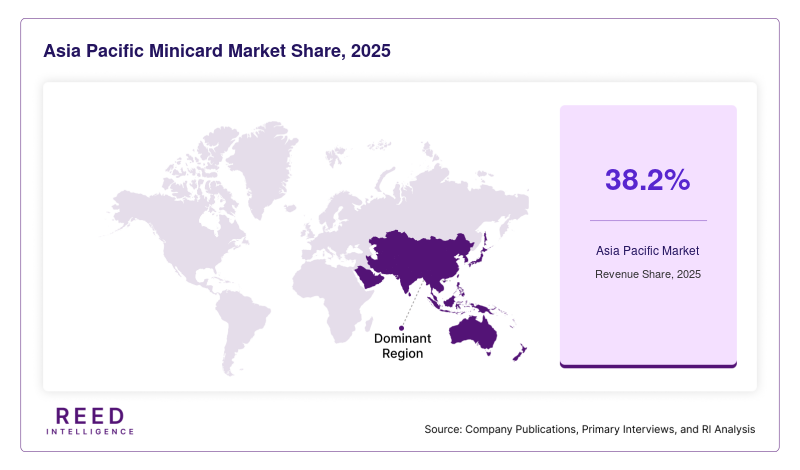
Dominant region: Asia Pacific. One third-party market estimate places the region at approximately 38.2% of global revenue in 2025. This figure is reported by the cited source and has not been independently audited.
Minicard Market Regional Analysis
North America Minicard Market
North America represents an important market for compact storage products used in consumer electronics, industrial computing, automotive electronics, surveillance, and enterprise equipment. Demand is influenced by digital content creation, gaming, vehicle electronics, industrial automation, and the need for dependable storage in specialized systems. Businesses may also procure storage products for embedded platforms and equipment requiring predictable product availability.
Market opportunities include industrial-grade storage, automotive electronics, and memory cards designed for continuous recording. Competition from embedded storage and solid-state drives remains a consideration, particularly in new device designs. One third-party estimate places North America at approximately 28.6% of global minicard market revenue in 2025. This is a source-reported estimate rather than an independently verified share for a standardized product category.
Europe Minicard Market
Europe's demand for compact storage products is supported by consumer electronics, automotive manufacturing, industrial automation, professional imaging, and surveillance applications. Automotive and industrial customers may require products with consistent specifications, reliable operation, and long product lifecycles. The region's demand also reflects the use of embedded systems in manufacturing, transportation, and connected infrastructure.
Opportunities include storage solutions for industrial equipment, vehicle cameras, and specialized recording devices. Market performance depends on manufacturing activity, product compatibility, replacement demand, and the relative adoption of removable versus integrated storage. A third-party market estimate reports approximately 18.9% of global minicard revenue for Europe in 2025; the figure should be treated cautiously because the product category is not universally standardized.
Asia Pacific Minicard Market
Asia Pacific is a major region for compact storage products due to its electronics manufacturing base, component supply chains, consumer device production, and demand from industrial and automotive applications. China, South Korea, Japan, Taiwan, and other regional economies participate in electronics manufacturing and storage-related supply chains. Expanding production of connected devices and digital equipment supports demand for compact storage components.
The region also offers opportunities in industrial automation, connected vehicles, surveillance systems, and portable electronics. Competition among manufacturers, price sensitivity, and the adoption of integrated storage solutions influence market performance. One third-party estimate places Asia Pacific at approximately 38.2% of global minicard market revenue in 2025. Applying this percentage to the supplied 2025 global market size of USD 2,220 million gives an indicative value of approximately USD 848 million. This value is mathematically derived, not an independently reported regional valuation, and assumes the source's market definition matches the supplied market-size data.
Latin America Minicard Market
Latin America's market is influenced by consumer electronics adoption, digital imaging, vehicle electronics, surveillance, and the use of storage in industrial and commercial equipment. Demand for removable memory products depends on the installed base of compatible devices, product affordability, distribution networks, and the availability of appropriate capacities and performance classes.
Potential opportunities include memory cards for cameras, security equipment, compatible automotive systems, and embedded devices. The region's dependence on imported components and exposure to currency movements can affect pricing and availability. A comparable, verified global market-share percentage and regional CAGR for Latin America are unavailable.
Middle East & Africa Minicard Market
The Middle East & Africa market is influenced by consumer electronics, surveillance systems, telecommunications equipment, industrial projects, and the use of storage in commercial and automotive devices. Compact memory cards may be used in cameras, recording systems, and other compatible electronics where removable storage is required.
Demand varies according to national economic conditions, electronics distribution, infrastructure investment, and the adoption of connected devices. Opportunities may emerge from surveillance, industrial automation, and expanding digital services, although affordability and supply availability remain important factors. A comparable, verified global market-share percentage and regional CAGR for this market are unavailable.
Minicard Market Competitive Landscape
The Minicard Market, interpreted as compact memory-card and storage products, includes memory manufacturers, storage brands, controller suppliers, and companies producing industrial or specialized storage solutions. Competition is based on capacity, speed, endurance, durability, product compatibility, warranty, pricing, and distribution.
Kingston Technology: Kingston supplies memory and storage products for consumer, enterprise, and industrial applications. Its broader storage portfolio includes removable memory products and industrial storage solutions. In June 2026, the company highlighted design-in memory, industrial SSDs, and embedded solutions for industrial PCs, edge systems, and mission-critical applications, emphasizing reliability and lifecycle support.
Key Market Players
- Kingston Technology
- Samsung Electronics
- Transcend Information
- SanDisk
- Lexar
- ADATA Technology
- Kioxia Corporation
- Micron Technology
- PNY Technologies
- Apacer Technology
Minicard Market Recent Developments
- June , 2026- Transcend announced a new generation of industrial SSD and memory-card solutions using 218-layer 3D NAND flash technology. The company positioned the portfolio for AIoT edge computing, smart manufacturing, industrial automation, and intelligent surveillance. The announcement highlights the role of higher-density flash memory in applications that need reliable storage and increased capacity.
- June, 2026- Kingston outlined its design-in memory, industrial SSD, and embedded storage portfolio for industrial PCs, edge systems, automation, smart logistics, and other mission-critical applications. The announcement emphasized controlled bills of materials, lifecycle management, and long-term product reliability. It is relevant to the broader compact-storage ecosystem, although it is not a dedicated minicard launch.
Minicard Market Segments
By Product Type
- Standard MiniCards
- High-Speed MiniCards
- Ultra-Compact MiniCards
- Others
By Application
- Consumer Electronics
- Industrial Devices
- Automotive Systems
- Others
By Region
- North America
- Europe
- APAC
- Middle East and Africa
- LATAM