Minimalist Watches Market Size, Share & Trends Analysis Report By Product Type (Analog Watches, Digital Watches, and Hybrid Watches), By Gender (Men, Women, and Unisex), By Distribution Channel (Online Retail and Offline Retail), By Material (Stainless Steel, Leather, Silicone, and Others) and By Region (North America, Europe, Asia Pacific, Latin America, Middle East & Africa) Forecasts, 2026–2034
USD 3950
Minimalist Watches Market Size
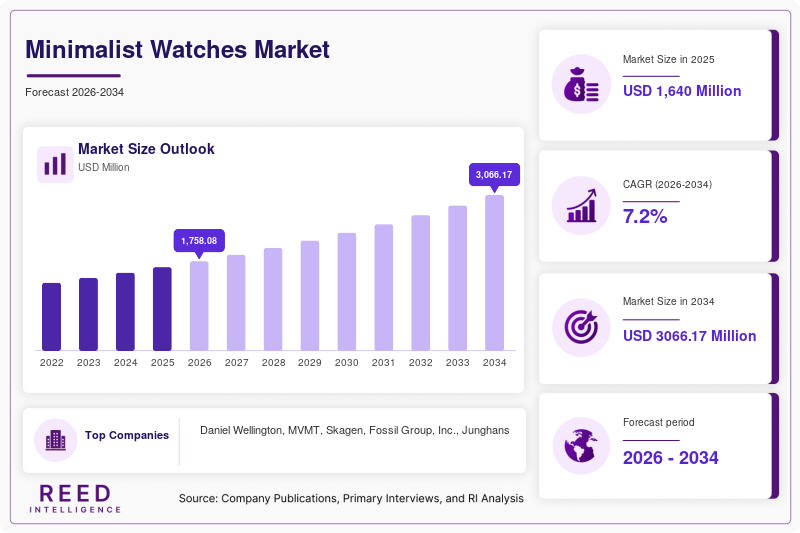
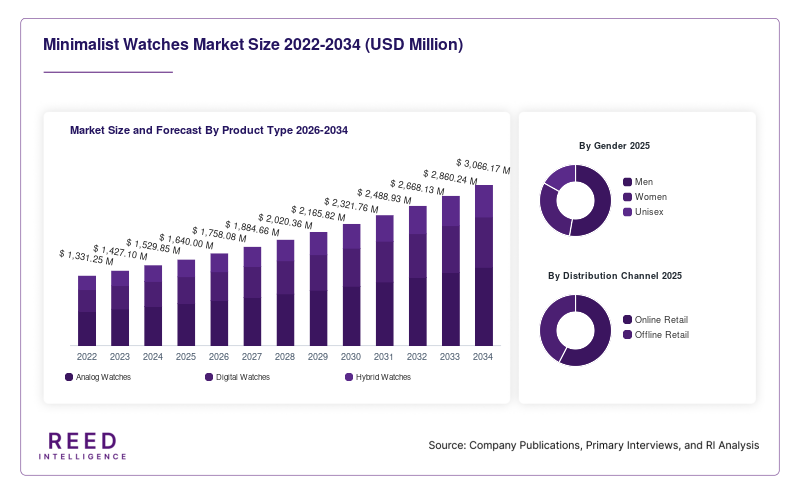
The global minimalist watches market was valued at USD 1,640 million in 2025 and is projected to grow from USD 1,758 million in 2026 to USD 3,066.17 million by 2034, registering a compound annual growth rate (CAGR) of 7.2% during the forecast period (2026–2034).
Minimalist watches are timepieces characterized by simple dial layouts, restrained decoration, clean lines, slim cases, and an emphasis on essential functionality. They may feature analog, digital, or hybrid displays and are available across a range of price points, materials, movements, and styles. Their appeal lies in their versatility, understated appearance, and suitability for everyday use.
The market includes fashion-focused brands, traditional watchmakers, and digital-native companies offering minimalist designs through online and offline channels. Product offerings range from affordable quartz watches to premium mechanical timepieces. Common design elements include uncluttered dials, neutral colors, understated indices, slim cases, leather straps, and stainless-steel bracelets.
Minimalist Watches Market Drivers
Growing preference for understated fashion: Consumers increasingly seek accessories with clean designs, neutral colors, and versatile styling. Minimalist watches can complement different outfits and occasions, supporting demand among professionals, students, and fashion-conscious consumers.
Expansion of e-commerce and direct-to-consumer brands: Online channels allow watch brands to reach customers across international markets without relying exclusively on physical retail. Digital advertising, product customization, social media, and online reviews help brands communicate their design identity and attract consumers.
Demand for versatile everyday accessories: Consumers often prefer watches that transition between professional, casual, and social settings. Minimalist designs offer broad styling compatibility, encouraging their adoption as everyday accessories and gifting products.
Interest in durability and timeless design: Some consumers prefer products designed to remain visually relevant beyond seasonal fashion cycles. Watches with durable cases, replaceable straps, reliable movements, and understated aesthetics can appeal to buyers seeking longer-term use.
Minimalist Watches Market Restraints
Intense competition among watch brands: The market includes established manufacturers, fashion labels, independent designers, and direct-to-consumer companies. Similar design characteristics can make product differentiation difficult and intensify competition on price, brand awareness, and marketing expenditure.
Availability of substitute products: Smartwatches and fitness-oriented wearables offer notifications, health monitoring, and connectivity. These devices may attract consumers who prioritize multifunctionality over traditional timekeeping and minimalist styling.
Counterfeit products and brand imitation: Popular minimalist designs can be copied by unauthorized sellers. Counterfeit products may undermine consumer trust, create pricing pressure, and affect the perceived value of authentic brands.
Discretionary spending sensitivity: Watches are often purchased as fashion accessories rather than essential goods. Economic uncertainty, inflation, or reduced discretionary income may lead consumers to postpone purchases or shift toward lower-priced products.
Minimalist Watches Market Opportunities
Growth in emerging consumer markets: Rising disposable incomes and expanding retail infrastructure create opportunities for minimalist watch brands to reach new customers. Localized pricing, regional distribution partnerships, and accessible product ranges can support market expansion.
Sustainable materials and responsible production: Brands can differentiate products through recycled metals, responsibly sourced materials, durable construction, and transparent manufacturing practices. These initiatives may appeal to consumers who prioritize product longevity and responsible consumption.
Personalization and product customization: Interchangeable straps, different case finishes, dial colors, and engraving services provide opportunities to enhance customer engagement. Customization can also help brands distinguish their offerings in a crowded market.
Premium minimalist positioning: Consumers interested in understated luxury may be attracted to refined finishing, mechanical movements, slim cases, and high-quality materials. Premium products can create opportunities for established watchmakers and independent design-focused brands.
Minimalist Watches Market Segmental Analysis
By Product Type
Analog watches represent a central category in the minimalist watches market because traditional hour and minute hands, simple indices, and uncluttered dials naturally support understated styling. These products are available with quartz and mechanical movements, offering options across budget, mid-range, and premium price points. Stainless-steel cases, slim profiles, and interchangeable leather or metal straps further support their versatility.
One market-specific industry estimate identifies analog watches as the dominant product category, with a 52.3% share in 2025. This figure is an external market estimate and has not been independently validated against a transparent dataset.
Digital watches offer clear time displays and may appeal to consumers who prefer practical functionality. Hybrid watches combine traditional watch aesthetics with selected connected features. These categories provide alternatives for consumers who want modern functionality while retaining a simple visual design. Digital and hybrid watches may offer growth opportunities as manufacturers integrate additional features without compromising usability. However, the fastest-growing product type and its CAGR have not been independently verified for this specific market.
By Gender
Men’s watches represent an important part of the market, supported by demand for versatile workwear accessories, understated casual styles, and slim everyday timepieces. Common design preferences include neutral dials, stainless-steel cases, leather straps, and moderate case sizes.
Women’s minimalist watches are offered in a range of case dimensions, strap materials, dial colors, and finishes. Unisex watches also appeal to consumers who prioritize design, comfort, and personal styling over traditional gender-based positioning. Brands can address this demand through adaptable sizing, interchangeable straps, and broader color selections.
The dominant gender category and its exact market share have not been independently verified. Demand varies according to price range, geography, brand positioning, and product design, so a definitive ranking requires a consistent market-specific dataset.
By Distribution Channel
Online retail is an important sales channel because consumers can compare designs, prices, specifications, and customer reviews across multiple brands. Brand-owned websites and online marketplaces also allow direct-to-consumer companies to reach customers beyond their physical retail footprint.
One market-specific estimate reports that online retail accounted for 58.4% of minimalist watch sales in 2025. This figure is indicative rather than independently verified.
Offline retail remains relevant because customers can examine watch dimensions, assess comfort, compare finishes, and receive assistance before purchasing. Specialty watch stores, department stores, and brand boutiques can be particularly important for premium products. The fastest-growing distribution channel and its CAGR have not been independently confirmed.
By Material
Stainless steel is widely used in minimalist watches because it combines durability, corrosion resistance, and a versatile appearance. Brushed and polished finishes can create different visual effects while maintaining a clean design. Leather straps offer a classic appearance, while silicone and other materials support lightweight, casual, or sport-oriented designs.
One market-specific estimate identifies stainless steel as the leading material category, with a reported 41.7% share in 2025. This is an external estimate and should not be treated as independently audited market data.
Minimalist Watches Market Regional Analysis
North America Minimalist Watches Market
North America is an established consumer market for watches and fashion accessories, supported by e-commerce, specialty retailers, department stores, and direct-to-consumer brands. The United States represents a major market for accessible fashion watches as well as premium products emphasizing craftsmanship, materials, and understated styling. Canada also contributes through online retail and specialty watch distribution.
Market opportunities include personalized products, premium minimalist designs, and direct-to-consumer offerings. Competition from smartwatches and changing discretionary spending may affect demand. A reliable market-specific percentage share for North America and its regional CAGR have not been independently verified in the available evidence.
Europe Minimalist Watches Market
Europe has a strong connection with minimalist design through Scandinavian aesthetics, Bauhaus influences, and established watchmaking traditions. Germany, Switzerland, Denmark, and other European markets include consumers and brands that value clean design, precision, craftsmanship, and durable materials. Both traditional retailers and online channels serve the region.
Opportunities include premium minimalist watches, sustainable materials, and products that combine restrained aesthetics with high-quality movements. However, the exact share of the global minimalist watches market and the fastest-growing European country have not been independently verified against a comparable dataset.
Asia Pacific Minimalist Watches Market
Asia Pacific is a major market for minimalist watches, supported by its large consumer base, growing urban populations, expanding e-commerce, and demand for fashion accessories. China, Japan, South Korea, and India contribute through domestic consumption, retail development, and demand for international and regional brands. The region also benefits from established manufacturing and component-supply networks.
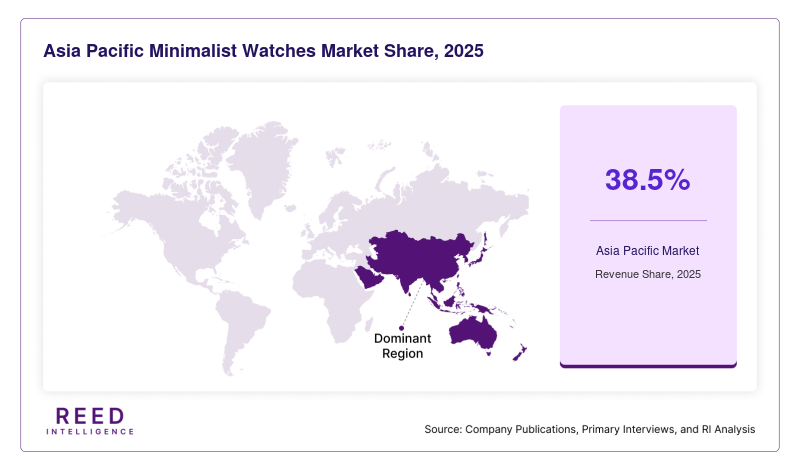
Asia Pacific dominated the global Minimalist Watches Market in 2025, accounting for an estimated 38.5% of global revenue. Applying this share to the supplied 2025 global market value of USD 1,640 million gives an estimated regional market value of USD 631.4 million. The value is calculated from the reported share and the supplied global market figure; it is a derived estimate rather than independently verified regional revenue.
Demand is supported by interest in understated fashion, increasing online shopping adoption, and consumer access to a wide range of price points. Nevertheless, a verified regional CAGR and fastest-growing country have not been independently established for this specific market.
Latin America Minimalist Watches Market
Latin America presents opportunities for minimalist watches through fashion retail, online marketplaces, and demand for versatile everyday accessories. Brazil and Mexico are important consumer markets, while other countries offer potential as online distribution and access to international brands expand.
Growth depends on disposable income, import costs, retail access, and consumer preferences across price categories. The region’s exact market share, dominant product category, and forecast CAGR have not been verified from sufficiently comparable public data.
Middle East & Africa Minimalist Watches Market
The Middle East & Africa market includes demand for fashion accessories, gifting products, and premium watches. Major urban retail centers, specialty watch stores, and e-commerce platforms provide access to both international and regional brands. Consumer preferences vary substantially by country, income level, and product positioning.
Opportunities include understated premium designs, versatile everyday watches, and products suited to gifting. However, the region’s numeric share of the global minimalist watches market, fastest-growing country, and forecast CAGR have not been independently verified.
Minimalist Watches Market Competitive Landscape
The Minimalist Watches Market is competitive and includes digital-native brands, fashion watch companies, and traditional watchmakers. Participants compete through design identity, price positioning, materials, movement quality, product variety, distribution, and digital marketing. Direct-to-consumer business models allow some brands to maintain direct relationships with customers, while established watchmakers benefit from heritage, retail networks, and technical expertise.
Daniel Wellington is associated with understated watch designs, interchangeable straps, and fashion-focused brand positioning. Its direct-to-consumer strategy and international retail presence have helped it reach consumers seeking simple, versatile accessories.
MVMT built its brand around modern styling, accessible price positioning, and digital marketing. Its products combine minimalist design elements with fashion-oriented appeal. Other participants include Skagen, Braun, Junghans, Mondaine, Nordgreen, Uniform Wares, Fossil, and Timex, which serve different customer segments and price ranges.
Key Market Players
- Daniel Wellington
- MVMT
- Skagen
- Fossil Group, Inc.
- Junghans
- Mondaine
- Braun Watches
- Nordgreen
- Uniform Wares
- Larsson & Jennings
Minimalist Watches Market Recent Developments
- March , 2026 Swatch introduced four watches in its SKIN line, a range associated with ultra-thin profiles, lightweight construction, and minimalist styling. The new collection uses tropical-inspired colors while retaining the line’s slim silhouette and simple aesthetic. This development demonstrates how brands can refresh minimalist watch designs through color and styling without abandoning the underlying design philosophy.
- September , 2026 A Vogue India feature described the collection’s emphasis on slim profiles, sculptural bracelet finishes, and restrained styling. The coverage reflects continued fashion interest in subtle watch designs and stacking watches with other accessories. It is fashion coverage rather than an independently documented company market launch.
Minimalist Watches Market Segments
By Product Type
- Analog Watches
- Digital Watches
- Hybrid Watches
By Gender
- Men
- Women
- Unisex
By Distribution Channel
- Online Retail
- Offline Retail
By Material
- Stainless Steel
- Leather
- Silicone
- Other Materials
By Price Range
- Budget
- Mid-Range
- Luxury
By Region
- North America
- Europe
- APAC
- Middle East and Africa
- LATAM