Minimally Invasive Direct Coronary Artery Bypass Market Size, Share & Trends Analysis Report By Procedure Type (Single-Vessel Bypass, Hybrid Coronary Revascularization, Others), By End User (Hospitals, Cardiac Surgery Centers, Specialty Clinics, Others) and By Region (North America, Europe, Asia Pacific, Latin America, Middle East & Africa) Forecasts, 2026–2034
USD 3950
Minimally Invasive Direct Coronary Artery Bypass Market Size
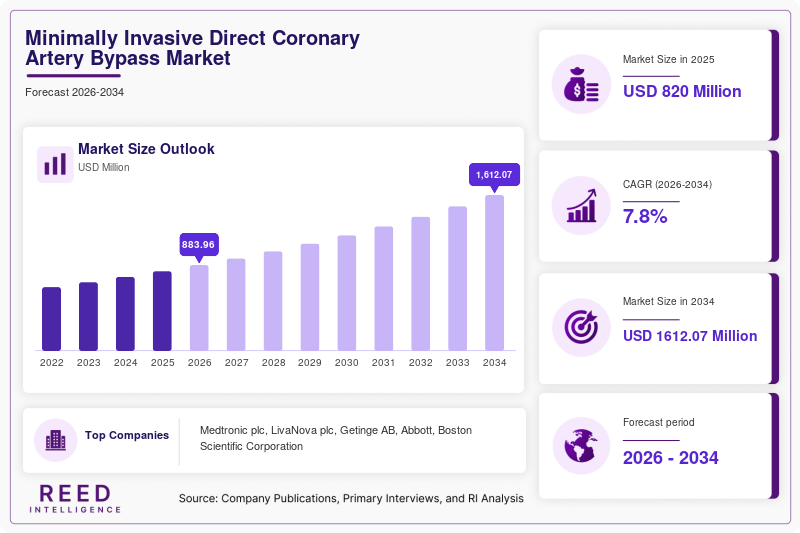
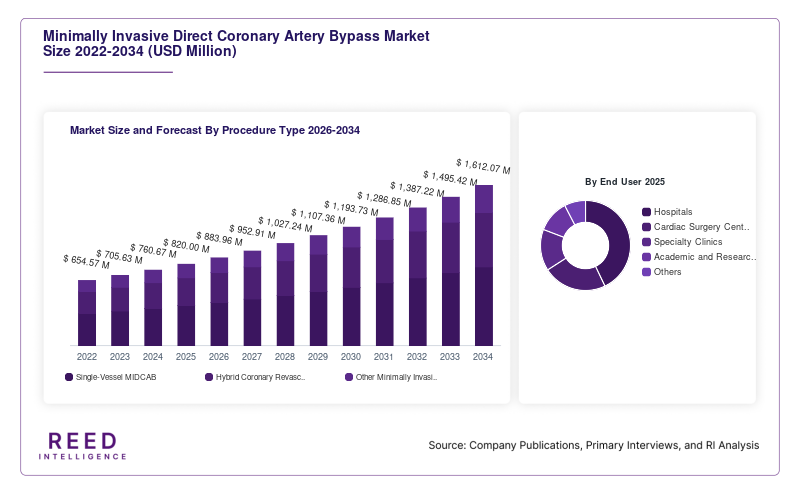
The global minimally invasive direct coronary artery bypass market was valued at USD 820 million in 2025 and is projected to grow from USD 883.96 million in 2026 to USD 1,612.07 million by 2034, registering a compound annual growth rate (CAGR) of 7.8% during the forecast period (2026–2034).
Minimally Invasive Direct Coronary Artery Bypass (MIDCAB) is a cardiac surgical procedure that restores blood flow to the heart by bypassing a blocked coronary artery through a smaller chest incision, generally without dividing the breastbone. The procedure commonly uses the left internal mammary artery to bypass a blockage in the left anterior descending coronary artery. It differs from conventional coronary artery bypass grafting, which typically involves a larger incision through the sternum.
The market is influenced by the prevalence of coronary artery disease, the demand for less invasive cardiac surgery, advances in surgical visualization and stabilization technologies, and the availability of experienced cardiac surgical teams. Hospitals may adopt MIDCAB for appropriately selected patients when the procedure offers clinical advantages. However, patient eligibility, the complexity of coronary disease, surgeon expertise, equipment requirements, and institutional capabilities influence the procedure's adoption.
Minimally Invasive Direct Coronary Artery Bypass Market Drivers
Increasing burden of coronary artery disease: Coronary artery disease remains a major cause of cardiovascular illness and can require surgical revascularization when medication or catheter-based interventions are insufficient. Demand for effective bypass procedures supports the development and use of minimally invasive surgical approaches in suitable patients.
Preference for less invasive surgical techniques: MIDCAB uses a smaller incision than conventional sternotomy-based surgery. For appropriately selected patients, this approach may reduce surgical trauma and support recovery. Growing clinical interest in minimally invasive cardiac surgery encourages hospitals to develop specialized programs and train surgical teams.
Advances in cardiac surgical technology: Improvements in surgical instruments, cardiac stabilization, visualization, graft-harvesting techniques, and perioperative care can help surgeons perform minimally invasive procedures with greater precision. These developments support the expansion of minimally invasive cardiac surgery at centers with appropriate expertise.
Minimally Invasive Direct Coronary Artery Bypass Market Restraints
Technical complexity and specialized training: MIDCAB requires advanced surgical skills and familiarity with operating on a beating heart through a restricted surgical field. Training requirements and the need for experienced surgical teams can limit adoption, particularly at hospitals with lower cardiac surgery volumes.
Patient-selection limitations: Not every patient with coronary artery disease is suitable for MIDCAB. The location and extent of blockages, the number of vessels requiring revascularization, patient health, and the need for additional cardiac procedures affect treatment selection.
High infrastructure and operating costs: Specialized instruments, surgical visualization systems, operating-room capabilities, and staff training can increase the initial costs of establishing a MIDCAB program. Smaller hospitals may face financial and operational barriers to introducing the procedure.
Minimally Invasive Direct Coronary Artery Bypass Market Opportunities
Expansion of minimally invasive cardiac surgery programs: Hospitals and specialized cardiac centers can expand treatment options by investing in surgical training, operating-room equipment, and standardized clinical pathways. These investments may improve access to minimally invasive procedures for eligible patients.
Hybrid coronary revascularization: Combining surgical bypass of selected coronary arteries with percutaneous coronary intervention for other lesions can offer an alternative for certain patients with multivessel disease. Continued clinical research and improved coordination between cardiac surgeons and interventional cardiologists may create opportunities for hybrid approaches.
Robotic and advanced visualization technologies: Improvements in robotic assistance, endoscopic visualization, and surgical instrumentation may support more precise minimally invasive procedures. Their wider use will depend on clinical evidence, affordability, training, and the suitability of the technology for specific patients.
Minimally Invasive Direct Coronary Artery Bypass Market Segmental Analysis
By Procedure Type
Single-vessel MIDCAB is an important procedure category, particularly for patients requiring bypass of a selected coronary artery, commonly the left anterior descending artery. Its use depends on coronary anatomy, the location of the blockage, the patient's clinical condition, and the treating team's experience. It provides a focused minimally invasive surgical option for appropriately selected patients.
Hybrid coronary revascularization combines surgical bypass with percutaneous coronary intervention to treat different coronary lesions. This approach can be considered when a combined treatment strategy is appropriate for the patient's anatomy and clinical needs. However, reliable comparable data establishing the exact dominant procedure share and fastest-growing procedure CAGR for this specific market were not independently verified.
By End User
Hospitals are central to the market because MIDCAB requires cardiac surgery facilities, specialized operating rooms, anesthesia services, intensive-care support, and coordinated postoperative care. Large hospitals with established cardiac surgery programs are better positioned to develop specialized minimally invasive procedures and maintain experienced surgical teams.
Specialized cardiac surgery centers may also contribute to adoption through focused surgical expertise, multidisciplinary patient selection, and experience with advanced cardiac procedures. Their ability to expand MIDCAB services depends on patient volumes, equipment investment, referral networks, and clinical outcomes. A verified fastest-growing end-user segment and comparable CAGR could not be established.
Minimally Invasive Direct Coronary Artery Bypass Market Regional Analysis
North America Minimally Invasive Direct Coronary Artery Bypass Market
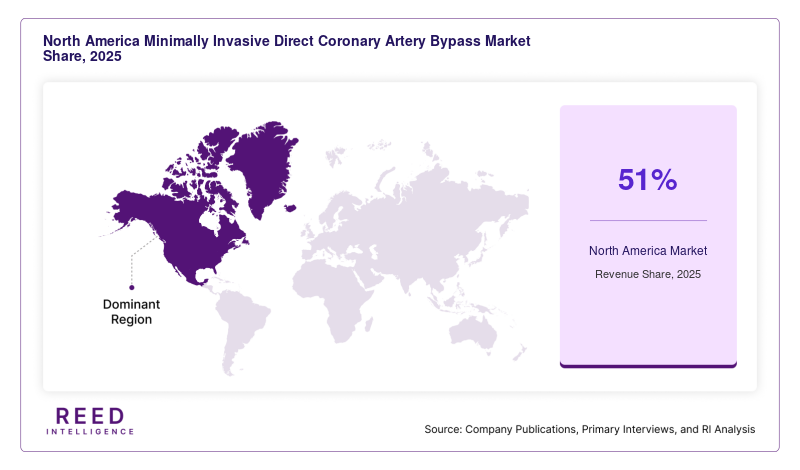
North America is identified as the dominant regional market in the available market-specific report. Its position is supported by established cardiac-care infrastructure, specialized surgical centers, access to advanced medical technologies, and the availability of trained cardiothoracic surgeons. The United States is particularly relevant because of its extensive hospital network and investment in cardiovascular care. The available report identifies North America as the leader but does not provide a sufficiently verifiable percentage for the exact market definition used here.
Europe Minimally Invasive Direct Coronary Artery Bypass Market
Europe has an established cardiac surgery sector, advanced hospital infrastructure, and clinical expertise in conventional and minimally invasive coronary revascularization. Countries such as Germany, France, and the United Kingdom have specialized cardiac centers and established cardiovascular treatment systems. Adoption of MIDCAB depends on clinical suitability, availability of trained surgeons, and the capacity of hospitals to support specialized procedures.
Further opportunities may arise from clinical research, multidisciplinary cardiac care, and continued development of minimally invasive techniques. A comparable, independently verified regional market-share percentage and CAGR for the exact MIDCAB market were not available; therefore, no unsupported regional value or fastest-growth claim is assigned.
Asia Pacific Minimally Invasive Direct Coronary Artery Bypass Market
Asia Pacific presents growth opportunities through expanding cardiovascular treatment capacity, increasing access to cardiac surgery, and investment in hospital infrastructure across China, India, Japan, South Korea, and other markets. The region's large patient population creates a need for effective treatment of coronary artery disease, although access to specialized minimally invasive surgery varies by country and hospital.
Growth will depend on surgeon training, equipment availability, healthcare funding, referral pathways, and the development of specialized cardiac centers.
Latin America Minimally Invasive Direct Coronary Artery Bypass Market
Latin America's market development is influenced by cardiovascular disease burden, the availability of cardiac surgery services, public and private healthcare investment, and access to specialized surgical teams. Major urban hospitals may be better positioned to provide minimally invasive procedures because they have the necessary equipment and multidisciplinary expertise.
Opportunities depend on investment in cardiac-care infrastructure, surgeon training, patient referral systems, and access to postoperative monitoring. A reliable regional market-share percentage and independently verified growth rate specific to MIDCAB were not available for this report.
Middle East & Africa Minimally Invasive Direct Coronary Artery Bypass Market
The Middle East & Africa region may experience demand growth as healthcare systems invest in specialized cardiac centers, advanced surgical infrastructure, and cardiovascular treatment services. The availability of MIDCAB varies substantially across countries and depends on hospital resources, trained personnel, patient access, and the cost of specialized equipment.
Minimally Invasive Direct Coronary Artery Bypass Market Competitive Landscape
The Minimally Invasive Direct Coronary Artery Bypass Market is shaped by cardiac surgical expertise, specialized instruments, visualization and stabilization systems, and the technologies used in coronary revascularization. Unlike a market focused solely on a discrete medical device, MIDCAB is a procedure-based market, so adoption also depends on clinical evidence, surgeon experience, hospital capabilities, and patient selection.
Medtronic plc is a major cardiovascular technology company with products and systems used in cardiac surgery and coronary revascularization. Its broader cardiac surgery portfolio positions it within the ecosystem supporting bypass procedures, although not every product is specific to MIDCAB.
Key Market Players
- Medtronic plc
- LivaNova plc
- Getinge AB
- Abbott
- Boston Scientific Corporation
- Edwards Lifesciences Corporation
- Terumo Corporation
- Intuitive Surgical, Inc.
- KARL STORZ SE & Co. KG
Minimally Invasive Direct Coronary Artery Bypass Market Recent Developments
-
August, 2026 An editorial examined current evidence, surgical training, and future directions in robotic coronary revascularization. It discussed robotic-assisted MIDCAB alongside totally endoscopic and hybrid approaches, emphasizing that these procedures differ in access, complexity, and revascularization strategy. The publication highlights the importance of evidence and training as minimally invasive cardiac surgery develops.
-
June, 2026 A first-in-human case report described a strategy combining the Liwen procedure for hypertrophic obstructive cardiomyopathy with MIDCAB through a single access. The report presented the approach as feasible in a patient with coexisting hypertrophic obstructive cardiomyopathy and coronary artery disease. As a single case report, it does not establish broad clinical effectiveness or routine adoption.
Minimally Invasive Direct Coronary Artery Bypass Market Segments
By Procedure Type
- Single-Vessel MIDCAB
- Hybrid Coronary Revascularization
- Other Minimally Invasive Bypass Procedures
By End User
- Hospitals
- Cardiac Surgery Centers
- Specialty Clinics
- Academic and Research Medical Centers
- Others
By Region
- North America
- Europe
- APAC
- Middle East and Africa
- LATAM