Minimally Invasive Hemodynamic Monitoring System Market Size, Share & Trends Analysis Report By Product Type (Cardiac Output Monitors, Arterial Lines, Pulmonary Artery Catheters, Transesophageal Echocardiography Probes), By Application (Perioperative Monitoring, Intensive Care Unit Monitoring, Emergency Department Monitoring), By End User (Hospitals, Ambulatory Surgical Centers, Specialty Clinics) Forecasts 2026–2034
USD 3950
Minimally Invasive Hemodynamic Monitoring System Market Size
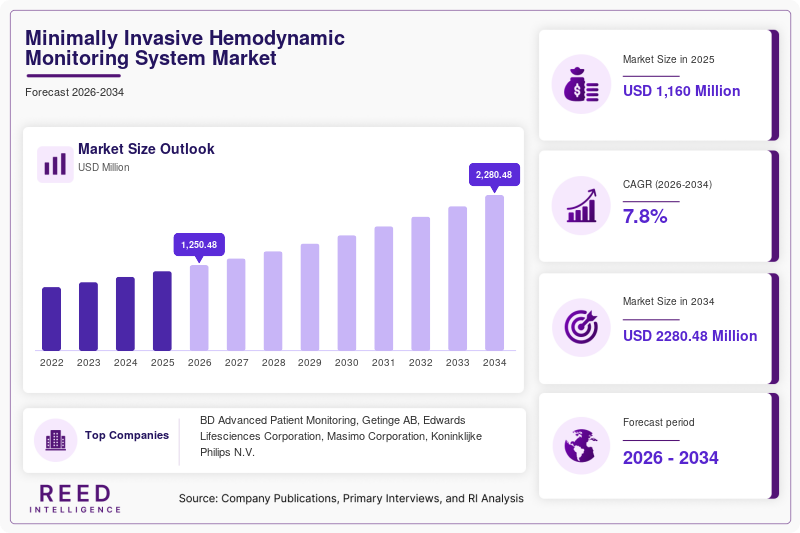
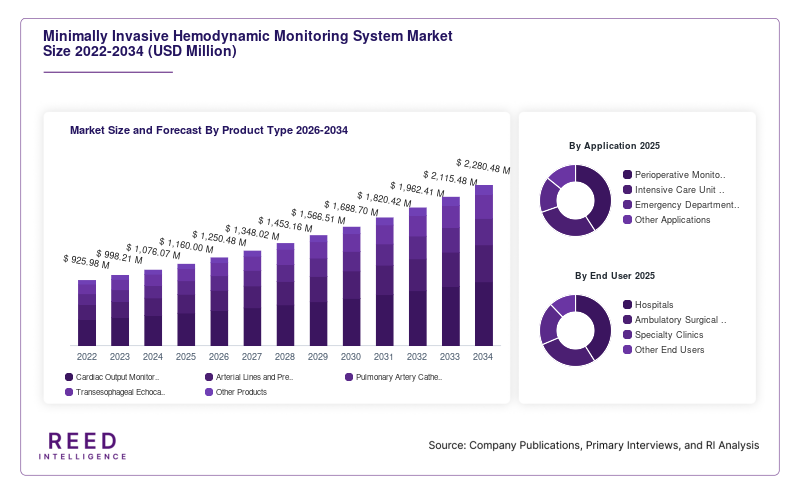
The global Minimally Invasive Hemodynamic Monitoring System Market was valued at USD 1,160 million in 2025 and is projected to grow from USD 1,250.48 million in 2026 to USD 2,280.48 million by 2034, registering a compound annual growth rate (CAGR) of 7.8% during the forecast period from 2026 to 2034.
The Minimally Invasive Hemodynamic Monitoring System Market focuses on medical technologies that help clinicians evaluate cardiovascular performance and circulatory stability while limiting the invasiveness associated with traditional monitoring procedures. These systems measure or estimate parameters such as cardiac output, stroke volume, blood pressure, systemic vascular resistance, and fluid responsiveness. They support clinical decision-making in operating rooms, intensive care units, emergency departments, and other high-acuity healthcare settings.
Market growth is supported by increasing cardiovascular disease prevalence, a growing population requiring complex surgical procedures, and greater emphasis on individualized patient management. Minimally invasive monitoring technologies can provide continuous or near-real-time hemodynamic information using arterial lines, specialized sensors, catheters, and advanced analytical platforms. These capabilities help healthcare professionals assess changes in patient condition and guide fluid management and cardiovascular interventions.
Minimally Invasive Hemodynamic Monitoring System Market Drivers
Growing Burden of Cardiovascular Diseases and Critical Illness
The increasing prevalence of cardiovascular disorders, sepsis, shock, and other conditions associated with circulatory instability is supporting demand for advanced hemodynamic assessment. Continuous or repeated monitoring can help clinicians understand changes in cardiac output and tissue perfusion, particularly among high-risk surgical and critically ill patients. Greater attention to early recognition of hemodynamic deterioration is encouraging healthcare facilities to invest in monitoring technologies that support timely clinical assessment.
Increasing Volume of Complex Surgical Procedures
Complex cardiovascular, abdominal, thoracic, and other major surgical procedures can expose patients to substantial hemodynamic changes. Minimally invasive monitoring systems help clinicians evaluate fluid responsiveness and cardiovascular performance during the perioperative period. The growing focus on goal-directed fluid therapy, individualized anesthesia management, and postoperative complication reduction is supporting the adoption of advanced monitoring systems in operating rooms and recovery settings.
Minimally Invasive Hemodynamic Monitoring System Market Restraints
High Equipment and Consumable Costs
Advanced hemodynamic monitoring platforms may require specialized monitors, sensors, catheters, compatible disposables, software, and maintenance services. These costs can create procurement challenges for smaller hospitals and healthcare facilities operating under constrained budgets. Differences in reimbursement and purchasing power across countries may also slow adoption, particularly where hospitals prioritize essential medical equipment over specialized monitoring technologies.
Need for Clinical Training and Evidence-Based Implementation
Correct use of minimally invasive monitoring systems requires trained clinicians who can interpret hemodynamic measurements in the context of a patient's condition. Variations in clinical protocols, patient characteristics, and measurement techniques can affect how the results are interpreted. Healthcare providers may therefore require training, workflow adjustments, and evidence supporting clinical and economic benefits before adopting new monitoring platforms on a wider scale.
Minimally Invasive Hemodynamic Monitoring System Market Opportunities
Expansion of Advanced Critical Care Infrastructure
Investment in intensive care units, emergency services, and specialist surgical centers creates opportunities for manufacturers to supply advanced hemodynamic monitoring solutions. Emerging healthcare markets may offer additional growth potential as hospitals expand critical care capacity and modernize medical equipment. Partnerships with healthcare providers and distributors can help manufacturers improve product accessibility and provide local training and technical support.
Integration of Connected Monitoring and Clinical Decision Support
Integration with hospital information systems, electronic medical records, and broader patient-monitoring platforms creates opportunities to improve clinical workflows. Decision-support tools that help clinicians interpret trends and recognize potential hemodynamic instability may strengthen the value proposition of advanced monitoring systems. Manufacturers that demonstrate reliable measurements, usability, interoperability, and meaningful clinical utility may be better positioned to differentiate their products.
Minimally Invasive Hemodynamic Monitoring System Market Segmental Analysis
By Product Type
Cardiac output monitors, arterial-line-based sensors, and catheter-based technologies are important product categories in the minimally invasive hemodynamic monitoring market. Their clinical roles differ: some technologies estimate cardiac output from arterial pressure waveforms, while others use specialized catheters or probes to provide additional cardiovascular information. Demand is influenced by the complexity of cases treated, compatibility with existing monitoring equipment, ease of use, and the clinical parameters required.
The dominant product category and the fastest-growing product category cannot be confirmed independently from the available comparable evidence for this specific market definition. Product-level shares and growth rates are therefore not stated as verified figures.
By Application
Perioperative monitoring is an important application because major surgical procedures can cause changes in blood pressure, cardiac output, and fluid balance. Hemodynamic assessment can help anesthesia and surgical teams evaluate patient status and guide individualized fluid-management strategies. Intensive care unit monitoring is also significant for patients experiencing shock, severe illness, or cardiovascular instability, while emergency departments may use monitoring technologies to assess patients requiring rapid clinical evaluation.
A market-specific, independently verifiable comparison of application shares and growth rates is not available from the sources reviewed. Perioperative monitoring is identified as a leading application in a published market estimate, but its reported share should be treated as a third-party estimate rather than an independently confirmed industry statistic.
By End User
Hospitals are central to market demand because they operate intensive care units, operating rooms, emergency departments, and specialist surgical services. Their purchasing decisions are influenced by patient volume, clinical protocols, equipment compatibility, budget availability, and evidence supporting the utility of monitoring systems. Larger hospitals and tertiary-care centers may be particularly well positioned to adopt platforms that provide multiple hemodynamic parameters through integrated monitoring workflows.
Minimally Invasive Hemodynamic Monitoring System Market Regional Analysis
North America Minimally Invasive Hemodynamic Monitoring System Market
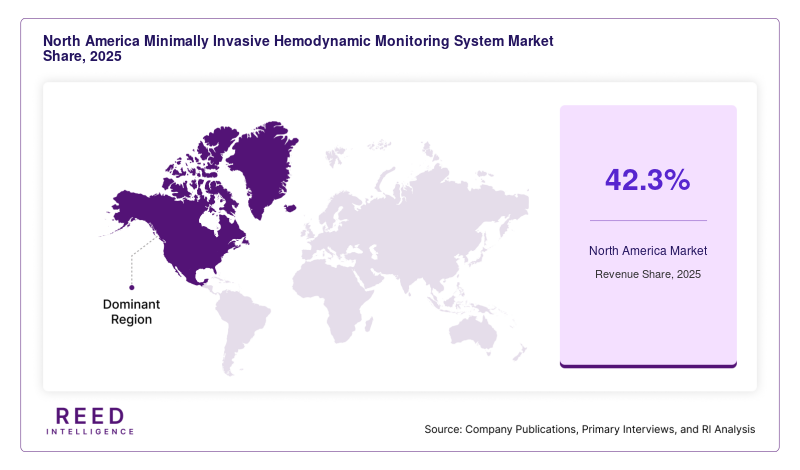
North America is identified as the dominant region in a published market-specific estimate, which reports a 42.3% revenue share. This figure is a third-party estimate and has not been independently validated against audited regional revenue data. The region benefits from established hospital infrastructure, specialist cardiac and surgical services, access to advanced medical technologies, and demand for monitoring solutions in critical care and perioperative settings. The United States is an important market because of its extensive hospital network and adoption of advanced patient-monitoring equipment.
Market expansion is supported by continued investment in critical care technology, growing attention to patient safety, and demand for improved clinical assessment during complex procedures. However, adoption is influenced by hospital capital budgets, reimbursement, procurement policies, and the need to demonstrate clinical and economic value. A comparable independently verified regional CAGR for this exact market definition is unavailable.
Europe Minimally Invasive Hemodynamic Monitoring System Market
Europe represents an established market for minimally invasive hemodynamic monitoring, supported by specialist hospitals, intensive care services, and advanced surgical infrastructure. Adoption is influenced by clinical guidelines, medical-device regulation, hospital modernization, and the need to manage critically ill patients and individuals undergoing complex surgery. Manufacturers compete through monitoring accuracy, integration with existing equipment, clinical evidence, and usability.
Demand varies across countries according to healthcare expenditure, procurement practices, and access to specialist care. Guideline recognition may also influence clinical awareness and implementation. A directly comparable, independently verified European market share and regional CAGR for this specific market definition are unavailable.
Asia Pacific Minimally Invasive Hemodynamic Monitoring System Market
Asia Pacific offers growth opportunities as healthcare infrastructure expands and hospitals invest in intensive care, cardiovascular services, and modern surgical equipment. China, Japan, India, South Korea, and Australia are relevant markets with differing levels of healthcare spending, clinical infrastructure, and medical-device adoption. Increasing demand for advanced hospital care and greater availability of specialist services may support the use of hemodynamic monitoring technologies.
The pace of adoption will depend on affordability, local regulatory requirements, clinician training, distribution networks, and the ability of manufacturers to support hospitals beyond major metropolitan areas.
Latin America Minimally Invasive Hemodynamic Monitoring System Market
Latin America presents opportunities as hospitals and specialist centers invest in modern monitoring equipment and expand critical care capabilities. Demand is associated with the development of surgical services, the management of cardiovascular conditions, and the need for reliable monitoring in high-acuity environments. Brazil and Mexico are important healthcare markets within the region, while adoption in other countries varies with local infrastructure and procurement capacity.
Budget limitations, uneven access to specialist services, currency volatility, and reliance on imported equipment may constrain expansion. Manufacturers can address some barriers through regional distribution partnerships, clinician education, and product portfolios suited to different hospital budgets. A comparable verified regional market share and CAGR for this exact market definition are unavailable.
Middle East & Africa Minimally Invasive Hemodynamic Monitoring System Market
The Middle East & Africa market is influenced by investment in tertiary-care hospitals, specialist cardiac centers, intensive care infrastructure, and broader healthcare modernization. Some Gulf countries are investing in advanced hospital technologies, while demand across other parts of the region is shaped by healthcare funding, infrastructure availability, and access to trained clinical staff.
Minimally Invasive Hemodynamic Monitoring System Market Competitive Landscape
The Minimally Invasive Hemodynamic Monitoring System Market is characterized by competition among medical-device manufacturers offering monitoring platforms, sensors, catheters, and software-supported clinical assessment tools. Companies compete through product reliability, measurement capabilities, workflow integration, clinical evidence, regulatory compliance, distribution, and technical support.
BD Advanced Patient Monitoring has a portfolio of critical-care monitoring technologies acquired from Edwards Lifesciences in September 2024. Its offerings include advanced hemodynamic monitoring solutions intended to support assessment and management of patients in surgical and critical-care settings.
Getinge AB provides hemodynamic monitoring technologies, including PiCCO and ProAQT, for use in intensive care and perioperative settings. Its monitoring portfolio supports assessment of cardiac output, fluid responsiveness, and related cardiovascular parameters.
Key Market Players
- BD Advanced Patient Monitoring
- Getinge AB
- Edwards Lifesciences Corporation
- Masimo Corporation
- Koninklijke Philips N.V.
- GE HealthCare Technologies Inc.
- ICU Medical, Inc.
- Deltex Medical Group plc
- Nihon Kohden Corporation
- Baxter International Inc.
- Drägerwerk AG & Co. KGaA
Minimally Invasive Hemodynamic Monitoring System Market Recent Developments
- November 2025 Getinge's PiCCO technology included in a clinical guideline Getinge's Q4 and full-year 2025 report stated that its PiCCO minimally invasive hemodynamic monitoring system was included in the European Society of Intensive Care Medicine's Guideline on Circulatory Shock. This is relevant to the clinical positioning of the technology in critical-care monitoring.
- September 2024 BD completed the acquisition of Edwards Lifesciences' Critical Care product group: The business was renamed BD Advanced Patient Monitoring, expanding BD's portfolio in critical-care monitoring. Although this transaction falls outside the most recent 12-month window, it remains an important structural development in the competitive landscape.
Minimally Invasive Hemodynamic Monitoring System Market Segments
By Product Type
- Cardiac Output Monitors
- Arterial Lines and Pressure Sensors
- Pulmonary Artery Catheters
- Transesophageal Echocardiography Probes
- Other Products
By Application
- Perioperative Monitoring
- Intensive Care Unit Monitoring
- Emergency Department Monitoring
- Other Applications
By End User
- Hospitals
- Ambulatory Surgical Centers
- Specialty Clinics
- Other End Users
By Region
- North America
- Europe
- APAC
- Middle East and Africa
- LATAM