Minimally Invasive Spine Surgery Market Size, Share & Trends Analysis Report By Procedure Type (Minimally Invasive Spinal Fusion, Microdiscectomy, Laminectomy and Decompression, Endoscopic Spine Surgery), By Product (Spinal Implants, Instruments, Surgical Navigation and Robotic Systems), By End User (Hospitals, Ambulatory Surgical Centers, and Specialty Clinics) and Forecasts 2026–2034
USD 3950
Minimally Invasive Spine Surgery Market Size
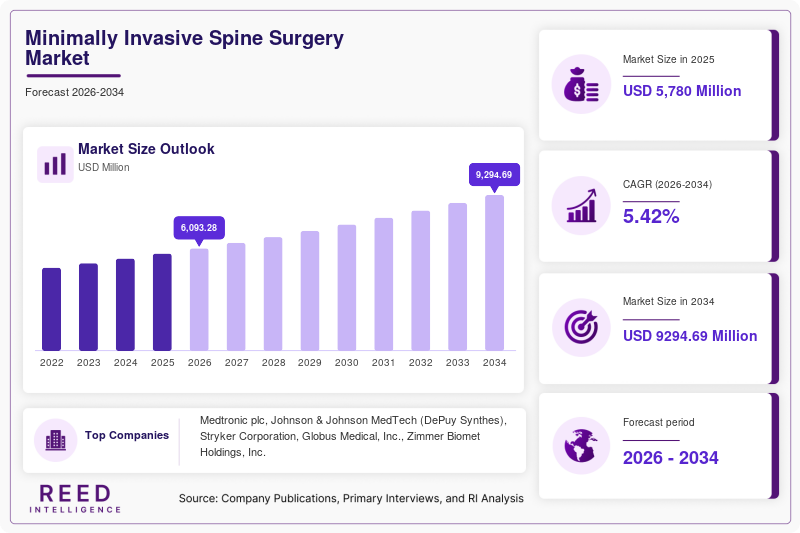
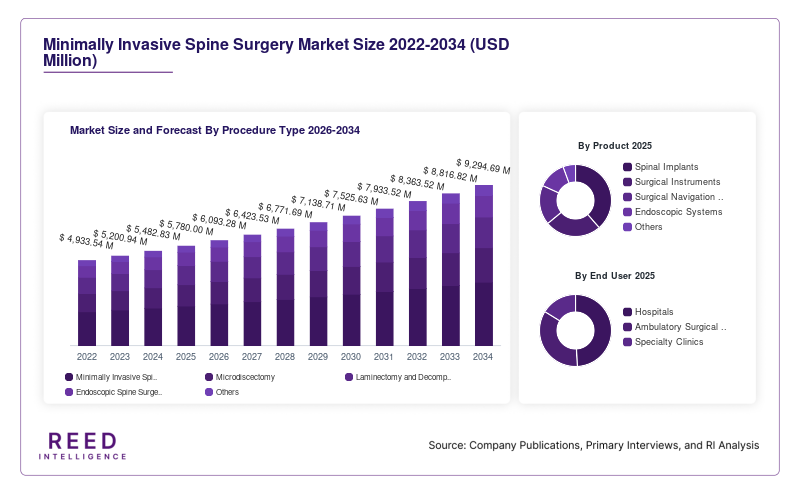
The global minimally invasive spine surgery market was valued at USD 5,780 million in 2025 and is projected to grow from USD 6,093.28 million in 2026 to USD 9,294.69 million by 2034, registering a compound annual growth rate (CAGR) of 5.42% during the forecast period (2026–2034).
Minimally invasive spine surgery (MISS) involves surgical techniques that use smaller incisions and specialized instruments to access and treat spinal conditions while limiting damage to surrounding muscles and tissues. Depending on the procedure and patient condition, these techniques may reduce blood loss, postoperative discomfort, and recovery time compared with certain traditional open procedures.
The market includes spinal implants, specialized surgical instruments, endoscopic systems, navigation platforms, and robotic-assisted technologies. Common procedures include minimally invasive spinal fusion, microdiscectomy, decompression, and endoscopic spine surgery. These approaches are used to treat conditions such as herniated discs, spinal stenosis, degenerative disc disease, and selected spinal instability conditions.
Minimally Invasive Spine Surgery Market Drivers
Increasing prevalence of spinal disorders: Degenerative disc disease, spinal stenosis, herniated discs, and other spinal conditions create demand for surgical interventions. Aging populations and improved diagnosis contribute to the number of patients assessed for spine treatment, including minimally invasive approaches where clinically appropriate.
Growing preference for less-invasive procedures: Minimally invasive techniques may reduce muscle disruption, blood loss, and recovery time for selected patients. These potential benefits encourage hospitals and surgeons to evaluate less-invasive options as part of broader spine-care strategies.
Advancements in surgical technology: Improvements in endoscopic visualization, navigation, imaging, specialized instruments, and robotic assistance are expanding the technical capabilities of spine surgery. These technologies may help surgeons perform selected procedures through smaller access points and with greater procedural precision.
Expansion of outpatient surgical care: Some minimally invasive spine procedures can be performed in ambulatory settings for carefully selected patients. Growth in outpatient care may encourage investment in efficient surgical workflows, specialized equipment, and recovery protocols.
Minimally Invasive Spine Surgery Market Restraints
High equipment and procedure costs: Endoscopic systems, surgical navigation, robotic platforms, and specialized implants can require substantial capital investment. Hospitals and smaller surgical centers may face financial barriers when adopting new technologies.
Need for specialized training: Minimally invasive procedures require appropriate surgeon training, experience, and familiarity with specialized instruments. Learning curves and training requirements can slow adoption, especially in healthcare facilities with limited access to advanced surgical education.
Reimbursement and cost-effectiveness considerations: Payment policies vary by procedure, care setting, insurer, and country. Hospitals must assess whether investment in specialized systems and implants is supported by reimbursement arrangements and demonstrable clinical or operational benefits.
Clinical limitations and patient selection: Certain complex spinal deformities, extensive revisions, or other challenging conditions may require different surgical approaches. Minimally invasive techniques cannot replace open surgery in every case, and clinical suitability remains a key determinant of adoption.
Minimally Invasive Spine Surgery Market Opportunities
Growth in endoscopic spine surgery: Advances in endoscopic instruments and visualization may expand the range of selected procedures that can be performed through small access points. Training and clinical evidence will influence the pace of adoption.
Robotic-assisted and navigation-guided procedures: Navigation and robotic systems offer opportunities to support surgical planning, instrument positioning, and implant placement. Their adoption depends on clinical value, system cost, operating-room integration, and training.
Expansion of ambulatory spine care: Appropriate outpatient procedures may create opportunities for ambulatory surgical centers to improve scheduling efficiency and patient convenience. Growth will depend on patient selection, postoperative support, reimbursement, and local healthcare regulations.
Emerging-market healthcare investment: Improvements in hospital infrastructure, access to specialist surgeons, and availability of advanced medical devices may support adoption in developing healthcare markets. Local affordability and training remain important factors.
Minimally Invasive Spine Surgery Market Segmental Analysis
By Procedure Type
Minimally invasive spinal fusion is an important procedure category for treating selected conditions involving spinal instability and degenerative changes. These procedures use specialized instruments and implants to stabilize the spine while limiting the size of the surgical approach. Techniques may include transforaminal, posterior, lateral, or other approaches depending on the patient’s condition and the surgeon’s treatment plan.
Microdiscectomy and decompression procedures are used to address selected conditions involving nerve compression, including herniated discs and spinal stenosis. Endoscopic techniques provide visualization through specialized scopes and may allow certain procedures to be performed through small access points. The appropriate approach depends on the location and severity of the condition, patient anatomy, and surgeon expertise.
The dominant procedure type and its exact market share have not been independently verified using a transparent, comparable dataset covering the full market definition. Minimally invasive spinal fusion is a significant category, but a definitive leadership claim requires consistent segment-level revenue data.
Endoscopic spine surgery may offer growth opportunities as equipment, visualization, training, and procedural techniques continue to develop. However, the fastest-growing procedure type and its CAGR have not been independently confirmed for this market.
By Product
Spinal implants are used in procedures requiring stabilization or fusion, including screws, rods, cages, plates, and related fixation components. Implant design, material properties, anatomical fit, and compatibility with the surgical approach influence product selection. Specialized instruments support access, tissue handling, decompression, and implant placement.
Surgical navigation and robotic systems assist with planning and guidance in selected procedures. Endoscopic systems provide visualization for techniques that use small access points, while related instruments support tissue access and surgical manipulation.
The dominant product category and its precise share have not been independently verified. Product leadership may differ according to whether the market includes implants alone or also includes instruments, endoscopic equipment, navigation platforms, and robotics.
Robotic assistance, navigation, and endoscopic systems offer potential growth opportunities, but the fastest-growing product category and its CAGR remain unverified in the absence of a comparable market-specific segment forecast.
By End User
Hospitals remain important providers of minimally invasive spine surgery because they offer operating-room infrastructure, specialist surgical teams, imaging capabilities, inpatient services, and resources for managing complex cases. They also support procedures requiring advanced equipment or postoperative monitoring.
Ambulatory surgical centers may serve patients who are suitable for outpatient procedures and have appropriate clinical and recovery support. Specialty clinics contribute through consultation, diagnosis, follow-up, and rehabilitation, although the surgical procedures they perform depend on their facilities and authorization.
Minimally Invasive Spine Surgery Market Regional Analysis
North America Minimally Invasive Spine Surgery Market
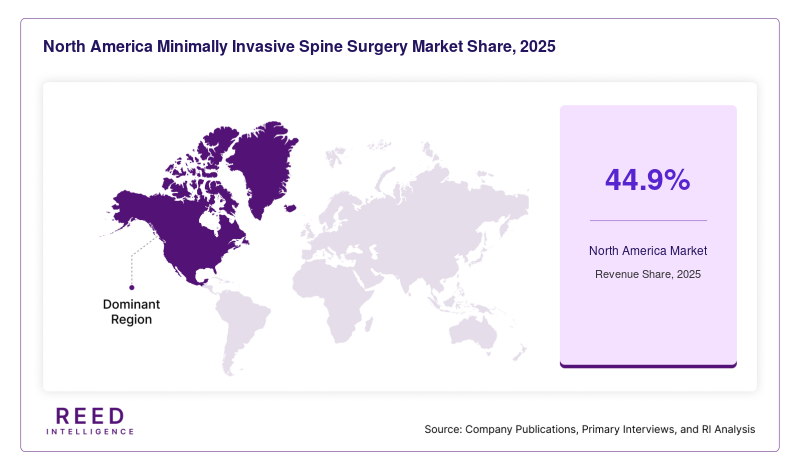
North America is a leading market for minimally invasive spine surgery, supported by established spine-care facilities, advanced surgical infrastructure, specialized training, and access to implants and surgical technologies. The United States contributes significantly through its hospital network, specialist surgeons, and adoption of advanced imaging, navigation, and robotic-assisted systems. Canada also contributes through hospital-based spine care and specialist treatment services.
A market-specific estimate reports that North America accounted for 44.93% of global market revenue in 2025, with estimated regional revenue of USD 2,605.9 million. Applying the reported share to the supplied global market value of USD 5,780 million gives a derived estimate of approximately USD 2,597.8 million. The small difference reflects the use of different underlying totals or rounding; the share and regional revenue should therefore be treated as third-party estimates rather than independently audited figures.
Europe Minimally Invasive Spine Surgery Market
Europe has established spine-care services and medical-device markets, supported by hospitals, specialist surgeons, clinical research, and access to advanced surgical instruments. Germany, France, the United Kingdom, Italy, and other European markets contribute through diagnosis and treatment of degenerative spinal conditions and the use of specialized surgical technologies.
Demand may be supported by an aging population, improvements in surgical instrumentation, and greater attention to recovery and healthcare-resource utilization. Adoption varies according to reimbursement, hospital procurement, clinical guidelines, and access to specialist training. The precise European market share is estimated at 25.30% in one market-specific source, but this figure has not been independently validated against a transparent dataset matching the supplied global market value. A comparable regional CAGR has not been verified.
Asia Pacific Minimally Invasive Spine Surgery Market
Asia Pacific is an important growth market as healthcare infrastructure expands and access to advanced spine treatment improves. China, Japan, India, South Korea, and Australia contribute through hospital investment, specialist surgical services, and demand for medical technologies. The region includes markets with mature surgical systems as well as countries where access to minimally invasive procedures is continuing to develop.
Opportunities include surgeon training, expansion of specialist centers, adoption of endoscopic systems, and wider availability of implants and surgical instruments. However, adoption varies substantially according to affordability, reimbursement, hospital infrastructure, and specialist availability. A market-specific estimate places Asia Pacific at 21.63% of global revenue in 2025, but the share and regional value have not been independently validated against the supplied global market figure. A reliable regional CAGR and fastest-growing country have not been confirmed.
Latin America Minimally Invasive Spine Surgery Market
Latin America represents an emerging market for minimally invasive spine surgery, supported by specialist hospitals, private healthcare providers, and increasing access to advanced surgical equipment in selected urban centers. Brazil and Mexico are relevant markets because of their healthcare infrastructure and demand for orthopedic and neurosurgical treatment.
Market expansion depends on access to specialist surgeons, device affordability, hospital procurement, insurance coverage, and public and private healthcare investment. The adoption of endoscopic and navigation-assisted procedures may vary significantly across countries. The region’s precise market share and forecast CAGR have not been independently verified using comparable market-specific data.
Middle East & Africa Minimally Invasive Spine Surgery Market
The Middle East & Africa market is influenced by healthcare infrastructure investment, development of specialist hospitals, and access to advanced medical technologies. Some markets in the Gulf region are investing in modern surgical facilities and specialist care, while access to minimally invasive spine surgery remains uneven across the wider region.
Opportunities may emerge from surgeon training, hospital modernization, and wider availability of specialized implants and surgical instruments. Market development depends on affordability, procurement budgets, reimbursement, and the availability of trained personnel.
Minimally Invasive Spine Surgery Market Competitive Landscape
The Minimally Invasive Spine Surgery Market includes diversified medical-device companies, specialist spinal implant manufacturers, and developers of surgical navigation and robotic technologies. Competition is influenced by implant performance, surgical access systems, instrument design, regulatory clearances, clinical evidence, training, and support for surgeons and hospitals.
Medtronic is a major participant in spine technologies, with products and systems supporting spinal fusion, surgical instruments, navigation, and robotic-assisted procedures. Its broad portfolio enables it to serve different surgical approaches and healthcare settings.
Key Market Players
- Medtronic plc
- Johnson & Johnson MedTech (DePuy Synthes)
- Stryker Corporation
- Globus Medical, Inc.
- Zimmer Biomet Holdings, Inc.
- Orthofix Medical Inc.
- Alphatec Holdings, Inc.
- B. Braun SE
- NuVasive-related spinal technology portfolio
- SeaSpine-related spinal technology portfolio
Minimally Invasive Spine Surgery Market Recent Developments
- August, 2026 -KYOCERA Medical Technologies launched the Tesera-K PL Posterior Lumbar Interbody Fusion System. The company announced a new posterior lumbar interbody fusion system incorporating its Resilience low-modulus technology and a 3D-printed implant design. The system is intended to support lumbar stabilization and restoration of disc height. This development is relevant to spinal fusion technologies used in minimally invasive and other spine procedures; the specific surgical approach depends on the product’s intended use and the surgeon’s technique.
- June, 2026 -Life Spine received FDA 510(k) clearance for the VersaLift Expandable Interbody System. Life Spine announced clearance for an expandable interbody system with a 6 mm starting height for transforaminal and posterior lumbar interbody fusion procedures. The company describes the low-profile design as intended to facilitate insertion through constrained anatomy. The clearance represents a regulatory milestone for a product designed to support minimally invasive surgical access.
Minimally Invasive Spine Surgery Market Segments
By Procedure Type
- Minimally Invasive Spinal Fusion
- Microdiscectomy
- Laminectomy and Decompression
- Endoscopic Spine Surgery
- Others
By Product
- Spinal Implants
- Surgical Instruments
- Surgical Navigation and Robotic Systems
- Endoscopic Systems
- Others
By End User
- Hospitals
- Ambulatory Surgical Centers
- Specialty Clinics
By Region
- North America
- Europe
- APAC
- Middle East and Africa
- LATAM