# Minimally Invasive Spine Technologies Market Size, Share & Trends Analysis Report By Technology (Surgical Instruments, Spinal Implants, Endoscopic Systems, Navigation and Robotic Systems), By Procedure (Spinal Fusion, Decompression, Disc Procedures, Vertebral Augmentation) and By Region (North America, Europe, Asia Pacific, Latin America, Middle East & Africa) Forecasts, 2026–2034
USD 3950
Minimally Invasive Spine Technologies Market Size
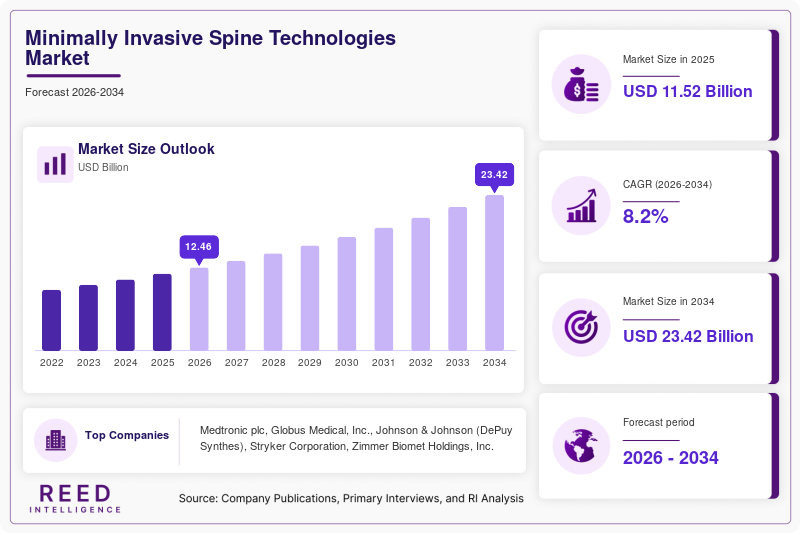
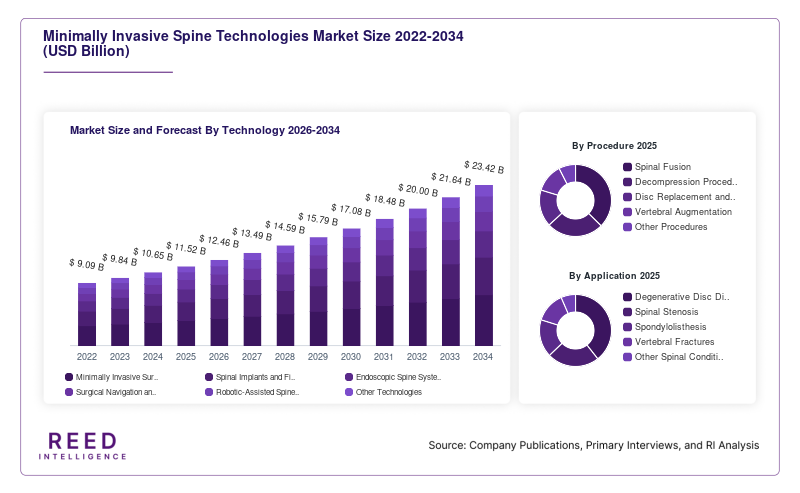
The global Minimally Invasive Spine Technologies Market was valued at USD 11.52 billion in 2025 and is projected to grow from USD 12.46 billion in 2026 to USD 23.42 billion by 2034, registering a compound annual growth rate (CAGR) of 8.2% during the forecast period.
The Minimally Invasive Spine Technologies Market encompasses surgical instruments, implants, visualization systems, navigation platforms, and robotic technologies used to perform spinal procedures through smaller incisions and with less disruption to surrounding tissue than conventional open surgery. These technologies are applied in procedures such as spinal fusion, decompression, disc surgery, and vertebral stabilization. Market growth is supported by demand for less invasive treatment options, advancements in surgical imaging, and increasing adoption of endoscopic and navigation-assisted procedures. Hospitals, specialty spine centers, and ambulatory surgery centers are important users of these technologies.
Minimally Invasive Spine Technologies Market Drivers
Increasing preference for minimally invasive procedures: Patients and healthcare providers are increasingly interested in approaches that may reduce tissue disruption, blood loss, postoperative discomfort, and recovery time in appropriately selected cases.
Advancements in surgical navigation and imaging: Real-time imaging, three-dimensional visualization, and computer-assisted guidance can help surgeons plan procedures and position instruments and implants more precisely.
Growing demand for spine care: Aging populations and the prevalence of degenerative spinal conditions are contributing to demand for surgical treatment and technologies that support less invasive approaches.
Expansion of endoscopic and robotic techniques: Improvements in endoscopic instrumentation, robotic assistance, and navigation systems are broadening the range of procedures that can be performed using minimally invasive techniques.
Minimally Invasive Spine Technologies Market Restraints
High equipment and procedural costs: Advanced imaging systems, navigation platforms, robotics, and specialized instruments can require substantial capital investment.
Training requirements: Surgeons and operating-room teams need specialized training and experience to use complex technologies effectively.
Reimbursement and access limitations: Differences in insurance coverage, reimbursement policies, and healthcare infrastructure can slow adoption.
Clinical suitability and procedural complexity: Not every spinal condition is appropriate for a minimally invasive approach, and some cases require open surgery or conversion to an alternative technique.
Minimally Invasive Spine Technologies Market Opportunities
Development of next-generation navigation systems: Image fusion, trackerless guidance, and improved intraoperative visualization may enhance procedural workflows.
Growth of ambulatory surgery centers: The expansion of outpatient spine procedures creates opportunities for compact, efficient, and cost-conscious technology platforms.
Emerging-market adoption: Investments in specialist healthcare facilities and surgical infrastructure may support wider adoption of minimally invasive spine technologies.
Integration of data and artificial intelligence: Planning software, decision-support tools, and connected surgical systems offer opportunities to improve workflow consistency and procedural documentation.
Minimally Invasive Spine Technologies Market Segmental Analysis
By Technology
Spinal implants and fixation devices are an important technology category because fusion and stabilization procedures often require implants to maintain spinal alignment and support healing. Navigation and imaging platforms, endoscopic systems, and specialized access instruments also play key roles in enabling minimally invasive procedures.
Robotic assistance and advanced surgical navigation are promising growth areas as providers seek improved visualization, workflow consistency, and instrument guidance. However, a definitive leading technology segment and the fastest-growing technology segment cannot be confirmed without a comparable, independently verifiable market breakdown for this specific market.
By Procedure
Spinal fusion is a major application for minimally invasive spine technologies because these procedures commonly use specialized access instruments, fixation devices, imaging, and navigation. Decompression and endoscopic procedures are also relevant, particularly where surgeons seek to treat nerve compression while limiting disruption to surrounding tissue.
The fastest-growing procedure segment is not stated because a reliable, comparable segment-level growth forecast has not been verified for this market.
By Application
Degenerative spinal conditions, including spinal stenosis and degenerative disc disease, are important sources of demand for minimally invasive spine procedures. The technologies can support selected treatments for these conditions, depending on the patient's diagnosis, anatomy, and clinical suitability.
A definitive dominant application and fastest-growing application cannot be confirmed from a verified, market-specific segment-share dataset.
By End User
Hospitals are important users because they typically have established surgical infrastructure, specialist teams, and access to advanced imaging and operating-room equipment. Ambulatory surgery centers and specialty spine centers may also contribute to adoption as selected procedures move toward outpatient settings.
Minimally Invasive Spine Technologies Market Regional Analysis
North America Minimally Invasive Spine Technologies Market
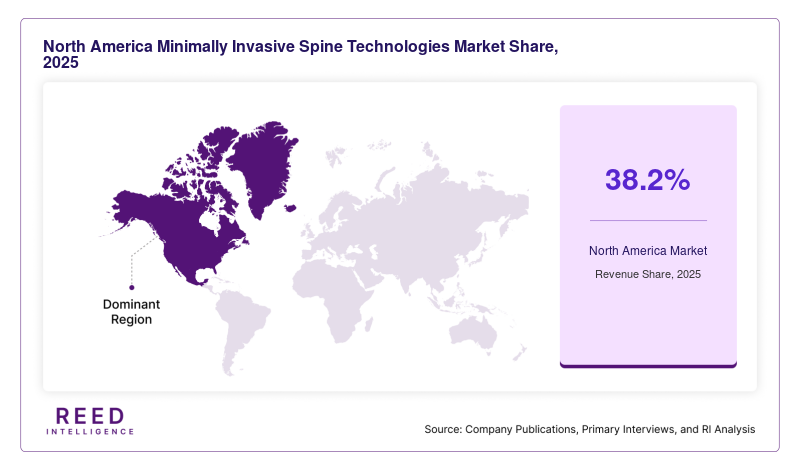
North America is a key market for minimally invasive spine technologies, supported by specialist spine care, established surgical infrastructure, and access to advanced imaging, navigation, and implant systems. Adoption is influenced by clinical training, reimbursement arrangements, and investment in surgical technology. The United States is an important contributor to regional demand.
Dominant-region status and market share: A reliable, market-specific percentage for North America's share of the global Minimally Invasive Spine Technologies Market has not been verified. A numeric share or regional revenue value should not be presented as confirmed without a comparable source.
Europe Minimally Invasive Spine Technologies Market
Europe benefits from established healthcare systems, specialist surgical centers, and continuing interest in technologies that support precision and less invasive treatment. Adoption varies by country according to reimbursement, procurement priorities, clinical training, and access to advanced operating-room infrastructure. Germany, France, the United Kingdom, and other Western European markets are relevant participants.
Asia Pacific Minimally Invasive Spine Technologies Market
Asia Pacific offers growth potential as healthcare infrastructure expands, specialist spine services develop, and demand for treatment of degenerative spinal conditions increases. Adoption differs across markets depending on affordability, training, hospital investment, and the availability of advanced surgical equipment. China, Japan, India, South Korea, and Australia are relevant markets.
Latin America Minimally Invasive Spine Technologies Market
Latin America is developing its adoption of minimally invasive spine technologies through private hospital investment, specialist-care expansion, and gradual modernization of surgical facilities. High equipment costs, unequal access to advanced healthcare, and reimbursement constraints can limit penetration, creating differences in adoption between countries and healthcare providers.
Middle East & Africa Minimally Invasive Spine Technologies Market
The Middle East and Africa region presents opportunities as selected countries invest in advanced hospitals, specialist surgical services, and modern operating-room equipment. Adoption remains uneven because of differences in healthcare spending, access to trained specialists, and availability of advanced imaging and navigation systems.
Minimally Invasive Spine Technologies Market Competitive Landscape
The market includes established medical technology companies, spinal implant manufacturers, and specialist innovators developing endoscopic systems, navigation software, access instruments, and minimally invasive fixation devices. Competition is shaped by clinical performance, ease of use, procedural efficiency, regulatory clearances, surgeon training, and the ability to integrate products into existing operating-room workflows.
Recent activity illustrates several areas of competition: Neo Medical introduced its Instant MIS Access platform in the United States in July 2026; Kyocera Medical Technologies launched its Tesera-K XL lateral interbody fusion system in July 2026; and Siemens Healthineers presented trackerless spine-guidance software in September 2026. These announcements reflect innovation in access systems, implant design, and surgical guidance rather than a verified ranking of market share.
Key Market Players
- Medtronic plc
- Globus Medical, Inc.
- Johnson & Johnson (DePuy Synthes)
- Stryker Corporation
- Zimmer Biomet Holdings, Inc.
- NuVasive, Inc.
- Alphatec Holdings, Inc.
- Orthofix Medical Inc.
- Joimax GmbH
- B. Braun SE (Aesculap)
Minimally Invasive Spine Technologies Market Recent Developments
-
September, 2026 Siemens Healthineers presented Vuze trackerless spine-guidance software designed to combine preoperative CT or intraoperative cone-beam CT images with intraoperative X-ray images to guide K-wire placement for pedicle screws. The company stated that the software was incorporated into its Cios Spin C-arm system; future availability of the trackerless guidance technology is not guaranteed.
-
July, 2026 The company announced the Tesera-K XL Lateral Interbody Fusion System for lateral spinal surgery. The system features a 3D-printed titanium implant with a dual-wall lattice structure and instrumentation designed to support lateral access approaches.
Minimally Invasive Spine Technologies Market Segments
By Technology
- Minimally Invasive Surgical Instruments
- Spinal Implants and Fixation Devices
- Endoscopic Spine Systems
- Surgical Navigation and Imaging Systems
- Robotic-Assisted Spine Surgery Systems
- Other Technologies
By Procedure
- Spinal Fusion
- Decompression Procedures
- Disc Replacement and Disc Procedures
- Vertebral Augmentation
- Other Procedures
By Application
- Degenerative Disc Disease
- Spinal Stenosis
- Spondylolisthesis
- Vertebral Fractures
- Other Spinal Conditions
By End User
- Hospitals
- Ambulatory Surgery Centers
- Specialty Spine Centers
- Other Healthcare Facilities
By Region
- North America
- Europe
- APAC
- Middle East and Africa
- LATAM