Minimally Invasive Surgical Instruments Market Size, Share & Trends Analysis Report By Product Type (Handheld Instruments, Electrosurgical Devices, Guiding Devices, Cutter Instruments,), By Application (Orthopedic Surgery, Cardiovascular Surgery, Gastrointestinal Surgery), By End User (Hospitals, Ambulatory Surgical Centers, Specialty Clinics) and By Region (North America, Europe, Asia Pacific, Latin America, Middle East & Africa) Forecasts, 2026–2034
USD 3950
Minimally Invasive Surgical Instruments Market Size
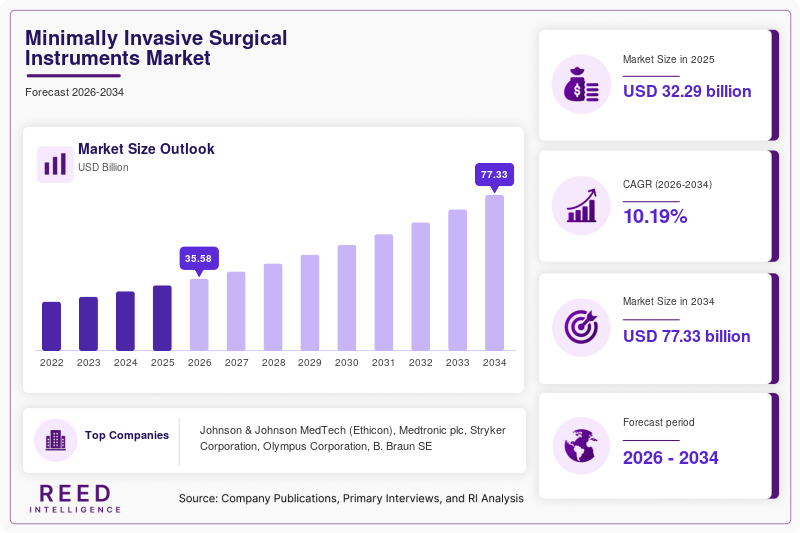
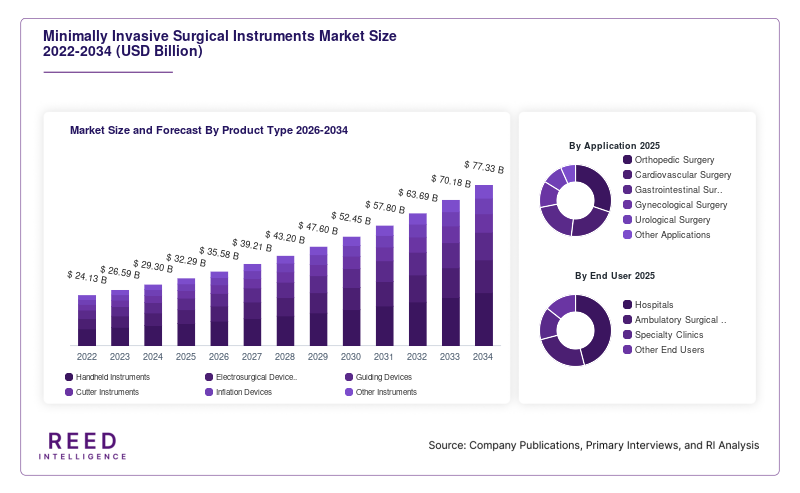
The global Minimally Invasive Surgical Instruments Market was valued at USD 32.29 billion in 2025 and is projected to grow from USD 35.58 billion in 2026 to USD 77.33 billion by 2034, registering a compound annual growth rate (CAGR) of 10.19% during the forecast period from 2026 to 2034.
The Minimally Invasive Surgical Instruments Market comprises specialized medical devices used to perform surgical procedures through small incisions or natural body openings. These instruments support laparoscopic, endoscopic, arthroscopic, and other minimally invasive procedures, helping surgeons access anatomical structures while limiting unnecessary tissue disruption. Major product categories include handheld instruments, electrosurgical devices, guiding devices, inflation systems, cutters, trocars, and other procedure-specific instruments.
Market growth is supported by the increasing preference for surgical techniques that can reduce tissue trauma, postoperative discomfort, hospital stays, and recovery time when clinically appropriate. Advances in surgical visualization, instrument articulation, energy delivery, tissue sealing, and robotic-assisted platforms are expanding the range of procedures that can be performed using minimally invasive techniques. These developments are encouraging healthcare providers to upgrade surgical equipment and improve operating-room capabilities.
Minimally Invasive Surgical Instruments Market Drivers
Increasing Preference for Minimally Invasive Procedures
Patients and healthcare providers increasingly consider minimally invasive approaches for procedures where they offer suitable clinical benefits. Smaller incisions and reduced disruption of surrounding tissue can support recovery and may reduce postoperative complications in appropriate cases. Growing adoption across general surgery, gynecology, urology, orthopedics, and gastrointestinal surgery is creating demand for specialized instruments, visualization systems, cutting tools, and tissue-sealing technologies.
Technological Advancements in Surgical Instruments
Innovation in instrument design, energy-based devices, high-definition visualization, and robotic-assisted surgery is improving the capabilities available to surgeons. Articulating instruments, advanced staplers, and energy devices can support complex procedures in restricted anatomical spaces. Manufacturers are focusing on ergonomics, precision, reliable tissue handling, and integration with surgical platforms to help healthcare providers improve procedural efficiency and expand the range of minimally invasive interventions.
Minimally Invasive Surgical Instruments Market Restraints
High Acquisition and Maintenance Costs
Advanced surgical instruments may require substantial investment in equipment, compatible accessories, sterilization infrastructure, maintenance, and staff training. Robotic-compatible and energy-based systems can add further costs for healthcare providers. These expenses may limit adoption among smaller hospitals, facilities in lower-income markets, and institutions with restricted capital budgets. Procurement decisions consequently depend on procedure volumes, expected clinical value, equipment utilization, and the availability of funding.
Training Requirements and Procedural Complexity
Minimally invasive surgery requires specialized skills in instrument handling, visualization, navigation, and coordination. Surgeons and operating-room teams may need structured training and supervised experience before adopting new devices or techniques. Differences in clinical expertise and access to simulation facilities can slow implementation. In addition, reusable instruments require appropriate cleaning, inspection, and sterilization procedures, while disposable instruments create recurring procurement costs and waste-management considerations.
Minimally Invasive Surgical Instruments Market Opportunities
Expansion of Ambulatory and Outpatient Surgery
The development of ambulatory surgical centers and outpatient procedure programs creates opportunities for suppliers of minimally invasive instruments. When clinically appropriate, minimally invasive techniques can support shorter recovery periods and efficient use of healthcare resources. Providers that develop reliable, procedure-specific instrument sets and simplified workflows may benefit from demand among facilities seeking to improve operating-room utilization and deliver selected procedures outside traditional inpatient settings.
Growth of Robotic-Assisted and Advanced Energy Technologies
Robotic-assisted procedures, advanced stapling, electrosurgical instruments, and improved surgical visualization offer opportunities for differentiated product development. Manufacturers can strengthen their portfolios by improving instrument precision, articulation, energy control, and compatibility with surgical platforms. Continued investment in surgeon education, clinical evidence, and connected operating-room technologies may support adoption, particularly in hospitals expanding complex minimally invasive surgery programs.
Minimally Invasive Surgical Instruments Market Segmental Analysis
By Product Type
Handheld instruments are essential components of minimally invasive procedures because they allow surgeons to grasp, dissect, manipulate, cut, and suture tissue through small access points. This category includes forceps, graspers, scissors, needle holders, and related tools. Electrosurgical devices are also important because they deliver energy for cutting, coagulation, and tissue sealing. Guiding devices, inflation systems, cutters, and other instruments perform specialized roles within procedure-specific workflows.
A published market estimate identifies handheld instruments as a leading product category, reflecting their broad use across surgical specialties. Electrosurgical devices are also expected to benefit from demand for efficient cutting and hemostasis. However, the exact leading-segment share and fastest-growing product CAGR for the precise market definition used in this report cannot be independently verified from comparable public evidence; no unverified percentages are assigned.
By Application
Orthopedic, cardiovascular, gastrointestinal, gynecological, and urological procedures represent important application areas for minimally invasive surgical instruments. The required devices differ by specialty: orthopedic procedures may rely on arthroscopic instruments, while gastrointestinal and gynecological procedures often use laparoscopic instruments, access devices, cutters, and energy-based tools. Cardiovascular and urological procedures may require specialized instruments designed for anatomical access and precise intervention.
The relative importance of each application depends on procedure volumes, clinical suitability, specialist availability, and adoption of minimally invasive techniques. Orthopedic surgery is identified as a leading application in one published estimate for the market, while gastrointestinal and cardiothoracic procedures are cited among growth opportunities in another estimate.
By End User
Hospitals are important end users because they provide multidisciplinary surgical services, manage complex cases, and maintain operating rooms equipped for a wide range of procedures. Their demand encompasses reusable and single-use instruments, electrosurgical equipment, access devices, cutters, and procedure-specific tool sets. Large hospitals and specialist centers may also invest in advanced technologies that support complex laparoscopic and robotic-assisted surgery.
Ambulatory surgical centers are an additional market opportunity as selected procedures move toward outpatient settings. Their procurement priorities may emphasize reliable instruments, predictable procedure costs, efficient turnover, and appropriate sterilization workflows.
Minimally Invasive Surgical Instruments Market Regional Analysis
North America Minimally Invasive Surgical Instruments Market
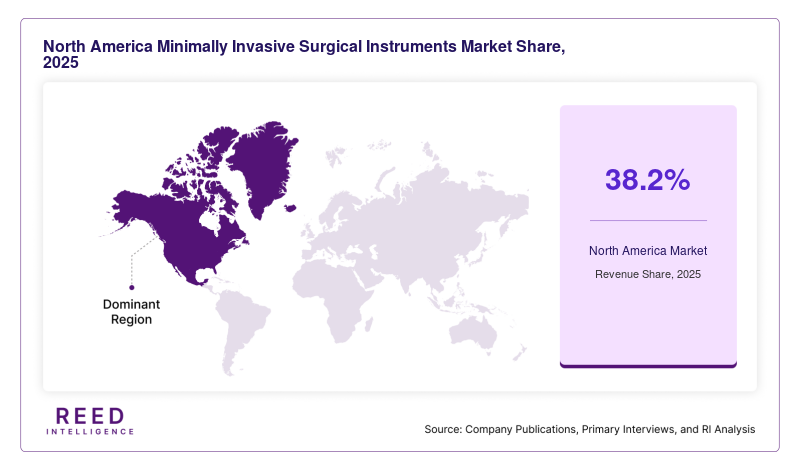
North America dominated the Minimally Invasive Surgical Instruments Market in 2025, accounting for an estimated 38.2% of global market revenue, according to Dataintelo's report on the broader minimally invasive surgical instruments and accessories market. This percentage is a third-party estimate from a related market scope, rather than a verified share specific to the USD 32.29 billion market valuation used in this report. North America's position is supported by advanced healthcare infrastructure, high surgical procedure volumes, established reimbursement systems, and widespread adoption of laparoscopic, endoscopic, and robotic-assisted surgical technologies. The United States represents a major contributor to regional demand, supported by investments in advanced surgical equipment and the presence of leading medical-device manufacturers.
Europe Minimally Invasive Surgical Instruments Market
Europe represents an established market for minimally invasive surgical instruments, supported by advanced hospital infrastructure, specialist surgical centers, and the widespread use of laparoscopic and endoscopic procedures. Germany, France, the United Kingdom, Italy, and other European countries contribute to regional demand for handheld instruments, electrosurgical devices, cutters, and specialized surgical tools. Product safety, regulatory compliance, clinical performance, and procurement requirements influence competition among manufacturers.
Asia Pacific Minimally Invasive Surgical Instruments Market
Asia Pacific offers substantial growth opportunities as healthcare infrastructure expands and hospitals increase their capacity to perform minimally invasive procedures. China, Japan, India, South Korea, and Australia are important markets, with demand influenced by healthcare spending, specialist availability, hospital modernization, and adoption of advanced surgical technologies. Greater access to surgical care and the development of specialist facilities may support demand for procedure-specific instruments.
Latin America Minimally Invasive Surgical Instruments Market
Latin America presents opportunities as hospitals and surgical centers modernize operating rooms and expand minimally invasive procedures. Brazil and Mexico are important regional markets, while other countries contribute through private hospitals, specialist clinics, and developing surgical infrastructure. Demand spans instruments used in general surgery, gynecology, orthopedics, urology, and other specialties.
Middle East & Africa Minimally Invasive Surgical Instruments Market
The Middle East & Africa market is influenced by investment in tertiary-care hospitals, specialist surgical centers, and healthcare modernization. Some Gulf countries are expanding advanced surgical capabilities, while demand in other markets depends on healthcare funding, infrastructure availability, and access to trained surgical professionals. These factors influence purchasing decisions for handheld instruments, electrosurgical devices, and specialized minimally invasive tools.
Minimally Invasive Surgical Instruments Market Recent Developments
The Minimally Invasive Surgical Instruments Market is competitive, with multinational medical-device companies and specialist manufacturers supplying instruments for laparoscopic, endoscopic, arthroscopic, and other minimally invasive procedures. Companies compete through instrument reliability, ergonomic design, precision, advanced energy delivery, product breadth, clinical evidence, regulatory compliance, and distribution capabilities.
Johnson & Johnson MedTech (Ethicon) is a significant participant in surgical instruments, stapling, energy-based devices, and related surgical technologies. Its portfolio includes instruments designed for open, laparoscopic, and robotic-assisted procedures. Product development emphasizes tissue handling, staple-line integrity, usability, and integration with evolving surgical platforms.
Key Market Players
- Johnson & Johnson MedTech (Ethicon)
- Medtronic plc
- Stryker Corporation
- Olympus Corporation
- B. Braun SE
- Smith & Nephew plc
- CONMED Corporation
- Zimmer Biomet Holdings, Inc.
- Karl Storz SE & Co. KG
- Richard Wolf GmbH
Recent Market Developments
- April 2026 -Johnson & Johnson receives CE Mark approval for the ETHICON 4000 Stapler: Johnson & Johnson announced European approval for the ETHICON 4000 Stapler and ETHICON 3D Reloads for use in open and laparoscopic surgery across specialties in the European Union. The system incorporates 3D stapling technology and enhanced gripping-surface technology intended to support staple-line integrity across different tissue thicknesses.
- June 2026 -Stryker launches the TPX HD power tool: Stryker announced the launch of its TPX HD small-bone power tool for demanding orthopedic procedures, including minimally invasive surgery and oral and maxillofacial procedures. The design emphasizes visibility in confined spaces, control, and ergonomics.
Minimally Invasive Surgical Instruments Market Segments
By Product Type
- Handheld Instruments
- Electrosurgical Devices
- Guiding Devices
- Cutter Instruments
- Inflation Devices
- Other Instruments
By Application
- Orthopedic Surgery
- Cardiovascular Surgery
- Gastrointestinal Surgery
- Gynecological Surgery
- Urological Surgery
- Other Applications
By End User
- Hospitals
- Ambulatory Surgical Centers
- Specialty Clinics
- Other End Users
By Region
- North America
- Europe
- APAC
- Middle East and Africa
- LATAM