Mining Dewatering Aid Market Size, Share & Demand Report By Product Type (Flocculants, Coagulants, Filtration Aids), By Mining Type (Coal Mining, Metal Mining, Mineral Mining, Rare Earth Mining), By Application (Tailings Management, Sludge Dewatering, Wastewater Treatment), By End-Use (Underground Mining Operations), By Distribution Channel (Direct Sales, Industrial Distributors, Online Procurement Platforms), By Region & Segment Forecasts, 2026–2034
USD 3950
Market Overview
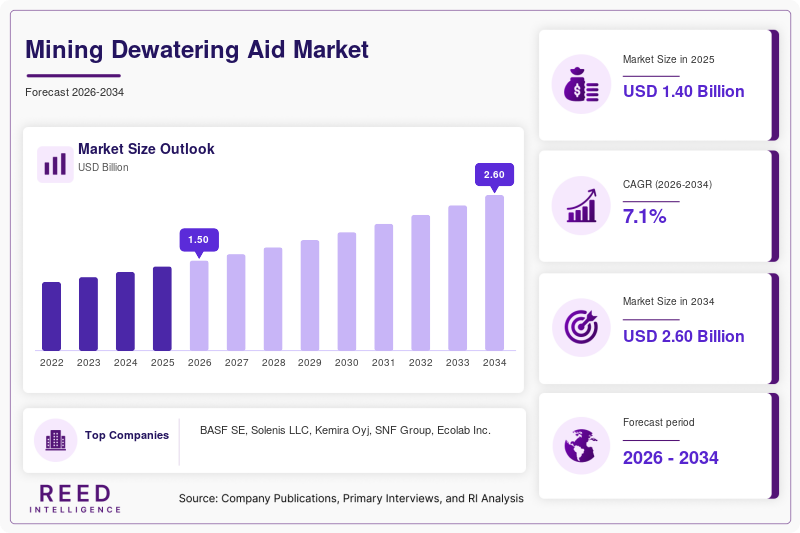
The global Mining Dewatering Aid Market size was valued at USD 1.4 billion in 2026 and is projected to reach USD 2.5 billion by 2034, expanding at a CAGR of 7.1% during the forecast period of 2026–2034. The market growth has been driven by rising mineral extraction activities, increasing water management requirements, and stricter environmental regulations across mining economies. Mining dewatering aids are widely used to improve solid-liquid separation processes, reduce moisture content in tailings, and enhance operational efficiency in mining projects.
A major global factor supporting the Mining Dewatering Aid Market has been the growing demand for critical minerals used in renewable energy systems, batteries, and infrastructure development. The rise in copper, lithium, nickel, iron ore, and rare earth mining projects has increased the requirement for advanced dewatering chemicals and processing technologies. Mining companies have been focusing on efficient water recovery systems to reduce freshwater consumption and optimize operational costs. As a result, demand for flocculants, coagulants, and specialty dewatering chemicals has expanded across both developed and developing economies.
Key Highlights
- Asia Pacific accounted for 38.6% of the global Mining Dewatering Aid Market share in 2025 and remained the dominant regional market.
- Latin America is projected to witness the fastest CAGR of 8.4% during 2026–2034 due to rising copper and lithium mining investments.
- By product type, flocculants held the largest market share of 41.3% in 2025 owing to their widespread use in tailings thickening applications.
- Specialty dewatering chemicals are expected to register the fastest CAGR of 8.8% during the forecast period due to rising demand for customized formulations.
- By mining type, metal mining dominated the market with 36.9% share in 2025.
- Rare earth mining is anticipated to expand at the fastest CAGR of 8.9% during 2026–2034.
- By application, tailings management accounted for 34.8% of the Mining Dewatering Aid Market share in 2025.
- Mine water recovery applications are projected to witness the fastest CAGR of 8.6% over the forecast period.
- China remained the dominant country market, valued at USD 258 million in 2024 and USD 274 million in 2025.
Market Trends
Increasing Adoption of Sustainable Tailings Management
Mining companies are increasingly adopting sustainable tailings management systems to reduce environmental risks and improve water recovery efficiency. The demand for mining dewatering aids has increased significantly in tailings thickening and dry stacking operations. Companies are using advanced flocculants and filtration chemicals to minimize water wastage and improve the handling of mining residues. This trend has supported investments in eco-friendly dewatering solutions with lower chemical residue and improved operational performance.
Rising Integration of Automated Water Treatment Systems
Automation in mineral processing and wastewater treatment has emerged as another major trend in the Mining Dewatering Aid Market. Mining operators are integrating sensor-based monitoring systems and automated dosing technologies to optimize chemical usage. These systems improve sludge separation efficiency while lowering operational downtime. The growing use of smart mining technologies is expected to strengthen the adoption of high-performance dewatering aids during the forecast period.
Market Drivers
Expansion of Global Mineral Extraction Activities
The rapid increase in mining projects for copper, lithium, iron ore, and industrial minerals has significantly driven the Mining Dewatering Aid Market. Growing industrialization and infrastructure investments have raised the demand for minerals worldwide. Mining companies are expanding production capacities to meet rising raw material requirements from renewable energy, automotive, and construction industries. This expansion has increased the need for effective water separation and tailings management solutions.
Increasing Focus on Water Recycling in Mining Operations
Water scarcity concerns and regulatory pressure have encouraged mining operators to implement efficient water recycling systems. Mining dewatering aids play a critical role in improving water recovery and reducing freshwater consumption. Many mining companies are investing in closed-loop water systems to improve sustainability and lower operational costs. This factor has created substantial demand for advanced coagulants and filtration aids across large-scale mining operations.
Market Restraint
High Cost of Advanced Dewatering Chemicals
The high cost associated with specialty dewatering chemicals and customized formulations remains a key restraint for the Mining Dewatering Aid Market. Small and medium-sized mining operators often face challenges in adopting premium dewatering technologies due to budget limitations. In addition, fluctuations in raw material prices for chemical manufacturing can affect overall market profitability.
Market Opportunities
Development of Bio-Based Dewatering Chemicals
The growing emphasis on sustainable mining practices has created opportunities for bio-based and environmentally safer dewatering chemicals. Manufacturers are increasingly focusing on biodegradable formulations that reduce environmental impact while maintaining operational efficiency. This trend is expected to open new growth opportunities for market participants over the forecast period.
Growth in Rare Earth and Lithium Mining Projects
Rising investments in rare earth and lithium mining projects are expected to generate significant opportunities for the Mining Dewatering Aid Market. These mining activities require advanced solid-liquid separation technologies due to complex ore compositions. The increasing global demand for electric vehicle batteries and renewable energy storage systems is expected to strengthen demand for specialized dewatering solutions.
Segmental Analysis
By Product Type
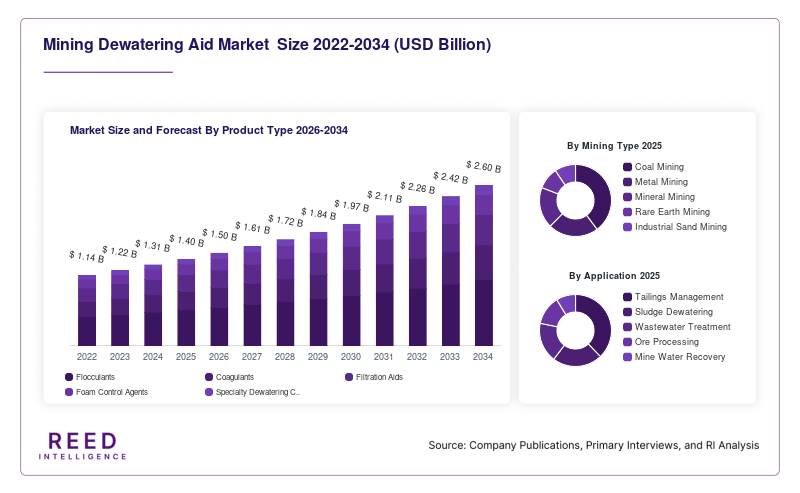
Based on product type, the Mining Dewatering Aid Market is segmented into flocculants, coagulants, filtration aids, foam control agents, and specialty dewatering chemicals.
Flocculants dominated the market with a 41.3% share in 2025 due to their widespread use in tailings thickening and sludge separation processes. These chemicals improve sedimentation efficiency and reduce moisture content in mining waste streams. Mining operators preferred flocculants because of their ability to enhance water recovery and improve operational productivity.
Specialty dewatering chemicals are projected to witness the fastest CAGR of 8.8% during the forecast period. The growth of this segment will be driven by increasing demand for customized formulations designed for specific ore compositions and mining conditions. These products are expected to gain adoption in advanced mineral processing operations requiring high separation efficiency.
By Mining Type
Based on mining type, the market is divided into coal mining, metal mining, mineral mining, rare earth mining, and industrial sand mining.
Metal mining accounted for the largest market share of 36.9% in 2025 due to strong demand for copper, iron ore, nickel, and gold extraction. The expansion of infrastructure and renewable energy industries supported higher production levels in metal mining operations. Dewatering aids were widely used to improve wastewater treatment and tailings handling efficiency.
Rare earth mining is anticipated to expand at the fastest CAGR of 8.9% during 2026–2034. The growth of this segment will be supported by rising global demand for rare earth materials used in electric vehicles, wind turbines, and electronic devices. Rare earth extraction processes require advanced dewatering technologies due to complex ore characteristics.
By Application
Based on application, the Mining Dewatering Aid Market is segmented into tailings management, sludge dewatering, wastewater treatment, ore processing, and mine water recovery.
Tailings management held the dominant market share of 34.8% in 2025. Mining companies increasingly focused on improving tailings disposal efficiency and reducing environmental risks associated with mining waste. Dewatering aids played a critical role in enhancing solid-liquid separation and minimizing water loss.
Mine water recovery is expected to witness the fastest CAGR of 8.6% during the forecast period. The segment growth will be driven by rising concerns regarding freshwater scarcity and increasing adoption of recycling systems in mining operations. Mining operators are expected to invest heavily in technologies that improve water reuse efficiency.
By End-Use
Based on end-use, the market is categorized into underground mining operations, open-pit mining operations, mineral processing plants, and mining waste management facilities.
Mineral processing plants accounted for the largest market share of 33.5% in 2025 due to extensive use of dewatering chemicals in ore beneficiation and wastewater treatment systems. These facilities require efficient water separation technologies to maintain productivity and comply with environmental regulations.
Mining waste management facilities are projected to register the fastest CAGR of 8.3% during the forecast period. Increasing regulatory focus on tailings storage and environmental safety is expected to drive investments in advanced waste management systems and specialty dewatering solutions.
By Distribution Channel
Based on distribution channel, the Mining Dewatering Aid Market is segmented into direct sales, industrial distributors, online procurement platforms, and third-party chemical suppliers.
Direct sales dominated the market with a 45.7% share in 2025 as mining companies preferred long-term procurement agreements with chemical manufacturers. Direct procurement ensured consistent product quality and technical support for mining operations.
Online procurement platforms are expected to witness the fastest CAGR of 9.1% during 2026–2034. The increasing adoption of digital supply chain systems and e-commerce procurement platforms in industrial sectors is expected to support the growth of this segment.
Regional Analysis
North America
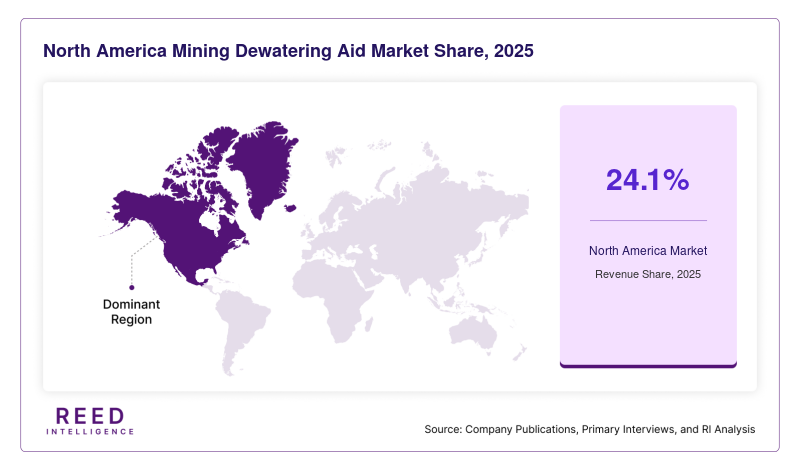
North America accounted for 24.1% of the global Mining Dewatering Aid Market share in 2025. The region benefited from increasing investments in mineral extraction projects and advanced wastewater treatment infrastructure. The United States remained the dominant country market due to strong demand for copper, gold, and industrial minerals. Rising adoption of automated mineral processing technologies supported the use of advanced dewatering chemicals across mining facilities. The regional market is projected to expand at a CAGR of 6.7% during 2026–2034.
Europe
Europe held 19.4% of the global Mining Dewatering Aid Market share in 2025. The region experienced stable demand due to stringent environmental standards and growing emphasis on sustainable mining practices. Germany remained the leading country market owing to its industrial chemical manufacturing capabilities and advanced water treatment technologies. Mining operators across Europe focused on reducing wastewater discharge and improving recycling efficiency. The regional market is expected to grow at a CAGR of 6.5% during the forecast period.
Asia Pacific
Asia Pacific dominated the Mining Dewatering Aid Market with a 38.6% share in 2025. The region benefited from large-scale mining activities in China, Australia, and India. China emerged as the dominant country market due to extensive coal, rare earth, and metal mining operations. Increasing industrialization and infrastructure development supported higher mineral demand across the region. Mining companies also invested heavily in tailings management and wastewater treatment systems. The Asia Pacific market is projected to expand at a CAGR of 7.8% during 2026–2034.
Middle East & Africa
The Middle East & Africa accounted for 9.2% of the global Mining Dewatering Aid Market share in 2025. The region experienced growing demand from gold, phosphate, and mineral extraction industries. South Africa remained the dominant country market owing to extensive mining operations and increasing investments in water management systems. Mining operators focused on improving operational efficiency in water-scarce regions, which supported the adoption of advanced dewatering chemicals. The market is expected to witness a CAGR of 6.9% during the forecast period.
Latin America
Latin America held 8.7% of the global Mining Dewatering Aid Market share in 2025. The region benefited from rising copper and lithium mining activities in Chile, Peru, and Argentina. Chile remained the dominant country market due to its large copper mining sector and increasing investments in water recycling technologies. The growing focus on sustainable mining operations supported the demand for flocculants and specialty dewatering chemicals. The regional market is forecast to grow at the fastest CAGR of 8.4% during 2026–2034.
Competitive Landscape
The Mining Dewatering Aid Market remains moderately consolidated with the presence of global chemical manufacturers and specialized industrial solution providers. Companies are focusing on product innovation, sustainability initiatives, and strategic collaborations to strengthen their market positions.
BASF SE remained a leading player in the market due to its broad portfolio of mining chemicals and advanced water treatment technologies. The company has focused on developing sustainable flocculants and customized dewatering solutions for mining applications. Its extensive global distribution network and strong research capabilities have supported market leadership.
Solenis LLC has strengthened its position through investments in specialty chemical technologies designed for mineral processing and industrial wastewater treatment. Kemira Oyj continues to expand its mining chemical offerings with advanced coagulant solutions. SNF Group has maintained strong market presence due to its expertise in polymer-based dewatering products. Ecolab Inc. has focused on improving water efficiency solutions for mining operators worldwide.
Recent industry developments have included partnerships between mining companies and chemical manufacturers to improve water recycling systems and reduce environmental impact. Market participants are also investing in digital monitoring technologies to optimize chemical dosing and operational efficiency.
Key Players List
- BASF SE
- Solenis LLC
- Kemira Oyj
- SNF Group
- Ecolab Inc.
- Ashland Inc.
- Clariant AG
- Orica Limited
- Dow Inc.
- Arkema S.A.
- Thermax Limited
- Nouryon
- ArrMaz
- Cytec Industries LLC
- Veolia Water Technologies
- Feralco Group
- Buckman Laboratories
- Ixom Operations Pty Ltd.
- SUEZ Water Technologies & Solutions
- ChemTreat Inc.
Recent Developments
- BASF SE introduced a new polymer-based dewatering aid designed for improved tailings thickening efficiency in metal mining applications.
- Kemira Oyj expanded its mining chemicals production capacity to support rising demand from Asia Pacific mining operations.
- SNF Group launched advanced flocculant formulations focused on enhancing water recovery performance in rare earth mining projects.
- Solenis LLC partnered with mining operators to develop automated chemical dosing systems for wastewater treatment facilities.
- Ecolab Inc. introduced digital monitoring technologies aimed at improving water management efficiency in large-scale mining operations.
Mining Dewatering Aid Market Segments
By Product Type
- Flocculants
- Coagulants
- Filtration Aids
- Foam Control Agents
- Specialty Dewatering Chemicals
By Mining Type
- Coal Mining
- Metal Mining
- Mineral Mining
- Rare Earth Mining
- Industrial Sand Mining
By Application
- Tailings Management
- Sludge Dewatering
- Wastewater Treatment
- Ore Processing
- Mine Water Recovery
By End-Use
- Underground Mining Operations
- Open-Pit Mining Operations
- Mineral Processing Plants
- Mining Waste Management Facilities
By Distribution Channel
- Direct Sales
- Industrial Distributors
- Online Procurement Platforms
- Third-Party Chemical Suppliers
By Region
- North America
- Europe
- APAC
- Middle East and Africa
- LATAM